Conflict


In JAMB English Language, the concept of conflict is frequently tested under Literature-in-English and Prose Comprehension sections. Understanding conflict is essential because it forms the backbone of storytelling in prose, drama, and poetry. You'll learn what conflict means in literary terms, the different types of conflict, how to identify them in passages, and how to answer questions that test your ability to recognize and analyze conflict in texts.
Key Concepts and Definitions
What is Conflict?
Conflict refers to the struggle or opposition between opposing forces in a story. It is the central problem or challenge that drives the plot forward and creates tension. Without conflict, there would be no story because characters would have nothing to overcome or resolve.
In simple terms, conflict is the problem or challenge that characters face in a narrative. It can be between people, within a person's mind, or between a person and external forces like nature or society.
Example: In a story where a student struggles to pass JAMB despite studying hard, the conflict is between the student and the difficulty of the examination system.
Why is Conflict Important?
- It creates suspense and keeps readers interested
- It reveals character traits through how characters respond to challenges
- It drives the plot from beginning to resolution
- It makes stories realistic and relatable because everyone faces challenges in life
Components of Conflict
Every conflict has these key elements:
- Protagonist: The main character or hero who faces the conflict
- Antagonist: The opposing force, which could be another character, society, nature, or even the protagonist's own mind
- Stakes: What the protagonist stands to gain or lose
- Resolution: How the conflict is eventually solved or concluded
Example: In a story about a farmer battling drought (protagonist vs. nature), the stakes are his family's survival, and the resolution might be finding an alternative water source.
Types of Conflict
JAMB questions often ask you to identify the type of conflict present in a passage. There are five major types of conflict you must know:
1. Man vs. Man (Person vs. Person)
This is the most common type of conflict. It occurs when two or more characters have opposing goals, values, or desires.
Characteristics:
- Direct confrontation between characters
- Physical or verbal fights
- Competition or rivalry
Example: Two students competing for the best result in their class, or a landlord arguing with a tenant over unpaid rent.
JAMB-style clue: Look for words like "argue," "fight," "oppose," "rival," "enemy," or "compete" in passages.
2. Man vs. Self (Person vs. Self)
This is an internal conflict that happens within a character's mind. The character struggles with emotions, decisions, beliefs, or desires.
Characteristics:
- Involves doubt, fear, guilt, or indecision
- No external opponent
- Often involves moral dilemmas
Example: A student who knows cheating is wrong but feels tempted to do so because they are unprepared for an exam.
JAMB-style clue: Look for phrases like "he wondered," "she debated," "torn between," "felt guilty," or "couldn't decide."
3. Man vs. Society (Person vs. Society)
This conflict occurs when a character challenges or is oppressed by societal norms, laws, customs, or institutions.
Characteristics:
- Character fights against traditions, government, or cultural expectations
- Themes of injustice, discrimination, or rebellion
- Often political or social in nature
Example: A young woman who refuses an arranged marriage in a traditional community, or a journalist exposing corruption in government.
JAMB-style clue: Look for words like "tradition," "custom," "law," "authority," "culture," "system," or "injustice."
4. Man vs. Nature (Person vs. Nature)
This conflict involves a character struggling against natural forces such as weather, animals, disease, or the environment.
Characteristics:
- Survival is often at stake
- Nature is indifferent, not evil
- Physical struggle is common
Example: A fisherman caught in a storm at sea, or a community dealing with a flood or drought.
JAMB-style clue: Look for words like "storm," "flood," "drought," "wild animal," "disease," or "wilderness."
5. Man vs. Fate/Supernatural (Person vs. Fate)
This conflict occurs when a character struggles against destiny, God, fate, or supernatural forces beyond human control.
Characteristics:
- Involves prophecy, divine intervention, or magic
- Character feels powerless or cursed
- Common in myths, folktales, and religious stories
Example: A character trying to escape a prophecy that says they will die young, or a person haunted by an ancestral curse.
JAMB-style clue: Look for words like "curse," "prophecy," "destiny," "gods," "spirits," or "fate."
Comparison Table: Types of Conflict
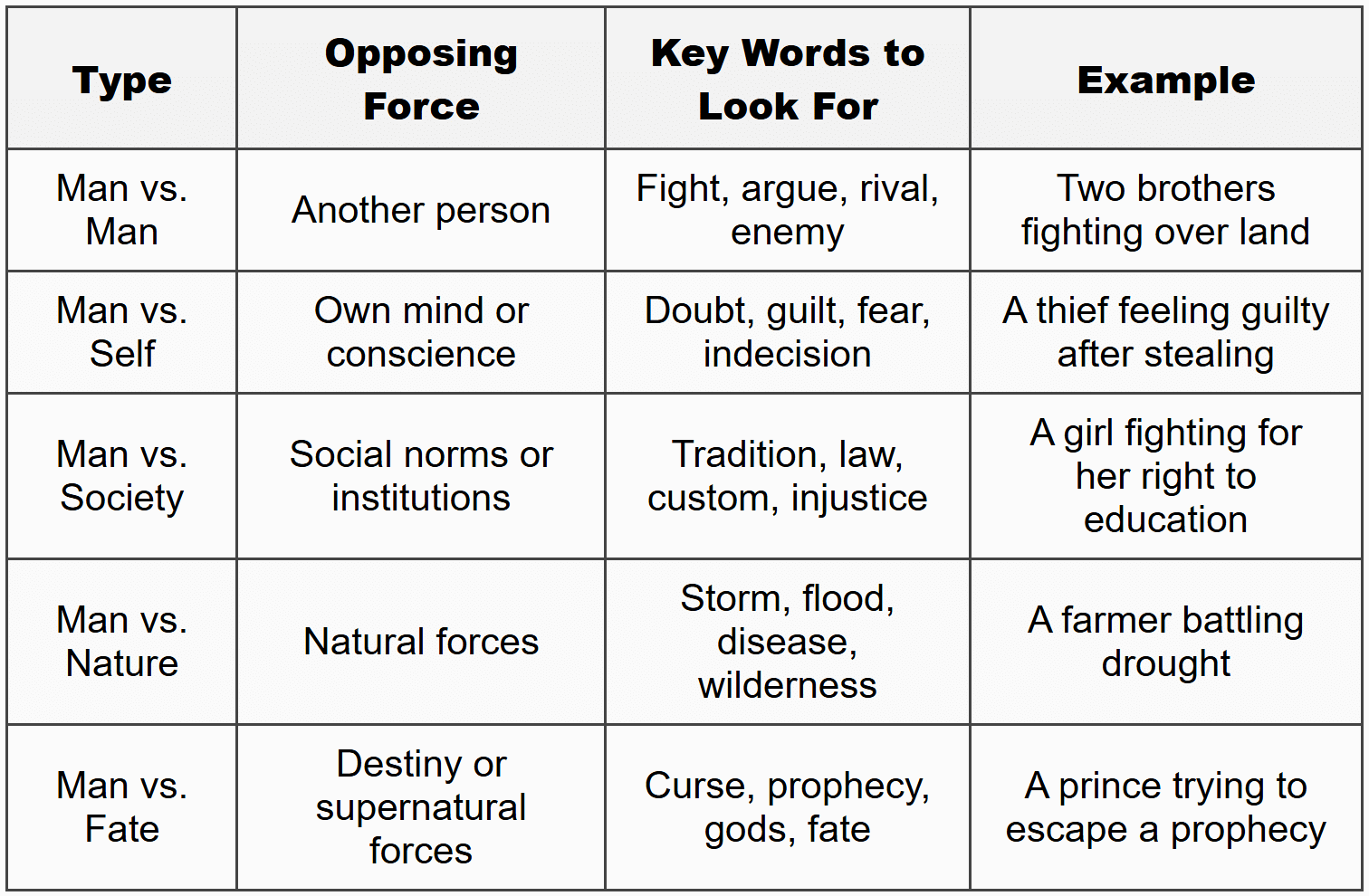
How JAMB Tests Conflict
JAMB typically tests your understanding of conflict in the following ways:
- Identification: You are given a passage and asked to identify the type of conflict present
- Comprehension: You must understand what the conflict is about and who the opposing forces are
- Analysis: You may be asked how the conflict affects the characters or drives the plot
- Vocabulary: You must recognize signal words and phrases that indicate conflict types
Common Question Formats
- "The conflict in the passage is between..."
- "The main conflict in the story can be described as..."
- "The character's struggle is best described as..."
- "What type of conflict is portrayed in the passage?"
- "The passage illustrates a conflict between the protagonist and..."
Rules and Strategies for Identifying Conflict
Step-by-Step Approach
- Identify the protagonist: Who is the main character?
- Identify the problem: What challenge or obstacle is the character facing?
- Identify the opposing force: What or who is causing the problem?
- Match to conflict type: Use the opposing force to classify the conflict
Common Mistakes to Avoid
- Confusing Man vs. Self with Man vs. Man: If the struggle is in the character's mind alone (e.g., guilt, fear), it's Man vs. Self, not Man vs. Man
- Confusing Man vs. Society with Man vs. Man: If the character is fighting an entire system or culture (not just one person), it's Man vs. Society
- Confusing Man vs. Nature with Man vs. Fate: Nature is physical (storm, animal); fate is abstract (destiny, curse)
Quick Recognition Tips
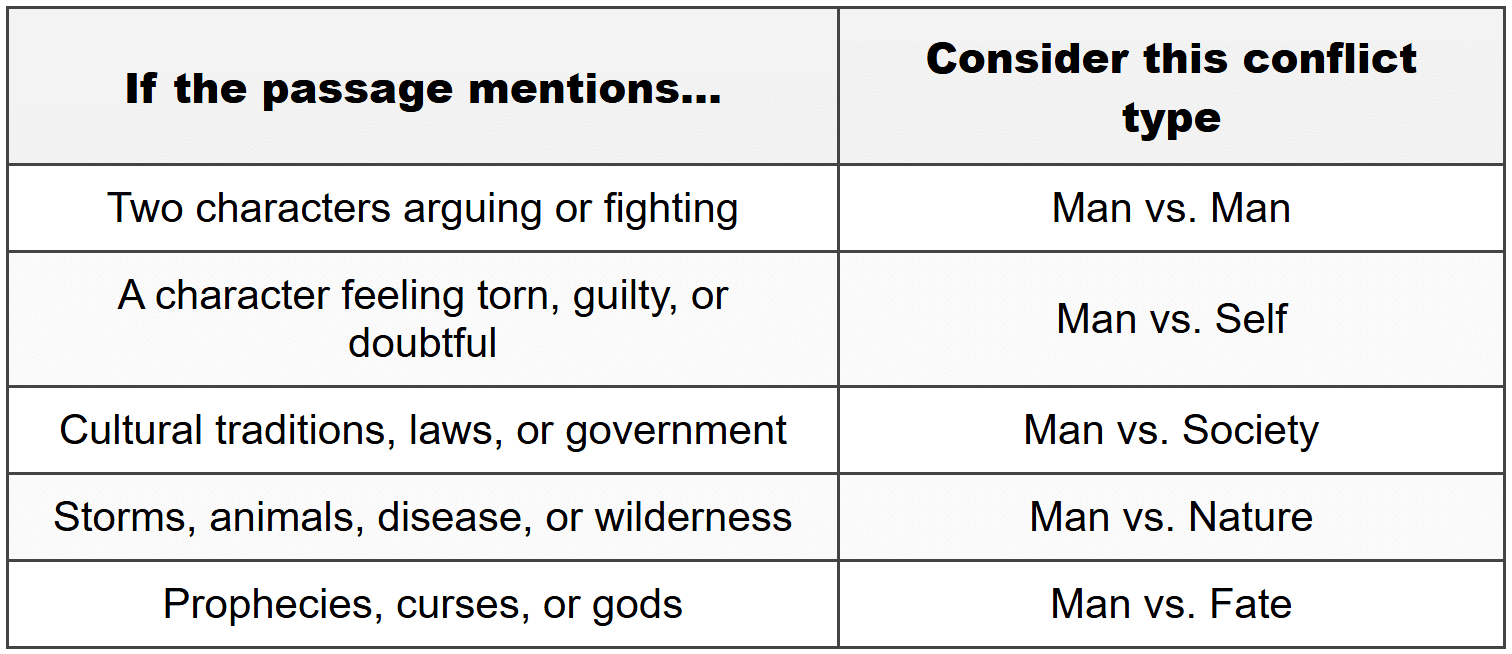
Worked Examples
Q1: Read the passage below and answer the question.
"Chioma stared at the JAMB registration form on her phone. Her parents expected her to study Medicine, but her heart longed for Music. She knew choosing Music would disappoint them deeply, yet studying Medicine would mean living a lie. Tears rolled down her cheeks as she wrestled with the decision."
What type of conflict is illustrated in the passage?
(a) Man vs. Man
(b) Man vs. Self
(c) Man vs. Society
(d) Man vs. Nature
Ans: (b)
Explanation: The conflict here is Man vs. Self because Chioma is struggling internally with her own emotions and decision. She is torn between her parents' expectations and her personal desires. There is no direct confrontation with another person (so not Man vs. Man), and though her parents have expectations, the focus is on her internal struggle, not a fight against societal norms (so not Man vs. Society). The key phrases are "wrestled with the decision" and "tears rolled down her cheeks," which indicate internal emotional conflict.
Q2: Read the passage below and answer the question.
"For three weeks, the rains had not come. The crops withered under the scorching sun, and the village well had dried up. Musa watched helplessly as his maize farm turned brown. He knew that without rain soon, his family would face starvation."
The conflict in the passage is best described as:
(a) Man vs. Man
(b) Man vs. Self
(c) Man vs. Society
(d) Man vs. Nature
Ans: (d)
Explanation: The conflict is Man vs. Nature because Musa is struggling against natural forces beyond his control-specifically, the drought and scorching sun. The passage describes environmental conditions (lack of rain, dried well, withering crops) that threaten his survival. There is no human opponent, no internal struggle, and no fight against society. Words like "rains," "scorching sun," and "withered" clearly point to a conflict with nature.
Q3: Read the passage below and answer the question.
"When Amina announced she would not marry the man her family chose, the entire village turned against her. Her father called her a disgrace. The elders warned that she was bringing shame to their customs. But Amina stood firm, insisting she had the right to choose her own husband."
The main conflict in the passage is:
(a) Man vs. Man
(b) Man vs. Self
(c) Man vs. Society
(d) Man vs. Fate
Ans: (c)
Explanation: The conflict is Man vs. Society because Amina is challenging the traditional customs and expectations of her entire community, not just one individual. The passage mentions "the entire village," "the elders," and "customs," which indicate that she is fighting against a societal norm or cultural practice. While her father is mentioned, the broader conflict is with the collective values of the society, not just one person. Key phrases like "bringing shame to their customs" confirm this is a societal conflict.
Quick Summary
- Conflict is the struggle between opposing forces in a story; it drives the plot and creates tension
- Man vs. Man: Conflict between two or more characters (fights, arguments, rivalry)
- Man vs. Self: Internal conflict within a character's mind (guilt, doubt, fear, indecision)
- Man vs. Society: Conflict between a character and societal norms, laws, or institutions
- Man vs. Nature: Conflict between a character and natural forces (storms, disease, animals)
- Man vs. Fate: Conflict between a character and destiny, supernatural forces, or prophecy
- To identify conflict: find the protagonist, identify the problem, determine the opposing force, then match to conflict type
- Avoid confusing similar types: Man vs. Self is internal; Man vs. Society involves collective norms, not just one person
- Look for signal words in passages: fight, argue (Man vs. Man); doubt, guilt (Man vs. Self); tradition, law (Man vs. Society); storm, flood (Man vs. Nature); curse, prophecy (Man vs. Fate)
- JAMB tests conflict identification, comprehension, and analysis-practice recognizing conflict types in passages
Practice Questions
Q1: "The two brothers had not spoken in years. Their dispute over their father's inheritance had turned them into bitter enemies. Each time they met at family gatherings, the tension was unbearable."
What type of conflict is described in the passage?
(a) Man vs. Self
(b) Man vs. Man
(c) Man vs. Society
(d) Man vs. Nature
Q2: "Ebuka felt a knot in his stomach as he stood at the crossroads. One path led to his village where his sick mother needed him. The other path led to the city where his dream job awaited. He had to choose, but neither option felt right."
The conflict in the passage can best be described as:
(a) Man vs. Man
(b) Man vs. Self
(c) Man vs. Society
(d) Man vs. Fate
Q3: "The government had banned the annual masquerade festival, calling it a relic of the past. But the youth of the village refused to accept this. They organized secretly, determined to keep their cultural heritage alive despite the threat of arrest."
The passage illustrates a conflict between:
(a) The youth and their parents
(b) The youth and themselves
(c) The youth and the government
(d) The youth and nature
Q4: "As the hurricane approached, families boarded up their windows and prayed. The wind howled louder each hour. Trees were uprooted, roofs torn off, and the sea swallowed homes along the coast. Survival was all that mattered now."
The primary conflict in the passage is:
(a) Man vs. Man
(b) Man vs. Self
(c) Man vs. Nature
(d) Man vs. Society
Q5: "The old prophet had warned that any child born on that day would bring doom to the kingdom. When the king's wife gave birth at midnight, the king was faced with an impossible choice: kill his own son or risk the destruction foretold by fate."
What type of conflict does the passage present?
(a) Man vs. Man
(b) Man vs. Self
(c) Man vs. Fate
(d) Man vs. Society
Q6: "Ngozi had always been the obedient daughter. But when her father insisted she drop out of school to help with the family business, something inside her snapped. She loved her father, but she also loved learning. For the first time in her life, she considered disobeying him."
The conflict Ngozi experiences is:
(a) Man vs. Man
(b) Man vs. Self
(c) Man vs. Society
(d) Man vs. Nature
Answer Key and Explanations
Q1 Answer: (b) Man vs. Man
Explanation: The conflict is between two brothers who are fighting over their father's inheritance. This is a direct confrontation between two characters, making it a classic Man vs. Man conflict. Key words: "dispute," "bitter enemies," "tension."
Q2 Answer: (b) Man vs. Self
Explanation: Ebuka is struggling with an internal decision between two difficult choices. The conflict is happening inside his mind, not with another person or external force. Key phrases: "felt a knot in his stomach," "had to choose," "neither option felt right."
Q3 Answer: (c) The youth and the government
Explanation: The youth are fighting against a government ban, which represents societal authority and law. This is a Man vs. Society conflict because they are challenging an institutional decision, not just one individual. Key words: "government had banned," "threat of arrest."
Q4 Answer: (c) Man vs. Nature
Explanation: The families are battling a hurricane, which is a natural disaster. The passage describes physical forces of nature (wind, uprooted trees, flooding) that threaten human survival. Key words: "hurricane," "wind howled," "sea swallowed homes."
Q5 Answer: (c) Man vs. Fate
Explanation: The king is struggling against a prophecy or fate that predicts doom. The conflict involves supernatural or destined forces beyond human control. Key words: "prophet had warned," "doom," "destruction foretold by fate."
Q6 Answer: (b) Man vs. Self
Explanation: Although Ngozi's father is mentioned, the focus is on her internal struggle between obedience and her personal desires. She is wrestling with her own emotions and values, not directly confronting her father. Key phrases: "something inside her snapped," "considered disobeying," "she loved her father, but..."



