Rhythm And Metre


In JAMB English Language, poetry questions often test your ability to recognize and analyze the musical qualities of verse-specifically rhythm and metre. These elements are central to understanding how poems create mood, emphasacy, and meaning through sound patterns. This chapter will equip you with clear definitions, practical techniques for identifying metrical patterns, and strategies for tackling exam questions confidently and accurately.
Key Concepts and Definitions
What is Rhythm?
Rhythm refers to the pattern of sound created by the arrangement of stressed and unstressed syllables in a line of poetry. It is the natural flow or beat you feel when reading a poem aloud-similar to the beat in music.
Think of rhythm as the heartbeat of a poem. When you read lines like "The sun sets over Lagos bay," you naturally emphasize certain syllables more than others. This pattern of emphasis creates rhythm.
Key points about rhythm:
- It emerges from the natural stress patterns of words
- It can be regular (following a predictable pattern) or irregular
- It affects the mood and pace of the poem
- JAMB tests your ability to identify rhythmic patterns in given lines
What is Metre?
Metre (or meter) is the systematic, regular arrangement of rhythm in poetry. It is the measured pattern of stressed and unstressed syllables that repeats throughout a poem or line.
While rhythm can exist in everyday speech, metre is deliberate and structured. It is rhythm organized into recognizable, repeating units called feet.
Important distinction:
- Rhythm = General pattern of sound (can be irregular)
- Metre = Regular, systematic rhythm (follows set patterns)
Understanding Stressed and Unstressed Syllables
Before identifying metre, you must understand syllable stress:
Stressed syllable (/): A syllable pronounced with greater emphasis or force. Example: BA-by, com-PLETE, HAP-py
Unstressed syllable (×): A syllable pronounced with less emphasis. Example: ba-BY (first syllable), COM-plete (first syllable)
In the word "Nigeria" (Ni-GE-ri-a), the stress falls on the second syllable: × / × ×
The Metrical Foot
A foot is the basic unit of metre-a combination of stressed and unstressed syllables that repeats in a pattern. Different combinations create different types of feet.
Types of Metrical Feet
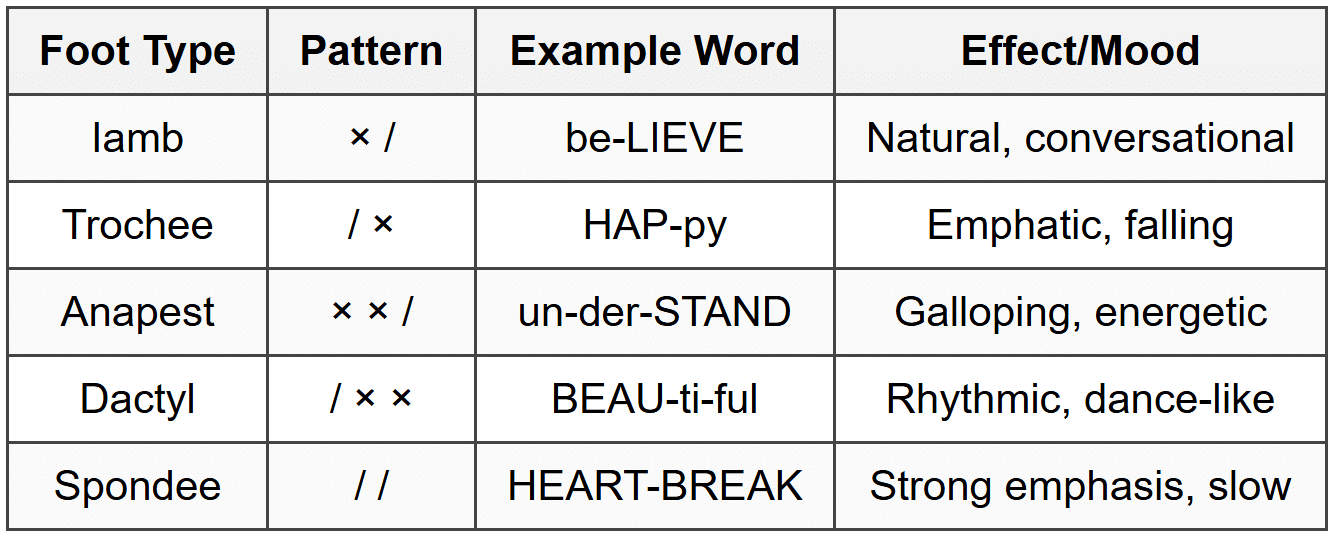
JAMB typically tests your knowledge of the most common metrical feet. Below are the five major types you must know:
1. Iamb (Iambic)
Pattern: × / (unstressed-stressed)
Example: a-WAKE, be-LIEVE, to-DAY
In a line: "The sun will rise a-gain to-day"
This is the most common metre in English poetry. It sounds natural because it mirrors everyday speech patterns.
2. Trochee (Trochaic)
Pattern: / × (stressed-unstressed)
Example: HAP-py, NEV-er, TI-ger
In a line: "Ti-ger, ti-ger, burn-ing bright"
Trochaic metre creates a falling, emphatic rhythm-often used for dramatic or forceful effects.
3. Anapest (Anapestic)
Pattern: × × / (unstressed-unstressed-stressed)
Example: in-ter-VENE, un-der-STAND
In a line: "On the shore of the sea we will play"
Anapestic metre creates a galloping, energetic rhythm-often used in lively or cheerful poems.
4. Dactyl (Dactylic)
Pattern: / × × (stressed-unstressed-unstressed)
Example: MER-ri-ly, BEAU-ti-ful
In a line: "This is the for-est pri-me-val"
Dactylic metre creates a rhythmic, dance-like quality-less common in English poetry but still tested.
5. Spondee (Spondaic)
Pattern: / / (stressed-stressed)
Example: HEART-BREAK, BOOK-CASE, DEAD STOP
In a line: "Break, break, break on thy cold grey stones"
Spondees are rarely used throughout an entire poem but appear for emphasis or to break regular patterns.
Comparison Table of Metrical Feet
Metrical Lines and Their Names
The number of metrical feet in a line determines its name. JAMB questions often ask you to identify the metre of a line by counting feet.
Common Line Lengths
- Monometer: One foot per line (very rare)
- Dimeter: Two feet per line
- Trimeter: Three feet per line
- Tetrameter: Four feet per line
- Pentameter: Five feet per line (most common, especially iambic pentameter)
- Hexameter: Six feet per line
- Heptameter: Seven feet per line
- Octameter: Eight feet per line
Combining Foot Type and Line Length
When identifying metre, combine the foot type with the line length. For example:
- Iambic pentameter: Five iambic feet per line (× / × / × / × / × /)
- Trochaic tetrameter: Four trochaic feet per line (/ × / × / × / ×)
- Anapestic trimeter: Three anapestic feet per line (× × / × × / × × /)
Example of iambic pentameter (the most important for JAMB):
"Shall I com-PARE thee TO a SUM-mer's DAY?"
× / × / × / × / × /
This line contains five iambs, making it iambic pentameter-the metre Shakespeare used extensively.
How to Identify Metre in Exam Questions
JAMB typically provides a line or stanza and asks you to identify its metre. Follow these steps:
Step-by-Step Process
- Read the line aloud naturally to hear where the stresses fall
- Mark stressed (/) and unstressed (×) syllables above each syllable
- Divide the line into feet by grouping syllables according to the pattern you see
- Identify the foot type (iamb, trochee, anapest, dactyl, or spondee)
- Count the number of feet in the line
- Combine the foot type and number to name the metre
Common Pitfalls to Avoid
- Forcing a pattern: Not all lines follow perfect metre; some have variations
- Ignoring natural pronunciation: Pronounce words as you normally would, not artificially
- Confusing rhythm with rhyme: Rhythm is about stress patterns; rhyme is about matching sounds
- Miscounting syllables: Count carefully-every syllable matters
Rules and Explanations
Rule 1: Iambic Pentameter Dominates English Poetry
Most serious English poems use iambic pentameter. If you're unsure in an exam, and the line has ten syllables with alternating unstressed-stressed pattern, it's likely iambic pentameter.
Why it matters: JAMB frequently tests this metre because it's the most common.
Rule 2: Variations Are Normal
Even in metrical poems, poets introduce variations to avoid monotony. A mainly iambic line might have one trochee or spondee for emphasis.
Example:
"BREAK, break, break on thy cold grey stones, O Sea!"
The first foot is a spondee (/ /), but the rest are iambic.
What to do in exams: Identify the dominant metre-the pattern that appears most frequently.
Rule 3: Context Clues Help
JAMB questions sometimes give context about the poem's mood or purpose. Use this to guide your analysis:
- Lively, energetic poems often use anapestic metre
- Forceful, dramatic poems often use trochaic metre
- Natural, reflective poems often use iambic metre
Rule 4: Silent Syllables and Elision
Poets sometimes compress words to fit the metre. For example:
- "o'er" instead of "over" (two syllables → one)
- "heav'n" instead of "heaven" (two syllables → one)
Count these as the compressed number of syllables.
Worked Examples
Q1: Identify the metre of the following line:
"The curfew tolls the knell of parting day"
Answer: Iambic pentameter
Explanation:
Step 1: Mark the stresses:
The CUR-few TOLLS the KNELL of PART-ing DAY
× / × / × / × / × /
Step 2: Identify the foot pattern:
Each foot follows × / (unstressed-stressed), which is an iamb.
Step 3: Count the feet:
There are five iambic feet in the line.
Step 4: Name the metre:
Five iambs = iambic pentameter
Q2: What is the dominant foot in this line?
"Double, double, toil and trouble"
Answer: Trochee
Explanation:
Step 1: Mark the stresses:
DOU-ble, DOU-ble, TOIL and TROU-ble
/ × / × / × / ×
Step 2: Identify the foot pattern:
Each foot follows / × (stressed-unstressed), which is a trochee.
Step 3: Count the feet:
There are four trochaic feet, making this trochaic tetrameter.
Step 4: The dominant foot is the trochee.
Q3: Identify the metre of the following line:
"'Twas the night before Christmas, when all through the house"
Answer: Anapestic tetrameter
Explanation:
Step 1: Mark the stresses:
'Twas the NIGHT before CHRIST-mas, when ALL through the HOUSE
× × / × × / × × / × × /
Step 2: Identify the foot pattern:
Each foot follows × × / (unstressed-unstressed-stressed), which is an anapest.
Step 3: Count the feet:
There are four anapestic feet in the line.
Step 4: Name the metre:
Four anapests = anapestic tetrameter
Quick Summary
- Rhythm = General pattern of stressed and unstressed syllables; can be regular or irregular
- Metre = Regular, systematic rhythm organized into repeating units called feet
- Stressed syllable (/) = Pronounced with greater emphasis
- Unstressed syllable (×) = Pronounced with less emphasis
- Foot = Basic unit of metre; a combination of stressed and unstressed syllables
- Iamb (× /): Most common foot; sounds natural
- Trochee (/ ×): Falling, emphatic rhythm
- Anapest (× × /): Galloping, energetic rhythm
- Dactyl (/ × ×): Rhythmic, dance-like quality
- Spondee (/ /): Two stressed syllables for emphasis
- Line length names: Monometer (1 foot), Dimeter (2), Trimeter (3), Tetrameter (4), Pentameter (5), Hexameter (6), Heptameter (7), Octameter (8)
- Iambic pentameter = Most important metre; five iambic feet per line; used by Shakespeare
- To identify metre: Read aloud → Mark stresses → Divide into feet → Identify foot type → Count feet → Name metre
- Variations are normal: Identify the dominant pattern, not necessarily every foot
- Context clues help: Mood and purpose can suggest likely metre
Practice Questions
Q1: Which of the following best describes rhythm in poetry?
(a) The rhyme scheme of a poem
(b) The pattern of stressed and unstressed syllables
(c) The number of lines in a stanza
(d) The use of metaphors and similes
Q2: The line "Shall I compare thee to a summer's day?" is an example of:
(a) Trochaic tetrameter
(b) Iambic pentameter
(c) Anapestic trimeter
(d) Dactylic hexameter
Q3: A metrical foot consisting of one stressed syllable followed by one unstressed syllable is called:
(a) Iamb
(b) Trochee
(c) Anapest
(d) Dactyl
Q4: How many feet are in a line of pentameter?
(a) Three
(b) Four
(c) Five
(d) Six
Q5: The line "Double, double, toil and trouble" primarily uses which metrical foot?
(a) Iamb
(b) Trochee
(c) Anapest
(d) Spondee
Q6: Which of the following foot patterns represents an anapest?
(a) / ×
(b) × /
(c) × × /
(d) / × ×
Answer Key and Explanations
Q1 Answer: (b)
Rhythm is specifically the pattern of stressed and unstressed syllables in poetry. Option (a) refers to rhyme, not rhythm. Options (c) and (d) are unrelated to rhythm.
Q2 Answer: (b)
This famous Shakespearean line contains five iambic feet (× / × / × / × / × /), making it iambic pentameter. It's one of the most recognizable examples of this metre.
Q3 Answer: (b)
A trochee follows the pattern / × (stressed-unstressed). An iamb is the reverse (× /), while anapest is × × / and dactyl is / × ×.
Q4 Answer: (c)
The prefix "penta-" means five. Pentameter contains five metrical feet per line, regardless of the foot type.
Q5 Answer: (b)
"DOU-ble, DOU-ble, TOIL and TROU-ble" follows the pattern / × / × / × / ×, which is trochaic. Each foot begins with a stressed syllable followed by an unstressed one.
Q6 Answer: (c)
An anapest consists of two unstressed syllables followed by one stressed syllable (× × /). Option (a) is a trochee, (b) is an iamb, and (d) is a dactyl.
