Stanza Forms


In JAMB English Language, understanding stanza forms is crucial for tackling poetry questions with confidence. A stanza is simply a grouped set of lines in a poem, and knowing how different stanza forms work helps you analyze poems quickly and answer questions accurately. This chapter will teach you the major stanza forms, their characteristics, and exactly how to identify them in exam passages.
What is a Stanza?
A stanza is a division of lines in a poem, similar to how a paragraph divides prose writing. Just as paragraphs organize ideas in an essay, stanzas organize thoughts, images, or emotions in poetry. The space between stanzas signals a shift in focus, tone, or perspective.
Key Points:
- Stanzas are separated by blank spaces in a poem
- Each stanza typically contains a complete thought or idea
- Stanzas can have regular or irregular patterns
- The number of lines in a stanza determines its name
Major Stanza Forms
JAMB tests your ability to recognize and name different stanza forms based on the number of lines they contain. Here are the most important forms you must know:
1. Couplet (Two Lines)
A couplet is a two-line stanza. Couplets often rhyme and express a complete thought within those two lines. They are commonly used to conclude poems or emphasize particular ideas.
Example:
The sun sets over Lagos bay,
And night replaces brightened day.
Characteristics:
- Contains exactly two lines
- Often rhymes (but not always)
- Frequently used in heroic couplets (iambic pentameter with rhyming pairs)
- May stand alone or appear as part of a longer poem
2. Tercet or Triplet (Three Lines)
A tercet (also called a triplet) is a three-line stanza. When all three lines rhyme together, it is specifically called a triplet. Tercets are common in various poetic forms including terza rima.
Example:
The harmattan wind blows cold and dry,
Across the savanna, swift and high,
Beneath the vast and cloudless sky.
Characteristics:
- Contains exactly three lines
- May have various rhyme schemes (aaa, aba, etc.)
- Used in terza rima (aba bcb cdc pattern)
- Offers more development than a couplet but remains concise
3. Quatrain (Four Lines)
A quatrain is a four-line stanza and is the most common stanza form in English poetry. JAMB frequently tests quatrains because they appear in ballads, hymns, and many popular poetic forms.
Example:
The market women sing at dawn, (a)
Their voices rise above the street, (b)
While customers arrive to meet (b)
And trade continues until gone. (a)
Common Rhyme Schemes in Quatrains:
- ABAB - Alternate rhyme (most common)
- AABB - Coupled rhyme
- ABBA - Enclosed rhyme
- ABCB - Simple four-line ballad stanza
Characteristics:
- Contains exactly four lines
- Most versatile and widely used stanza form
- Used in sonnets (three quatrains plus a couplet)
- Found in ballads, hymns, and lyric poems
4. Quintet or Quintain (Five Lines)
A quintet (also called quintain) is a five-line stanza. This form is less common than quatrains but appears in specific poetic traditions including limericks.
Example:
In Kano's ancient city walls,
Where history's echo softly calls,
The dyeing pits still gleam,
Like colors in a dream,
As craftsmen work in covered halls.
Characteristics:
- Contains exactly five lines
- The limerick is a famous five-line form (AABBA rhyme scheme)
- Allows for more complex development than quatrains
- Less predictable in structure
5. Sestet (Six Lines)
A sestet is a six-line stanza. It is especially important in sonnets, where the final six lines of an Italian (Petrarchan) sonnet form a sestet.
Example:
The Niger River flows serene and wide,
Through valleys green and cities old,
Her waters carry stories yet untold,
Of kingdoms that once flourished by her side,
Of traders, fishermen with nets of gold,
And secrets that her gentle currents hide.
Characteristics:
- Contains exactly six lines
- Common rhyme schemes include ABABCC, AABBCC, or CDECDE
- Forms the concluding section of Petrarchan sonnets
- Provides resolution or commentary on earlier stanzas
6. Septet (Seven Lines)
A septet is a seven-line stanza. The most famous seven-line form is rhyme royal, which uses the rhyme scheme ABABBCC and was popularized by Geoffrey Chaucer.
Characteristics:
- Contains exactly seven lines
- Rhyme royal (ABABBCC) is the most recognized form
- Less common in modern poetry
- Allows extended development of ideas
7. Octave (Eight Lines)
An octave (also called octet) is an eight-line stanza. It forms the first eight lines of an Italian sonnet, where it typically presents a problem or question.
Characteristics:
- Contains exactly eight lines
- In Petrarchan sonnets, follows ABBAABBA rhyme scheme
- Ottava rima is another eight-line form (ABABABCC)
- Often presents a theme or problem that later stanzas address
8. Spenserian Stanza (Nine Lines)
The Spenserian stanza is a specific nine-line form created by Edmund Spenser. It consists of eight lines in iambic pentameter followed by a single line in iambic hexameter (an alexandrine).
Characteristics:
- Contains exactly nine lines
- Rhyme scheme: ABABBCBCC
- Final line is longer (alexandrine)
- Named after Edmund Spenser, who invented it
Irregular Stanza Forms
Not all poems follow regular stanza patterns. Some important irregular forms include:
Free Verse
Free verse poetry has no fixed stanza length, meter, or rhyme scheme. Stanzas can vary in length throughout the poem, and poets may break lines wherever they feel appropriate.
Characteristics:
- No set number of lines per stanza
- Stanzas may vary throughout the poem
- No required rhyme scheme or meter
- Common in modern and contemporary poetry
Blank Verse
Blank verse consists of unrhymed lines in iambic pentameter. While it does not rhyme, it maintains a regular rhythmic pattern. Stanza divisions in blank verse are flexible.
Characteristics:
- Unrhymed but maintains meter (usually iambic pentameter)
- Stanza breaks used for emphasis or shifts in thought
- Common in dramatic and epic poetry
How JAMB Tests Stanza Forms
JAMB typically tests stanza forms in the following ways:
- Direct identification: You may be given a poem excerpt and asked to identify the stanza form
- Counting lines: Questions may require you to count lines in a stanza
- Recognizing patterns: You might need to identify rhyme schemes associated with specific stanza forms
- Structural analysis: Questions may ask about the function or effect of a particular stanza form
- Terminology: You must know the correct names for different stanza lengths
Quick Reference Table
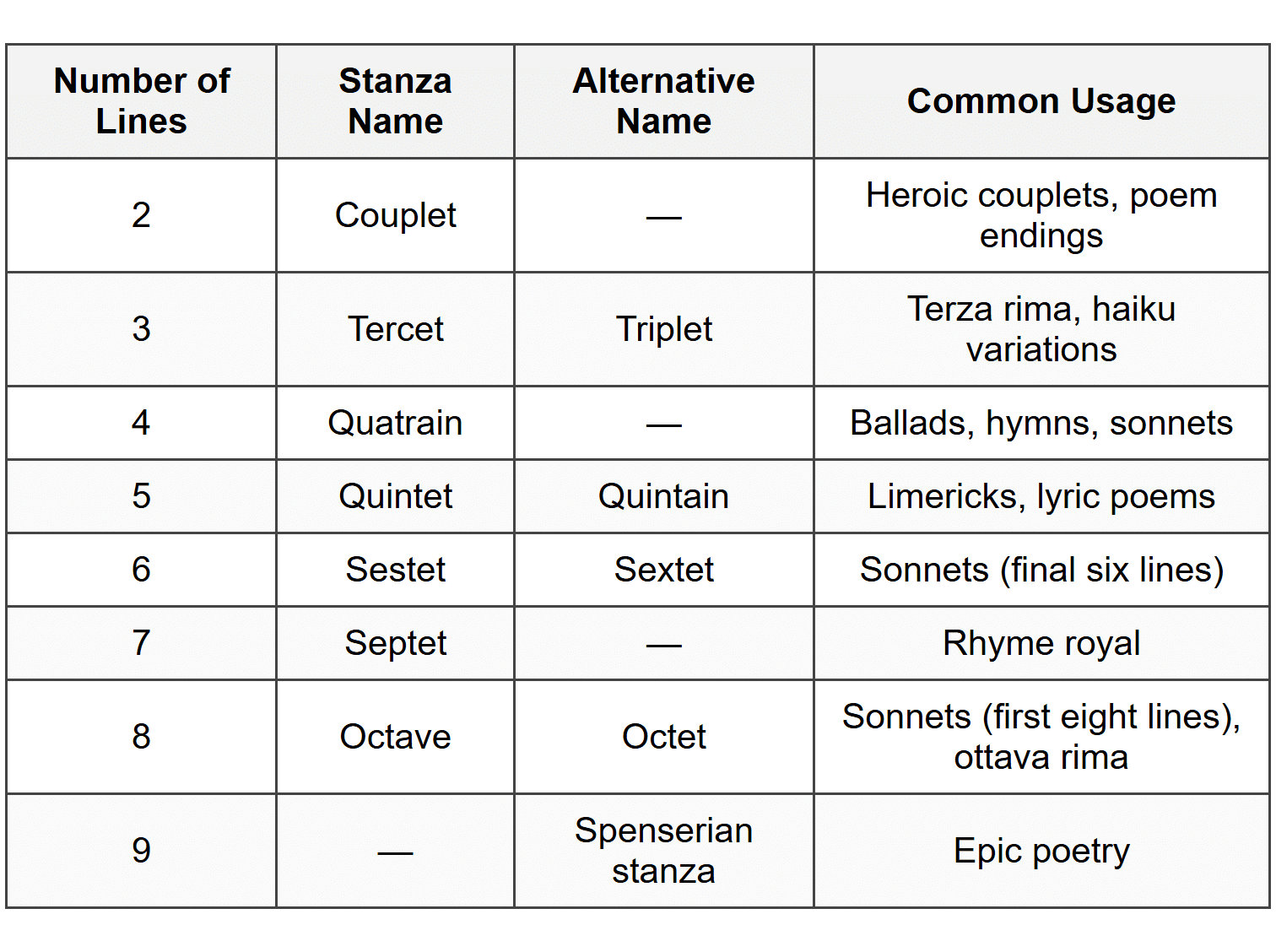
Common Mistakes to Avoid
1. Confusing Tercet and Triplet: While often used interchangeably, a triplet specifically refers to a tercet where all three lines rhyme (aaa). A tercet can have other rhyme patterns.
2. Miscounting Lines: Always count carefully. Students often misidentify stanzas by counting incorrectly, especially in longer poems.
3. Mixing Up Sestet and Sextet: Both terms refer to six-line stanzas and are acceptable, though "sestet" is more common in discussions of sonnets.
4. Forgetting Octave vs. Octet: Both terms are correct for eight-line stanzas, but "octave" is standard when discussing sonnets.
5. Assuming All Stanzas Rhyme: Stanza forms are defined by line count, not rhyme. A quatrain can be rhymed or unrhymed.
Worked Examples
Q1: Identify the stanza form in the following excerpt:
The eagle soars above the hill,
With wings spread wide and keen,
The valley lies so calm and still,
A peaceful, verdant scene.
(a) Couplet
(b) Tercet
(c) Quatrain
(d) Sestet
Ans: (c) Quatrain
Explanation: Count the lines carefully: there are exactly four lines in this stanza. A four-line stanza is called a quatrain. The stanza also follows an ABAB rhyme scheme (hill/still, keen/scene), which is a common pattern in quatrains, but the line count alone determines the answer.
Q2: The first eight lines of a Petrarchan sonnet are called:
(a) Sestet
(b) Octave
(c) Septet
(d) Couplet
Ans: (b) Octave
Explanation: In a Petrarchan (Italian) sonnet, the poem is divided into two parts: the first eight lines form an octave, and the final six lines form a sestet. The octave typically presents a problem or situation, while the sestet offers a resolution or commentary. This is a standard structure you must memorize.
Q3: Read the following stanza and answer the question:
When morning breaks on Ife's sacred ground,
The ancient bronze heads silently stand,
Witnesses to history profound.
What stanza form is used above?
(a) Couplet
(b) Tercet
(c) Quatrain
(d) Quintet
Ans: (b) Tercet
Explanation: This stanza contains exactly three lines, which makes it a tercet. The rhyme scheme is ABA (ground/profound, stand), which is a common tercet pattern. Even though "tercet" and "triplet" both refer to three-line stanzas, the term "tercet" is more general and applies to any three-line stanza, while "triplet" specifically refers to tercets where all three lines rhyme.
Quick Summary
- A stanza is a grouped division of lines in poetry, separated by spaces
- Couplet = 2 lines
- Tercet/Triplet = 3 lines
- Quatrain = 4 lines (most common stanza form)
- Quintet/Quintain = 5 lines
- Sestet/Sextet = 6 lines
- Septet = 7 lines
- Octave/Octet = 8 lines
- Spenserian stanza = 9 lines with specific rhyme scheme (ABABBCBCC)
- Stanza forms are identified by counting lines, not by rhyme scheme
- In Petrarchan sonnets: first 8 lines = octave; last 6 lines = sestet
- Quatrains are the most frequently tested stanza form in JAMB
- Free verse has irregular stanza lengths with no fixed pattern
- Always count lines carefully to avoid identification errors
- Know alternative names: tercet/triplet, sestet/sextet, octave/octet
Practice Questions
Q1: How many lines are in a sestet?
(a) Four
(b) Five
(c) Six
(d) Seven
Q2: Identify the stanza form:
The rain falls soft on Abuja's streets,
Where modern towers touch the sky.
(a) Couplet
(b) Tercet
(c) Quatrain
(d) Quintet
Q3: A nine-line stanza with the rhyme scheme ABABBCBCC is called:
(a) Ottava rima
(b) Spenserian stanza
(c) Rhyme royal
(d) Sestet
Q4: Which of the following is the most common stanza form in English poetry?
(a) Couplet
(b) Tercet
(c) Quatrain
(d) Octave
Q5: In a Petrarchan sonnet, the final six lines are called:
(a) An octave
(b) A sestet
(c) A couplet
(d) A septet
Q6: Read the following stanza:
There was a young student from Benin,
Whose knowledge was terribly thin,
He studied all night,
Till his answers were right,
And walked out of JAMB with a grin.
What stanza form is used above?
(a) Quatrain
(b) Quintet
(c) Sestet
(d) Septet
Answer Key and Explanations
Q1: Ans: (c) Six
A sestet (also spelled sextet) is a six-line stanza. The prefix "ses-" or "sex-" indicates six. This is an important term in sonnet analysis, where the final six lines of a Petrarchan sonnet form the sestet.
Q2: Ans: (a) Couplet
Count the lines: there are exactly two lines in this excerpt, which makes it a couplet. The lines also rhyme (streets/sky does not rhyme perfectly, but the line count determines the stanza form). Couplets are two-line stanzas that often express a complete thought concisely.
Q3: Ans: (b) Spenserian stanza
The Spenserian stanza is specifically a nine-line form with the rhyme scheme ABABBCBCC, invented by Edmund Spenser. The final line is typically longer (an alexandrine in iambic hexameter). This is a specific form you must recognize by its unique structure.
Q4: Ans: (c) Quatrain
The quatrain (four-line stanza) is the most common stanza form in English poetry. It appears in ballads, hymns, songs, and many lyric poems. Its versatility and balance make it the preferred choice for many poets. JAMB frequently tests quatrains because of their prevalence.
Q5: Ans: (b) A sestet
In a Petrarchan (Italian) sonnet, the poem divides into two parts: an octave (first eight lines) and a sestet (final six lines). The octave typically presents a problem or situation, while the sestet provides resolution or commentary. Understanding this structure is essential for sonnet analysis.
Q6: Ans: (b) Quintet
Count the lines carefully: this stanza has exactly five lines, making it a quintet (also called quintain). This particular example is a limerick, which is a specific type of five-line poem with an AABBA rhyme scheme and a humorous tone. The line count determines the basic classification as a quintet.
