Diction And Imagery


Understanding diction and imagery is essential for excelling in the JAMB English Language exam. These literary devices appear in comprehension passages, poetry, and prose sections, and you're expected to identify them, interpret their meaning, and explain their effects. Diction refers to the choice of words a writer uses, while imagery involves language that appeals to our senses. Mastering these concepts will help you analyze texts more effectively and score higher marks in both objective and theory sections.
Key Concepts and Definitions
What is Diction?
Diction is the choice and use of words and phrases in speech or writing. It's about selecting particular words to convey meaning, create mood, or establish tone. Writers carefully choose words based on their connotations, formality, and emotional impact.
Types of Diction:
- Formal Diction: Uses sophisticated vocabulary, complete sentences, and follows strict grammatical rules. Common in academic writing, official speeches, and serious literature. Example: "The government has implemented stringent measures to ameliorate the economic situation."
- Informal Diction: Uses conversational language, simpler words, and may include contractions. Example: "The government's trying to fix the bad economy."
- Colloquial Diction: Uses everyday language specific to a particular region or group. Example: "That babe na correct person" (Nigerian Pidgin influence).
- Slang: Uses very informal words and expressions, often short-lived and specific to particular groups. Example: "That exam was lit!"
- Abstract Diction: Uses words that refer to ideas, concepts, or qualities rather than concrete objects. Example: "Freedom, justice, and equality are fundamental human rights."
- Concrete Diction: Uses words that refer to tangible, specific things you can see, touch, or experience. Example: "The red Toyota drove through the dusty road in Kaduna."
- Poetic Diction: Uses elevated, often archaic or unusual word choices typical of poetry. Example: "Ere the dawn breaks, the nightingale sings."
What is Imagery?
Imagery is the use of descriptive language that appeals to one or more of our five senses (sight, hearing, touch, taste, smell). It creates mental pictures and helps readers experience what the writer describes. Imagery makes writing more vivid, engaging, and memorable.
Types of Imagery:
- Visual Imagery: Appeals to sight; describes what something looks like. Example: "The golden sunset painted the Lagos skyline in shades of orange and purple."
- Auditory Imagery: Appeals to hearing; describes sounds. Example: "The church bells rang loudly across the quiet Sunday morning."
- Olfactory Imagery: Appeals to smell. Example: "The aroma of jollof rice and fried chicken filled the party venue."
- Gustatory Imagery: Appeals to taste. Example: "The bitter taste of bitter leaf soup reminded him of home."
- Tactile Imagery: Appeals to touch; describes texture, temperature, or physical sensations. Example: "The harmattan wind felt cold and dry against her skin."
- Kinesthetic Imagery: Describes movement or physical action. Example: "He sprinted through the crowded market, dodging traders and customers."
- Organic Imagery: Describes internal sensations like hunger, thirst, fatigue, or emotions. Example: "Her heart pounded with fear as the exam time approached."
Why Writers Use Diction and Imagery
Purposes of Diction:
- To establish the appropriate tone (serious, humorous, sarcastic, formal)
- To reflect the character's background, education, or personality
- To create mood and atmosphere
- To make meaning clearer or more precise
- To appeal to specific audiences
Purposes of Imagery:
- To help readers visualize and experience what is being described
- To evoke emotions and create atmosphere
- To make abstract ideas more concrete and understandable
- To make writing more memorable and engaging
- To convey complex meanings through sensory details
How JAMB Tests Diction and Imagery
JAMB typically tests these concepts through:
- Identification Questions: You may be asked to identify the type of diction or imagery used in a passage.
- Effect Questions: You may need to explain what effect the diction or imagery creates.
- Interpretation Questions: You may be asked what specific images or word choices mean in context.
- Comparison Questions: You might need to distinguish between different types of diction or imagery.
Analyzing Diction in Texts
Steps to Analyze Diction
- Identify the words: Notice unusual, repeated, or particularly strong words.
- Classify the diction: Determine whether it's formal, informal, abstract, concrete, etc.
- Consider connotations: Think about the emotional associations and implied meanings of words.
- Examine the effect: How do these word choices affect tone, mood, or meaning?
Connotation vs. Denotation
Denotation is the literal, dictionary definition of a word.
Connotation is the emotional or cultural association a word carries beyond its literal meaning.
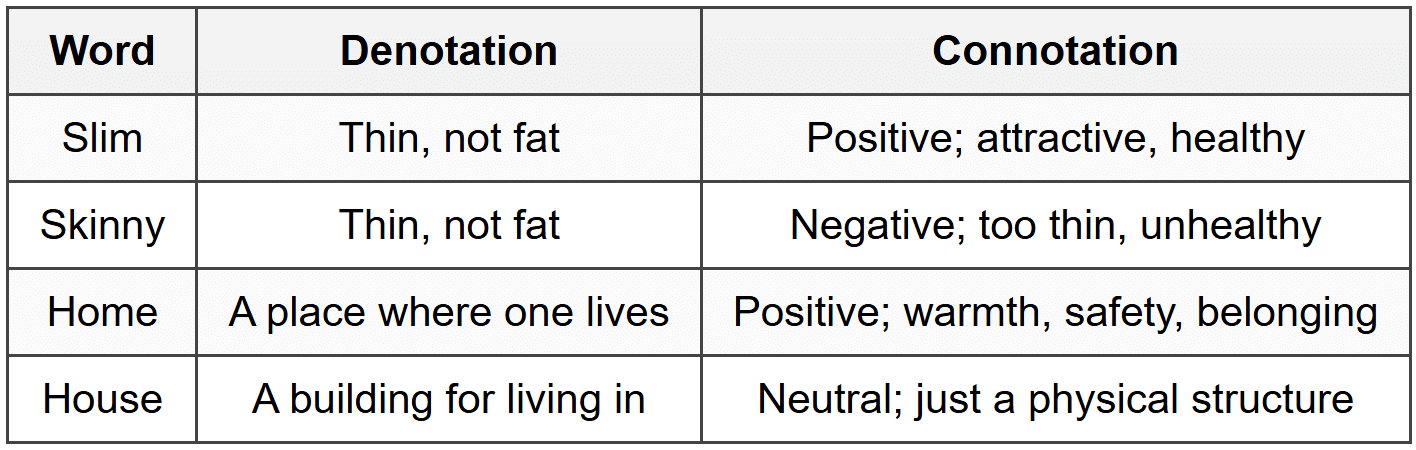
Understanding connotation is crucial because JAMB often tests your ability to recognize the emotional undertones of word choices.
Analyzing Imagery in Texts
Steps to Analyze Imagery
- Identify sensory language: Look for words that appeal to the five senses.
- Determine which sense: Decide whether it's visual, auditory, olfactory, gustatory, or tactile imagery.
- Visualize the image: Create a mental picture of what's being described.
- Interpret the effect: Consider what mood, emotion, or meaning the imagery creates.
Common Imagery Patterns in Literature
Light and Darkness: Often represents good vs. evil, knowledge vs. ignorance, hope vs. despair.
Nature Imagery: Used to reflect emotions, create atmosphere, or symbolize ideas. Example: "The storm reflected the turmoil in his mind."
Color Imagery: Different colors carry different meanings and emotions. Red might suggest passion or danger; white might suggest purity or innocence; black might suggest death or mystery.
Diction and Imagery Working Together
In effective writing, diction and imagery complement each other. The specific words chosen (diction) create the sensory experiences (imagery). Consider this example:
"The blazing sun scorched the parched earth."
- Diction analysis: "Blazing" and "scorched" are strong, vivid verbs; "parched" is a precise adjective conveying extreme dryness.
- Imagery analysis: Visual imagery (blazing sun), tactile imagery (scorched, parched).
- Combined effect: The careful word choice creates powerful imagery that makes readers feel the intense heat.
Common JAMB Question Patterns
JAMB questions on diction and imagery typically follow these patterns:
Pattern 1: "The dominant imagery in the passage is..."
You need to identify which type of imagery appears most frequently or powerfully.
Pattern 2: "The diction in line 5 can be described as..."
You need to classify the type of diction used.
Pattern 3: "The word '...' suggests..."
You need to interpret connotations or implied meanings.
Pattern 4: "The imagery in the passage creates a mood of..."
You need to determine the emotional atmosphere created by the imagery.
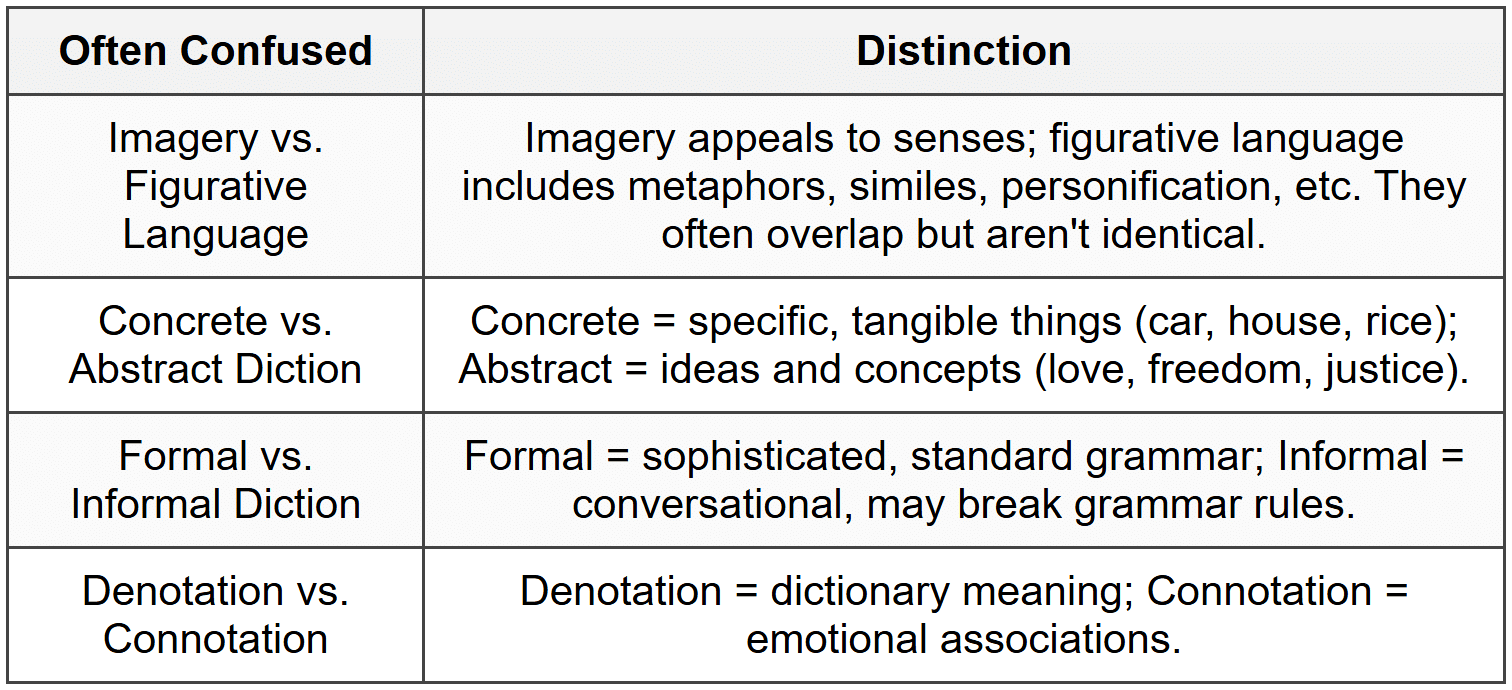
Important Distinctions JAMB Uses to Test Students
Worked Examples
Q1: Read the following sentence and answer the question:
"The market woman's shrill voice pierced the morning air as she advertised her fresh tomatoes."
What type of imagery is dominant in this sentence?
(a) Visual imagery
(b) Auditory imagery
(c) Olfactory imagery
(d) Tactile imagery
Ans: (b)
Explanation: The dominant imagery here is auditory imagery because it appeals to our sense of hearing. The key phrases are "shrill voice" and "pierced the morning air," which describe sound. While there's a minor visual element (fresh tomatoes), the sentence focuses on what we hear. The word "shrill" describes a high-pitched, sharp sound, and "pierced" suggests the sound was loud and penetrating. JAMB expects you to identify the primary sensory appeal, which in this case is clearly hearing.
Q2: Read the passage below and answer the question:
"The distinguished professor addressed the assembly with eloquent rhetoric, expounding upon the philosophical implications of contemporary socio-political discourse."
The diction in this passage can best be described as:
(a) Colloquial and informal
(b) Formal and abstract
(c) Concrete and simple
(d) Slang and regional
Ans: (b)
Explanation: The diction is formal and abstract. The passage uses sophisticated vocabulary ("distinguished," "eloquent," "expounding," "philosophical," "contemporary," "socio-political," "discourse") typical of academic or formal settings. These are also abstract words dealing with ideas and concepts rather than concrete, tangible things. There are no contractions, slang terms, or conversational expressions. The sentence structure is complex and follows strict grammatical rules. This type of diction would be appropriate for academic writing or formal speeches, which is exactly what the passage describes. JAMB tests your ability to recognize formality levels and abstract versus concrete language.
Q3: Examine this line from a poem:
"The harmattan wind whispered secrets through the dry, rustling leaves."
The word "whispered" in this context suggests:
(a) That the wind was very loud
(b) A gentle, soft, and mysterious quality to the wind's sound
(c) That someone was actually speaking
(d) That the wind made no sound at all
Ans: (b)
Explanation: This question tests your understanding of connotation and imagery. "Whispered" literally means to speak very softly, but when applied to wind (personification), it suggests gentleness and creates a mysterious atmosphere. The connotation of "whisper" includes softness, secrecy, and intimacy. Combined with "secrets," it creates an image of the wind making soft, mysterious sounds. Option (a) contradicts the meaning of whisper. Option (c) takes the word too literally; this is figurative language. Option (d) is incorrect because whispering still involves sound, just very soft sound. JAMB frequently tests whether you understand both the literal and figurative meanings of words, especially when used in imagery and personification.
Quick Summary
- Diction = word choice; can be formal, informal, colloquial, slang, abstract, concrete, or poetic
- Imagery = language appealing to the five senses (sight, sound, smell, taste, touch)
- Denotation = literal, dictionary meaning of a word
- Connotation = emotional or cultural associations beyond the literal meaning
- Visual imagery = appeals to sight; Auditory imagery = appeals to hearing
- Olfactory imagery = appeals to smell; Gustatory imagery = appeals to taste
- Tactile imagery = appeals to touch and physical sensations
- Formal diction = sophisticated vocabulary, proper grammar, serious tone
- Informal diction = conversational language, simpler words, relaxed tone
- Abstract diction = refers to ideas and concepts (love, freedom, justice)
- Concrete diction = refers to tangible, specific things (house, car, rice)
- Diction establishes tone, reflects character, and appeals to specific audiences
- Imagery makes writing vivid, evokes emotions, and helps readers visualize scenes
- JAMB tests identification, interpretation, and effect of diction and imagery
- Always consider context when analyzing word choice and sensory language
- Look for the dominant or primary type when multiple types appear together
Practice Questions
Q1: "The classroom was filled with the acrid smell of chalk dust and the musty odor of old textbooks."
The imagery in this sentence primarily appeals to which sense?
(a) Sight
(b) Touch
(c) Smell
(d) Taste
Q2: "The governor stated: 'We must expeditiously implement comprehensive strategies to ameliorate the infrastructural deficiencies plaguing our state.'"
The diction in this statement is best described as:
(a) Informal and conversational
(b) Formal and abstract
(c) Colloquial and regional
(d) Simple and concrete
Q3: "The baby's skin was as soft as silk."
This sentence contains:
(a) Visual imagery only
(b) Tactile imagery only
(c) Both visual and tactile imagery
(d) Auditory imagery only
Q4: Consider these two sentences:
Sentence A: "The politician's residence is a magnificent edifice."
Sentence B: "The politician's house is a big building."
How do these sentences differ primarily in terms of diction?
(a) Sentence A uses more concrete diction than Sentence B
(b) Sentence A uses more formal and elevated diction than Sentence B
(c) Sentence B uses more abstract diction than Sentence A
(d) Both sentences use equally formal diction
Q5: "Hope is the anchor of the soul."
In this sentence, the word "anchor" is:
(a) Used in its literal, concrete meaning
(b) An example of abstract diction creating an image
(c) A colloquial expression
(d) An example of informal diction
Q6: Read the following excerpt:
"The orange flames danced wildly in the fireplace, crackling and hissing as they consumed the dry wood. The warmth spread through the room, driving away the evening chill."
This passage contains primarily:
(a) Only visual imagery
(b) Visual, auditory, and tactile imagery
(c) Only auditory imagery
(d) Olfactory and gustatory imagery
Answer Key and Explanations
Q1 Answer: (c)
Explanation: The sentence specifically mentions "smell" and "odor," both of which are olfactory (smell-related) terms. "Acrid smell" and "musty odor" directly appeal to the sense of smell. While you might visualize a classroom, the dominant sensory appeal in this sentence is to smell, making this olfactory imagery. This is an easy question testing basic imagery identification.
Q2 Answer: (b)
Explanation: The governor's statement uses highly formal, sophisticated vocabulary ("expeditiously," "implement," "comprehensive," "ameliorate," "infrastructural," "deficiencies," "plaguing") typical of official or political speech. The words are also abstract, dealing with concepts and ideas rather than concrete objects. This type of elevated language is characteristic of formal diction. There are no contractions, slang, or conversational elements. This is a medium-difficulty question requiring you to recognize formality level and abstract versus concrete language.
Q3 Answer: (b)
Explanation: This sentence uses tactile imagery because it describes how something feels to the touch. "Soft" is a tactile word describing texture. While silk is a visual object, the comparison focuses on the sensation of touching it, not on how it looks. The simile "as soft as silk" emphasizes the sense of touch. This is an easy question but tests whether you can distinguish between what's being described and which sense is being appealed to.
Q4 Answer: (b)
Explanation: Sentence A uses more formal and elevated diction with words like "residence" (instead of house), "magnificent" (instead of big), and "edifice" (instead of building). These are more sophisticated, formal word choices. Both sentences are concrete (they refer to tangible things), so option (a) is wrong. Sentence B uses simpler, more everyday language, making it less formal than Sentence A. This is a medium-difficulty question testing your ability to compare diction levels between similar statements.
Q5 Answer: (b)
Explanation: "Anchor" is literally a concrete object (a heavy device that holds ships in place), but here it's used figuratively to represent stability and security for an abstract concept (hope). This creates an image that makes the abstract idea of hope more tangible and understandable. The sentence uses abstract diction (hope, soul) combined with concrete imagery (anchor) to convey meaning. This is a hard question because it requires understanding how concrete images can be used to represent abstract ideas.
Q6 Answer: (b)
Explanation: This passage contains multiple types of imagery. Visual imagery: "orange flames," "danced wildly," describing what can be seen. Auditory imagery: "crackling and hissing," describing sounds. Tactile imagery: "warmth," "chill," describing physical sensations of temperature. The passage does not describe smells or tastes, so olfactory and gustatory imagery are absent. This is a hard question because you must identify multiple types of imagery and determine which option correctly captures all of them. JAMB often includes passages with layered imagery to test comprehensive understanding.



