Types Of Poetry


Poetry is one of the most tested areas in JAMB English Language, and understanding the different types gives you a solid edge in both interpretation and unseen poetry questions. JAMB expects you to identify poetic forms, recognize their features, and analyze how poets use structure to convey meaning. In this chapter, you'll learn the major types of poetry, their distinguishing characteristics, and exactly how to spot them in exam passages.
Key Concepts and Definitions
What is Poetry?
Poetry is a literary form that uses concentrated language, rhythmic patterns, imagery, and often figurative language to express emotions, ideas, and experiences. Unlike prose, poetry pays special attention to sound, form, and the aesthetic arrangement of words.
Poetry can be classified based on structure, purpose, or subject matter. JAMB focuses primarily on structural and functional classifications.
Major Classifications of Poetry
Poetry is broadly divided into three main categories:
- Narrative Poetry - tells a story
- Lyric Poetry - expresses personal emotions or thoughts
- Dramatic Poetry - presents characters speaking to each other or to an audience
Within these broad categories are specific types that JAMB regularly tests. Let's explore each one in detail.
Narrative Poetry
Narrative poetry tells a story with characters, setting, plot, and sometimes dialogue. It combines the storytelling elements of prose with the musical qualities of verse.
Key Features of Narrative Poetry
- Has a clear plot with beginning, middle, and end
- Contains characters who perform actions
- Often told by a narrator
- May include dialogue between characters
- Uses poetic devices like rhyme, rhythm, and imagery
Types of Narrative Poetry
Epic
An epic is a long narrative poem that celebrates the heroic deeds of legendary or historical figures. Epics often involve supernatural elements, journeys, battles, and the fate of nations.
Characteristics:
- Very long poem (often thousands of lines)
- Heroic protagonist with superhuman qualities
- Grand setting (often involves entire nations or the universe)
- Elevated, formal language
- Often begins in medias res (in the middle of action)
- Contains supernatural beings or divine intervention
Examples: Homer's The Iliad and The Odyssey, Milton's Paradise Lost, and African epics like Sundiata.
Ballad
A ballad is a short narrative poem originally meant to be sung. Traditional ballads tell stories of love, tragedy, adventure, or historical events in simple language.
Characteristics:
- Simple language and straightforward narrative
- Regular rhyme scheme (often ABAB or ABCB)
- Repetition of lines or refrains
- Focuses on a single dramatic event
- Uses dialogue frequently
- Often has a tragic or mysterious tone
Example: "The Rime of the Ancient Mariner" by Samuel Taylor Coleridge.
Metrical Tale
A metrical tale is a narrative poem that tells a complete story in verse form but is shorter and less formal than an epic. It focuses on entertaining the reader with adventure, romance, or moral lessons.
Characteristics:
- Moderate length
- Clear plot structure
- Regular meter and rhyme
- Less elevated language than epic
- Focuses on human (not superhuman) characters
Example: Chaucer's The Canterbury Tales.
Lyric Poetry
Lyric poetry expresses the personal emotions, thoughts, or feelings of a speaker. Originally meant to be sung with a lyre (a musical instrument), lyric poems are now simply poems that convey subjective experiences.
Key Features of Lyric Poetry
- Expresses personal emotion or thought
- Usually short
- Uses first person perspective (though not always)
- Musical quality with rhythm and sound patterns
- Rich in imagery and figurative language
- Does not tell a story (unlike narrative poetry)
Types of Lyric Poetry
Sonnet
A sonnet is a 14-line lyric poem with a specific rhyme scheme and meter. Sonnets traditionally deal with themes of love, beauty, mortality, or nature.
Characteristics:
- Exactly 14 lines
- Written in iambic pentameter (usually)
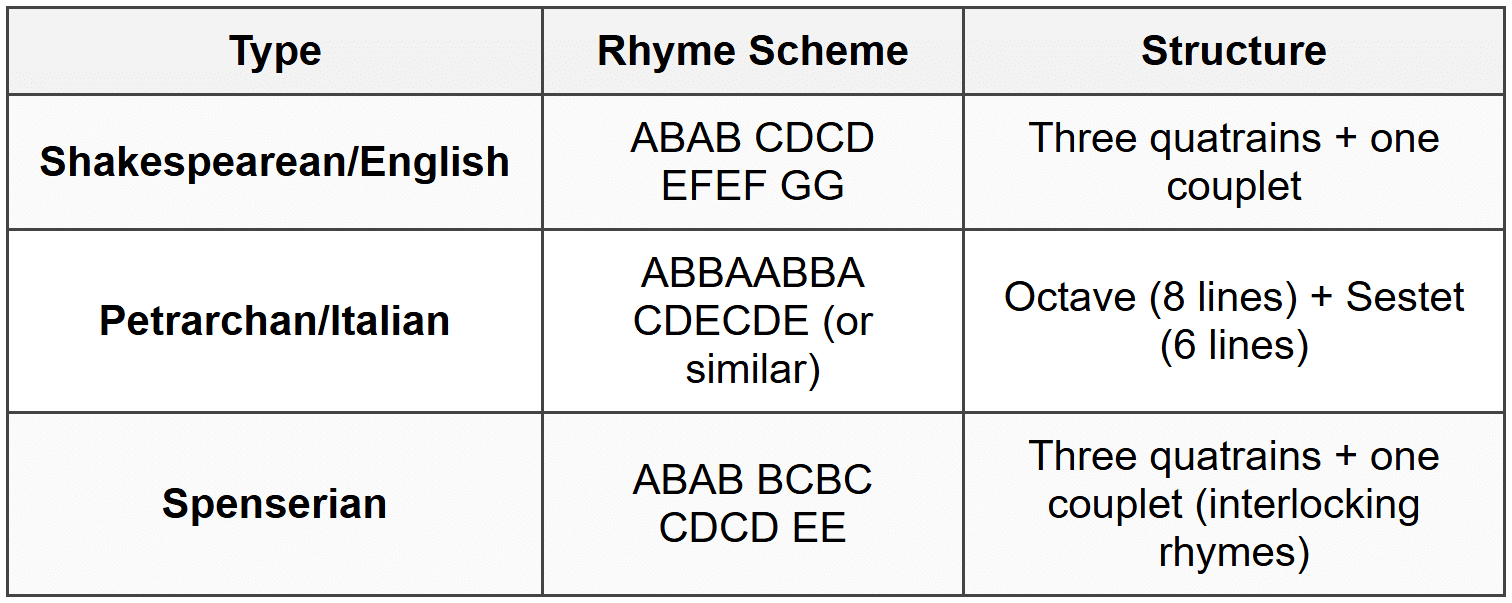
- Follows one of several rhyme schemes
- Explores a single theme or problem
- Often includes a volta (turn or shift in thought)
Types of Sonnets:
Ode
An ode is a formal lyric poem that addresses and often celebrates a person, place, thing, or abstract idea. Odes are characterized by elevated language and serious tone.
Characteristics:
- Formal and dignified tone
- Addresses a specific subject directly
- Complex stanza structures
- Elaborate language and imagery
- Expresses deep admiration or contemplation
Example: "Ode to a Nightingale" by John Keats, "Ode to the West Wind" by Percy Shelley.
Elegy
An elegy is a lyric poem that mourns the death of a person or laments a serious loss. Elegies are sorrowful and reflective.
Characteristics:
- Mournful, melancholic tone
- Reflects on death, loss, or mortality
- Often praises the deceased
- May offer consolation or acceptance
- Uses somber imagery
Example: "Elegy Written in a Country Churchyard" by Thomas Gray.
Pastoral
A pastoral poem idealizes rural life, nature, and the simplicity of shepherds and countryside living. It often contrasts the peace of rural life with the corruption of city life.
Characteristics:
- Celebrates rural and natural settings
- Features shepherds, farmers, or rustic characters
- Idealized, romanticized view of country life
- Peaceful, serene tone
- Often contains classical references
Example: "The Passionate Shepherd to His Love" by Christopher Marlowe.
Hymn
A hymn is a religious lyric poem that praises God, expresses faith, or celebrates spiritual themes. Hymns are meant to be sung in worship.
Characteristics:
- Religious or spiritual content
- Simple language for communal singing
- Regular meter and rhyme scheme
- Tone of reverence and worship
- Often structured in stanzas
Example: "Amazing Grace" by John Newton.
Free Verse
Free verse is lyric poetry that does not follow regular patterns of rhyme, rhythm, or meter. It relies on natural speech rhythms and varied line lengths.
Characteristics:
- No fixed rhyme scheme
- No regular meter
- Varied line lengths and stanza structures
- Uses other poetic devices like imagery, symbolism, enjambment
- Allows poets greater freedom of expression
Example: "The Love Song of J. Alfred Prufrock" by T.S. Eliot.
Dramatic Poetry
Dramatic poetry uses the techniques of drama within poetry. Characters speak directly, often revealing their thoughts and emotions through monologue or dialogue.
Key Features of Dramatic Poetry
- Characters speak in their own voices
- May include dialogue or monologue
- Reveals character through speech
- Often tells a story or presents a situation
- Reader learns indirectly through what characters say
Types of Dramatic Poetry
Dramatic Monologue
A dramatic monologue is a poem in which a single character speaks to a silent listener, revealing aspects of their personality, situation, or psychology.
Characteristics:
- Single speaker addresses a specific listener (who does not speak)
- Reveals speaker's character through their words
- Often reveals more than the speaker intends
- Set in a specific dramatic situation
- Reader must infer context and listener's presence
Example: "My Last Duchess" by Robert Browning.
Soliloquy
A soliloquy is a speech in which a character speaks their thoughts aloud, usually when alone. Unlike dramatic monologue, there is no listener-the character speaks to themselves or the audience.
Characteristics:
- Character speaks alone
- Reveals inner thoughts and feelings
- No other character hears the speech
- Common in verse drama (plays written in poetry)
- Audience gains insight into character's mind
Example: Hamlet's "To be or not to be" speech from Shakespeare's Hamlet.
Distinguishing Between Poetry Types: JAMB Focus
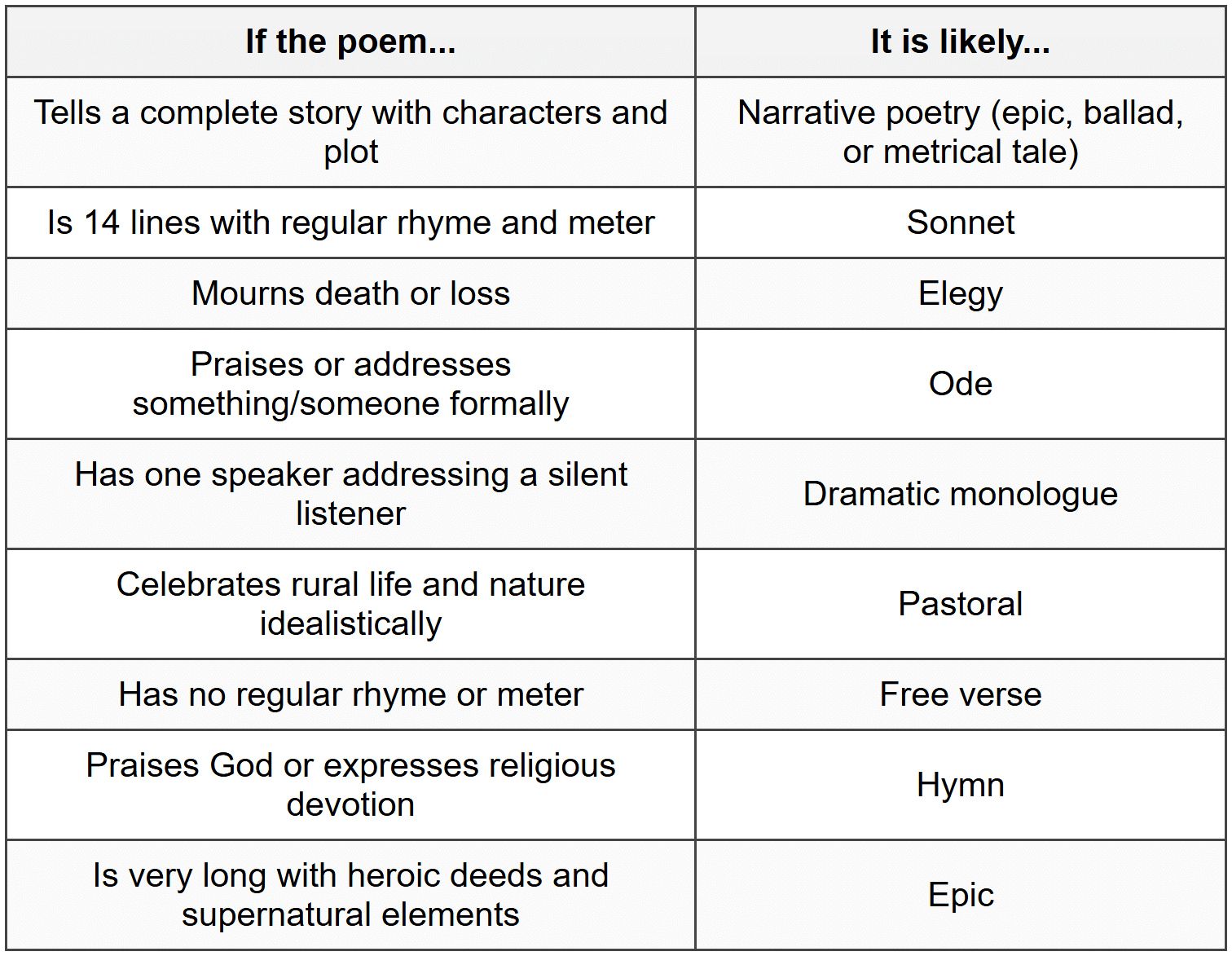
JAMB often gives you a poetry excerpt and asks you to identify its type. Here's how to distinguish quickly:
Rules and Key Points for JAMB Success
Rule 1: Count Lines for Sonnets
If a poem has exactly 14 lines and follows a rhyme scheme, it is almost certainly a sonnet. Check the rhyme scheme to determine if it's Shakespearean (ABAB CDCD EFEF GG) or Petrarchan (ABBAABBA + sestet).
Rule 2: Look for Story Elements in Narrative Poetry
Narrative poems have characters, setting, conflict, and resolution. If the poem tells what happened to someone, it's narrative. If it expresses how someone feels, it's lyric.
Rule 3: Identify the Speaker's Audience in Dramatic Poetry
In dramatic monologue, the speaker addresses a specific person who is present but silent. In soliloquy, the speaker is alone. This distinction is crucial.
Rule 4: Theme Helps Identify Type
- Death/mourning → Elegy
- Praise/celebration → Ode
- Rural/nature idealization → Pastoral
- Religious worship → Hymn
Rule 5: Form vs. Content
JAMB may test whether you understand that form (structure) and content (subject matter) are different. A sonnet is defined by its 14-line structure, not its subject. You can write a sonnet about anything-love, war, food-it remains a sonnet as long as it has 14 lines and follows the structural rules.
Worked Examples
Q1: A poem of 14 lines written in iambic pentameter with the rhyme scheme ABAB CDCD EFEF GG is called a:
(a) Petrarchan sonnet
(b) Spenserian sonnet
(c) Shakespearean sonnet
(d) Free verse
Ans: (c) Shakespearean sonnet
Explanation: The rhyme scheme ABAB CDCD EFEF GG is the defining structure of a Shakespearean sonnet. It consists of three quatrains (four-line stanzas) and a final rhyming couplet. The Petrarchan sonnet uses ABBAABBA for the octave, and Spenserian uses interlocking rhymes (ABAB BCBC CDCD EE). Free verse has no fixed rhyme scheme.
Q2: "The poem mourns the death of a young shepherd and reflects on the fleeting nature of life." This description best fits which type of poetry?
(a) Ode
(b) Elegy
(c) Pastoral
(d) Hymn
Ans: (b) Elegy
Explanation: The key phrase is "mourns the death". An elegy is a poem that laments death or serious loss and reflects on mortality. Although the subject is a shepherd (which might suggest pastoral), the dominant theme is mourning, which makes it an elegy. Pastoral poems celebrate rural life without the somber focus on death. Odes praise their subjects, and hymns are religious.
Q3: In a poem, a duke speaks to an emissary about his late wife, revealing his jealousy and pride through his words. The emissary does not respond. This is an example of:
(a) Soliloquy
(b) Dramatic monologue
(c) Ballad
(d) Epic
Ans: (b) Dramatic monologue
Explanation: This describes a dramatic monologue. The duke is speaking to a silent listener (the emissary), and through his speech, we learn about his character-his jealousy and pride. In a soliloquy, the speaker would be alone. A ballad is a narrative poem, and an epic is a long heroic narrative. The key here is the presence of a silent listener and character revelation.
Quick Summary
- Narrative poetry tells a story: epic, ballad, metrical tale
- Lyric poetry expresses personal emotion: sonnet, ode, elegy, pastoral, hymn, free verse
- Dramatic poetry presents characters speaking: dramatic monologue, soliloquy
- Sonnet = 14 lines, specific rhyme scheme
- Elegy = mourns death or loss
- Ode = formal praise of a subject
- Pastoral = idealizes rural life
- Hymn = religious worship poem
- Epic = long narrative with heroic deeds
- Ballad = short narrative, simple language, often tragic
- Dramatic monologue = one speaker, silent listener present
- Soliloquy = one speaker, alone, speaking thoughts aloud
- Free verse = no regular rhyme or meter
- Identify poetry type by checking: length, rhyme scheme, subject matter, speaker's situation
- Form (structure) and content (subject) are different-know both
Practice Questions
Q1: Which of the following is NOT a characteristic of an epic poem?
(a) Heroic protagonist with superhuman qualities
(b) Short length and simple language
(c) Elevated and formal language
(d) Involvement of supernatural beings
Q2: A poem that has no fixed rhyme scheme or regular meter is called:
(a) Sonnet
(b) Ballad
(c) Free verse
(d) Ode
Q3: "O Wild West Wind, thou breath of Autumn's being..." This line, addressing the wind directly and praising its power, is from what type of poem?
(a) Elegy
(b) Pastoral
(c) Ode
(d) Hymn
Q4: The octave and sestet structure is characteristic of which type of sonnet?
(a) Shakespearean sonnet
(b) Petrarchan sonnet
(c) Spenserian sonnet
(d) Free verse sonnet
Q5: A poem that tells the tragic story of a knight's love in simple, song-like stanzas with a refrain is most likely a:
(a) Metrical tale
(b) Epic
(c) Ballad
(d) Dramatic monologue
Q6: Which type of poem would most likely begin with a character alone on stage, revealing their inner conflict about a difficult decision?
(a) Soliloquy
(b) Dramatic monologue
(c) Pastoral
(d) Elegy
Answer Key and Explanations
Q1: (b) Short length and simple language
Epics are characterized by their great length, not short length. They use elevated, formal language, not simple language. All other options-heroic protagonist, elevated language, and supernatural involvement-are defining features of epic poetry.
Q2: (c) Free verse
Free verse is defined by the absence of regular rhyme scheme and meter. Sonnets have strict 14-line structures with specific rhyme schemes. Ballads have regular rhyme (often ABAB or ABCB). Odes have complex but structured stanza patterns.
Q3: (c) Ode
The line directly addresses the West Wind and expresses admiration for its power. This is characteristic of an ode, which formally praises or addresses a subject. Elegies mourn death, pastorals idealize rural life, and hymns are religious. The elevated language and direct address indicate an ode.
Q4: (b) Petrarchan sonnet
The Petrarchan (Italian) sonnet is divided into an octave (first 8 lines, rhyming ABBAABBA) and a sestet (final 6 lines, with varying rhyme schemes like CDECDE). Shakespearean sonnets use three quatrains and a couplet. Spenserian sonnets also use quatrains. There is no such thing as a "free verse sonnet"-sonnets by definition have structure.
Q5: (c) Ballad
The description matches a ballad: tells a story (narrative), tragic theme, simple language, song-like quality, and refrain (repeated lines). Metrical tales are longer and more complex. Epics are very long heroic narratives. Dramatic monologues involve a speaker addressing a listener, not telling a story in stanzas.
Q6: (a) Soliloquy
A soliloquy is when a character speaks alone, revealing inner thoughts, often about a conflict or decision. The key detail is "alone on stage." In a dramatic monologue, there would be a silent listener present. Pastorals deal with rural themes, and elegies mourn death-neither fits this scenario.



