Themes In African Poetry


African poetry carries the soul of a continent-its struggles, joys, histories, and hopes. In JAMB, questions on themes in African poetry test your ability to identify what the poet is saying beneath the surface: What ideas dominate the poem? What message is the poet passing across? This chapter will teach you to recognize, analyze, and explain the major themes that run through African poetry, giving you the tools to confidently tackle any poetry question that comes your way.
Key Concepts and Definitions
Before diving into specific themes, you need to understand what a theme is and how it differs from related concepts that JAMB often uses to confuse students.
What Is a Theme?
A theme is the central idea, message, or underlying meaning that runs through a literary work. It is what the poem is really about-not just the events or images described, but the deeper truth or observation the poet wants to communicate. Think of it as the backbone of the poem.
Example: A poem may describe a farmer working under the hot sun, but the theme could be about hardship and resilience, not just farming.
Theme vs Subject vs Tone
JAMB loves to test whether you can distinguish between these three concepts. The table below clarifies the differences:
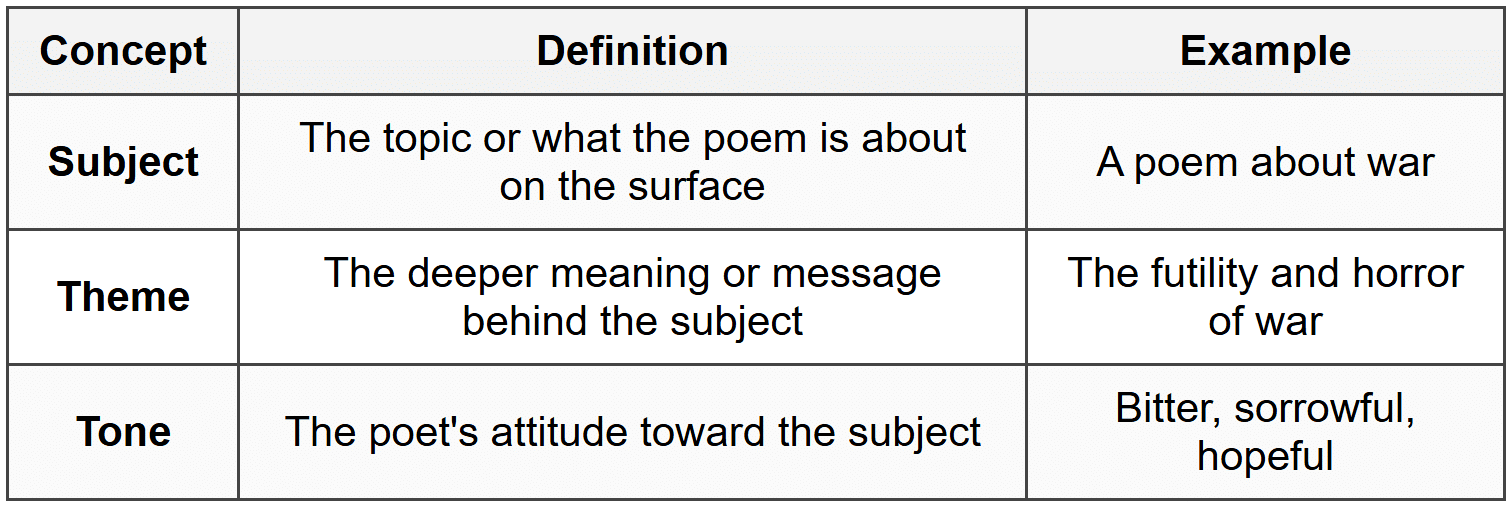
Remember: The subject is what you see on the surface. The theme is what the poet wants you to understand. The tone is how the poet feels about it.
Common Indicators of Theme
To identify the theme of a poem, look for these clues:
- Repetition: Words, phrases, or ideas repeated throughout the poem often point to the theme
- Imagery and symbols: Recurring images often represent larger ideas
- Title: The title frequently hints at the central theme
- Concluding lines: The final stanza or lines often summarize the poet's message
- Emotional weight: Where does the poet invest the most emotion? That area often reveals the theme
Major Themes in African Poetry
African poetry reflects the diverse experiences, histories, and aspirations of African peoples. While individual poems are unique, certain themes recur frequently. Below are the most commonly tested themes in JAMB.
1. Colonialism and Oppression
This theme explores the experience of being colonized, dominated, and exploited by foreign powers. Poets express anger, pain, and resistance against colonial rule and its lasting effects.
Key Ideas:
- Loss of freedom and dignity
- Exploitation of African resources and labor
- Cultural imposition and erasure
- Resistance and the fight for independence
Example: A poem describing chains, whips, and masters likely deals with colonialism or slavery, emphasizing the dehumanization of Africans.
2. African Culture and Tradition
Many African poets celebrate indigenous customs, beliefs, festivals, and ways of life. This theme often includes nostalgia for pre-colonial times and a call to preserve African identity.
Key Ideas:
- Pride in African heritage
- Respect for elders and ancestors
- Traditional ceremonies, rituals, and festivals
- The wisdom embedded in African proverbs and folklore
Example: A poem that references masquerades, drumming, or ancestral spirits is likely celebrating African culture.
3. Conflict Between Tradition and Modernity
This theme captures the tension between old and new, African customs and Western influence. Poets explore how modernization, Christianity, and Western education have disrupted traditional life.
Key Ideas:
- Cultural confusion and identity crisis
- Loss of traditional values
- Clash between generations (elders vs youth)
- Attempts to balance both worlds
Example: A poem showing a young man torn between his father's traditional practices and Western education reflects this theme.
4. Nature and the Environment
African poets often draw from the natural world-rivers, forests, animals, seasons-to convey messages about life, society, or spirituality. Nature is both a subject and a symbol.
Key Ideas:
- The beauty and power of nature
- Harmony between humans and the environment
- Environmental destruction and its consequences
- Nature as a metaphor for human experiences
Example: A poem describing a dying river may symbolize the decay of society or the loss of purity.
5. Death and Mortality
Death is a universal human experience, and African poets explore it from cultural, spiritual, and emotional perspectives. Death may be mourned, celebrated, or seen as a transition.
Key Ideas:
- Grief and loss
- The inevitability of death
- Belief in the afterlife or ancestral spirits
- Death as a release from suffering
Example: A poem about a funeral rite or speaking to the dead likely deals with the theme of death and the spiritual realm.
6. War and Conflict
War-whether colonial, civil, or ethnic-has scarred African history. Poets depict the brutality, senselessness, and human cost of violence.
Key Ideas:
- The horrors of war
- Loss of innocent lives
- Destruction of communities
- Hope for peace and reconciliation
Example: A poem depicting burning villages, orphans, and bloodshed addresses the theme of war.
7. Love and Relationships
Love poems celebrate romantic attraction, affection, desire, and sometimes heartbreak. African love poetry may also reflect cultural practices around courtship and marriage.
Key Ideas:
- Romantic passion and desire
- Beauty and admiration
- Betrayal and heartbreak
- Marital bonds and family love
Example: A poem praising a woman's beauty or lamenting lost love centers on the theme of love.
8. Social Injustice and Corruption
Poets criticize unfair treatment, inequality, political corruption, and the abuse of power. This theme addresses contemporary issues in African societies.
Key Ideas:
- Poverty and suffering of the masses
- Greed and selfishness of leaders
- Injustice and inequality
- Call for change and accountability
Example: A poem showing politicians feasting while citizens starve deals with corruption and social injustice.
9. Identity and Self-Discovery
This theme explores questions of who we are, where we come from, and where we belong. It often involves a search for personal or cultural identity.
Key Ideas:
- Questioning one's place in the world
- Reclaiming lost heritage
- Struggles with self-worth and belonging
- Affirming African identity
Example: A poem in which the speaker asks "Who am I?" or reflects on their roots deals with identity.
10. Hope and Resilience
Despite hardship, many African poems express hope for a better future, celebrating the strength and endurance of the African spirit.
Key Ideas:
- Optimism despite suffering
- Strength in adversity
- Belief in renewal and rebirth
- Faith in the future
Example: A poem ending with dawn breaking or flowers blooming after a storm symbolizes hope and renewal.
How to Identify Theme in a Poem (Step-by-Step)
When faced with a poem in the exam, follow these steps to accurately identify its theme:
- Read the poem carefully: Read it at least twice. Let the words and images sink in.
- Identify the subject: What is the poem about on the surface? (e.g., a river, a mother, a war)
- Look for repeated words or images: What keeps showing up? These are clues.
- Consider the tone: Is the poet angry? Sad? Hopeful? Nostalgic? Tone often points to theme.
- Examine the conclusion: How does the poem end? The ending often reveals the message.
- Ask yourself: What is the poet really saying? What message or truth is being communicated?
- Match to known themes: Does it fit colonialism? Love? Death? Social injustice? Choose the best match.
Warning: Do not confuse theme with plot summary. Saying "the poem is about a farmer" is not identifying the theme. The theme is what the farmer's experience represents-perhaps hard work, poverty, or dignity in labor.
Common JAMB Tricks and How to Avoid Them
JAMB examiners know where students struggle. Here are common traps and how to avoid them:
Trick 1: Confusing Subject with Theme
JAMB will offer you the surface subject as an option. For example, if a poem is about a funeral, one option might be "the poem is about a funeral." That's the subject, not the theme. The theme would be "death and the afterlife" or "grief and mourning."
Trick 2: Choosing Based on a Single Line
Don't pick a theme just because one or two lines mention it. The theme must run throughout the entire poem, not just appear once.
Trick 3: Picking the Most Dramatic Option
JAMB may offer a dramatic-sounding theme that isn't actually in the poem. Read carefully and stick to what the text actually supports.
Trick 4: Overlooking Subtle Themes
Sometimes the theme is not stated outright but implied through symbols and imagery. Train yourself to read between the lines.
Worked Examples
Q1: Read the excerpt below and answer the question.
"They came with bibles in one hand and guns in the other,
Preaching salvation while they looted our gold,
Teaching us love while they broke our bones."
What is the dominant theme of this excerpt?
(a) Religion and faith
(b) Violence and war
(c) Colonialism and hypocrisy
(d) Education and enlightenment
Ans: (c)
The excerpt criticizes colonizers who used religion (bibles) as a cover for exploitation and violence (guns, looting, breaking bones). The contrast between what they preached and what they did reveals the theme of colonialism and hypocrisy. Option (a) is too narrow-religion is mentioned but not the main focus. Option (b) misses the hypocrisy element. Option (d) is not supported at all.
Q2: Read the excerpt below and answer the question.
"My grandmother's voice echoes in the village square,
Her stories woven into the drums and moonlight,
But my children speak only the tongue of strangers."
What theme is explored in this excerpt?
(a) Death and remembrance
(b) Conflict between tradition and modernity
(c) The beauty of African culture
(d) Family love and unity
Ans: (b)
The excerpt contrasts the grandmother's traditional stories and cultural practices (drums, moonlight, her voice) with the children's adoption of foreign language ("tongue of strangers"). This signals a loss of cultural continuity, which is central to the theme of conflict between tradition and modernity. Option (a) is incorrect because no one has died. Option (c) only captures one side. Option (d) ignores the cultural tension.
Q3: Read the excerpt below and answer the question.
"Though the storm has torn our roofs and scattered our seeds,
We plant again when morning comes,
For the earth remembers those who never surrender."
What is the theme of this excerpt?
(a) The destructive power of nature
(b) Hope and resilience
(c) Agricultural practices
(d) Suffering and despair
Ans: (b)
Despite destruction (storm, torn roofs, scattered seeds), the speaker emphasizes renewal and determination ("we plant again," "never surrender"). This reflects the theme of hope and resilience. Option (a) is only part of the context, not the message. Option (c) is the subject, not the theme. Option (d) contradicts the hopeful tone.
Quick Summary
- Theme is the central message or underlying meaning of a poem, not just what happens on the surface.
- Subject is the topic; theme is the deeper truth; tone is the poet's attitude.
- Major themes in African poetry include: colonialism, culture and tradition, tradition vs modernity, nature, death, war, love, social injustice, identity, and hope.
- To identify theme, read carefully, look for repetition, consider tone, examine the conclusion, and ask what the poet is really saying.
- Avoid confusing subject with theme; don't choose based on one line; be wary of dramatic but unsupported options.
- Themes are often conveyed through symbols, imagery, and emotional weight, not just direct statements.
- JAMB tests your ability to see beyond the literal and grasp the poet's message.
Practice Questions
Q1: Which of the following best defines the term "theme" in poetry?
(a) The rhyme scheme of the poem
(b) The central message or underlying meaning
(c) The historical background of the poem
(d) The use of figurative language
Q2: A poem that describes the suffering of villagers under a corrupt government most likely explores the theme of:
(a) Love and affection
(b) Social injustice and corruption
(c) Nature and the environment
(d) Death and mortality
Q3: Read the line: "Our fathers danced to the drumbeat; we dance to the radio." This line suggests a theme of:
(a) Music and entertainment
(b) Conflict between tradition and modernity
(c) Celebration and joy
(d) Family relationships
Q4: A poem that repeatedly mentions broken chains, rising suns, and freedom songs is most likely centered on the theme of:
(a) Love and romance
(b) War and destruction
(c) Liberation and resistance
(d) Death and grief
Q5: Which of the following is NOT a reliable indicator of a poem's theme?
(a) Repetition of certain words or images
(b) The poet's tone and attitude
(c) The length of the poem
(d) The concluding lines of the poem
Q6: A poet writes about a river that once flowed clear but is now choked with waste and filth. The most likely theme is:
(a) The beauty of nature
(b) Environmental destruction
(c) The passage of time
(d) The power of water
Answer Key
Q1: (b)
Theme refers to the central message or underlying meaning of a literary work, not its structure or language techniques. Options (a), (c), and (d) describe other aspects of poetry but not theme itself.
Q2: (b)
A poem depicting the suffering of villagers under a corrupt government directly addresses social injustice and corruption. The other options do not fit the context of governmental abuse and suffering.
Q3: (b)
The contrast between fathers dancing to drums (traditional) and the current generation dancing to radio (modern) highlights the conflict between tradition and modernity. Option (a) is the subject, not the theme. Options (c) and (d) miss the cultural tension.
Q4: (c)
Broken chains, rising suns, and freedom songs are powerful symbols of liberation and resistance against oppression. These images do not fit the themes in the other options.
Q5: (c)
The length of a poem has no bearing on its theme. Theme is revealed through content, not structure. Repetition, tone, and concluding lines are all reliable indicators of theme.
Q6: (b)
A once-clear river now choked with waste symbolizes environmental destruction. Option (a) contradicts the pollution described. Option (c) is too vague. Option (d) does not address the pollution issue.
