Plot Structure


When you read a story or watch a film, you experience different stages-from the beginning where characters are introduced, through rising tension and conflict, to the climax and resolution. This is what we call plot structure, and understanding it is essential for JAMB Literature passages and prose comprehension questions. JAMB frequently tests your ability to identify which part of the plot a passage belongs to, recognize conflict types, and understand how events connect. In this chapter, you'll master the five main stages of plot, learn to identify them in any narrative, and practice answering JAMB-style questions with confidence.
Key Concepts and Definitions
What is Plot?
Plot refers to the sequence of events that make up a story. It is not just "what happens" but how those events are arranged to create meaning, suspense, and emotional impact. Plot is the backbone of every narrative-whether it's a novel, short story, play, or even a film.
The plot answers these questions:
- What happens in the story?
- In what order do events occur?
- How are the events connected?
- What is the cause and effect relationship between events?
What is Plot Structure?
Plot structure is the framework that organizes the events of a story into distinct stages. The most widely recognized model is the five-part plot structure, also called Freytag's Pyramid, named after German playwright Gustav Freytag. This structure divides a story into five key stages:
- Exposition
- Rising Action
- Climax
- Falling Action
- Resolution (or Denouement)
JAMB often asks you to identify which stage a given passage belongs to, or to recognize the function of a particular event in the overall plot.
---The Five Stages of Plot Structure
1. Exposition
The exposition is the opening part of the story. This is where the author introduces:
- The main characters
- The setting (time and place)
- The background information needed to understand the story
- The initial situation or status quo
The exposition sets the stage for everything that follows. It answers the basic questions: Who? Where? When? What is the situation?
Example: In a story about a young boy named Emeka who lives in a small village in Enugu, the exposition might describe his daily life, his family, the village environment, and perhaps hint at his dreams of going to university.
2. Rising Action
The rising action consists of a series of events that build tension and develop the conflict. This is usually the longest part of the story. During rising action:
- Complications arise
- Conflicts develop and intensify
- Characters face obstacles
- Suspense builds toward the climax
Each event in the rising action should increase tension and move the story toward its peak moment.
Example: Continuing with Emeka's story, the rising action might include: his father losing his job, Emeka struggling to pay school fees, meeting a mentor who offers help but with conditions, facing a difficult exam, and dealing with family pressure to abandon his education.
3. Climax
The climax is the turning point of the story-the moment of greatest tension or the most important decision. This is where:
- The main conflict reaches its peak
- The protagonist faces the biggest challenge
- A critical decision is made
- The outcome of the story becomes clear
The climax is often the most dramatic and emotional part of the story. Everything before it builds toward this moment, and everything after it flows from it.
Example: Emeka's climax might be the moment he must choose between accepting a bribe to pass his JAMB exam (which would solve his immediate problems) or maintaining his integrity and facing potential failure.
4. Falling Action
The falling action includes the events that occur after the climax. During this stage:
- Tension begins to decrease
- The consequences of the climax unfold
- Loose ends start to be tied up
- The story moves toward closure
The falling action is typically shorter than the rising action, as the story is winding down.
Example: After Emeka refuses the bribe, the falling action might show him studying harder, receiving unexpected help from his community, taking the exam honestly, and waiting for results.
5. Resolution (Denouement)
The resolution, also called the denouement (from French, meaning "untying"), is the final stage where:
- All conflicts are resolved
- Questions are answered
- The new normal is established
- The story comes to a close
The resolution shows the outcome of the story and often reveals what happens to the characters afterward.
Example: Emeka's resolution might show him receiving excellent JAMB results, gaining admission to university, and his family celebrating his success-demonstrating that integrity pays off.
---Understanding Conflict in Plot Structure
Every plot is driven by conflict-a struggle between opposing forces. Without conflict, there is no story. JAMB often tests your ability to identify the type of conflict in a passage.
Types of Conflict
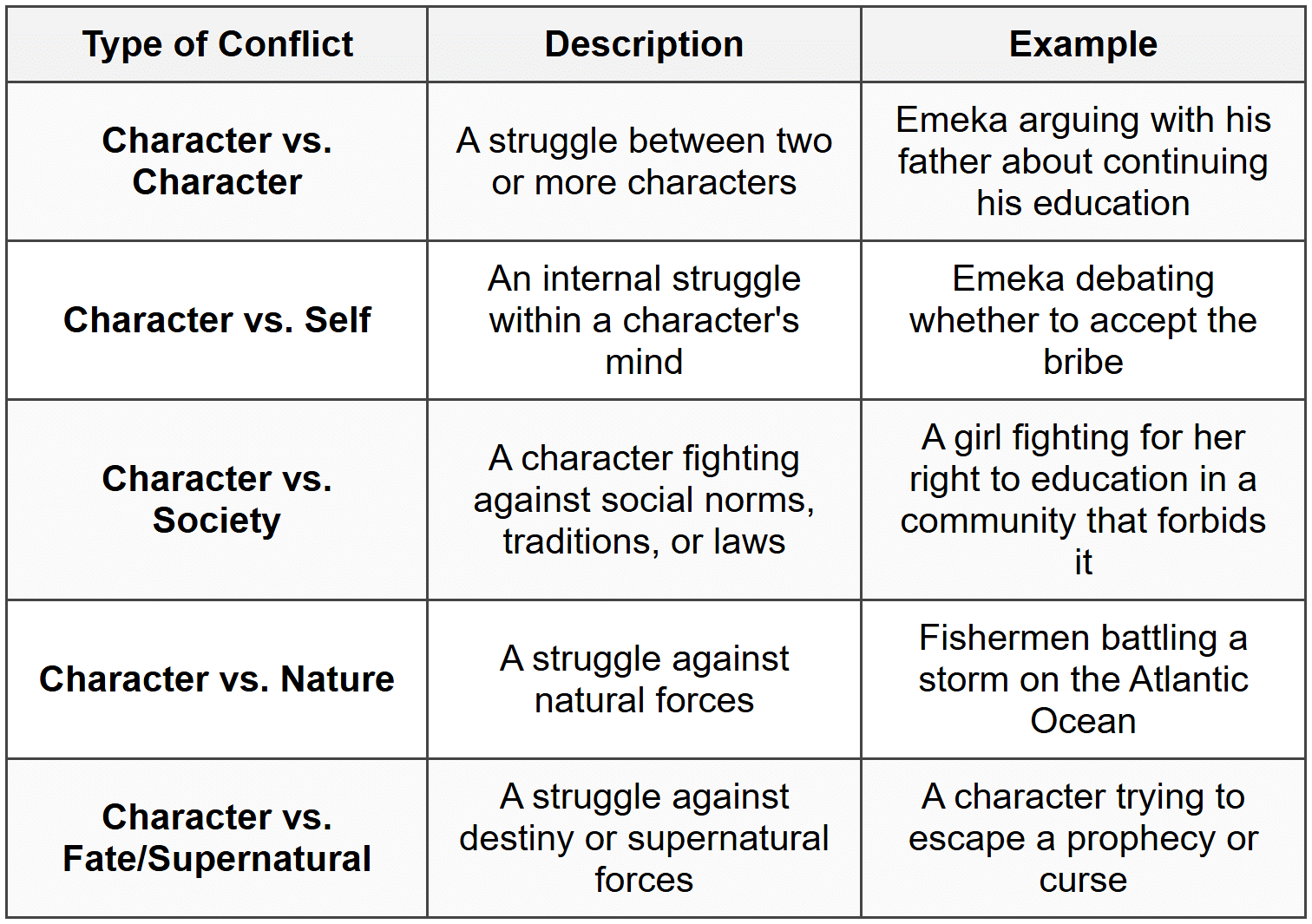
In JAMB questions, you might be asked to identify which type of conflict drives a particular passage or to explain how conflict develops through the plot stages.
---How JAMB Tests Plot Structure
Understanding how JAMB frames questions about plot structure will help you answer them accurately. Here are common question patterns:
Pattern 1: Identifying the Stage
You'll be given a passage and asked which stage of plot structure it represents.
Example: "The passage above can best be described as the..."
(a) exposition
(b) rising action
(c) climax
(d) resolution
Pattern 2: Recognizing Conflict Type
You'll identify what kind of conflict is present in the passage.
Example: "The main conflict in this passage is..."
(a) character vs. character
(b) character vs. self
(c) character vs. society
(d) character vs. nature
Pattern 3: Understanding Function of Events
You'll be asked about the role a specific event plays in the overall plot.
Example: "The event described in lines 10-12 serves to..."
(a) introduce the main character
(b) intensify the conflict
(c) resolve the story
(d) provide background information
Pattern 4: Predicting Plot Development
Based on a passage, you might be asked what is likely to happen next.
Example: "From the passage, what is likely to follow?"
(a) The conflict will be resolved
(b) Tension will continue to build
(c) A new character will be introduced
(d) The story will end
Key Differences That JAMB Tests
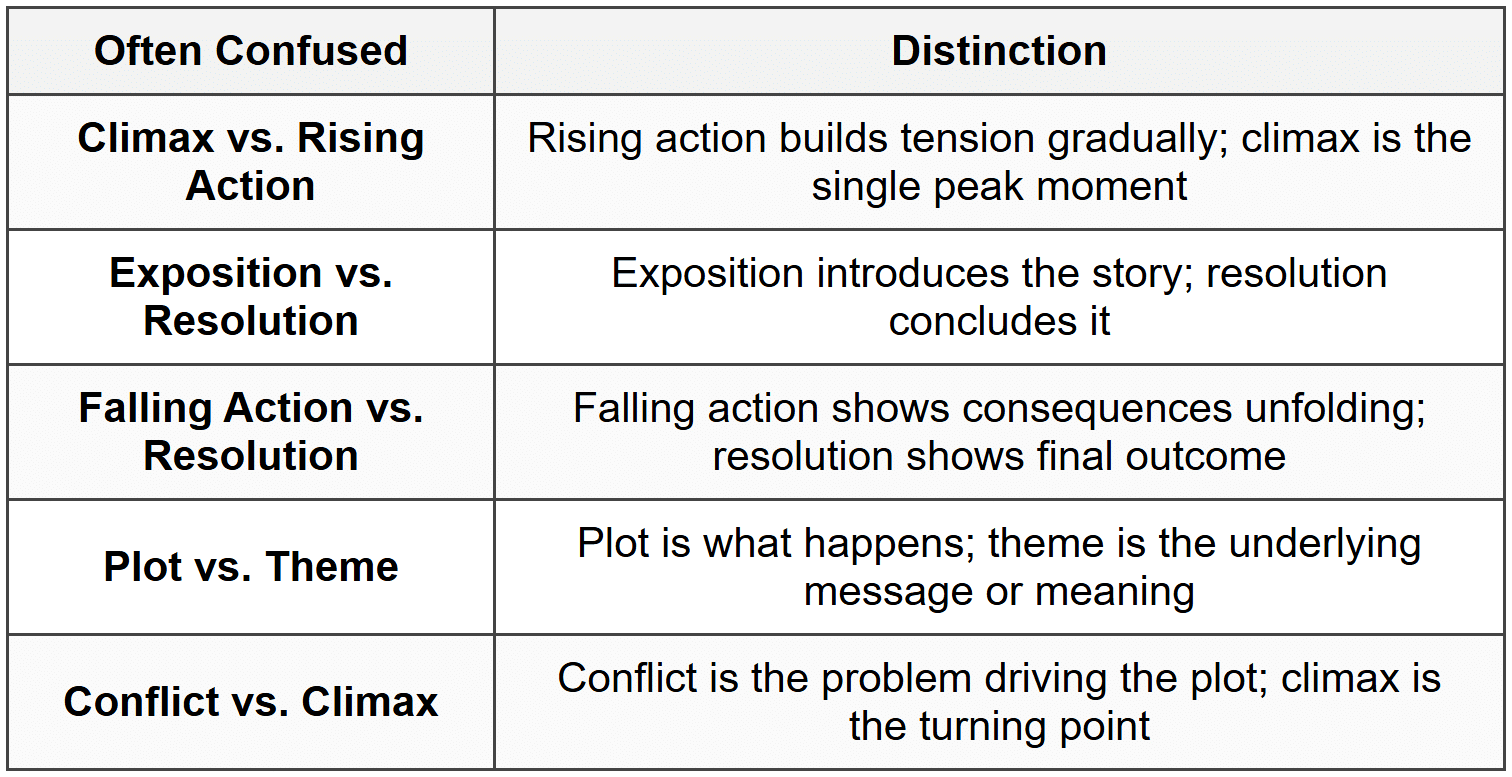 ---
---Worked Examples
Q1: Read the following passage:
"Ada woke up to the sound of her mother's voice calling her name. She stretched lazily and looked around her small room in their compound in Calabar. Today was the first day of her final year in secondary school, and she felt both excited and nervous. Her mother had already prepared breakfast, and the aroma of fried plantain filled the air."
This passage represents which stage of plot structure?
(a) Rising action
(b) Climax
(c) Exposition
(d) Falling action
Ans: (c)
Explanation: This passage is clearly the exposition. It introduces the main character (Ada), establishes the setting (her room in a compound in Calabar), and provides background information (first day of final year in secondary school). There is no conflict yet, no building tension-just scene-setting and character introduction, which are hallmarks of exposition.
Q2: Read the following passage:
"Chidi stood at the edge of the examination hall, his heart pounding. In his pocket was the piece of paper with all the answers his friend had given him. If he used it, he would surely pass and make his sick father proud. But if he was caught, everything would be over. The invigilator called his name. He had to decide now."
This passage can best be described as the:
(a) Exposition
(b) Rising action
(c) Climax
(d) Resolution
Ans: (c)
Explanation: This is the climax-the moment of greatest tension and the critical turning point. Chidi must make a life-changing decision right now. Everything in the story has built to this moment of choice, and his decision will determine the outcome. The phrases "he had to decide now" and the intense emotional description signal that this is the peak moment of the plot.
Q3: Read the following passage:
"Ngozi refused to marry the man her parents had chosen for her, even though the entire village condemned her decision. She packed her belongings and left for Lagos, determined to pursue her education and choose her own path. Her family disowned her, but she remained resolute."
What type of conflict is primarily illustrated in this passage?
(a) Character vs. character
(b) Character vs. self
(c) Character vs. society
(d) Character vs. nature
Ans: (c)
Explanation: This passage illustrates character vs. society conflict. Ngozi is fighting against social norms and traditions (arranged marriage, family authority, village expectations). While there may be elements of character vs. character (conflict with her parents), the broader conflict is with the entire social system-"the entire village condemned her decision" and she is fighting for her right to choose her own path against societal expectations.
Quick Summary
- Plot is the sequence of events in a story, organized to create meaning and emotional impact
- Plot structure divides a story into five stages: exposition, rising action, climax, falling action, and resolution
- Exposition introduces characters, setting, and background information
- Rising action builds tension through complications and obstacles
- Climax is the turning point-the moment of greatest tension or the critical decision
- Falling action shows the consequences of the climax as tension decreases
- Resolution ties up loose ends and shows the final outcome
- Conflict drives every plot-it can be character vs. character, self, society, nature, or fate
- JAMB tests your ability to identify plot stages, recognize conflict types, and understand how events function in the overall structure
- The climax is a single peak moment, while rising action is a series of events building toward it
- Exposition begins the story; resolution ends it
- Look for keywords: character introductions and setting descriptions signal exposition; decision moments and peak tension signal climax
Practice Questions
Q1: "The old fisherman had lived by the river all his life. Every morning, he would take his canoe out before sunrise, casting his nets in the same spots his father had taught him. His three sons had all moved to the city, leaving him alone with his memories and his work."
This passage is an example of:
(a) Rising action
(b) Exposition
(c) Climax
(d) Falling action
Q2: "After months of hiding, Amina finally confronted her uncle who had stolen her inheritance. She presented the documents to the village council, her hands shaking but her voice steady. The entire community watched in silence as the truth was revealed. Her uncle's face turned pale-he had been exposed."
The function of this passage in the plot is to:
(a) Introduce the setting
(b) Build suspense
(c) Present the climax
(d) Conclude the story
Q3: "Tunde struggled with himself all night. Part of him wanted to report what he had seen-the principal taking money from the school fund. But another part feared the consequences. He was just a teacher; who would believe him? What if he lost his job? His family depended on him."
What type of conflict is illustrated here?
(a) Character vs. character
(b) Character vs. self
(c) Character vs. society
(d) Character vs. nature
Q4: "The rain had been falling for three days without stopping. The river had swollen beyond its banks, flooding homes and destroying farmland. The villagers worked frantically to build sandbag barriers, but the water kept rising. Women carried children to higher ground while men tried to save what they could."
This passage illustrates which type of conflict?
(a) Character vs. character
(b) Character vs. self
(c) Character vs. society
(d) Character vs. nature
Q5: "After the trial ended and justice was served, Obi returned to his village a free man. The people who had once doubted him now welcomed him with celebration. He rebuilt his house, married the woman who had waited for him, and slowly, life returned to normal. The scars remained, but so did his triumph."
This passage represents which stage of plot structure?
(a) Exposition
(b) Rising action
(c) Climax
(d) Resolution
Q6: "Every day brought a new challenge for Fatima. First, her scholarship was cancelled due to an administrative error. Then her roommate betrayed her confidence to their professor. Her parents called to say they could no longer support her financially. Each obstacle seemed designed to force her to quit university, but she refused to give up."
This passage best represents:
(a) Exposition
(b) Rising action
(c) Climax
(d) Falling action
Answer Key and Explanations
Q1 Answer: (b) Exposition
This passage introduces the character (the old fisherman), establishes the setting (by the river), and provides background information (his routine, his sons moving away). There is no conflict or tension yet-just scene-setting, which is characteristic of exposition.
Q2 Answer: (c) Present the climax
This is clearly the climactic moment of the story. Amina confronts her uncle in the most dramatic scene-the moment of truth revelation. The phrases "entire community watched in silence" and "he had been exposed" indicate this is the peak moment of tension, the turning point where the main conflict reaches its resolution point.
Q3 Answer: (b) Character vs. self
Tunde's struggle is entirely internal-he is fighting with himself about what to do. The passage describes his inner debate: "Part of him wanted... But another part feared." This internal moral struggle is the defining characteristic of character vs. self conflict.
Q4 Answer: (d) Character vs. nature
The villagers are struggling against a natural force-the flooding river. They are fighting the rain and rising water to save their homes and lives. This is a clear example of character vs. nature conflict, where human beings battle against environmental or natural forces.
Q5 Answer: (d) Resolution
This passage shows the final outcome after all conflicts have been resolved. Obi returns home, is welcomed, rebuilds his life, and finds peace. The phrases "justice was served," "life returned to normal," and "his triumph" all indicate that the story has reached its conclusion-the resolution stage.
Q6 Answer: (b) Rising action
This passage describes a series of complications and obstacles that build upon each other: scholarship cancelled, betrayal, loss of financial support. Each event increases tension and difficulty. The phrase "each obstacle seemed designed to force her to quit" shows mounting pressure, which is the hallmark of rising action. There is no single peak moment (which would be climax), just escalating challenges.
