Types Of Drama


Drama is one of the most exciting components of literature you'll encounter in JAMB English Language. Understanding the different types of drama helps you analyze plays correctly, identify their features, and answer questions about dramatic works with confidence. In this chapter, you'll learn about the major classifications of drama, their unique characteristics, and how to distinguish one type from another-skills that JAMB tests regularly through comprehension passages and literary appreciation questions.
Key Concepts and Definitions
What is Drama?
Drama is a form of literature written to be performed by actors before an audience. It presents a story through dialogue and action rather than narration. Unlike prose or poetry that you read silently, drama comes alive through performance on stage, screen, or radio.
The key elements that make drama unique include:
- Dialogue: Conversations between characters that reveal the story
- Action: Physical movements and events that happen on stage
- Conflict: The central problem or struggle that drives the plot
- Performance: Drama is meant to be acted, not just read
- Audience: Drama requires viewers or listeners to be complete
Major Classifications of Drama
Drama can be classified in several ways, but JAMB focuses primarily on classification by content and emotional effect. The main types you must know are:
- Tragedy
- Comedy
- Tragicomedy
- Melodrama
- Farce
Tragedy
Definition and Characteristics
Tragedy is a serious drama that presents the downfall of a dignified, heroic character. The protagonist, called the tragic hero, moves from happiness to misery, often ending in death or complete destruction.
Key features of tragedy:
- Tragic hero: A noble, admirable character with high social status (king, prince, general, respected leader)
- Tragic flaw (hamartia): A weakness in the hero's character that leads to their downfall. This could be excessive pride, ambition, jealousy, or poor judgment
- Reversal of fortune: The hero experiences a dramatic change from good fortune to suffering
- Catharsis: The audience feels pity and fear, then emotional release or cleansing
- Serious tone: The play maintains dignity and gravity throughout
- Unhappy ending: The protagonist dies or suffers irreversible loss
- Inevitability: Events seem fated or unavoidable despite the hero's efforts
Examples and Application
Classic examples include Shakespeare's Othello, Macbeth, and King Lear. In Macbeth, the hero's ambition (tragic flaw) drives him to murder King Duncan. This action sets off a chain of events leading to his death. Macbeth begins as a respected general but ends as a hated tyrant killed in battle.
Nigerian examples include Ola Rotimi's The Gods Are Not to Blame, which adapts the Oedipus story to Yoruba culture. Odewale's pride and quick temper (tragic flaws) lead him unknowingly to kill his father and marry his mother, resulting in his ultimate disgrace.
Common JAMB Testing Points
JAMB often tests your ability to:
- Identify the tragic flaw in a given excerpt
- Recognize characteristics that make a hero "tragic"
- Distinguish tragedy from other serious forms like melodrama
- Understand the purpose of catharsis in tragedy
Comedy
Definition and Characteristics
Comedy is drama designed primarily to amuse and entertain the audience. It presents life's lighter side, often mocking human follies and weaknesses. Comedies typically end happily with problems resolved and relationships restored.
Key features of comedy:
- Humorous situations: Funny circumstances created through misunderstanding, mistaken identity, or absurd behavior
- Ordinary characters: Protagonists are usually common people, not noble heroes
- Happy ending: Conflicts resolve favorably; marriages often conclude the play
- Light tone: Even when addressing serious issues, the treatment remains playful
- Satire and ridicule: Comedy often criticizes social vices through mockery
- Verbal wit: Clever wordplay, puns, and humorous dialogue
- Physical humor: Slapstick actions, exaggerated movements, comic gestures
Types of Comedy
JAMB may require you to recognize these sub-types:
- Romantic comedy: Focuses on love relationships with obstacles overcome for a happy union
- Comedy of manners: Satirizes the behavior and customs of a particular social class, often the wealthy or sophisticated
- Satirical comedy: Uses humor to criticize social, political, or moral issues
- Sentimental comedy: Evokes tender emotions and emphasizes virtue rewarded
Examples and Application
Shakespeare's A Midsummer Night's Dream and Twelfth Night are classic comedies featuring mistaken identities, romantic confusion, and happy resolutions.
In Nigerian literature, Wole Soyinka's The Lion and the Jewel is a comedy that satirizes the clash between traditional and modern values. Lakunle's pretentious Western education and Baroka's cunning traditionalism create humorous situations, ending with Sidi's marriage to Baroka.
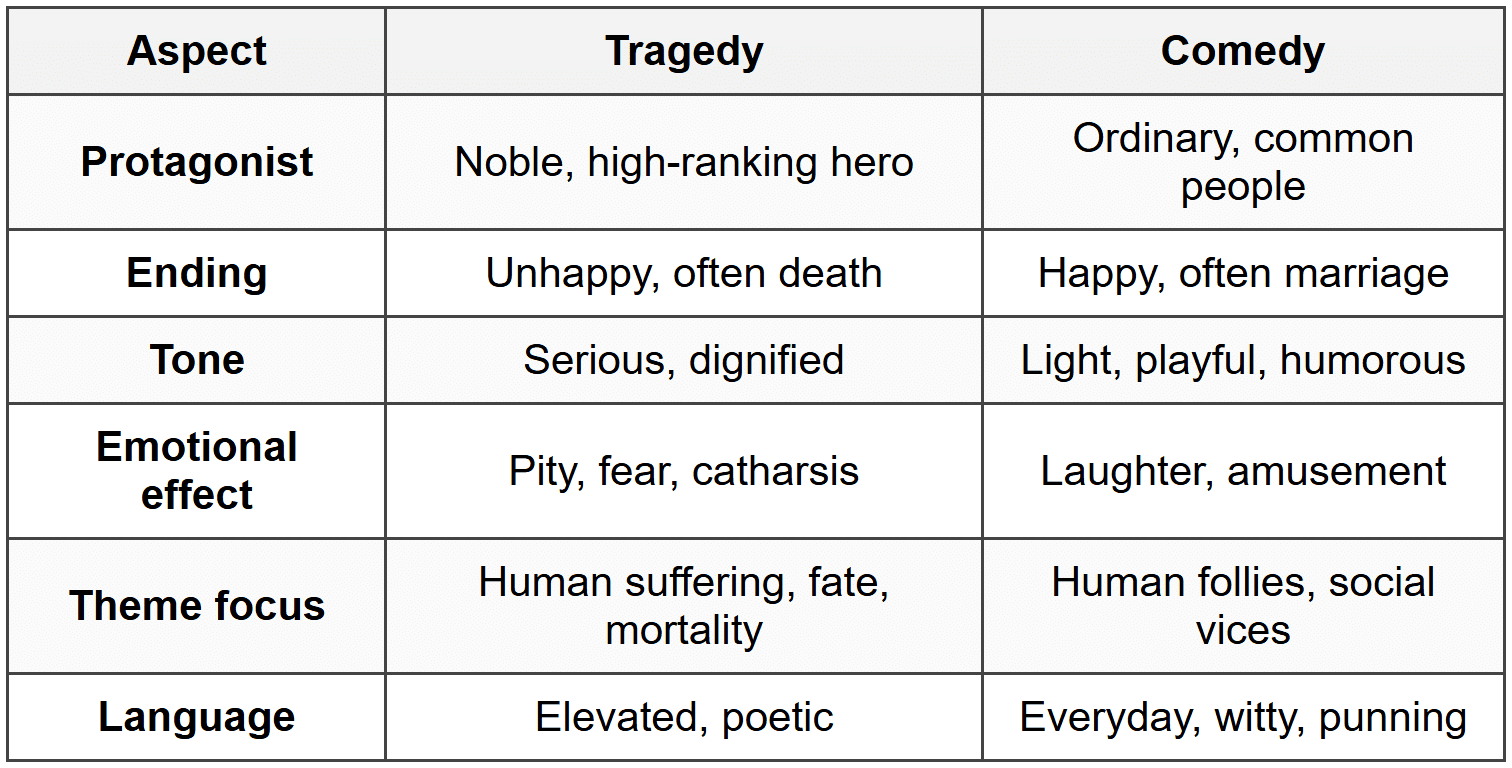
Tragedy vs Comedy: Key Differences
Tragicomedy
Definition and Characteristics
Tragicomedy blends elements of both tragedy and comedy in a single play. It contains serious, potentially tragic situations but avoids the catastrophic ending typical of pure tragedy. The play may begin like a tragedy but ends happily like a comedy.
Key features of tragicomedy:
- Mixed tone: Alternates between serious and humorous scenes
- Potentially tragic events: Situations that could lead to disaster but don't
- Last-minute rescue: Characters escape death or ruin through unexpected intervention
- Complex mood: Audience experiences both anxiety and relief, sorrow and joy
- Diverse characters: Includes both noble and common characters
- Happy or bittersweet ending: Problems resolve positively, though some sadness may remain
Examples and Application
Shakespeare's The Merchant of Venice is a classic tragicomedy. Shylock's demand for Antonio's flesh creates tragic tension, but clever intervention saves Antonio. The play includes both the serious courtroom drama and the comic romance plots.
The Winter's Tale, also by Shakespeare, begins with jealousy and apparent death but ends with miraculous reunion and forgiveness.
How JAMB Tests Tragicomedy
Questions often ask you to:
- Identify passages that mix tragic and comic elements
- Recognize why a play cannot be classified as pure tragedy or pure comedy
- Understand how tragicomedy differs from melodrama (which we'll discuss next)
Melodrama
Definition and Characteristics
Melodrama is a sensational drama that emphasizes plot and physical action over character development. It features exaggerated emotions, stereotyped characters, and clear distinctions between good and evil. The term comes from "melos" (music) because early melodramas used background music to heighten emotional impact.
Key features of melodrama:
- Exaggerated emotions: Characters display extreme feelings-intense love, hatred, fear, or despair
- Stereotyped characters: Clear heroes (completely good) and villains (completely evil) with little complexity
- Sensational plot: Exciting events like kidnappings, murders, rescues, narrow escapes
- Poetic justice: Virtue is always rewarded; vice is always punished
- Suspense and surprise: Unexpected twists keep the audience anxious
- Happy ending: Good triumphs over evil; heroes are saved
- Appeal to emotions: Aims to make the audience feel strongly rather than think deeply
Examples and Application
Many Nollywood films follow melodramatic patterns: the suffering widow, the wicked stepmother, the innocent child in danger, the last-minute rescue. These stories prioritize emotional impact and exciting action over psychological realism.
Classic stage melodramas include stories where the helpless heroine is threatened by a villain but saved by a brave hero just in time.
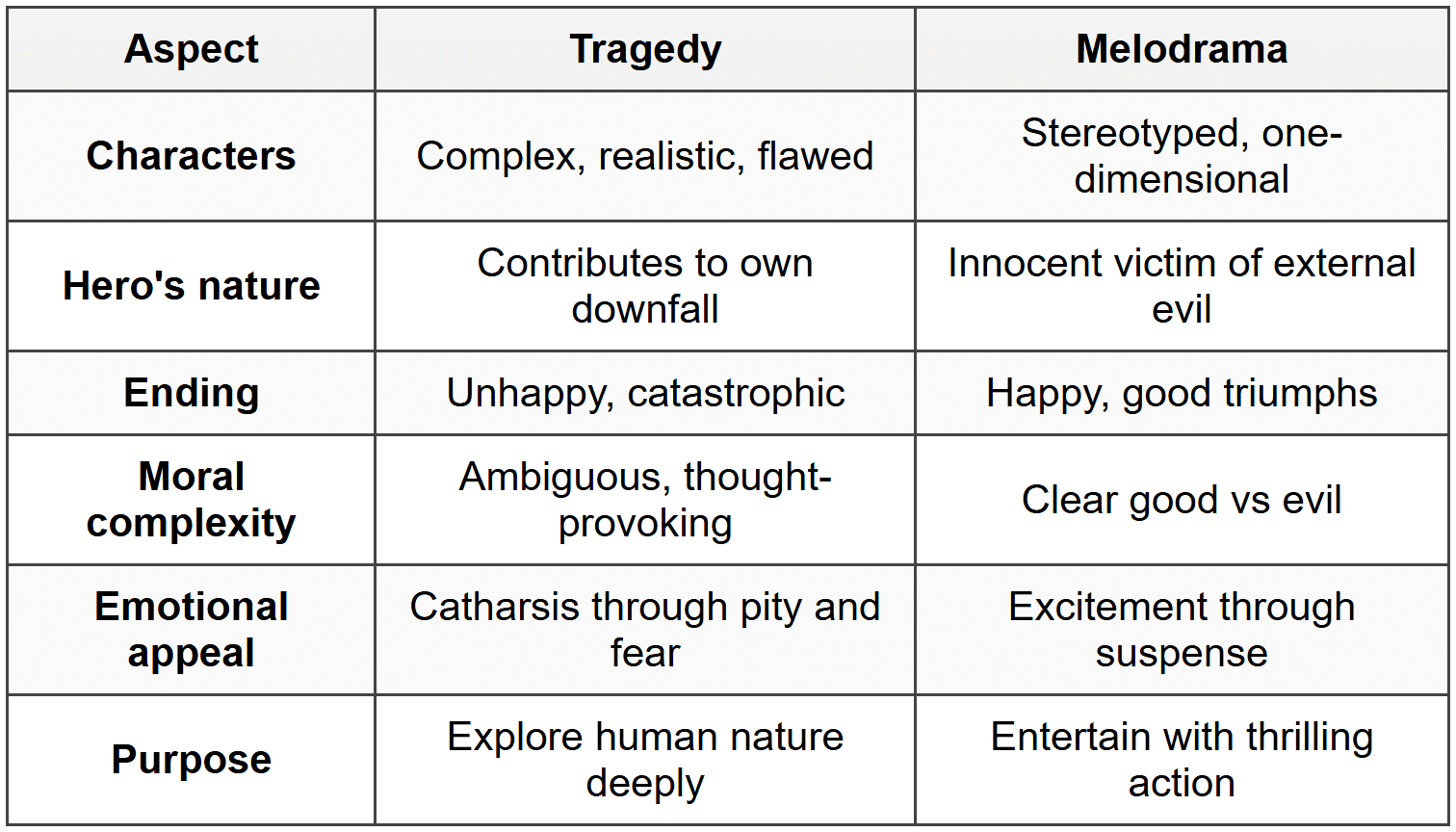
Melodrama vs Tragedy: Critical Distinctions
Farce
Definition and Characteristics
Farce is a type of comedy that uses exaggerated, improbable situations and physical humor to provoke laughter. It prioritizes ridiculous situations over realistic character development or meaningful themes. The word "farce" originally meant "stuffing," suggesting something light that fills space.
Key features of farce:
- Physical comedy: Pratfalls, chases, beatings, slapstick actions
- Improbable situations: Events that couldn't happen in real life but are funny to watch
- Mistaken identity: Characters confused for others, leading to absurd complications
- Fast pace: Rapid action with little time for reflection
- Exaggeration: Everything is overdone-emotions, reactions, situations
- Simple characters: Stock types rather than developed personalities
- Crude humor: Often includes jokes about bodily functions, sexuality, or embarrassment
- No serious message: Pure entertainment without moral lessons
Examples and Application
Shakespeare's The Comedy of Errors uses two sets of identical twins to create farcical confusion. Characters mistake one twin for another repeatedly, leading to absurd misunderstandings.
Many slapstick comedies, both on stage and screen, are farcical. Think of characters slipping on banana peels, hiding in closets, climbing through windows, or being chased around furniture-these are typical farcical elements.
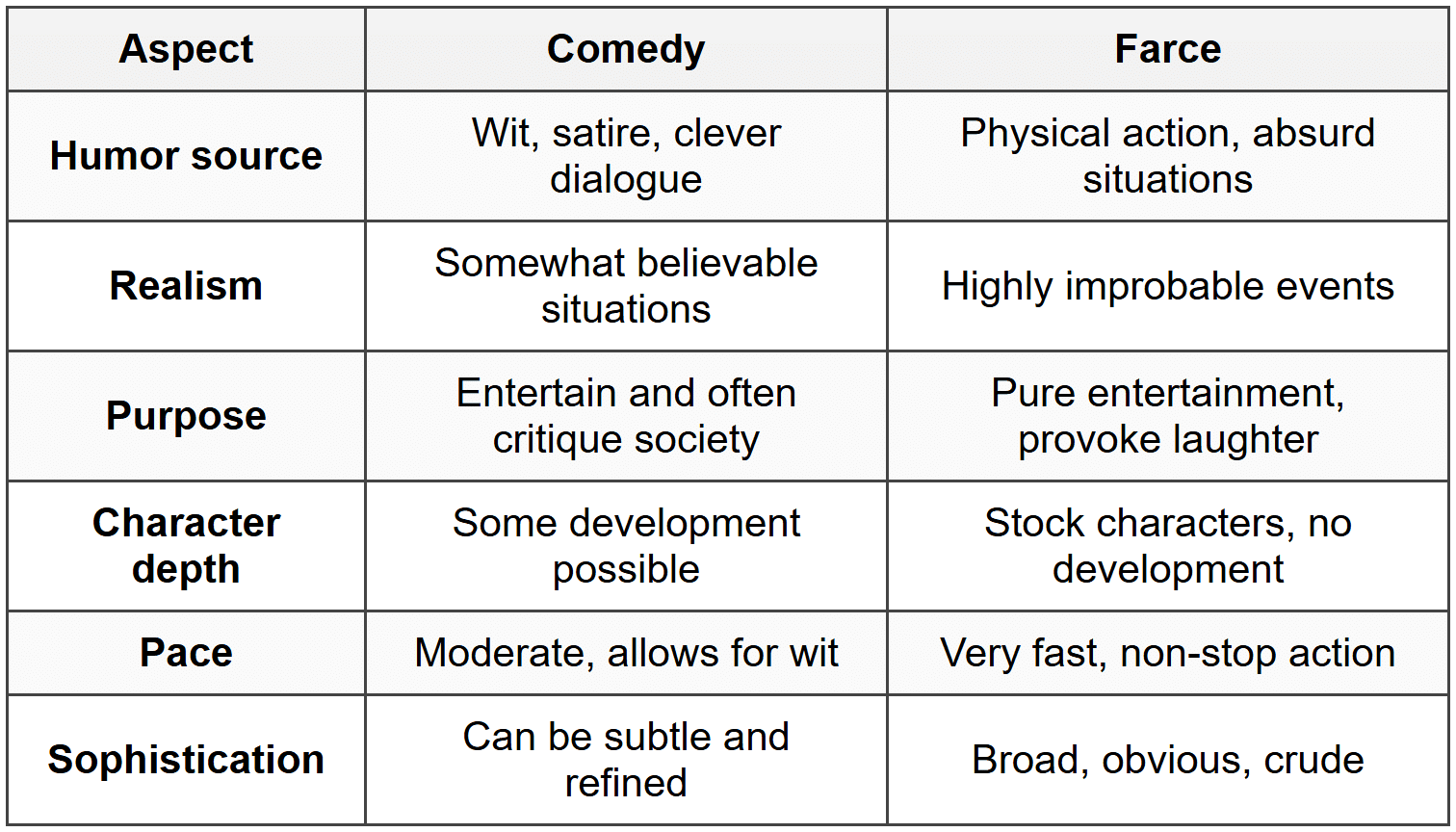
Farce vs Regular Comedy
Other Classifications of Drama
By Structure and Origin
While JAMB focuses mainly on content-based classification, you should be aware of these additional categories:
Classical drama: Follows strict rules from ancient Greek and Roman theater, including unity of time, place, and action. The entire play occurs in one location within 24 hours and focuses on one main plot.
Modern/Contemporary drama: Breaks classical rules, uses realistic dialogue, addresses current social issues, and experiments with structure.
Historical drama: Based on historical events and real historical figures.
Domestic drama: Focuses on family and household conflicts among middle-class or working-class characters.
Absurdist drama: Presents life as meaningless and illogical, challenging traditional dramatic structure.
How to Identify Drama Types in JAMB
When JAMB gives you an excerpt or description of a play, follow these steps:
- Check the ending: Happy ending suggests comedy or tragicomedy; unhappy ending suggests tragedy
- Examine the protagonist: Noble character suggests tragedy; ordinary character suggests comedy or melodrama
- Analyze the tone: Serious throughout indicates tragedy; humorous indicates comedy or farce
- Look for exaggeration: Extreme emotions and stereotypes suggest melodrama; absurd physical humor suggests farce
- Consider character complexity: Deep, flawed characters suggest tragedy; simple, one-dimensional characters suggest melodrama or farce
- Identify the purpose: If it aims to make you think deeply about human nature, likely tragedy; if it aims purely to entertain with laughter, likely farce
Worked Examples
Q1: A play tells the story of Eze, a respected community leader who becomes consumed by ambition to become king. He kills the ruling monarch and seizes power, but his guilt drives him mad. Former allies turn against him, and he dies in battle, abandoned by everyone. This play is best classified as:
(a) Comedy
(b) Tragedy
(c) Melodrama
(d) Farce
Ans: (b) Tragedy
Explanation: This play exhibits all the key features of tragedy. Eze is a dignified character with high status (respected leader aspiring to kingship), which fits the tragic hero profile. His ambition is the tragic flaw that leads to his downfall. He experiences reversal of fortune, moving from respect to isolation and death. The serious tone, focus on human weakness (ambition), and catastrophic ending all confirm this as tragedy, not comedy, melodrama, or farce.
Q2: In a dramatic performance, characters keep slamming doors, hiding under beds, and mistaking one person for another. The situations are highly unlikely but very funny. People chase each other around the stage at high speed. This description best fits:
(a) Tragedy
(b) Melodrama
(c) Farce
(d) Tragicomedy
Ans: (c) Farce
Explanation: The description contains clear markers of farce: physical comedy (slamming doors, hiding, chasing), improbable situations (mistaken identity), and fast-paced action. The emphasis on highly unlikely but funny situations distinguishes this from regular comedy. Tragedy and tragicomedy are immediately ruled out because there's no serious or potentially tragic element. Melodrama focuses on sensational plot and clear good-versus-evil conflict, not physical slapstick humor, so farce is correct.
Q3: A play begins with a young woman kidnapped by a ruthless villain who wants to force her into marriage. She refuses, remaining completely virtuous despite threats. At the last moment, her childhood sweetheart arrives and rescues her. The villain is arrested and punished. The lovers marry happily. This play demonstrates characteristics of:
(a) Tragedy
(b) Comedy
(c) Melodrama
(d) Farce
Ans: (c) Melodrama
Explanation: This is classic melodrama. The characters are stereotyped: the completely virtuous heroine, the entirely evil villain, and the heroic rescuer. The plot is sensational (kidnapping, forced marriage, last-minute rescue). There's clear poetic justice-virtue rewarded, vice punished. The happy ending and lack of character complexity distinguish it from tragedy. While it ends happily like comedy, the sensational plot, stereotyped characters, and focus on suspenseful action rather than humor make melodrama the correct classification.
Quick Summary
- Tragedy: Serious drama about the downfall of a noble hero due to a tragic flaw; ends unhappily; evokes pity and fear
- Comedy: Drama designed to amuse; features ordinary characters, humorous situations, and happy endings; may satirize social vices
- Tragicomedy: Mixes tragic and comic elements; potentially tragic situations that resolve happily; alternates serious and light tones
- Melodrama: Sensational drama with exaggerated emotions, stereotyped good and evil characters, and happy endings where virtue triumphs
- Farce: Extreme comedy using improbable situations, physical humor, and rapid action purely for laughter
- Drama is classified primarily by emotional effect and ending
- Protagonist status: Noble in tragedy, ordinary in comedy, stereotyped in melodrama
- Character complexity: Deep in tragedy, varied in comedy, simple in melodrama and farce
- Purpose: Tragedy explores human nature; comedy entertains and critiques; melodrama thrills; farce provokes pure laughter
- JAMB tests your ability to identify type from excerpts, character descriptions, plot summaries, and tone analysis
Practice Questions
Q1: Which of the following is NOT a characteristic of tragedy?
(a) The protagonist is a person of high status
(b) The hero has a fatal flaw that contributes to their downfall
(c) The play ends with the triumph of good over evil
(d) The audience experiences catharsis
Q2: A play satirizes the pretentious behavior of wealthy Lagos socialites who speak fake accents and compete for status. Characters make witty comments about each other's behavior, and the play ends with a character learning humility. This is an example of:
(a) Tragedy
(b) Comedy of manners
(c) Melodrama
(d) Farce
Q3: The main difference between tragicomedy and tragedy is that tragicomedy:
(a) Has no serious moments
(b) Features only common characters, not nobles
(c) Avoids a catastrophic ending despite serious situations
(d) Uses only physical humor to entertain
Q4: In a dramatic excerpt, the villain ties the heroine to railway tracks, cackling wickedly about his evil plan. The hero arrives just in time, defeats the villain easily, and saves the helpless heroine. They embrace as the villain is taken away. This scene demonstrates:
(a) Tragic inevitability
(b) Melodramatic stereotyping
(c) Farcical humor
(d) Tragicomic resolution
Q5: Which element is essential to farce but NOT to other forms of comedy?
(a) Happy ending
(b) Humorous situations
(c) Highly improbable, exaggerated physical action
(d) Criticism of social vices
Q6: A play begins seriously with a king discovering his wife's alleged infidelity and ordering her death. Midway, comedy relief comes through clowning servants. Near the end, the wife is proven innocent through surprising revelations, and the king joyfully reunites with her. This structure is characteristic of:
(a) Pure tragedy
(b) Pure comedy
(c) Tragicomedy
(d) Melodrama
Answer Key and Explanations
Q1 Answer: (c) The play ends with the triumph of good over evil
Explanation: Tragedy does NOT end with good triumphing over evil. Instead, tragedy ends with the hero's downfall, death, or suffering, regardless of moral status. The triumph of good over evil is characteristic of melodrama and some comedies. Options (a), (b), and (d) are all genuine characteristics of tragedy.
Q2 Answer: (b) Comedy of manners
Explanation: This scenario describes comedy of manners, which satirizes the behavior, customs, and affectations of a particular social class (here, wealthy Lagos socialites). The witty commentary, focus on social pretensions, and gentle moral lesson (learning humility) are typical of this comedy sub-type. It's not tragedy (no downfall), not melodrama (no sensational plot or clear villain), and not farce (no physical slapstick).
Q3 Answer: (c) Avoids a catastrophic ending despite serious situations
Explanation: The defining difference between tragicomedy and tragedy is the ending. Tragicomedy contains potentially tragic situations but resolves them happily or at least non-catastrophically, while tragedy ends in disaster. Option (a) is wrong because tragicomedy DOES have serious moments. Option (b) is incorrect because tragicomedy can feature nobles. Option (d) describes farce, not tragicomedy.
Q4 Answer: (b) Melodramatic stereotyping
Explanation: This scene contains classic melodrama markers: the purely evil villain, the helpless, innocent heroine, the completely heroic rescuer, sensational action (tied to tracks), last-minute rescue, and easy victory of good over evil. The characters are stereotypes without complexity. It's not tragic (no downfall), not farcical (not focused on absurd humor), and not truly tragicomic (no blending of serious and comic elements, just sensational action).
Q5 Answer: (c) Highly improbable, exaggerated physical action
Explanation: Farce is distinguished from other comedies by its emphasis on highly improbable situations and exaggerated physical action (slapstick). Other comedies may use wit, satire, or realistic humor. All comedies share happy endings (a), humorous situations (b), and sometimes social criticism (d), but the extreme physical improbability is farce's unique feature.
Q6 Answer: (c) Tragicomedy
Explanation: This play demonstrates tragicomedy's characteristic structure: it begins with serious, potentially tragic material (false accusation, death order), includes both serious and comic elements (servants providing comic relief), and resolves happily through unexpected revelation (wife proven innocent). It's not pure tragedy because it doesn't end catastrophically. It's not pure comedy because it begins seriously with life-threatening stakes. It's not melodrama because the characters aren't stereotyped and the focus is on emotional complexity rather than sensational action.



