Soliloquy And Monologue


When characters in plays and stories speak their thoughts aloud, they reveal their inner worlds to the audience. Understanding the difference between soliloquy and monologue is essential for JAMB candidates, as these literary devices appear frequently in drama and prose passages. This chapter will teach you how to identify each device, understand their purposes, and answer exam questions confidently by recognizing their distinct characteristics and functions in literature.
Key Concepts and Definitions
What is a Soliloquy?
A soliloquy is a speech delivered by a character who is alone on stage, speaking their thoughts aloud without addressing any other character. The character believes they are completely alone, and the audience becomes privy to their innermost feelings, plans, doubts, or reflections.
Key characteristics of soliloquy:
- The character is physically alone on stage
- No other character hears what is being said
- The speech reveals the character's true thoughts and emotions
- It allows the audience to understand the character's motivations
- The character is not seeking a response from anyone
- Often used to show internal conflict or decision-making processes
Example of Soliloquy:
In Shakespeare's Hamlet, when Hamlet says "To be or not to be, that is the question," he is alone on stage contemplating suicide and the meaning of existence. No other character hears these thoughts; only the audience witnesses his internal struggle.
Nigerian Context Example:
Imagine a character in Wole Soyinka's play standing alone after everyone has left a village meeting, saying: "They all trust me to lead them, but how can I when I know the truth about what happened? Should I confess and lose their respect, or keep silent and carry this burden forever?" This reveals the character's moral dilemma directly to the audience.
What is a Monologue?
A monologue is a long, uninterrupted speech delivered by one character, but unlike a soliloquy, other characters are usually present and listening. The speaker addresses either other characters, the audience directly, or both.
Key characteristics of monologue:
- One character speaks at length without interruption
- Other characters may be present and listening
- The speaker is consciously communicating with others
- Can be used to persuade, inform, or express strong emotion
- The content may not reveal the speaker's true thoughts (they might be performing or deceiving)
- More public than a soliloquy
Example of Monologue:
When a defense lawyer in a courtroom drama delivers a lengthy closing argument to the jury, explaining why their client is innocent, this is a monologue. The lawyer speaks continuously while the jury, judge, and audience listen.
Nigerian Context Example:
Consider a character in Chinua Achebe's dramatized work addressing the village elders: "My people, listen carefully. For three generations, our family has served this community with honor. My father built the first school here. My grandfather donated the land for the market. Now you accuse me of betrayal based on rumors from jealous neighbors?" This extended speech addresses present listeners and aims to persuade them.
Distinguishing Between Soliloquy and Monologue
JAMB often tests your ability to differentiate these two devices. The key distinction lies in audience awareness and privacy.
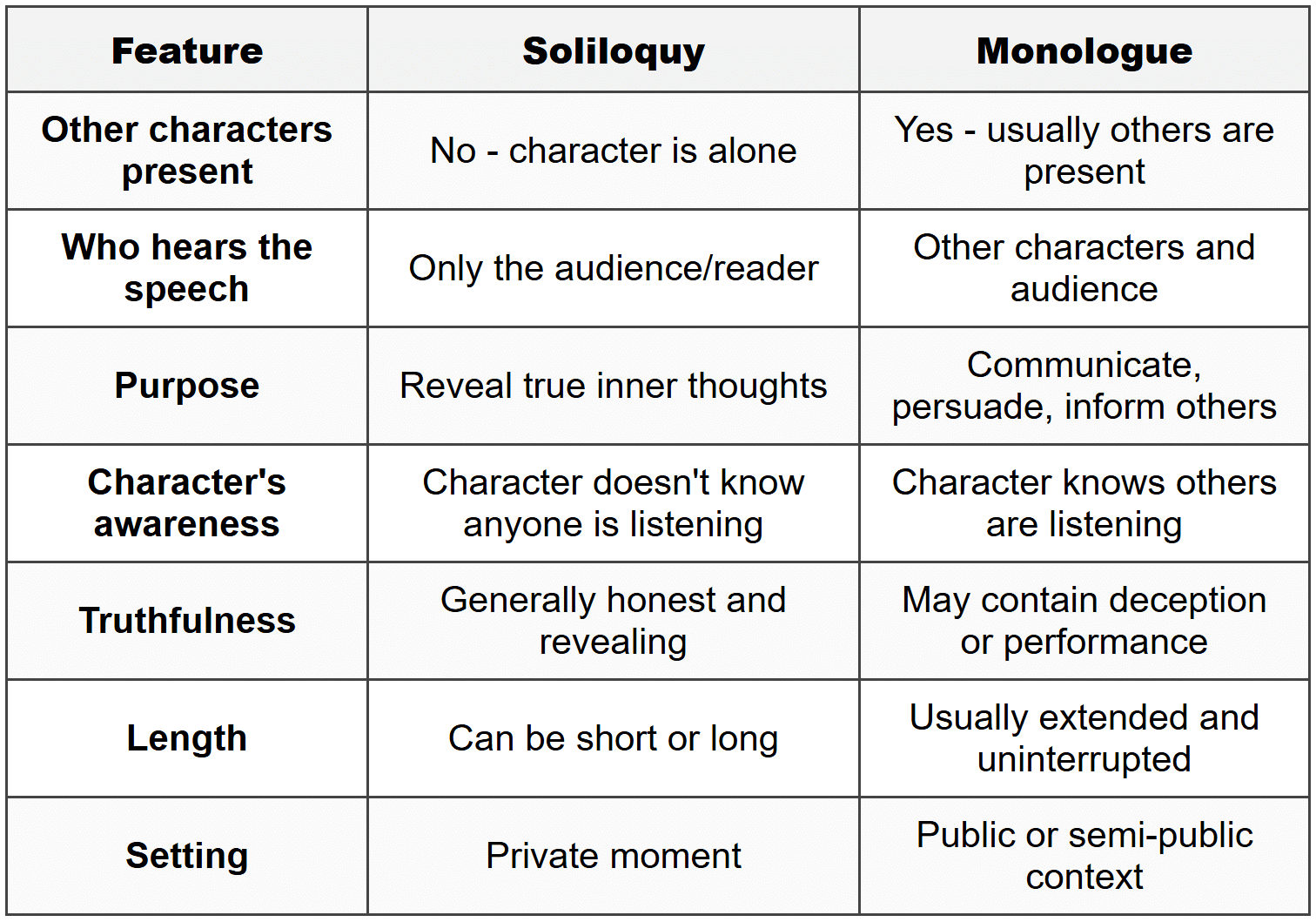
Types of Monologue
JAMB may test your knowledge of different monologue types:
1. Dramatic Monologue:
A character speaks to a silent listener whose presence is implied. The speaker's words reveal their personality and situation. The listener doesn't respond verbally, but their presence influences what the speaker says.
Example: A character confessing to a priest who remains silent throughout the confession scene.
2. Interior Monologue:
This represents a character's thoughts exactly as they occur in their mind, often in a stream-of-consciousness style. Though similar to soliloquy, it's typically found in prose fiction rather than drama.
Example: A passage showing a student's racing thoughts during an exam: "Question three... I studied this... or did I? Focus. The answer is... wait, was it photosynthesis or respiration? Why didn't I read that chapter again?"
3. Narrative Monologue:
A character tells a story or recounts events to other characters or the audience.
Example: A character describing how they survived a dangerous journey to their family gathered around them.
Functions and Purposes in Literature
Why Authors Use Soliloquy
Understanding why authors employ soliloquies helps you analyze passages correctly in JAMB:
- Character development: Reveals the complexity of a character's personality and moral struggles
- Plot advancement: Informs the audience of plans or decisions that drive the story forward
- Creating dramatic irony: The audience knows something other characters don't know
- Building suspense: Reveals intentions that create tension about what will happen next
- Philosophical exploration: Allows examination of deep themes like mortality, justice, or identity
- Emotional connection: Brings the audience closer to the character's experience
Why Authors Use Monologue
- Exposition: Provides necessary background information to the audience efficiently
- Persuasion: Shows a character attempting to convince others
- Emotional release: Allows a character to express intense feelings fully
- Characterization through speech: Reveals personality through speaking style and content
- Advancing argument: Presents a viewpoint or philosophy systematically
- Creating atmosphere: Sets mood through extended description or reflection
How JAMB Tests Soliloquy and Monologue
JAMB typically tests these concepts through:
1. Definition Questions:
You may be asked to define soliloquy or monologue, or identify which definition matches which device.
2. Identification in Passages:
You'll read an excerpt and determine whether it's a soliloquy or monologue based on context clues.
3. Function Questions:
Questions about why an author used a particular device in a given situation.
4. Comparison Questions:
Distinguishing between the two devices or identifying similarities.
5. Application Questions:
Recognizing examples in specific literary works or creating scenarios.
Context Clues for Identification
When analyzing a passage in JAMB, look for these clues:
Clues suggesting SOLILOQUY:
- Stage directions indicating the character is alone
- Phrases like "Now that I'm alone..." or "They've all gone..."
- Questions the character asks themselves
- Contradictions between what the character said to others earlier and what they're saying now
- Expressions of doubt, fear, or plans that the character wouldn't share publicly
- First-person pronouns with self-reflection
Clues suggesting MONOLOGUE:
- References to listeners ("You must understand..." or "Listen to me...")
- Persuasive language aimed at convincing others
- Responses to previous statements by other characters
- Direct address using second person ("you")
- Public declarations or announcements
- Stage directions showing other characters present
Worked Examples
Q1: Read the passage below and answer the question that follows:
"At last, they have all retired for the night. The house is quiet. Should I go through with this plan? My brother trusts me completely, yet here I am plotting against him. But if I don't act now, he will discover the truth about the missing funds, and then what? No, I must be strong. Tomorrow, before dawn, I'll take the documents and disappear. Forgive me, brother, but I have no choice."
The passage above is an example of:
(a) Dramatic monologue
(b) Soliloquy
(c) Narrative monologue
(d) Interior dialogue
Ans: (b)
Explanation: This passage is a soliloquy. The opening line "At last, they have all retired for the night" clearly indicates the character is now alone. The character expresses genuine internal conflict ("Should I go through with this plan?") and reveals true intentions that contradict the trust others have in him. The phrase "Forgive me, brother" shows the character addressing someone who isn't present, revealing plans he wouldn't share if his brother were actually listening. These are all hallmark features of soliloquy - private revelation of true thoughts and moral struggle.
Q2: "My fellow citizens, gather round and hear me well! For twenty years, I have walked among you as your neighbor, your friend, your servant. You know my face. You know my family. Today, I stand before you not to ask for your votes, but to remind you of our shared values. We built this community together through hard work and sacrifice. Those who come from outside with their promises of quick wealth do not understand our ways. They do not know that we value integrity over silver, and honor over gold. I ask you to remember this when you make your choice tomorrow."
This passage is best described as:
(a) A soliloquy revealing political ambition
(b) An interior monologue about community values
(c) A monologue addressing the community
(d) A dialogue between the speaker and citizens
Ans: (c)
Explanation: This is clearly a monologue. The speaker directly addresses an audience ("My fellow citizens, gather round and hear me well!") and uses second person pronouns throughout ("you know my face," "I ask you to remember"). Other people are clearly present and listening. The speech has a public, persuasive purpose - the speaker is campaigning and trying to convince the community to support him. Unlike a soliloquy, this isn't a private moment of self-reflection; it's a public address. Option (d) is incorrect because there's no back-and-forth exchange; only one person speaks throughout, making it a monologue rather than dialogue.
Q3: Which of the following statements about soliloquy is CORRECT?
(a) A soliloquy is always shorter than a monologue
(b) In a soliloquy, the character addresses other characters who remain silent
(c) A soliloquy reveals a character's genuine thoughts to the audience while the character believes they are alone
(d) Soliloquies are used primarily in prose fiction rather than drama
Ans: (c)
Explanation: Option (c) accurately captures the essential nature of a soliloquy. The defining characteristic is that the character genuinely believes they are alone and therefore speaks their true thoughts, which the audience overhears. Option (a) is incorrect because soliloquies can be any length - some famous soliloquies are quite lengthy. Option (b) describes a dramatic monologue, not a soliloquy; in a true soliloquy, no other characters are present at all. Option (d) is incorrect because soliloquies are primarily a dramatic device used in plays and stage performances, though they can appear in other forms of literature as well.
Common JAMB Mistakes to Avoid
Mistake 1: Confusing soliloquy with aside
An aside is a brief remark made by a character that other characters on stage cannot hear, but it's much shorter than a soliloquy and occurs while others are present. A soliloquy is longer and the character is completely alone.
Mistake 2: Thinking all long speeches are monologues
Length alone doesn't determine whether something is a monologue. A soliloquy can also be long. The key difference is whether other characters are present and listening.
Mistake 3: Assuming monologues are always truthful
Unlike soliloquies (where characters reveal true thoughts), monologues may contain lies, exaggerations, or performances because the speaker knows others are listening.
Mistake 4: Confusing interior monologue with soliloquy
Interior monologue is typically found in prose fiction and represents unspoken thoughts. Soliloquy is spoken aloud in drama, even though the character is alone.
Mistake 5: Ignoring stage directions and context
Always read carefully for clues about who is present, what has just happened, and whether the character knows they're being heard.
Quick Summary
Essential Points to Remember:
- Soliloquy: Character alone on stage, speaking true thoughts aloud, unaware of audience, reveals inner conflict
- Monologue: One character speaks at length, others usually present and listening, conscious communication
- Key difference: Presence and awareness of other characters distinguishes the two devices
- Soliloquy purpose: Character development, revealing true motivations, creating dramatic irony
- Monologue purpose: Exposition, persuasion, emotional expression to others
- Truthfulness: Soliloquies are generally honest; monologues may contain deception
- Setting: Soliloquy is private; monologue is public or semi-public
- Dramatic monologue: Spoken to a silent listener whose presence is felt
- Interior monologue: Stream of consciousness thoughts, usually in prose
- Context clues matter: Look for stage directions, pronouns, addresses to others
- Don't confuse with aside: Aside is brief; soliloquy is extended
- Both devices: Powerful tools for characterization and plot development
Practice Questions
Q1: "How strange it feels to be back in this room after so many years. Nothing has changed - the same old table, the same curtains. But I have changed. I was so young then, so foolish. If only I had known what that decision would cost me. Well, it's too late for regrets now."
The speech above is an example of:
(a) Dialogue
(b) Monologue
(c) Soliloquy
(d) Narration
Q2: The primary difference between a soliloquy and a monologue is that:
(a) A soliloquy is always written in verse while a monologue is in prose
(b) A monologue is delivered to other characters while a soliloquy is spoken when the character is alone
(c) A soliloquy is found only in comedy while a monologue appears in tragedy
(d) A monologue is shorter than a soliloquy
Q3: "Ladies and gentlemen of the jury, I stand before you today to defend a man who has been wrongly accused. The evidence will show that on the night in question, my client was nowhere near the scene of the crime. He was at home with his family, celebrating his daughter's birthday. We have witnesses, photographs, and testimonies that will prove his innocence beyond any reasonable doubt."
This passage is best classified as:
(a) A soliloquy
(b) A dramatic monologue
(c) A monologue
(d) An aside
Q4: Which of the following is TRUE about soliloquy?
(a) It is meant to be heard by other characters on stage
(b) It reveals the character's public persona
(c) It allows the audience to understand a character's private thoughts
(d) It is primarily used to advance dialogue between characters
Q5: In Shakespeare's plays, when Iago reveals his evil plans directly to the audience while alone on stage, this is an example of:
(a) Dramatic irony through monologue
(b) Dramatic irony through soliloquy
(c) Narrative exposition
(d) Character dialogue
Q6: "You stand there judging me, all of you, with your righteous faces. But where were you when I needed help? When my children were hungry, when my husband was sick, when I begged for assistance? You turned away. Now you condemn me for doing what I had to do to survive. Yes, I stole the medicine. Yes, I would do it again. You may punish me, but you cannot make me regret saving my child's life."
The passage above demonstrates:
(a) A soliloquy because it reveals inner thoughts
(b) A monologue because it addresses present listeners
(c) An aside because others cannot hear it
(d) Interior monologue because it's stream of consciousness
Answer Key and Explanations
Answer 1: (c) Soliloquy
The character is clearly alone, reflecting on the past in a private moment ("How strange it feels to be back in this room after so many years"). The use of rhetorical self-questioning ("If only I had known what that decision would cost me") and personal reflection without addressing anyone specific indicates this is a soliloquy. There's no indication other characters are present, and the thoughts are introspective and genuine.
Answer 2: (b) A monologue is delivered to other characters while a soliloquy is spoken when the character is alone
This is the fundamental distinction between the two devices. The presence or absence of other characters who can hear the speech is what separates monologue from soliloquy. Options (a), (c), and (d) are incorrect because both devices can appear in verse or prose, in any genre, and can be any length.
Answer 3: (c) A monologue
The lawyer directly addresses "Ladies and gentlemen of the jury," clearly indicating multiple listeners are present. This is a public speech with a persuasive purpose, making it a monologue. It's not a dramatic monologue specifically because the audience (jury) is actively present and acknowledged, not merely implied. It's not a soliloquy because the character isn't alone, and it's not an aside because it's openly addressed to the listeners.
Answer 4: (c) It allows the audience to understand a character's private thoughts
This captures the essential function of soliloquy. Option (a) is incorrect because other characters don't hear soliloquies - they're alone. Option (b) is wrong because soliloquies reveal private, not public, personas. Option (d) is incorrect because soliloquies don't advance dialogue; there's no one else to dialogue with.
Answer 5: (b) Dramatic irony through soliloquy
When Iago speaks alone, revealing his evil plans, it's a soliloquy because he's alone on stage. It creates dramatic irony because the audience knows his true intentions while other characters remain deceived. This is a classic example of how soliloquy functions in tragedy to build tension and create situational irony.
Answer 6: (b) A monologue because it addresses present listeners
The speaker directly addresses others throughout the passage ("You stand there judging me, all of you"). The use of second person ("where were you," "you turned away," "you condemn me") clearly indicates listeners are present. This is a defensive, emotional monologue spoken to accusers. It's not a soliloquy because the character isn't alone; it's not an aside because it's openly addressed to the listeners; and it's not interior monologue because it's spoken aloud to others.



