Anticlimax


Anticlimax is one of the most interesting literary devices you'll encounter in your JAMB English Language exam, and understanding it will not only help you score marks in the comprehension and literary appreciation sections but also sharpen your ability to analyze how writers create and manipulate expectations. In simple terms, anticlimax occurs when a sequence builds up your expectations only to end in something disappointingly ordinary or trivial. This chapter will teach you exactly what anticlimax is, how to identify it in passages and poems, how it differs from similar devices like bathos, and most importantly, how JAMB tests your knowledge of this concept through multiple-choice questions.
Key Concepts and Definitions
What is Anticlimax?
Anticlimax is a literary device where a series of ideas, events, or words arranged in ascending order of importance suddenly ends with something significantly less important, serious, or dignified than what preceded it. The effect is often humorous, disappointing, or deflating.
Think of it this way: imagine climbing a staircase where each step gets higher and more impressive, but when you reach what should be the top, you find yourself stepping down into an ordinary room instead of the grand hall you expected.
The Structure of Anticlimax
Anticlimax typically follows this pattern:
- Build-up: A series of increasingly important, serious, or grand elements
- Peak expectation: The reader or listener anticipates something even more significant
- Sudden drop: The sequence ends with something trivial, mundane, or disappointing
Purpose and Effect
Writers use anticlimax for several deliberate purposes:
- Humor: Creating comedy through the contrast between expectation and reality
- Satire: Mocking pretentiousness or exposing false values
- Emphasis: Drawing attention to the insignificance of the final element
- Characterization: Revealing a character's shallow priorities or confused thinking
Simple Examples to Understand Anticlimax
Example 1: "The lawyer prepared for months, researched every precedent, rehearsed his arguments brilliantly, and forgot his car keys."
Notice how the sequence builds from serious professional preparation to a trivial everyday mistake. The contrast creates the anticlimax.
Example 2: "She lost her family, her home, her fortune, and her earring."
The first three losses are devastating and profound, but the final item (an earring) is comparatively insignificant, creating an anticlimactic effect.
Example 3: "The principal announced that he would discuss examination malpractice, student indiscipline, poor academic performance, and the broken classroom windows."
The serious academic and behavioral issues are followed by a minor property damage concern, deflating the gravity of the announcement.
Anticlimax vs. Bathos
JAMB often tests your ability to distinguish between similar literary devices. Here's the critical difference:
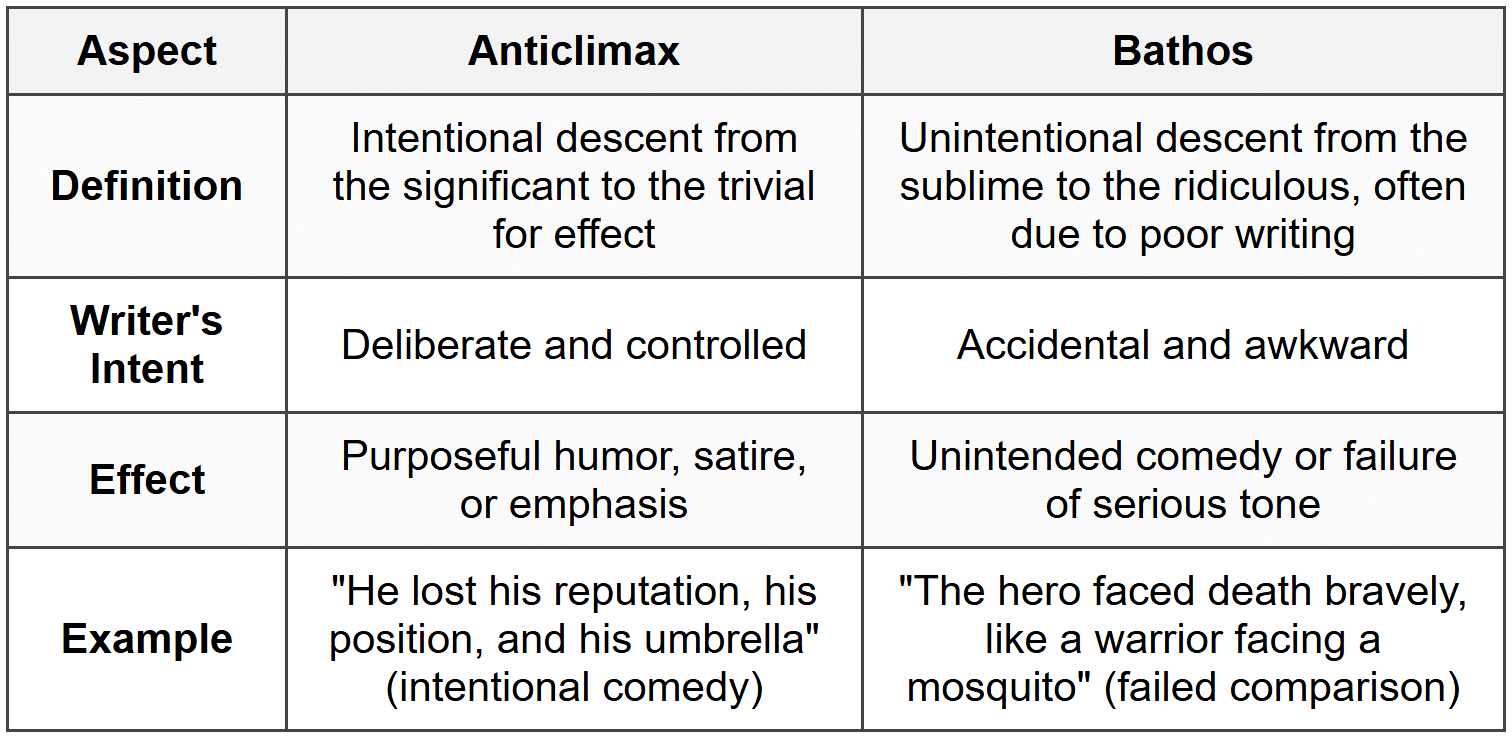
Key point for JAMB: Anticlimax is deliberate; bathos is accidental. If the writer meant to create the deflating effect, it's anticlimax. If it seems like a writing mistake, it's bathos.
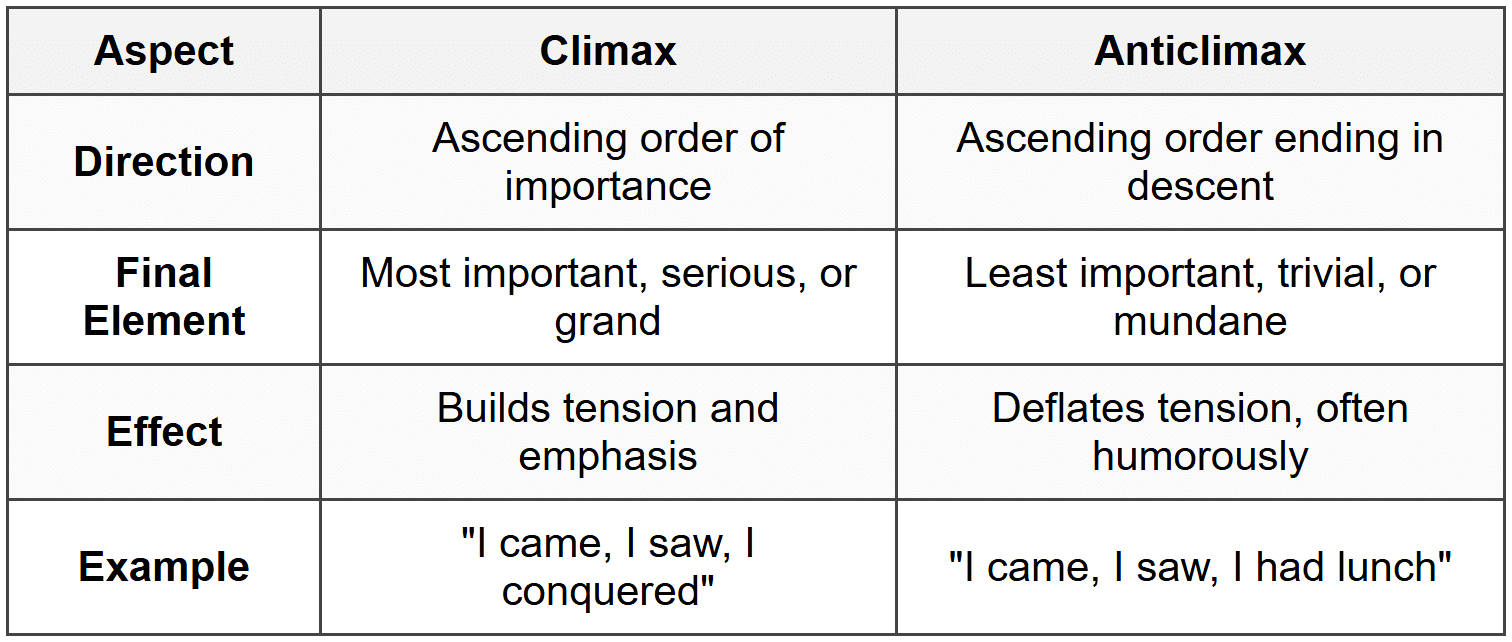
Anticlimax vs. Climax
Understanding climax helps you recognize anticlimax by contrast:
Rules and Detailed Explanations
How to Identify Anticlimax in JAMB Passages
Follow these steps when analyzing a passage for anticlimax:
- Look for a series or sequence: Anticlimax requires multiple elements arranged in order
- Check the progression: Identify whether elements increase in importance or seriousness
- Examine the final element: Does it break the pattern by being significantly less important?
- Assess the effect: Does the contrast seem deliberate and create humor, satire, or emphasis?
- Consider context: Does the anticlimax fit the author's apparent purpose?
Common JAMB Question Patterns
JAMB typically tests anticlimax in these ways:
- Direct identification: "The literary device used in line X is..."
- Effect questions: "The effect of the statement in line X is..."
- Purpose questions: "The writer's purpose in using the expression is..."
- Comparison questions: Distinguishing anticlimax from bathos, climax, or other devices
Nigerian Context Examples
Understanding anticlimax through familiar situations makes identification easier during the exam:
Example 1: "The governor promised to tackle corruption, improve infrastructure, revamp education, and paint the government house fence."
Analysis: The serious policy issues (corruption, infrastructure, education) are followed by a trivial aesthetic concern, creating anticlimax that satirizes misplaced priorities.
Example 2: "After JAMB, she worried about her English score, her Mathematics performance, her overall aggregate, and whether her pen wrote clearly."
Analysis: Major concerns about exam results are deflated by a minor worry about pen clarity.
Example 3: "The wedding featured the state governor, two senators, multiple business tycoons, and my neighbor's cousin."
Analysis: The progression from highly important guests descends to an ordinary person, creating humorous anticlimax.
Critical Distinctions for JAMB Success
When It's NOT Anticlimax
Avoid these common mistakes:
- Simple listing: If items are roughly equal in importance, there's no anticlimax (e.g., "She bought rice, beans, and yam")
- Random order: If there's no clear progression, anticlimax doesn't apply
- All serious elements: If everything remains important throughout, it may be climax, not anticlimax
- Two-item comparison: Anticlimax typically requires three or more elements to establish the pattern
Anticlimax in Different Literary Forms
In Prose
Prose writers use anticlimax in dialogue, narration, and description. Watch for it in character speech (revealing personality) and satirical writing.
Example: "The professor's research addressed climate change, global poverty, world peace, and the cafeteria menu."
In Poetry
Poets use anticlimax for ironic or humorous effect, often at the end of stanzas or poems.
Example:
"I love thee with the passion of the ages,
With fire that burns through endless time,
With devotion written on eternal pages,
And because you lent me twenty naira last time."
In Drama
Playwrights use anticlimax in dialogue to create comedy or reveal character flaws.
Example: "I shall fight for justice, defend the oppressed, change society, and then have lunch."
Worked Examples
Q1: Read the following sentence and answer the question:
"The president addressed issues of national security, economic recovery, constitutional reform, and the color of the national flag."
What literary device is employed in this statement?
(a) Metaphor
(b) Climax
(c) Anticlimax
(d) Personification
Ans: (c)
Explanation: This is a clear example of anticlimax. The sentence begins with three very serious national issues (security, economy, constitutional reform) arranged in ascending order of complexity and importance. However, it ends with a trivial matter (the color of the national flag) that is insignificant compared to the previous items. This deliberate descent from important to trivial matters creates an anticlimactic effect, likely intended to satirize misplaced priorities or trivial concerns. Option (b) climax is incorrect because climax would end with the most important item, not the least. Options (a) and (d) are completely unrelated literary devices.
Q2: "After the examination, Bola was concerned about her future, her family's expectations, her university admission, and her blue pen that stopped writing in the last five minutes."
The effect of the final clause is to:
(a) Emphasize the importance of all the student's concerns equally
(b) Create a humorous deflation of the serious concerns
(c) Suggest that the pen was the most important concern
(d) Build tension toward a climactic ending
Ans: (b)
Explanation: The writer intentionally creates anticlimax by listing progressively serious concerns (future, family expectations, university admission) and then abruptly ending with a minor, mundane worry about a pen. This creates a humorous deflating effect because the final concern is disproportionately trivial compared to the weighty matters that preceded it. The contrast between the profound and the petty generates comedy. Option (a) is wrong because the concerns are clearly not equal in importance. Option (c) misreads the passage entirely; the pen is the least important concern. Option (d) is incorrect because the passage creates anticlimax (descending importance), not climax (ascending importance).
Q3: Identify the statement that does NOT contain anticlimax:
(a) "The activist fought against injustice, corruption, tyranny, and bad restaurant service."
(b) "The storm destroyed homes, uprooted trees, shattered windows, and devastated the entire community."
(c) "The politician promised progress, prosperity, development, and better parking spaces."
(d) "The hero conquered his fears, defeated his enemies, saved the kingdom, and tied his shoelaces."
Ans: (b)
Explanation: Option (b) does not contain anticlimax because all the elements maintain a similar level of seriousness and importance. The sequence describes various types of destruction (homes, trees, windows) and culminates with the overall effect (devastating the community). There is no descent from serious to trivial; everything remains consistently serious, creating either a climactic effect or simple parallel structure. In contrast, options (a), (c), and (d) all end with trivial matters (restaurant service, parking spaces, shoelaces) after building up with serious concerns, creating clear anticlimax. This question tests your ability to recognize when anticlimax is absent by identifying consistent levels of importance throughout a sequence.
Quick Summary
- Anticlimax is the deliberate descent from important/serious elements to trivial/mundane ones in a sequence
- The structure requires: build-up, peak expectation, sudden drop to something less significant
- Purpose: humor, satire, emphasis, or characterization
- Anticlimax vs. Bathos: Anticlimax is intentional; bathos is accidental poor writing
- Anticlimax vs. Climax: Climax ends with the most important element; anticlimax ends with the least
- To identify anticlimax: look for series, check progression, examine final element, assess deliberate effect
- Requires three or more elements to establish the ascending pattern before the drop
- Common in all literary forms: prose, poetry, and drama
- Often tested through identification, effect, purpose, and comparison questions in JAMB
- The final element must be significantly less important than what precedes it
- Creates contrast between expectation and reality
- Not every descending sequence is anticlimax; must be deliberate and create specific effect
Practice Questions
Q1: "The revolution would bring freedom, equality, justice, and cheaper bus fares."
The literary device used in this statement is:
(a) Simile
(b) Climax
(c) Anticlimax
(d) Alliteration
Q2: Which of the following best describes the effect of anticlimax?
(a) It builds tension progressively
(b) It creates a deflating or humorous contrast
(c) It compares two unlike things
(d) It gives human qualities to non-human things
Q3: "He prepared his testimony carefully, consulted with lawyers, reviewed all evidence, prayed fervently, and wore his lucky socks."
The writer's purpose in ending the sentence with "wore his lucky socks" is to:
(a) Emphasize the equal importance of all preparations
(b) Suggest that the socks were the most crucial element
(c) Create a humorous deflation of the serious preparations
(d) Build toward a climactic conclusion
Q4: Identify the option that contains anticlimax:
(a) "The teacher was intelligent, dedicated, and hardworking."
(b) "The student studied Mathematics, English, and Chemistry."
(c) "The speech addressed poverty, unemployment, inequality, and the office dress code."
(d) "The athlete trained daily, ate properly, and rested adequately."
Q5: "The hero's journey involved crossing treacherous mountains, facing deadly enemies, solving impossible riddles, discovering ancient secrets, and finding a parking spot."
The primary difference between this anticlimax and bathos is that:
(a) Anticlimax is longer than bathos
(b) Anticlimax is intentional while bathos is accidental
(c) Bathos is funnier than anticlimax
(d) They are exactly the same thing
Q6: Read the following carefully:
"The senator's speech covered national debt, foreign policy, constitutional amendments, military strategy, healthcare reform, and the need for new curtains in the senate chambers."
Which statement about this passage is correct?
(a) It demonstrates climax by ending with the most important issue
(b) It uses anticlimax to satirize misplaced priorities
(c) It shows bathos through accidental poor writing
(d) It contains no literary devices
Answer Key and Explanations
Q1 Answer: (c) Anticlimax
The statement builds from grand revolutionary ideals (freedom, equality, justice) to a mundane economic concern (cheaper bus fares). This deliberate descent from the profound to the trivial creates anticlimax. The contrast satirizes how grand revolutionary rhetoric sometimes includes petty practical concerns alongside noble principles.
Q2 Answer: (b) It creates a deflating or humorous contrast
The defining effect of anticlimax is the contrast between the build-up of important elements and the disappointingly trivial conclusion. This creates either humor, satire, or emphasis through deflation. Option (a) describes climax, not anticlimax. Options (c) and (d) describe metaphor/simile and personification respectively.
Q3 Answer: (c) Create a humorous deflation of the serious preparations
The sentence lists serious, rational preparations (testimony, lawyers, evidence, prayer) and ends with a superstitious, trivial action (lucky socks). This intentional anticlimax creates humor by revealing the character's irrational side and deflating the seriousness of the preceding preparations. It's clearly deliberate characterization through comic contrast.
Q4 Answer: (c) "The speech addressed poverty, unemployment, inequality, and the office dress code."
This option contains anticlimax because it begins with serious societal problems (poverty, unemployment, inequality) and ends with a trivial workplace concern (dress code). The other options contain simple lists of comparable items without the ascending-then-descending pattern necessary for anticlimax.
Q5 Answer: (b) Anticlimax is intentional while bathos is accidental
This is the fundamental distinction between these two devices. Both involve descent from serious to trivial matters, but anticlimax is a deliberate literary technique used for specific effect, while bathos results from poor writing or misjudgment. The parking spot example is clearly intentional humor, making it anticlimax rather than bathos.
Q6 Answer: (b) It uses anticlimax to satirize misplaced priorities
The passage deliberately lists critical national issues (debt, foreign policy, amendments, military, healthcare) before ending with a trivial aesthetic concern (curtains). This anticlimax satirizes politicians who discuss minor matters alongside major national concerns, suggesting confused or superficial priorities. It's clearly intentional satire, not accidental bathos, and definitely not climax since it ends with the least important item.



