Deus Ex Machina


In Nigerian literature and drama studied for UTME, you will encounter various literary devices and techniques used by playwrights to resolve complex plots. Deus Ex Machina is one such dramatic convention that appears in classical and modern works, and JAMB often tests your ability to identify this technique in prose, drama, and poetry passages. This chapter will teach you what deus ex machina means, how to recognize it in texts, and how to distinguish it from other plot devices that JAMB examiners use to challenge students.
Key Concepts and Definitions
What is Deus Ex Machina?
Deus Ex Machina is a Latin phrase meaning "god from the machine." It refers to a plot device where an unexpected, artificial, or improbable character, event, or ability suddenly appears to resolve a seemingly unsolvable problem in a story. The term originated from ancient Greek theatre where actors playing gods were literally lowered onto the stage by a mechanical crane to solve the characters' dilemmas.
Key characteristics of Deus Ex Machina:
- Appears suddenly without adequate preparation or foreshadowing
- Resolves a conflict that characters could not solve themselves
- Often feels contrived or artificial to the audience
- Typically occurs near the end of a story
- May weaken the plot by making resolution too easy
Simple Examples
Example 1: In a play, a young man is about to be executed for a crime he didn't commit. Just as the executioner raises his weapon, a stranger rushes in with evidence proving the young man's innocence. This stranger was never mentioned before in the story and appears only at this critical moment. This is deus ex machina.
Example 2: A family in a Nigerian village story is starving and about to lose their land to creditors. Suddenly, in the final scene, a long-lost uncle from America whom nobody ever mentioned arrives with bags of money and solves all their problems instantly. This resolution is deus ex machina because it comes from nowhere.
Example 3: Two rival kingdoms are locked in battle with no clear victor. Out of nowhere, an earthquake destroys both armies simultaneously, forcing peace. If the earthquake wasn't hinted at earlier in the story, this is deus ex machina.
Why It Matters in Literature
Understanding deus ex machina helps you:
- Analyze plot structure and development
- Evaluate the quality and credibility of a story's resolution
- Identify weak versus strong storytelling techniques
- Answer JAMB questions about dramatic techniques and literary devices
- Distinguish between planned resolution and artificial intervention
Types and Variations
Classic Deus Ex Machina
This involves a supernatural or divine intervention that solves human problems. In classical Greek plays, gods would literally appear to settle disputes, forgive crimes, or rescue heroes. In African literature, this might appear as ancestral spirits intervening in human affairs without prior indication.
Example: A deity appears in the final act to pronounce judgment and restore order when human characters have failed.
Character-Based Deus Ex Machina
A new character who was never introduced or mentioned suddenly appears with the exact solution needed. This character has no prior connection to the plot but possesses precisely what is required to resolve the conflict.
Example: A wealthy philanthropist nobody knew existed appears to pay off all debts in the final chapter.
Event-Based Deus Ex Machina
An unexpected event or natural occurrence suddenly resolves the conflict. This event has no logical connection to previous plot developments and appears purely for convenience.
Example: A sudden rainstorm extinguishes a fire that was about to destroy the entire village, with no previous mention of weather conditions.
Ability-Based Deus Ex Machina
A character suddenly develops or reveals an ability, skill, or knowledge they never possessed before, specifically to solve the current problem. This differs from character growth because it appears without development or justification.
Example: The protagonist who struggled throughout the story suddenly speaks a foreign language perfectly to negotiate peace, despite never studying it.
Deus Ex Machina vs. Legitimate Plot Resolution
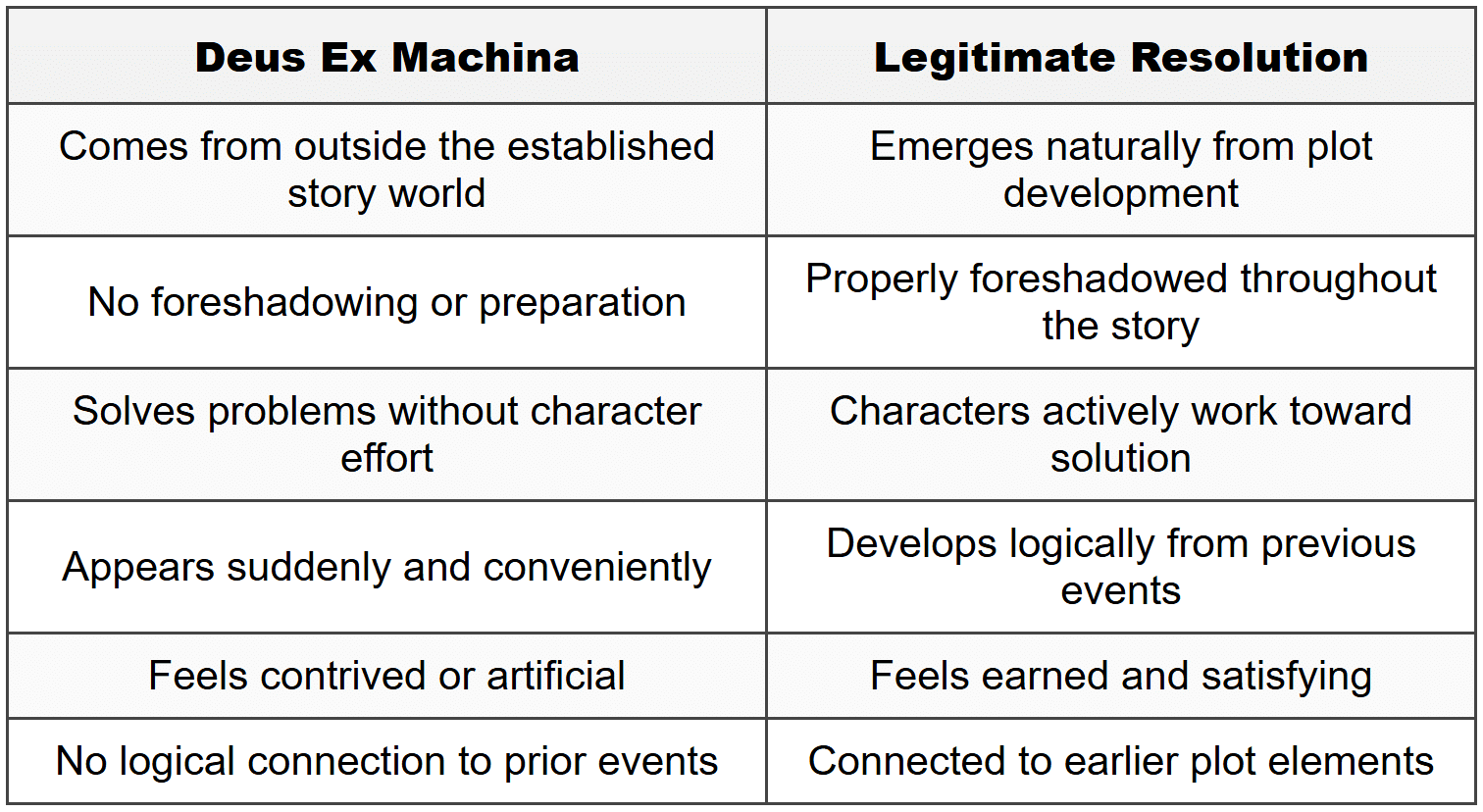
JAMB often tests your ability to distinguish between artificial plot devices and legitimate story resolution. Here's how to tell them apart:
Foreshadowing Makes the Difference
Foreshadowing is the key element that separates deus ex machina from proper plot resolution. If a solution is hinted at, mentioned, or prepared for earlier in the story, it is not deus ex machina even if it seems miraculous.
Not Deus Ex Machina: If a character mentioned having a wealthy uncle in America in chapter two, and this uncle arrives with money in the final chapter, this is legitimate plot resolution because it was foreshadowed.
Is Deus Ex Machina: If the wealthy uncle was never mentioned, hinted at, or prepared for in any way, his sudden appearance is deus ex machina.
Common JAMB Testing Patterns
How JAMB Tests This Concept
Examiners typically test deus ex machina through:
- Identification questions: You read a passage and identify whether the resolution involves deus ex machina
- Definition questions: You select the correct definition from options
- Example recognition: You identify which scenario represents deus ex machina from multiple choices
- Literary analysis: You evaluate the effectiveness or weakness of a plot device
- Comparison questions: You distinguish deus ex machina from similar concepts like coincidence, fate, or divine intervention
Related Concepts JAMB May Test Alongside
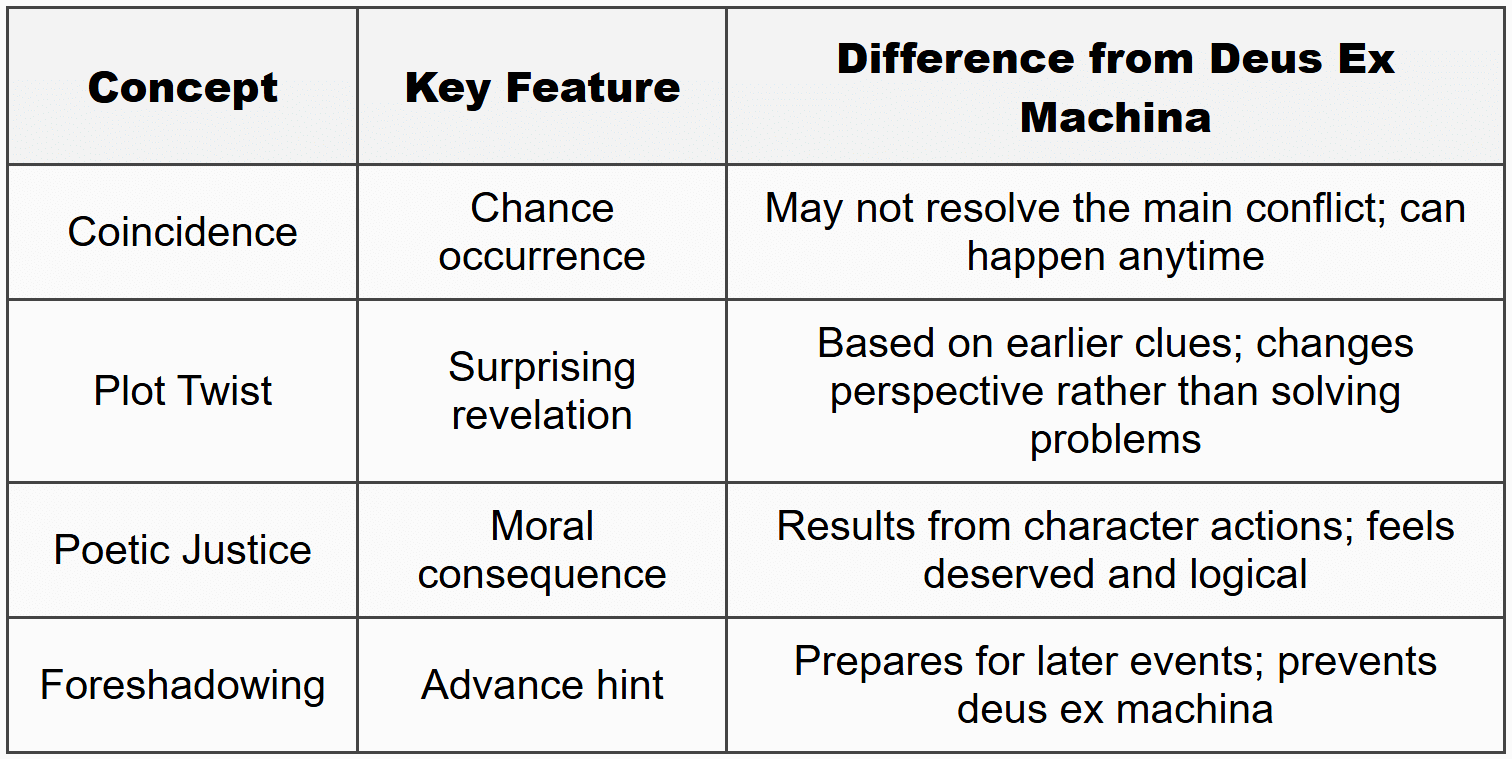
Coincidence: An unexpected occurrence that happens by chance. Unlike deus ex machina, coincidence doesn't always resolve major conflicts and may occur earlier in the story.
Fate or Destiny: Events that seem predetermined or inevitable. In stories emphasizing fate, outcomes feel like natural consequences of established cosmic order, not artificial intervention.
Poetic Justice: When good characters are rewarded and bad characters are punished in ways that feel morally satisfying and logically connected to their actions.
Plot Twist: An unexpected development that changes the story's direction. A plot twist is properly foreshadowed with subtle clues, while deus ex machina appears without preparation.
Recognizing Deus Ex Machina in Different Genres
In Drama
Stage plays may use deus ex machina when:
- A character with authority appears in the final act to pardon criminals
- A previously unknown will or document surfaces to resolve inheritance disputes
- Natural disasters conveniently eliminate antagonists
- Supernatural beings intervene without prior indication
In Prose Fiction
Novels and short stories may employ deus ex machina through:
- Sudden wealth solving financial problems (lottery wins, inheritances, found treasure)
- Convenient deaths of antagonists removing obstacles
- Unknown relatives appearing with solutions
- Medical miracles curing terminal illnesses without explanation
In Poetry
Though less common, narrative poetry may show deus ex machina when:
- Divine intervention resolves human struggles in the final stanzas
- Natural phenomena suddenly change circumstances
- Unexplained transformations solve problems
Critical Evaluation
Why Writers Use Deus Ex Machina
Despite being generally considered a weakness, some writers use this device intentionally:
- To emphasize the role of fate or divine power in human affairs
- To comment on the unpredictability of life
- To create irony or satire by highlighting artificial storytelling
- When unable to resolve complex plots through character action
- In children's literature where simple resolutions are acceptable
Why It's Generally Considered Weak
Literary critics and examiners view deus ex machina negatively because:
- It undermines character development by removing agency
- It disappoints readers who expect logical resolution
- It suggests the writer couldn't create a proper solution
- It makes the story feel incomplete or unsatisfying
- It violates the principle that conflicts should be resolved through established elements
Worked Examples
Q1: In a play, the protagonist owes a large debt and faces imprisonment. Throughout the story, he struggles to raise money through various failed schemes. In the final scene, his long-dead father's friend appears, claiming he owed the protagonist's father money, and pays off the entire debt. This friend was never mentioned in previous scenes. What literary device does this represent?
(a) Flashback
(b) Foreshadowing
(c) Deus ex machina
(d) Dramatic irony
Ans: (c)
This is deus ex machina because the father's friend appears suddenly without any prior mention or preparation in the story, and conveniently solves the protagonist's problem. The resolution comes from outside the established narrative rather than from the protagonist's efforts or from previously introduced elements. Flashback would be a scene from the past; foreshadowing would be hints about future events; dramatic irony occurs when the audience knows something characters don't. None of these apply here.
Q2: A novel describes a village suffering from drought. In chapter three, an old woman mentions that rainfall patterns might change during the harmattan season. Throughout the story, characters attempt various solutions. In the final chapter, during harmattan, heavy rains come and solve the water crisis. Is this deus ex machina?
(a) Yes, because rain solving the problem is too convenient
(b) Yes, because natural events cannot resolve human conflicts
(c) No, because the rain was foreshadowed in chapter three
(d) No, because drought naturally ends with rain
Ans: (c)
This is not deus ex machina because the solution was foreshadowed in chapter three when the old woman mentioned changing rainfall patterns. The rain doesn't appear from nowhere; it was prepared for earlier in the narrative. Even though rain is a natural event that conveniently solves the problem, the fact that it was mentioned earlier makes it legitimate plot resolution rather than deus ex machina. Option (a) is wrong because convenience alone doesn't make something deus ex machina if it's properly set up. Option (b) is incorrect because natural events can resolve conflicts if properly foreshadowed. Option (d) misses the point that foreshadowing is what matters, not just the natural cycle.
Q3: Which of the following scenarios best represents deus ex machina?
(a) A detective solves a murder using clues gathered throughout the investigation
(b) A student who studied hard passes her JAMB examination with excellent scores
(c) Two enemies reconcile after a wise elder mediates, as hinted in earlier chapters
(d) A thief about to be caught falls into a previously unmentioned well and dies, ending the chase
Ans: (d)
Option (d) is deus ex machina because the well was never mentioned before and conveniently appears exactly when needed to resolve the conflict. The thief's death ends the chase through an artificial, unprepared element rather than through the characters' actions. Options (a), (b), and (c) all represent legitimate resolutions: the detective uses established clues, the student's success results from her effort, and the elder's mediation was foreshadowed. These resolutions emerge naturally from the story's development rather than appearing artificially from outside the narrative.
Quick Summary
- Deus ex machina means "god from the machine" - an artificial plot device that suddenly resolves conflicts
- Appears without proper foreshadowing or preparation in the story
- Typically occurs near the end when characters cannot solve problems themselves
- Can involve new characters, unexpected events, or sudden abilities that weren't established earlier
- Foreshadowing is the key difference: if a solution was hinted at earlier, it's not deus ex machina
- Generally considered a weakness in storytelling because it undermines character agency and logical development
- Different from coincidence (chance occurrence), plot twist (surprising but foreshadowed), and poetic justice (deserved consequences)
- JAMB tests your ability to identify, define, and distinguish deus ex machina from legitimate plot resolution
- Found in drama, prose, and narrative poetry across various literary traditions
- Key question to ask: "Was this solution introduced or hinted at earlier in the story?"
- If the answer is no, and the solution appears conveniently from nowhere, it's likely deus ex machina
Practice Questions
Q1: The term "deus ex machina" originally comes from which theatrical tradition?
(a) Nigerian traditional theatre
(b) Ancient Greek theatre
(c) Elizabethan English theatre
(d) Modern American theatre
Q2: In a story, two warring families have fought for generations. In the final chapter, both family heads simultaneously die of heart attacks, and their children, who are secretly in love, unite the families. Neither the heart conditions nor the romance was mentioned before. This resolution is:
(a) Poetic justice
(b) Tragic irony
(c) Deus ex machina
(d) Foreshadowing
Q3: Which element would prevent a resolution from being considered deus ex machina?
(a) The solution comes from a powerful character
(b) The solution was mentioned or hinted at earlier in the story
(c) The solution involves supernatural elements
(d) The solution happens quickly
Q4: A novel about a condemned prisoner mentions in chapter one that the governor occasionally grants pardons during national holidays. In the final chapter, set during Independence Day, the governor pardons the prisoner. This is:
(a) Deus ex machina because the governor is powerful
(b) Deus ex machina because the timing is too convenient
(c) Not deus ex machina because the possibility was established in chapter one
(d) Not deus ex machina because governors have pardon powers
Q5: In a play, the protagonist searches desperately for a cure for his sick child throughout five acts. No cure is found through his efforts. In the final scene, a herbalist who was never mentioned before appears with the exact cure needed. This represents:
(a) Character development
(b) Plot twist
(c) Dramatic irony
(d) Deus ex machina
Q6: Which statement about deus ex machina is most accurate?
(a) It always involves divine or supernatural intervention
(b) It is considered excellent storytelling because it surprises readers
(c) It resolves conflicts through unprepared, convenient interventions
(d) It can only occur in dramatic works, not in prose or poetry
Answer Key and Explanations
Q1 Answer: (b)
Deus ex machina originated in ancient Greek theatre, where actors playing gods were lowered onto the stage by mechanical cranes to resolve plot conflicts. The Latin phrase literally references this theatrical practice. Nigerian traditional theatre (a), Elizabethan theatre (c), and modern American theatre (d) may use similar devices, but they didn't originate the term or practice.
Q2 Answer: (c)
This is deus ex machina because neither the heart conditions nor the secret romance was established earlier in the story. Two convenient, unprepared elements suddenly appear to resolve the conflict. Poetic justice (a) would require the resolution to feel like earned consequences of actions. Tragic irony (b) involves awareness of unfortunate circumstances. Foreshadowing (d) is the opposite of what's happening here-there was no advance warning of these developments.
Q3 Answer: (b)
Foreshadowing or earlier mention prevents a resolution from being deus ex machina. If a solution was hinted at, prepared for, or established earlier in the narrative, it's legitimate plot development rather than artificial intervention. Power (a), supernatural elements (c), and speed (d) don't determine whether something is deus ex machina; what matters is whether it was properly prepared for in the story.
Q4 Answer: (c)
This is not deus ex machina because the possibility of a governor's pardon was established in chapter one, making it foreshadowed plot development. The solution doesn't appear from nowhere; it was prepared for earlier. Option (a) wrongly focuses on the governor's power rather than foreshadowing. Option (b) mistakes convenience for poor plotting; convenient timing is acceptable if properly set up. Option (d) misses the point that real-world plausibility alone doesn't prevent deus ex machina-what matters is story-internal preparation.
Q5 Answer: (d)
This is classic deus ex machina: a new character appears suddenly with the exact solution needed, without any prior mention or preparation. The herbalist comes from outside the established story world to resolve the conflict. Character development (a) would involve the protagonist changing or growing. A plot twist (b) would be surprising but based on earlier clues. Dramatic irony (c) occurs when the audience knows something characters don't, which isn't relevant here.
Q6 Answer: (c)
Deus ex machina resolves conflicts through unprepared, convenient interventions-this is its defining characteristic. It doesn't always involve supernatural elements (a); it can be a person, event, or ability. It's generally considered weak storytelling (b), not excellent, because it feels artificial and unearned. It can occur in any narrative form (d), including drama, prose, and poetry, not just dramatic works.
