Elegy


In JAMB English Literature, understanding different poetic forms is essential, and the elegy is one genre that frequently appears in exam questions. An elegy is a mournful poem that laments the dead or reflects on serious loss. This chapter will teach you the defining features of elegies, how to identify them, how they differ from similar poetic forms, and exactly what JAMB expects you to know when answering questions about this reflective and somber genre.
Key Concepts and Definitions
What is an Elegy?
An elegy is a poem of serious reflection, typically mourning the death of a person or lamenting a significant loss. The tone is melancholic, sad, and contemplative. Elegies express grief, celebrate the life of the deceased, or meditate on mortality and the passage of time.
Key characteristics of an elegy:
- Written to mourn someone's death or a significant loss
- Tone is sorrowful, reflective, and melancholic
- Often includes praise for the deceased
- May address themes of mortality, loss, memory, and consolation
- Can be personal or public in scope
- Language is typically formal and dignified
Example:
If a poet writes a poem mourning the death of a friend and reflecting on how death affects us all, that poem is an elegy. Thomas Gray's "Elegy Written in a Country Churchyard" is a famous example that reflects on the lives of common people buried in a rural graveyard.
Types of Elegies
Elegies can be classified based on their focus:
Personal Elegy: Mourns the death of a specific individual known to the poet. The tone is intimate and emotional.
Example: A poet writes about the death of his mother, recalling memories and expressing personal grief.
Pastoral Elegy: Uses rural or natural imagery, often featuring shepherds and idealized countryside settings. The deceased is often portrayed as a shepherd.
Example: John Milton's "Lycidas" mourns a drowned friend using pastoral imagery.
Public Elegy: Mourns a public figure or national hero. The loss is felt by a community or nation.
Example: A poem mourning the death of a former president or national leader.
Distinguishing Elegy from Similar Poetic Forms
JAMB often tests your ability to differentiate elegies from other reflective or emotional poems. The table below clarifies common distinctions:
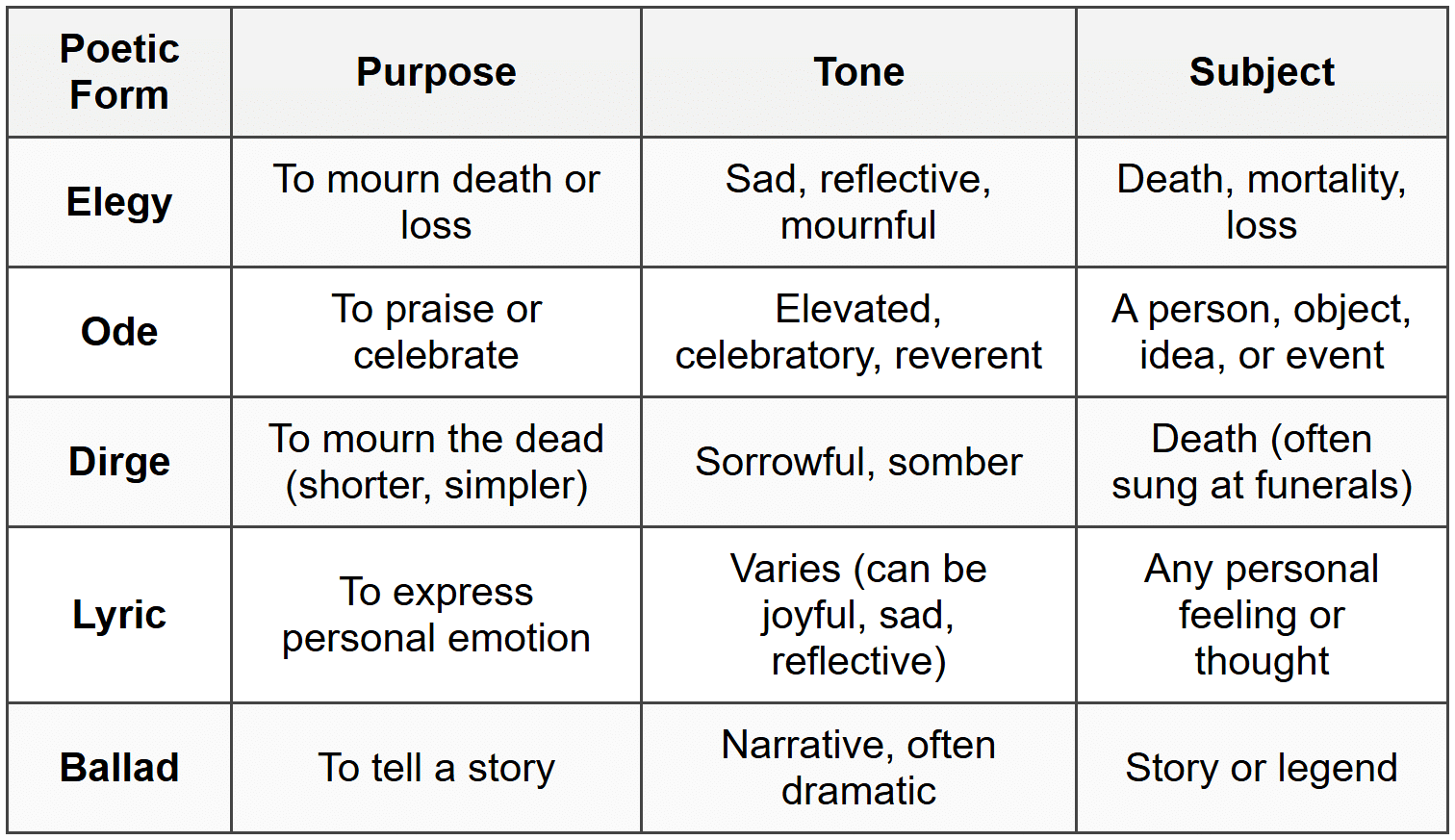
Important Note: While both elegies and dirges mourn the dead, a dirge is shorter, simpler, and often meant to be sung or chanted at funerals. An elegy is longer, more reflective, and literary in nature.
Common Themes in Elegies
JAMB may ask you to identify themes in a given elegiac passage. Familiarize yourself with these recurring themes:
- Mortality: Reflection on the inevitability of death
- Grief and Sorrow: Expression of deep sadness over loss
- Memory: Celebration of the life and virtues of the deceased
- Transience: Acknowledgment of life's fleeting nature
- Consolation: Attempts to find comfort or acceptance
- Legacy: Reflection on what the deceased left behind
- Nature: Use of natural imagery to reflect on life and death
Structure and Language of Elegies
Structural Features
While elegies do not follow a rigid structural pattern like sonnets or haikus, they often share certain organizational features:
- Lament: The opening section expresses grief and sorrow
- Praise: The middle section celebrates the life and virtues of the deceased
- Consolation: The closing section seeks comfort, acceptance, or philosophical resolution
Example:
A poet begins by describing the pain of loss, then recalls the good deeds and character of the deceased, and finally finds solace in the belief that the deceased now rests peacefully.
Language and Tone
Elegies employ specific linguistic and tonal qualities:
- Formal and dignified language: Elegies use elevated diction to honor the deceased
- Imagery of nature: References to seasons, flowers, sunsets, and darkness are common
- Metaphors and symbols: Death may be symbolized by night, sleep, or a journey
- Melancholic tone: The mood is consistently sorrowful or reflective
- Philosophical reflection: Questions about life, death, and meaning are explored
Example of Language:
"The autumn leaves fall silent on his grave, as nature herself weeps for the passing of such grace."
How JAMB Tests Elegies
Understanding how JAMB frames questions about elegies will help you answer confidently. The exam typically tests:
- Identification: Recognizing a poem as an elegy based on content and tone
- Theme recognition: Identifying themes like mortality, grief, or consolation
- Purpose and tone: Determining the poet's intention and emotional mood
- Comparison: Distinguishing elegies from odes, dirges, or lyrics
- Interpretation: Understanding the meaning of specific lines or stanzas in elegiac poems
Common JAMB Question Patterns
Pattern 1: You are given a poem excerpt and asked to identify its type. Look for words like "mourn," "death," "grief," "loss," and a sad tone to identify an elegy.
Pattern 2: You are asked about the theme or purpose of an elegiac passage. Focus on expressions of sorrow, praise for the deceased, or reflections on mortality.
Pattern 3: You must distinguish between similar forms. Remember: elegies mourn death with reflection, odes celebrate with praise, and dirges are short funeral songs.
Worked Examples
Q1: Read the following excerpt and identify the poetic form:
"Gone are the days when laughter filled these halls,
Now silence reigns where once bright joy did dwell.
Your gentle spirit answered mercy's calls,
And now in peace, dear friend, forever dwell."
(a) Ode
(b) Ballad
(c) Elegy
(d) Sonnet
Ans: (c)
Explanation: This excerpt mourns the death of a friend, reflecting on the loss and acknowledging the deceased's virtues. The tone is sad and reflective, and the subject is death. These are defining features of an elegy. An ode would celebrate rather than mourn, a ballad would tell a story, and while the form might resemble a sonnet, the content clearly marks it as an elegy.
Q2: Which of the following best describes the primary purpose of an elegy?
(a) To narrate a heroic story
(b) To express personal love and affection
(c) To mourn the dead and reflect on loss
(d) To celebrate a joyful occasion
Ans: (c)
Explanation: The primary purpose of an elegy is to mourn the dead and reflect on loss. Option (a) describes an epic or ballad, option (b) describes a love lyric, and option (d) describes an ode or celebratory poem. Only option (c) accurately captures the essence of an elegy.
Q3: Which of the following themes is most commonly explored in elegies?
(a) Romantic love
(b) Mortality and transience
(c) Political revolution
(d) Adventure and exploration
Ans: (b)
Explanation: Mortality and transience are central themes in elegies, as these poems reflect on death and the fleeting nature of life. Romantic love is typical of love lyrics, political revolution may appear in protest poetry, and adventure is characteristic of ballads or epics. Elegies focus on death and loss, making option (b) the correct answer.
Quick Summary
- An elegy is a mournful poem that laments death or significant loss
- The tone is sad, reflective, and melancholic
- Common themes: mortality, grief, memory, transience, consolation
- Elegies often follow a three-part structure: lament, praise, consolation
- Personal elegies mourn individuals; pastoral elegies use rural imagery; public elegies mourn public figures
- Distinguish elegies from odes (celebratory), dirges (short funeral songs), and lyrics (general personal emotion)
- Language in elegies is formal, dignified, and filled with natural imagery
- JAMB tests your ability to identify elegies, recognize themes, and distinguish them from similar forms
- Look for keywords like mourn, death, grief, loss, memory when identifying elegies in exam passages
Practice Questions
Q1: Which of the following best defines an elegy?
(a) A poem that tells a heroic story
(b) A poem that mourns death or loss
(c) A poem that praises nature
(d) A poem that narrates a love affair
Q2: Read the lines below:
"The shepherd sleeps beneath the willow tree,
His flute now silent, stilled by death's cold hand.
The fields he loved lie bare for all to see,
And sorrow spreads across this lonely land."
The poem above is an example of:
(a) Pastoral elegy
(b) Epic
(c) Ode
(d) Ballad
Q3: What is the primary difference between an elegy and a dirge?
(a) An elegy is joyful, while a dirge is sad
(b) An elegy is reflective and literary, while a dirge is short and meant for funerals
(c) An elegy celebrates life, while a dirge mourns death
(d) There is no difference
Q4: Which tone is most characteristic of an elegy?
(a) Joyful and celebratory
(b) Sad and reflective
(c) Humorous and light
(d) Angry and accusatory
Q5: In an elegy, the section where the poet seeks comfort or philosophical resolution is called:
(a) Lament
(b) Praise
(c) Consolation
(d) Celebration
Q6: Which of the following is NOT a common theme in elegies?
(a) Mortality
(b) Grief
(c) Adventure
(d) Memory
Answer Key and Explanations
Q1: Ans: (b)
An elegy is defined as a poem that mourns death or loss. Option (a) describes an epic, option (c) may describe a nature ode, and option (d) describes a love lyric or narrative poem.
Q2: Ans: (a)
The poem uses pastoral imagery (shepherd, fields, willow tree) and mourns the death of the shepherd. This makes it a pastoral elegy. It is not an epic, ode, or ballad because it does not narrate a heroic story, celebrate, or tell a tale in narrative form.
Q3: Ans: (b)
An elegy is reflective, literary, and longer, while a dirge is a short, simple funeral song or chant. Option (a) is incorrect because both are sad. Option (c) reverses their purposes. Option (d) is incorrect because there is a clear difference.
Q4: Ans: (b)
The tone of an elegy is sad and reflective, as it mourns death and contemplates loss. Options (a), (c), and (d) do not match the mournful nature of elegies.
Q5: Ans: (c)
The consolation section is where the poet seeks comfort, acceptance, or philosophical resolution. Lament expresses grief, praise honors the deceased, and celebration is not a typical section in an elegy.
Q6: Ans: (c)
Adventure is not a common theme in elegies. Elegies focus on mortality, grief, and memory. Adventure is more typical of epics, ballads, or narrative poems.



