Foreshadowing


Foreshadowing is one of the most commonly tested literary devices in JAMB English Language, especially in comprehension and prose passages. It refers to the technique authors use to give hints or clues about what will happen later in a story. Understanding how to identify and interpret foreshadowing will help you answer questions on plot development, authorial technique, and textual inference with confidence. In this chapter, you will learn what foreshadowing is, how it works, the different types, how to spot it in passages, and how JAMB tests this concept in exam questions.
Key Concepts and Definitions
What Is Foreshadowing?
Foreshadowing is a literary device in which a writer gives an advance hint or clue about events that will occur later in the story. It prepares the reader for what is coming without revealing too much too soon.
Purpose of Foreshadowing:
- To build suspense and tension
- To prepare the reader emotionally for future events
- To make the story more coherent and unified
- To create dramatic irony (when readers know something characters do not)
- To enhance the reader's engagement with the plot
Example:
In a story, if a character repeatedly mentions that he never learned to swim, and the story later involves a boat accident, the earlier mention is foreshadowing.
How Foreshadowing Differs From Other Devices
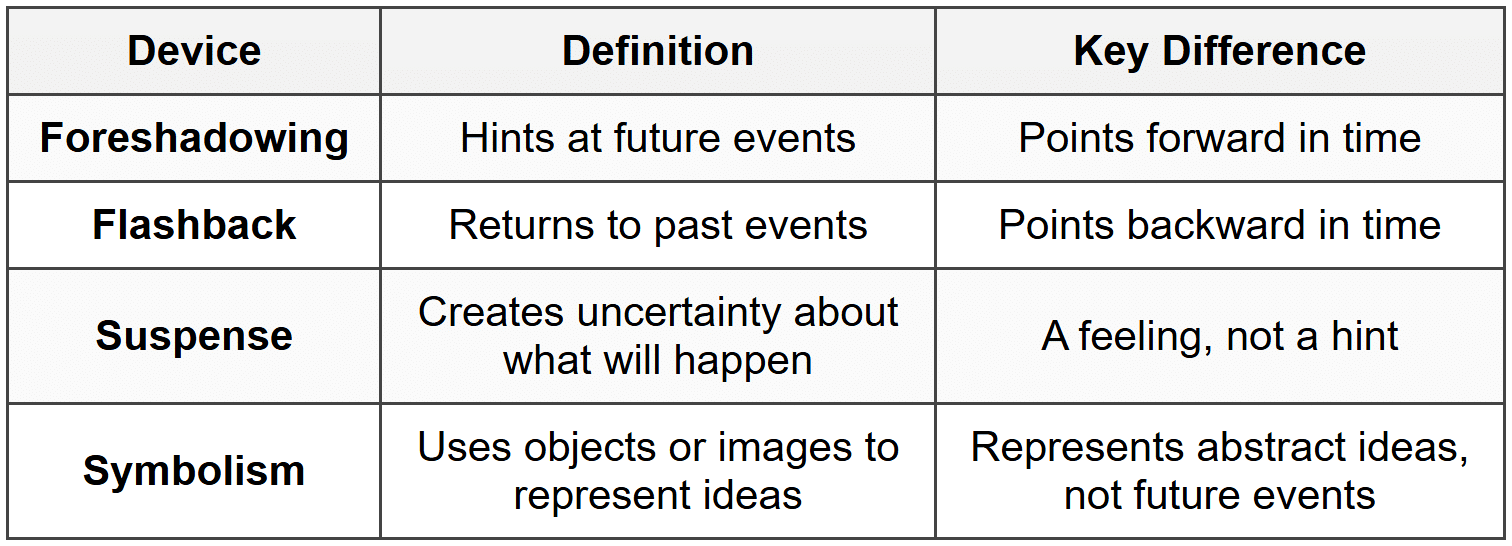
JAMB often confuses students by asking them to distinguish foreshadowing from suspense or symbolism. Remember: foreshadowing is always about hinting at the future.
Types of Foreshadowing
Understanding the different types helps you identify foreshadowing more accurately in passages.
1. Direct (Overt) Foreshadowing
The author or narrator explicitly tells the reader what will happen. This is less subtle.
Example:
"Little did Chidi know that his decision to trust his friend would lead to his greatest regret."
Here, the narrator directly states that something bad will happen because of Chidi's trust.
2. Indirect (Covert) Foreshadowing
The author uses subtle clues, symbols, or dialogue that hint at future events without stating them outright. This type is more common in literature.
Example:
"As Ada walked into the dark room, she noticed the photograph of her mother was broken and lying face down on the table."
The broken photograph may foreshadow danger, loss, or conflict involving Ada's mother.
3. Prophecy or Prediction
A character makes a prediction or receives a prophecy that later comes true.
Example:
"The herbalist warned Emeka: 'Beware of a man in a red cap.' Days later, Emeka was betrayed by his uncle, who always wore a red cap."
4. Symbolic Foreshadowing
Objects, weather, or settings are used symbolically to suggest future events.
Example:
"Storm clouds gathered over the village on the morning of the wedding."
The storm clouds may symbolize trouble or conflict ahead in the marriage or ceremony.
5. Chekhov's Gun
This principle states that if a significant object or detail is mentioned early in a story, it must be used later. Otherwise, it should not be mentioned at all.
Example:
If a gun is shown hanging on the wall in Chapter 1, it must be fired by the end of the story. The early mention is foreshadowing.
Common Features of Foreshadowing in JAMB Passages
- Weather descriptions: storms, dark skies, or sudden cold often hint at conflict or disaster
- Dialogue: a character's warning, offhand comment, or prophecy
- Character behavior: nervousness, hesitation, or unease before a major event
- Objects or images: broken mirrors, dead birds, blood, wilted flowers
- Narrator's tone: ominous or foreboding language
Rules and Explanations
How to Identify Foreshadowing in a Passage
Follow these steps when you encounter a passage in JAMB:
- Read the passage carefully: Foreshadowing is often subtle and easy to miss on a quick read.
- Look for unusual details: If the author emphasizes something that seems irrelevant at the moment, it may be foreshadowing.
- Pay attention to tone: Words like "ominous," "foreboding," "little did he know," or "unaware of what awaited" signal foreshadowing.
- Check for repetition: If a detail or phrase is repeated, it likely has future significance.
- Watch character reactions: If a character feels uneasy or warns another, it may hint at coming trouble.
- Connect early and late events: After reading the passage, ask yourself if any early detail connects to a later outcome.
Common JAMB Question Patterns on Foreshadowing
JAMB typically asks foreshadowing questions in these ways:
- "The phrase '...' in paragraph 2 foreshadows..."
- "The author's description of the weather suggests that..."
- "The mention of ... early in the passage hints at..."
- "Which of the following best explains the significance of ... in the story?"
- "The function of the dialogue in lines ... is to..."
In these questions, you must identify what is being hinted at, not just what is stated directly.
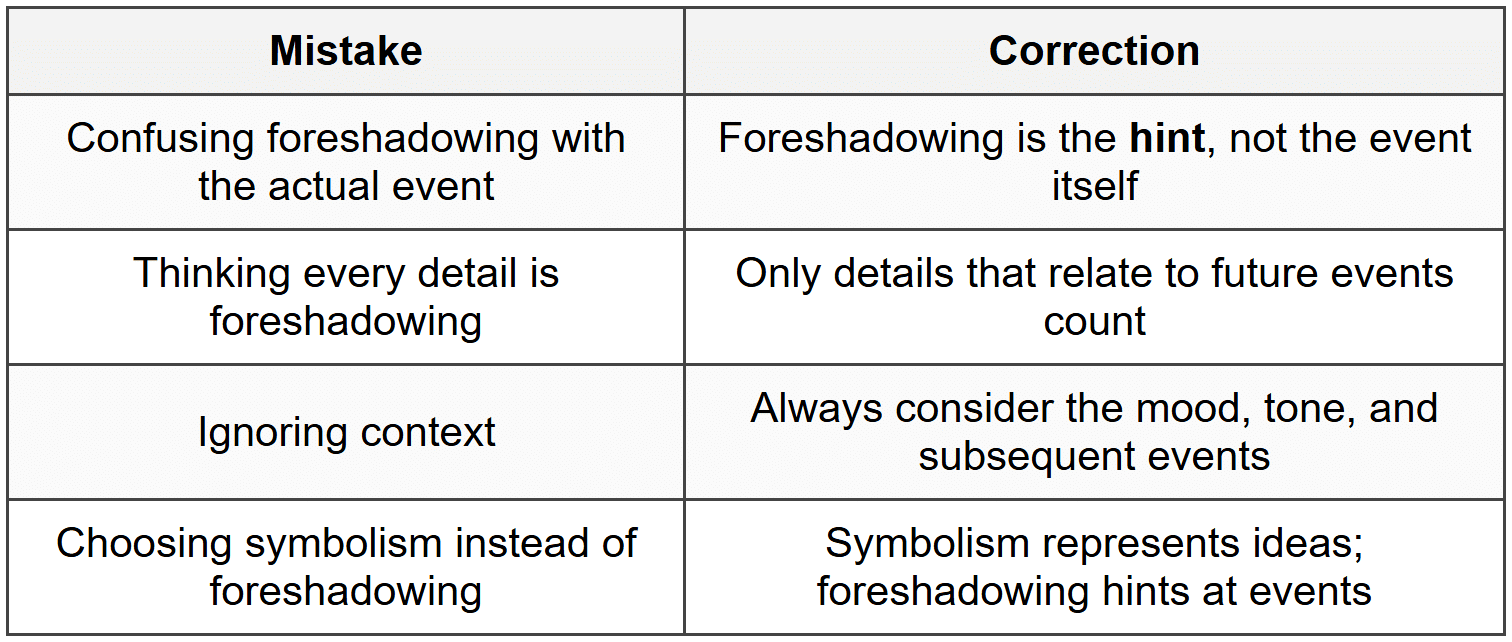
Mistakes Students Make
Worked Examples
Q1: Read the passage below and answer the question that follows.
"Taiwo walked briskly to the market that morning, whistling a cheerful tune. However, as she passed the old baobab tree at the edge of the village, a cold wind suddenly blew, and a crow perched on the lowest branch cawed loudly. She shivered and quickened her pace, but she could not shake the uneasy feeling that crept over her."
The description of the cold wind and the crow's caw serves to:
(a) Symbolize Taiwo's happiness
(b) Foreshadow an unfortunate event
(c) Describe the beauty of the village
(d) Show that Taiwo is superstitious
Ans: (b)
Explanation:
The passage describes Taiwo feeling cheerful initially, but the sudden cold wind and the crow's caw create an ominous mood. These details do not match her happiness, nor do they describe the village's beauty. They are classic symbols of bad omens in literature and serve to hint that something unfortunate will happen to Taiwo later. The unease she feels reinforces this foreshadowing. Option (d) is a distraction; the passage does not say Taiwo is superstitious-it simply uses these images to hint at trouble ahead.
Q2: In a story, a character says, "I have never been late to an important appointment in my entire life." Later in the story, she misses a job interview because of a traffic jam.
The character's earlier statement is an example of:
(a) Irony
(b) Foreshadowing
(c) Flashback
(d) Hyperbole
Ans: (b)
Explanation:
The character's statement about never being late hints at (foreshadows) the later event where she actually is late. This is indirect foreshadowing because the statement draws attention to punctuality, making the reader anticipate or expect something related to lateness. While the situation also involves irony (the opposite of what she claimed happens), the question asks about the function of the earlier statement, which is to foreshadow the future event. Flashback refers to past events, and hyperbole is exaggeration, which may be present but is not the main literary device at work here.
Q3: "The knife lay on the kitchen table, gleaming in the afternoon light. No one had touched it in weeks, but it seemed to call out to whoever passed by."
The detailed description of the knife in the passage suggests that:
(a) The knife is very expensive
(b) The knife will play an important role later
(c) The narrator is fond of kitchen utensils
(d) Someone cleaned the knife recently
Ans: (b)
Explanation:
This is an example of Chekhov's Gun-when an object is given unusual or detailed attention early in a narrative, it signals that the object will be significant later. The knife is described as gleaming and almost alive ("seemed to call out"), which draws the reader's focus to it. This is foreshadowing that the knife will be used in a future event, likely one involving violence or conflict. Options (a), (c), and (d) are not supported by the passage and do not explain why the author chose to highlight the knife in such a vivid way.
Quick Summary
- Foreshadowing is a literary device that hints at future events in a story.
- It builds suspense, prepares readers emotionally, and makes plots more unified.
- Direct foreshadowing: the author or narrator explicitly states what will happen.
- Indirect foreshadowing: subtle clues through dialogue, imagery, symbols, or tone.
- Prophecy: a character predicts what will happen.
- Symbolic foreshadowing: weather, objects, or settings hint at future events.
- Chekhov's Gun: any significant object mentioned early must be used later.
- Common clues: ominous tone, unusual details, weather changes, character unease, repeated objects or phrases.
- JAMB questions ask you to identify what is being hinted at, not just what is directly stated.
- Do not confuse foreshadowing with flashback, suspense, or symbolism.
- Foreshadowing always points forward in time.
- Pay attention to context, tone, and later events when identifying foreshadowing.
Practice Questions (MCQs)
Q1: "As Kunle prepared to leave for Lagos, his grandmother held his hand tightly and whispered, 'May you return safely.' Her eyes were filled with tears."
The grandmother's statement and behavior suggest:
(a) She is very emotional by nature
(b) Kunle is going on a dangerous journey
(c) She does not want Kunle to travel
(d) Kunle will not return safely
Q2: In a novel, the author writes: "The clock on the wall had stopped at exactly 3:15 p.m. Nobody noticed it then, but later, everyone would remember."
This statement is an example of:
(a) Flashback
(b) Foreshadowing
(c) Simile
(d) Personification
Q3: "The sky was unusually bright that morning, and the birds sang louder than ever. It was as if nature itself was celebrating."
This description most likely foreshadows:
(a) A tragedy
(b) A joyful event
(c) A storm
(d) A funeral
Q4: A character in a story repeatedly says, "I trust my brother with my life." Later, the brother betrays him.
The repeated statement serves to:
(a) Show the character's foolishness
(b) Foreshadow the betrayal
(c) Prove the brother's loyalty
(d) Create suspense only
Q5: "The old woman had warned them never to open the red box in the attic. But curiosity got the better of them."
The warning about the red box is an example of:
(a) Irony
(b) Foreshadowing
(c) Metaphor
(d) Climax
Q6: In a passage, the narrator says, "If only she had known what awaited her at the end of that road, she would have turned back."
This statement primarily functions to:
(a) Create suspense and foreshadow danger
(b) Describe the character's ignorance
(c) Show the narrator's sympathy
(d) Provide background information
Answer Key and Explanations
Q1: Ans: (d)
The grandmother's tearful eyes and plea for Kunle to return safely hint strongly that something unfortunate may happen to him. This is indirect foreshadowing. While (b) suggests danger, (d) is more precise because the grandmother's emotional reaction foreshadows that Kunle may not return, which is the central hint. Option (a) is too general and ignores the foreshadowing function. Option (c) is not supported-she does not stop him from leaving.
Q2: Ans: (b)
The phrase "later, everyone would remember" clearly signals that the stopped clock will become significant in future events. This is direct foreshadowing because the narrator tells us outright that the detail will matter later. Flashback refers to past events, simile involves comparison using "like" or "as," and personification gives human traits to non-human things.
Q3: Ans: (b)
Bright skies and singing birds are positive images that typically foreshadow joyful or celebratory events. The phrase "as if nature itself was celebrating" supports this. A tragedy or funeral would more likely be foreshadowed by dark skies or ominous weather. A storm would be foreshadowed by gathering clouds, not brightness.
Q4: Ans: (b)
Repetition of trust before betrayal is a classic foreshadowing technique. The repeated statement draws attention to the relationship and prepares the reader for the twist. While the character may appear foolish in hindsight, the literary function of the repetition is to foreshadow the betrayal, not to highlight foolishness. Suspense is a result, but foreshadowing is the device being used.
Q5: Ans: (b)
The old woman's warning is a clear hint that opening the red box will lead to negative consequences. This is direct foreshadowing through prophecy or warning. Irony involves a contrast between expectation and reality. Metaphor is a direct comparison without "like" or "as." Climax is the turning point of a story, not a hint about future events.
Q6: Ans: (a)
The phrase "if only she had known" tells the reader that something bad awaits the character at the end of the road. This creates both suspense (uncertainty about what will happen) and foreshadows danger (hints at a negative outcome). While it may show the narrator's sympathy or the character's ignorance, the primary literary function is to build suspense and hint at future trouble, which is foreshadowing.



