Paradox


Paradox is one of the most fascinating literary devices you'll encounter in JAMB English, and examiners love testing it because it challenges your critical thinking. At first glance, a paradox appears to contradict itself, yet beneath the surface lies a deeper truth. Understanding how to identify and interpret paradoxes will help you tackle literature passages, comprehension questions, and literary appreciation sections with confidence.
Key Concepts and Definitions
What is a Paradox?
A paradox is a statement that seems self-contradictory or absurd but contains a hidden truth when examined more closely. It combines opposing ideas that initially appear impossible but reveal meaningful insight upon reflection.
Key characteristics of a paradox:
- Contains two contradictory elements in one statement
- Seems illogical or impossible at first reading
- Reveals deeper truth or wisdom when analyzed
- Used deliberately by writers to provoke thought
- Different from simple contradiction or error
Simple Examples of Paradox
Example 1: "Less is more"
This seems contradictory because less and more are opposites. However, the deeper meaning is that simplicity often achieves better results than complexity.
Example 2: "The beginning of the end"
How can something begin and end simultaneously? The paradox reveals that some events mark both a start and a conclusion of different phases.
Example 3: "I must be cruel to be kind"
Cruelty and kindness oppose each other, yet sometimes harsh truth or discipline serves a loving purpose.
Example 4: "The child is father to the man"
A child cannot literally father an adult, but childhood experiences shape adult personality-the child creates the man.
Paradox vs Similar Literary Devices
JAMB frequently tests your ability to distinguish paradox from related concepts. Here's a clear comparison:
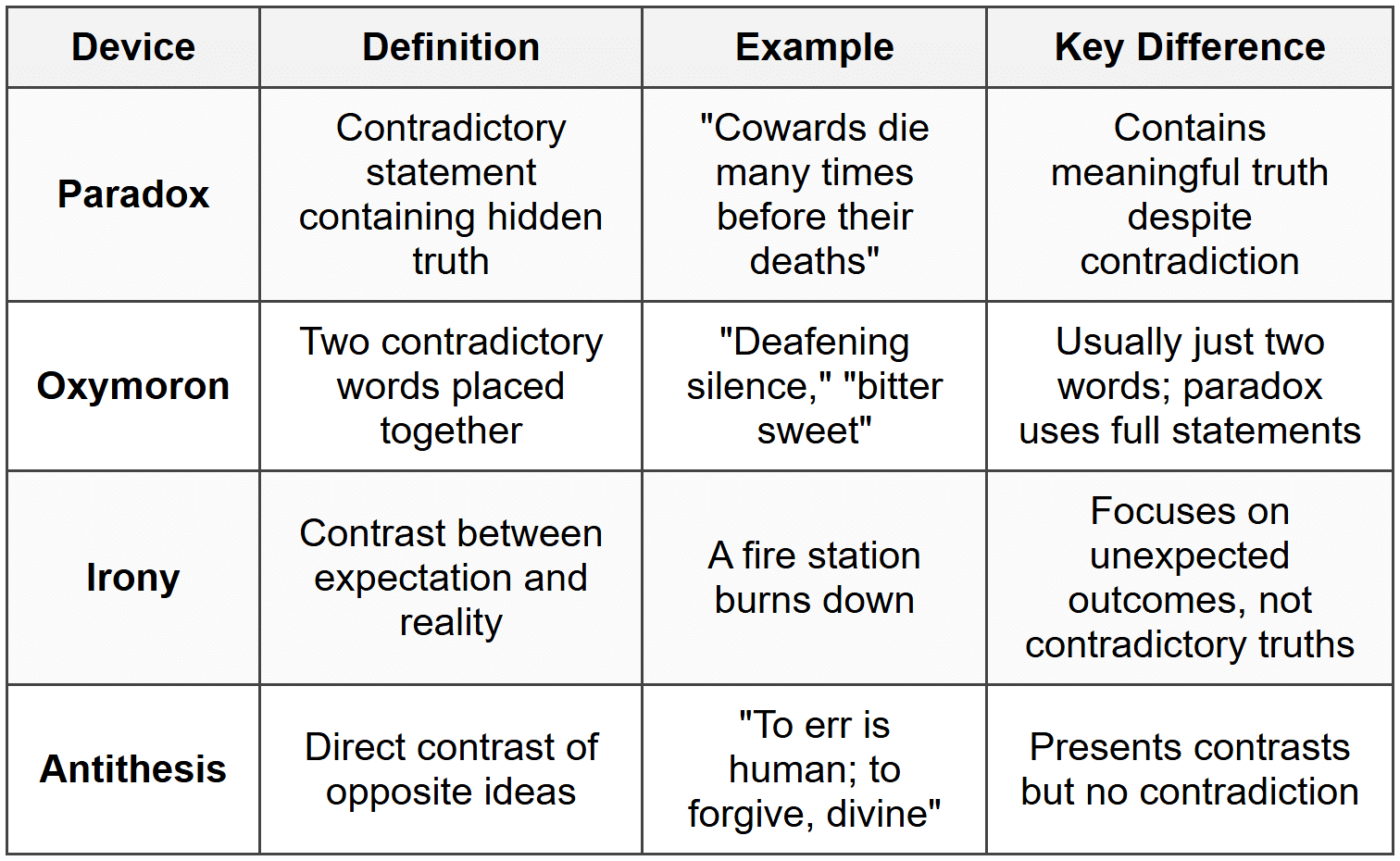
Types of Paradox
Situational Paradox
This involves contradictory circumstances or events that surprisingly coexist.
Example: A student who studies less but scores higher than one who studies more. The paradox lies in the unexpected result that contradicts normal expectations.
Literary Paradox
Writers deliberately craft paradoxical statements to convey complex truths about life, human nature, or society.
Example from literature: "War is peace" (from George Orwell's 1984). This reveals how totalitarian governments manipulate language and truth.
Logical Paradox
These involve self-referential contradictions that challenge logical thinking.
Example: "This statement is false." If it's true, then it's false. If it's false, then it's true.
Rules and Explanations
How to Identify Paradox in JAMB Passages
Step 1: Look for statements that combine contradictory terms or ideas (words like "sweet pain," "living death," "wise fool").
Step 2: Check if the statement seems impossible or illogical at surface level.
Step 3: Ask yourself: "Does this contradiction reveal a deeper truth?" If yes, it's likely a paradox.
Step 4: Distinguish it from mere contradiction-paradox always contains wisdom or insight.
Common Paradoxical Expressions
JAMB often uses these well-known paradoxes in comprehension and literature sections:
- "I can resist anything except temptation" - Shows human weakness through contradiction
- "The more you learn, the more you realize you don't know" - Knowledge reveals ignorance
- "Nobody goes to that restaurant anymore; it's too crowded" - Logic collapses on itself
- "You must spend money to save money" - Investment paradox
- "The only constant is change" - Permanence of impermanence
- "Silence speaks louder than words" - Non-communication communicates
Why Writers Use Paradox
Understanding authorial purpose helps you answer questions about why a writer employs paradox:
- To capture complex truths: Some realities cannot be expressed through simple statements
- To provoke thought: Contradictions force readers to think deeply
- To create memorable expressions: Paradoxes stick in memory because they're unusual
- To reveal irony in life: Many life situations are inherently contradictory
- To challenge conventional thinking: Questions assumptions and common beliefs
Interpreting Paradox Correctly
JAMB questions often ask what a paradoxical statement means. Follow this approach:
Interpretation Framework:
- Identify the two contradictory elements
- Explain why they seem to contradict each other
- Reveal the underlying truth that resolves the contradiction
- Connect to the broader context (if in a passage)
Example Application:
"Make haste slowly"
Contradictory elements: Haste (speed) vs. slowly (lack of speed)
Surface contradiction: Cannot be fast and slow simultaneously
Hidden truth: Working carefully and thoughtfully (slowly) often produces faster overall results than rushing and making mistakes
Meaning: Balance urgency with careful planning
Common JAMB Question Patterns
Examiners test paradox through these typical question formats:
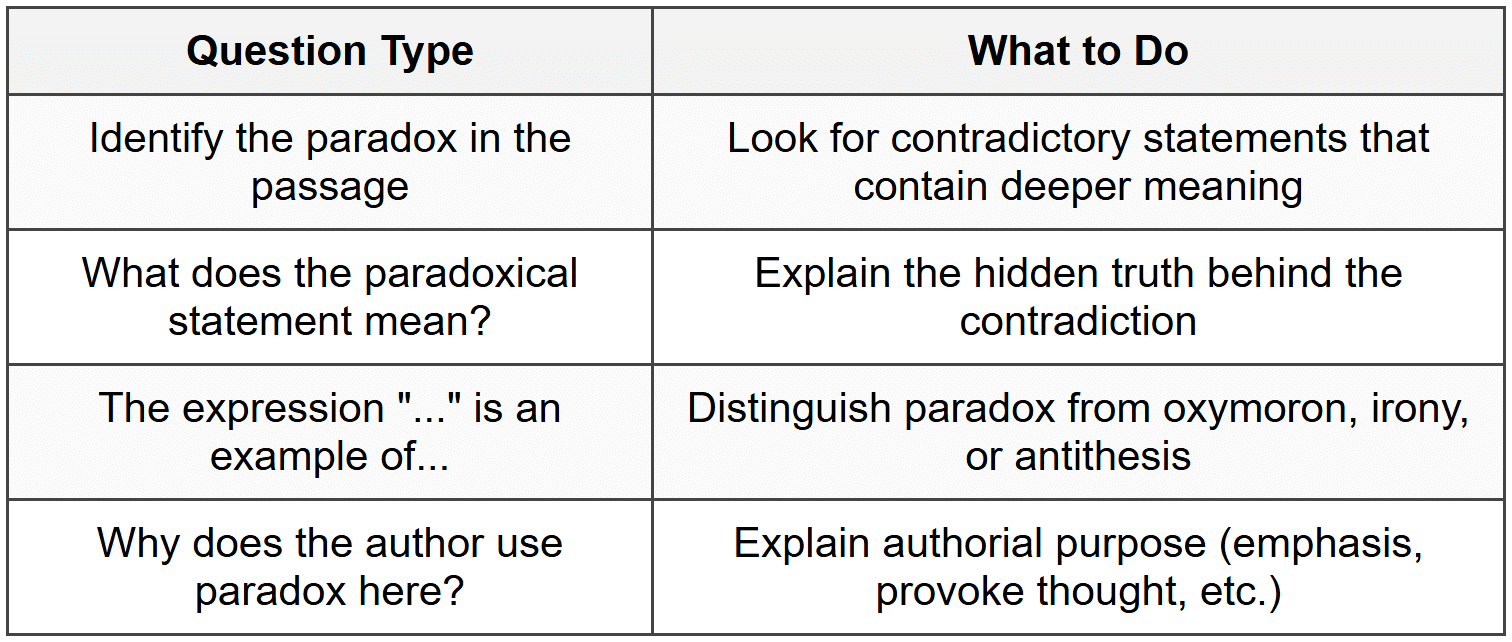
Worked Examples
Q1: Read the following statement: "The man was alone in the crowded marketplace." This statement is best described as:
(a) An oxymoron
(b) A paradox
(c) An antithesis
(d) A metaphor
Ans: (b)
Explanation: This is a paradox because it presents a contradictory situation-how can someone be alone while surrounded by crowds? The deeper truth is that physical proximity doesn't prevent emotional isolation. A person can feel lonely despite being among many people. This isn't an oxymoron (which would be just two words like "alone together"), nor antithesis (which would directly contrast two ideas without contradiction), nor metaphor (which makes implicit comparison). The full contradictory statement revealing psychological truth makes it a paradox.
Q2: In the passage below, identify the paradox:
"The athlete trained for years to achieve his dream. When victory finally came, he felt empty. Success, he discovered, was his greatest failure."
Which statement contains the paradox?
(a) "The athlete trained for years"
(b) "When victory finally came, he felt empty"
(c) "Success was his greatest failure"
(d) "He discovered"
Ans: (c)
Explanation: "Success was his greatest failure" is the paradox because it directly contradicts itself-success and failure are opposites, yet the statement equates them. The hidden truth is that achieving his goal left him unfulfilled, making the success feel like failure. Option (b) is ironic but not paradoxical-it presents unexpected emotion, not self-contradiction. Options (a) and (d) contain no contradiction at all. Only option (c) combines contradictory terms to reveal a deeper truth about the hollowness of achievement without meaning.
Q3: "I must go down to the seas again, to the lonely sea and the sky,
And all I ask is a tall ship and a star to steer her by."
The poet later writes: "The sea called me to freedom, and I became its willing prisoner."
What does the paradox "willing prisoner" suggest?
(a) The speaker is confused about his feelings
(b) The sea physically captured him
(c) He chose to be bound by his love for the sea
(d) He was forced to sail against his will
Ans: (c)
Explanation: "Willing prisoner" is paradoxical because prisoners are typically unwilling captives, yet this one is willing. The deeper meaning is that the speaker freely chooses to be bound by his passion for the sea-he's captivated by something he loves. This is not confusion (option a), not literal capture (option b), and not force (option d). The paradox reveals that we can be both free (willing) and bound (prisoner) when we're devoted to something we love. Our choices can create their own constraints, and we embrace those constraints gladly.
Quick Summary
- Paradox is a self-contradictory statement that reveals hidden truth
- Always contains two opposing elements that seem impossible together
- Different from oxymoron (just two words) and irony (unexpected outcomes)
- Not a simple error or mistake-deliberately crafted for effect
- Common examples: "less is more," "cruel to be kind," "alone in a crowd"
- Writers use paradox to provoke thought and express complex truths
- To identify paradox: find contradiction + look for deeper meaning
- To interpret: explain contradiction, then reveal underlying truth
- JAMB tests recognition, interpretation, and distinction from similar devices
- Situational paradox: contradictory circumstances
- Literary paradox: crafted statements in writing
- Always ask: "What truth lies beneath this contradiction?"
Practice Questions
Q1: Which of the following is an example of paradox?
(a) "The classroom was as silent as a graveyard"
(b) "I'm dying of laughter"
(c) "Her voice was music to my ears"
(d) "He ran faster than the wind"
Q2: "The wound is the place where the Light enters you." This statement is paradoxical because:
(a) Wounds are painful experiences
(b) Light cannot literally enter through wounds
(c) Suffering (wound) is presented as creating opportunity (light entry)
(d) It uses metaphorical language
Q3: In the sentence "The more things change, the more they stay the same," what deeper truth does the paradox reveal?
(a) Nothing ever really changes
(b) Everything changes constantly
(c) Fundamental patterns persist despite surface transformations
(d) Change is an illusion
Q4: Which statement below is NOT a paradox?
(a) "I am nobody"
(b) "The silence was deafening"
(c) "It was the best of times, it was the worst of times"
(d) "He walked slowly down the long road"
Q5: "The exam was so easy, it was difficult." What makes this statement paradoxical?
(a) Easy and difficult are opposites used together
(b) The exam was very hard
(c) The student was confused
(d) It contains two adjectives
Q6: Read the passage:
"Chief Adewale was known throughout the village as an honest thief. He stole from corrupt politicians and distributed the wealth to the poor, breaking the law to uphold justice."
The phrase "honest thief" functions as:
(a) A metaphor showing his character
(b) An ironic description of his actions
(c) A paradox revealing his moral complexity
(d) An antithesis contrasting two ideas
Answer Key and Explanations
Q1: Ans: (b)
"I'm dying of laughter" is a paradox because dying (ending life) contradicts laughter (expression of joy and life). The deeper truth is that laughter can be so intense it feels overwhelming. Option (a) is a simile, (c) is a metaphor, and (d) is hyperbole-none contains self-contradiction revealing deeper truth.
Q2: Ans: (c)
The paradox works because wounds represent pain and damage, while light represents growth and enlightenment. The contradiction reveals that suffering can create openings for wisdom and transformation. Option (b) addresses literal impossibility but misses the deeper meaning. Options (a) and (d) are true but don't explain the paradoxical nature.
Q3: Ans: (c)
This paradox reveals that while specific details and circumstances change constantly, underlying human nature, social patterns, and fundamental realities remain consistent. Option (a) is too absolute, (b) ignores the "stay the same" part, and (d) denies change entirely. The truth lies in recognizing both change and continuity simultaneously.
Q4: Ans: (d)
"He walked slowly down the long road" contains no contradiction-it's a straightforward statement. Option (a) is paradoxical (being nobody while being somebody), (b) is paradoxical (silence cannot literally deafen), and (c) is paradoxical (same time period being both best and worst). Only (d) lacks the contradictory elements essential to paradox.
Q5: Ans: (a)
The statement is paradoxical specifically because it combines opposite qualities (easy/difficult) in a way that seems impossible yet reveals truth-perhaps the ease made students careless, or the simplicity concealed subtle traps. While option (a) simply states the opposition exists, this is what creates the paradox. Options (b), (c), and (d) don't explain the paradoxical mechanism.
Q6: Ans: (c)
"Honest thief" is a paradox because honesty and theft are morally opposite, yet the phrase reveals his complex character-criminal actions serving moral purposes. This isn't simple metaphor (a), though metaphorical elements exist. It's not just irony (b), which would focus on unexpected outcomes rather than contradictory character. It's not antithesis (d), which would contrast ideas without claiming they exist simultaneously in one person. The paradox captures moral ambiguity and ethical complexity.



