Satire


Satire is one of the most commonly tested literary devices in the JAMB English Language exam, appearing frequently in comprehension passages, poetry, and prose. Understanding satire isn't just about recognizing humour-it's about identifying the writer's deeper purpose of criticizing society, exposing foolishness, or calling for reform. In this chapter, you'll learn what satire is, its types, techniques, how to identify it in passages, and exactly how JAMB tests your knowledge of it.
Key Concepts and Definitions
What is Satire?
Satire is a literary technique where a writer uses humour, irony, exaggeration, or ridicule to expose and criticize people's stupidity, vices, corruption, or shortcomings, especially in the context of politics, society, and contemporary issues. The main purpose is not just to entertain, but to bring about change or awareness.
Example: A writer who describes a corrupt politician as "a generous man who kindly accepts gifts from everyone" is using satire. The humour lies in the irony-the politician isn't generous; he's greedy and corrupt.
Purpose of Satire
Understanding why writers use satire is crucial for JAMB questions. The purposes include:
- To criticize individuals, institutions, governments, or society
- To expose hypocrisy, corruption, or foolishness
- To entertain while making serious points
- To provoke thought and encourage readers to reflect on issues
- To call for reform or social change
JAMB Tip: When a question asks about the writer's purpose in using satire, look for options that mention criticism, exposure, or reform-not just entertainment.
Satire vs Other Literary Devices
JAMB often tests your ability to distinguish satire from similar devices. Here's a clear comparison:
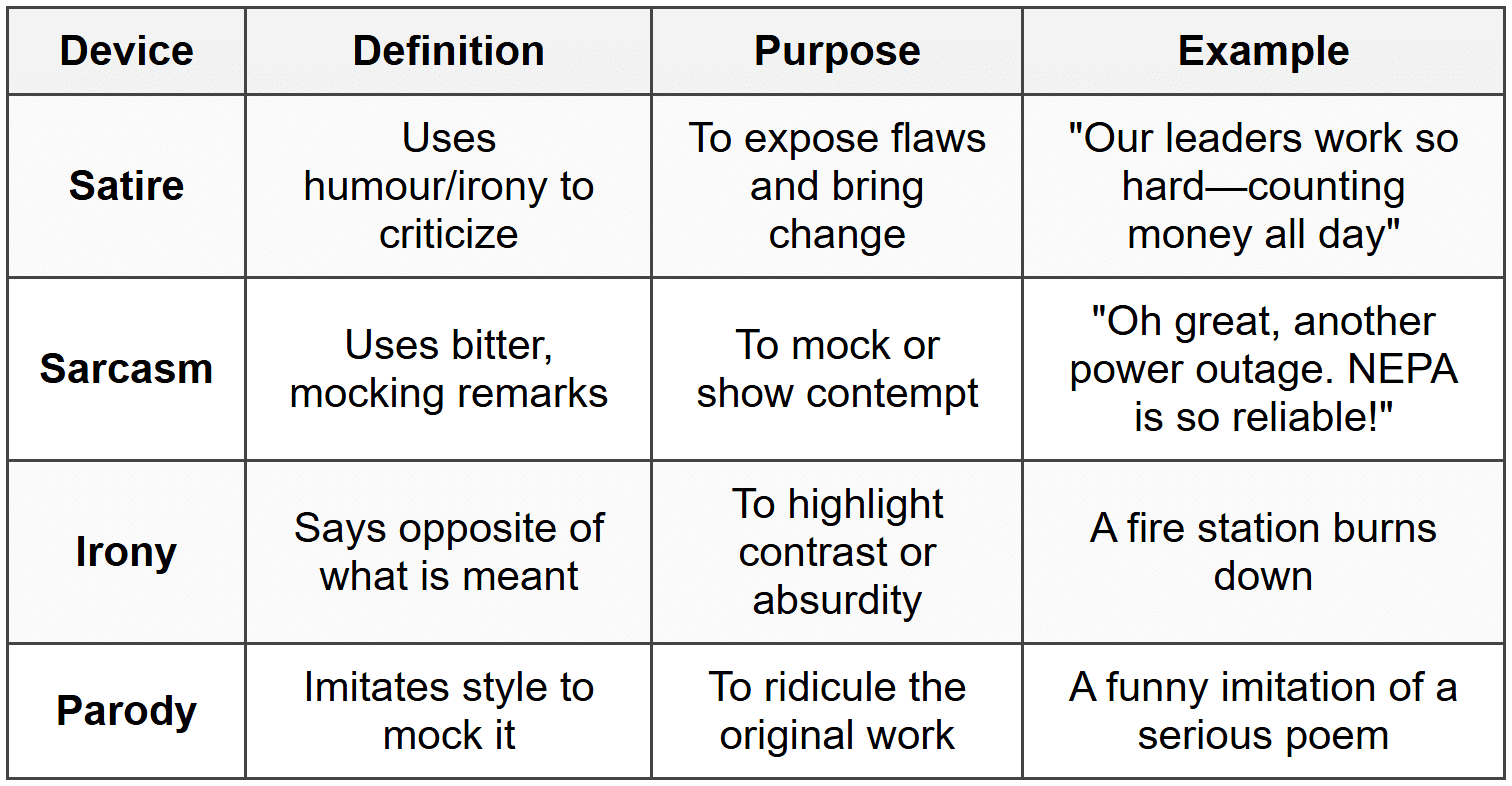
Key Difference: Satire always has a social or moral purpose beyond just making fun. Sarcasm is more personal and bitter. Irony is broader. Parody focuses on imitating a specific work or style.
Types of Satire
JAMB occasionally asks you to identify the type of satire used in a passage. There are three main types:
1. Horatian Satire
This is gentle, light-hearted, and humorous. The writer pokes fun at human folly in a playful way, intending to make people laugh while gently suggesting improvement.
Characteristics:
- Mild tone
- Good-natured mockery
- Seeks to amuse and correct gently
- Focuses on foolishness rather than evil
Example: A writer who gently mocks students who spend hours on social media but complain they have no time to study is using Horatian satire.
2. Juvenalian Satire
This is harsh, bitter, and angry. The writer uses strong language and dark humour to attack serious evils like corruption, injustice, or cruelty. The tone is indignant and condemnatory.
Characteristics:
- Harsh and serious tone
- Attacks vice and crime
- Uses contempt and moral indignation
- Seeks to condemn rather than correct
Example: A writer who bitterly describes how politicians steal public funds while citizens starve, using dark imagery and angry language, is using Juvenalian satire.
3. Menippean Satire
This targets mental attitudes, beliefs, or philosophies rather than individuals. It mocks faulty thinking, dogmas, or intellectual pretensions.
Characteristics:
- Targets ideas and attitudes
- Often uses complex characters
- Less common in JAMB passages
JAMB Focus: Most passages use either Horatian (gentle) or Juvenalian (harsh) satire. Learn to distinguish them by tone-gentle vs bitter.
Techniques Used in Satire
Writers employ various techniques to create satirical effects. JAMB tests your ability to identify these techniques within passages.
1. Irony
Irony is saying the opposite of what you mean. It's the most common satirical technique.
Example: Calling a lazy worker "the most hardworking employee" is ironic satire.
2. Exaggeration (Hyperbole)
Exaggeration means overstating something to ridiculous extremes to make a point.
Example: "The senator's house is so big, it has its own local government area."
3. Understatement
Understatement deliberately represents something as less important than it is, creating ironic effect.
Example: Calling widespread corruption "a small administrative challenge" is satirical understatement.
4. Ridicule
Ridicule means making someone or something appear foolish or contemptible.
Example: Describing a pompous official as "a peacock in borrowed feathers."
5. Parody
Parody imitates the style of someone or something to make fun of it.
Example: Writing a fake government press release full of meaningless jargon to mock poor communication.
6. Juxtaposition
Juxtaposition places contrasting ideas side by side to highlight absurdity.
Example: "While the governor inaugurated a multi-million naira statue, hospital patients died for lack of basic drugs."
7. Wit and Wordplay
Clever use of language, puns, and double meanings to create humorous criticism.
Example: "Our leaders are truly out-standing-they stand outside while the country burns."
How to Identify Satire in Passages
JAMB comprehension passages often contain satirical elements. Follow these steps to identify them:
Step 1: Look for the Tone
Ask yourself: Is the writer being serious, or is there a mocking, ironic, or humorous tone? Satirical passages often have a tone that doesn't match the seriousness of the subject.
Step 2: Identify the Target
What or who is being criticized? Satire always has a target-politicians, social customs, human weaknesses, institutions, etc.
Step 3: Check for Techniques
Look for irony, exaggeration, ridicule, or any of the techniques listed above.
Step 4: Determine the Purpose
Is the writer trying to expose something wrong or call for change? That confirms it's satire, not just humour.
Common JAMB Question Format: "The writer's attitude towards the politician can best be described as..." The answer will often be "satirical," "mocking," "ironic," or "critical."
Satire in Different Genres
Satire in Prose
Satirical prose appears in essays, articles, and fiction. Writers like Jonathan Swift used prose satire extensively. In Nigerian literature, writers often satirize corruption and social issues.
What to look for:
- Ironic descriptions of characters or situations
- Exaggerated portrayals of social problems
- Contrast between what is said and what is meant
Satire in Poetry
Satirical poems use rhythm, imagery, and language to mock their subjects. They may employ humorous rhymes or serious condemnation.
What to look for:
- Mocking tone in the speaker's voice
- Ironic imagery
- Wordplay and puns
Satire in Drama
Satirical plays use dialogue, action, and character to expose social issues. Comedy of manners is a common satirical dramatic form.
What to look for:
- Foolish or hypocritical characters
- Situations that expose social problems
- Ironic dialogue
Common JAMB Exam Patterns on Satire
Understanding how JAMB tests satire helps you prepare effectively. Here are the most common question types:
Pattern 1: Identifying Satirical Tone or Attitude
Question format: "The writer's tone in the passage is..."
Options typically include: satirical, serious, sympathetic, objective, didactic
How to answer: Look for irony, mockery, or criticism. If present, choose "satirical" or related options like "mocking" or "ironic."
Pattern 2: Identifying the Purpose of Satire
Question format: "The writer's main purpose in the passage is to..."
Options typically include: entertain, criticize, inform, describe, argue
How to answer: For satirical passages, the answer is usually "criticize" or "expose" something, not just "entertain."
Pattern 3: Identifying Satirical Techniques
Question format: "The literary device used in the expression '...' is..."
Options typically include: metaphor, irony, hyperbole, personification, satire
How to answer: Identify the specific technique (irony, exaggeration, etc.). Remember that satire is the overall effect, while irony and hyperbole are techniques used to create it.
Pattern 4: Determining the Target of Satire
Question format: "What is the writer criticizing in this passage?"
Options vary based on passage content
How to answer: Identify who or what is being mocked or criticized-usually politicians, social customs, human weaknesses, or institutions.
Rules and Important Points
Rule 1: Satire Must Have a Target
Pure humour without criticism is not satire. There must be a subject being criticized or exposed.
Correct satire: "Our honourable members of parliament are so dedicated-they never miss an opportunity to increase their own salaries."
Not satire (just humour): "The cat chased its tail for ten minutes."
Rule 2: Satire Uses Indirect Criticism
Satire doesn't state criticism directly-it uses irony, humour, or exaggeration.
Direct criticism (not satire): "Politicians are corrupt."
Satirical criticism: "Our politicians are angels-they only steal to feed their extended families of fifty children."
Rule 3: Context Determines Whether Something is Satirical
The same statement can be literal or satirical depending on context and tone.
Literal: "The president works hard" (said admiringly in a positive context).
Satirical: "The president works hard" (said about a lazy leader, clearly ironic).
Rule 4: Satire Often Uses Contrast
Satirists frequently contrast what should be with what is, or what is said with what is meant.
Example: Describing luxurious government buildings while mentioning dilapidated schools creates satirical contrast.
Worked Examples
Q1: Read the following sentence and answer the question.
"Our dear governor has finally visited the state hospital-after all the patients had been secretly moved to create a false impression of adequate healthcare."
The statement above is an example of:
(a) Metaphor
(b) Satire
(c) Personification
(d) Alliteration
Ans: (b) Satire
Explanation: This sentence uses irony and criticism to expose the governor's hypocrisy and the poor state of healthcare. The writer isn't being literal-the phrase "our dear governor" is ironic, and the entire statement mocks the dishonest attempt to hide problems. This is clearly satirical because it criticizes a social/political issue (poor healthcare and government deception) using irony and mockery. It's not metaphor (no comparison), not personification (no human qualities given to non-human things), and not alliteration (no repeated consonant sounds).
Q2: Read the passage below and answer the question.
"The honourable minister arrived at the poverty alleviation programme in his latest Range Rover, worth more than the entire annual budget of the programme. He smiled warmly at the cameras and promised that every poor person would soon drive a car like his."
The writer's attitude towards the minister is:
(a) Sympathetic
(b) Admiring
(c) Satirical
(d) Objective
Ans: (c) Satirical
Explanation: The writer is clearly mocking the minister by highlighting the absurd contrast between his expensive car and a poverty alleviation programme, and the ridiculous promise that poor people will drive such cars. The description isn't neutral (objective) or admiring, and certainly not sympathetic. The ironic tone-showing the minister's hypocrisy and the emptiness of his promises-makes this satirical. The writer is criticizing both the minister's insensitivity and the failure of poverty alleviation programmes.
Q3: "The examination malpractice is so minimal that only 10,000 candidates were caught cheating in one centre alone."
The device used in the expression above is:
(a) Hyperbole
(b) Irony
(c) Oxymoron
(d) Paradox
Ans: (b) Irony
Explanation: The writer says the malpractice is "minimal" (small) but then mentions 10,000 candidates caught in just one centre, which is actually massive. This is irony because the writer means the opposite of what is stated-the malpractice is clearly widespread and serious, not minimal. While there's some exaggeration involved, the primary device is irony because the statement contradicts itself to make a point. This ironic statement would likely be part of a larger satirical criticism of examination malpractice. It's not oxymoron (no contradictory terms placed together like "bitter sweet"), and not paradox (no seemingly contradictory statement that reveals truth).
Quick Summary
- Satire is the use of humour, irony, exaggeration, or ridicule to criticize and expose human folly, vice, or social issues.
- The main purpose of satire is to criticize, expose, and bring about change, not just to entertain.
- Horatian satire is gentle and humorous; Juvenalian satire is harsh and bitter.
- Common satirical techniques include: irony, exaggeration, understatement, ridicule, parody, juxtaposition, and wordplay.
- To identify satire, look for: mocking tone, a target being criticized, ironic language, and a reformist purpose.
- Satire is different from simple humour because it always has a moral or social purpose.
- In JAMB questions, satirical tone is often indicated by words like: mocking, ironic, critical, derisive, contemptuous.
- Satire uses indirect criticism through humour and irony, not direct statements.
- Context is crucial-the same words can be literal or satirical depending on tone and situation.
- Satirical passages often use contrast between appearance and reality, or between what is said and what is meant.
- The target of satire can be: individuals, institutions, governments, social customs, human weaknesses.
Practice Questions
Q1: "After only fifteen years in office, the humble civil servant could finally afford a modest mansion with just twelve bedrooms and a small fleet of exotic cars."
The expression above is satirical because it:
(a) Praises the civil servant's success
(b) Uses irony to criticize corruption
(c) Describes a realistic situation
(d) Shows admiration for hard work
Q2: Which of the following best describes the difference between satire and sarcasm?
(a) Satire is always gentle while sarcasm is harsh
(b) Satire has social purpose while sarcasm is more personal mockery
(c) Satire uses irony while sarcasm does not
(d) Satire is written while sarcasm is spoken
Q3: Read the following: "The principal announced proudly that the school had achieved 100% success in the examination-after removing all the failed students' names from the result sheet."
The writer's purpose is to:
(a) Commend the principal's achievement
(b) Inform readers about examination success
(c) Expose dishonest practices satirically
(d) Encourage other schools to follow this method
Q4: "The poverty eradication meeting was well attended by ministers who arrived in private jets and discussed strategies over a meal that cost more than a poor family's annual income."
The literary device employed in the passage above is:
(a) Metaphor
(b) Personification
(c) Satire
(d) Simile
Q5: Which of the following statements is NOT true about satire?
(a) Satire always has a target it criticizes
(b) Satire uses only gentle humour
(c) Satire aims to expose folly or vice
(d) Satire often employs irony
Q6: "The minister of education expressed deep concern about the state of schools while his own children studied in expensive foreign universities."
The tone of this statement can best be described as:
(a) Objective and factual
(b) Sympathetic and understanding
(c) Satirical and critical
(d) Admiring and respectful
Answer Key and Explanations
Q1: Answer: (b) Uses irony to criticize corruption
This is a clear example of irony used for satirical purposes. Words like "humble," "modest," and "small" contradict the reality described-twelve bedrooms and exotic cars are not modest. The passage criticizes corruption among civil servants who acquire unexplained wealth. Option (a) is wrong because the passage mocks rather than praises. Option (c) is incorrect because the situation, while unfortunately common, is presented ironically. Option (d) is wrong because the passage questions how such wealth was acquired, implying corruption rather than honest hard work.
Q2: Answer: (b) Satire has social purpose while sarcasm is more personal mockery
This is the fundamental distinction JAMB tests. Satire always has a broader social, moral, or political purpose-to expose and reform. Sarcasm is typically more immediate and personal, expressing contempt or mockery without necessarily seeking reform. Option (a) is incorrect because satire can be harsh (Juvenalian satire). Option (c) is wrong because both can use irony. Option (d) is incorrect because both can be written or spoken.
Q3: Answer: (c) Expose dishonest practices satirically
The writer uses irony to criticize academic dishonesty. The word "proudly" is ironic because there's nothing to be proud of when success is achieved through fraud. The writer's purpose isn't to commend (option a) or inform neutrally (option b), but to expose and criticize the dishonest manipulation of results. Option (d) is clearly wrong because the passage condemns rather than encourages this practice.
Q4: Answer: (c) Satire
The passage uses ironic contrast to criticize the hypocrisy of wealthy officials discussing poverty eradication while displaying enormous wealth. This is satirical because it exposes the absurdity and insincerity of the situation. It's not metaphor (no comparison saying one thing is another), not personification (no human qualities given to non-human things), and not simile (no comparison using "like" or "as").
Q5: Answer: (b) Satire uses only gentle humour
This statement is false. While Horatian satire is gentle, Juvenalian satire is harsh, bitter, and angry. Satire can range from mild mockery to vicious attack. All other options are true: satire must have a target (option a), aims to expose folly or vice (option c), and commonly employs irony (option d).
Q6: Answer: (c) Satirical and critical
The passage uses contrast to expose hypocrisy-a minister expressing concern about local schools while sending his own children abroad suggests he doesn't believe in or care about the schools he oversees. This ironic contrast creates a satirical, critical tone. The statement isn't objective (option a) because the writer is clearly making a critical point. It's not sympathetic (option b) or admiring (option d) because it exposes hypocrisy.



