Tragedy


Tragedy is one of the oldest and most powerful forms of drama, and understanding it is essential for your success in the JAMB English Language exam. This chapter will teach you what makes a play tragic, the key elements that define tragedy, the types of tragic heroes, and how to recognize tragic structure and themes. You'll also learn how to analyze excerpts from tragic works-a skill JAMB tests regularly in literature questions.
Key Concepts and Definitions
What is Tragedy?
Tragedy is a form of drama that presents serious and dignified subjects, usually involving a central character (the tragic hero) who experiences suffering, downfall, or death as a result of fate, personal flaws, or circumstances beyond their control. The purpose of tragedy is to evoke feelings of pity and fear in the audience, leading to what Aristotle called catharsis-an emotional purging or cleansing.
Key characteristics of tragedy:
- Deals with serious, often universal themes like death, suffering, justice, and human limitations
- Features a protagonist of high social standing (king, prince, nobleman, or person of importance)
- Ends unhappily, usually with the death or ruin of the main character
- Creates emotional responses of pity and fear in the audience
- Often explores the conflict between human will and fate or divine forces
The Tragic Hero
The tragic hero is the central character in a tragedy. This character is not simply a victim but someone whose own actions contribute significantly to their downfall.
Essential qualities of a tragic hero:
- Noble birth or high status: The hero must be someone important-a king, queen, prince, or person of significance in society
- Admirable qualities: The hero possesses courage, intelligence, or other virtues that make the audience respect them
- Tragic flaw (Hamartia): The hero has a weakness or error in judgment that leads to their downfall-examples include excessive pride, ambition, jealousy, or indecision
- Recognition (Anagnorisis): The hero eventually realizes their mistake or the truth about their situation
- Reversal of fortune (Peripeteia): The hero falls from prosperity to misery
- Accepts responsibility: The tragic hero ultimately acknowledges their role in their fate
Example: In Shakespeare's Macbeth, Macbeth is a respected general (noble status) with courage and military skill (admirable qualities), but his ambition and willingness to murder (tragic flaw) lead him to kill King Duncan. This action sets off a chain of events that results in his death (reversal of fortune).
Hamartia (Tragic Flaw)
Hamartia refers to the error, flaw, or weakness in the tragic hero's character that brings about their downfall. It is not necessarily a moral defect but can be an error in judgment or an excess of a normally good quality.
Common types of hamartia:
- Hubris: Excessive pride or arrogance, often leading characters to defy the gods or ignore warnings
- Ambition: Overwhelming desire for power or status
- Jealousy: Intense suspicion or envy
- Indecision: Inability to act decisively when action is needed
- Rashness: Acting too quickly without proper thought
Example: In Shakespeare's Othello, Othello's hamartia is his jealousy and readiness to believe Iago's lies about his wife Desdemona. This flaw leads him to murder his innocent wife and ultimately take his own life.
Catharsis
Catharsis is the emotional cleansing or purification that the audience experiences through watching tragedy. According to Aristotle, tragedy arouses pity (sympathy for the hero's suffering) and fear (recognition that similar fates could befall anyone), and through these emotions, the audience experiences a kind of emotional release.
This concept is important because it explains why tragedy, despite being painful to watch, is valuable and satisfying. The audience leaves feeling emotionally purged rather than simply depressed.
Anagnorisis (Recognition or Discovery)
Anagnorisis is the moment when the tragic hero moves from ignorance to knowledge-when they discover an important truth about themselves, other characters, or their situation. This recognition often comes too late to prevent disaster but allows the hero to understand the consequences of their actions.
Example: In Sophocles' Oedipus Rex, Oedipus discovers that he has unknowingly killed his father and married his mother. This terrible recognition leads to his self-blinding and exile.
Peripeteia (Reversal of Fortune)
Peripeteia is a sudden reversal of circumstances or fortune. In tragedy, this typically means the hero's fall from happiness, prosperity, and power to misery, suffering, and often death.
The reversal must be connected logically to the hero's actions-it cannot be purely accidental or arbitrary. The audience should see how the hero's choices led inevitably to this reversal.
Hubris
Hubris is excessive pride, arrogance, or overconfidence, especially when a character defies the natural order, the gods, or ignores wise counsel. In Greek tragedy, hubris was considered a serious moral failing that inevitably led to punishment from the gods.
Example: In Christopher Marlowe's Doctor Faustus, Faustus's hubris is shown in his belief that he can outsmart divine justice and avoid the consequences of selling his soul to the devil.
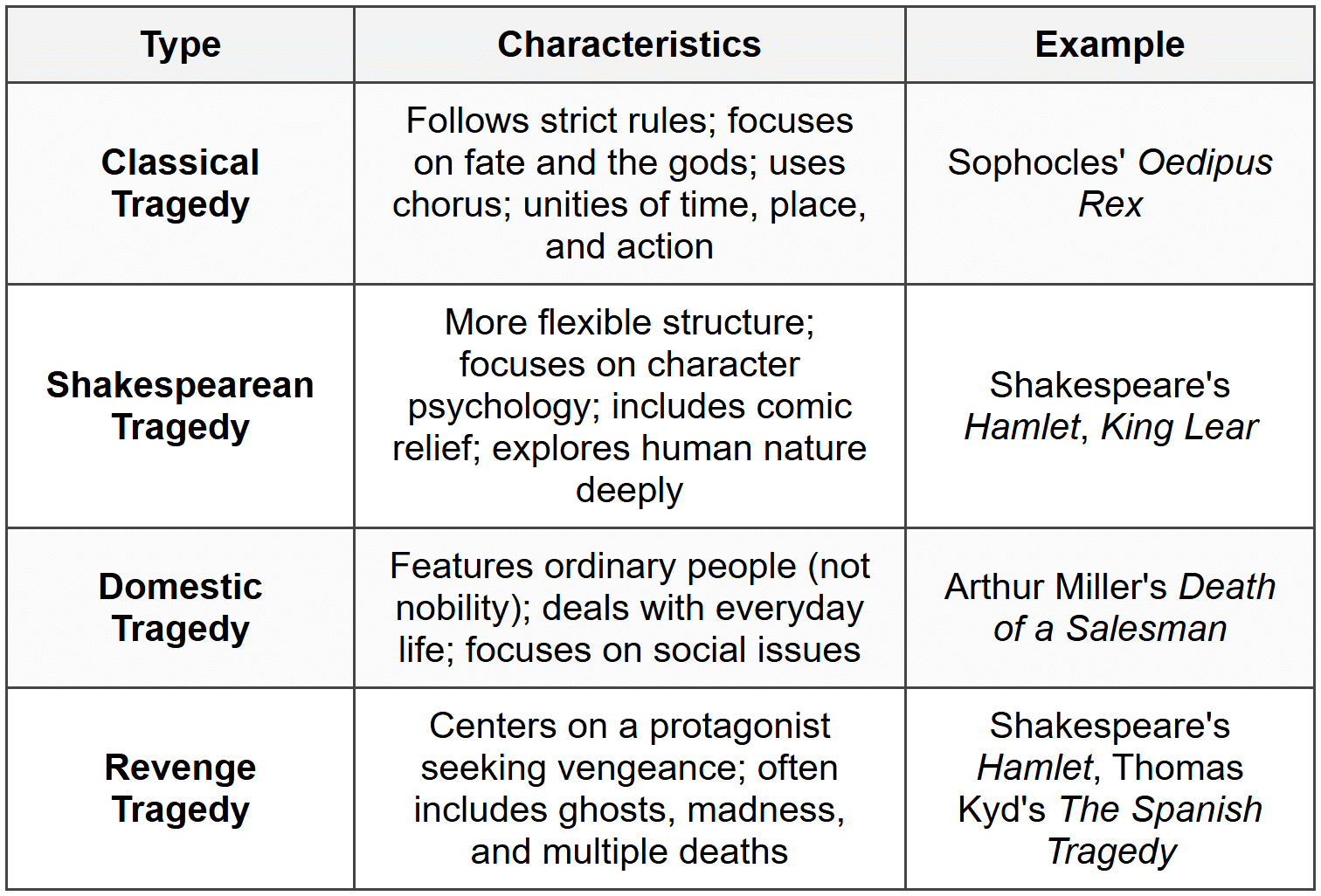
Types of Tragedy
Structure of Classical Tragedy
Classical Greek tragedy typically followed a five-part structure:
- Exposition: Introduction of characters, setting, and background information
- Rising Action: Development of conflict; complications arise
- Climax (Crisis): The turning point; moment of highest tension
- Falling Action: Consequences unfold; the hero's fate becomes clearer
- Catastrophe (Denouement): The final disaster; resolution through death or ruin
Note that in tragedy, the final stage is called catastrophe rather than resolution because it involves the hero's downfall rather than a happy ending.
Important Elements and Conventions
The Chorus (in Classical Tragedy)
The chorus was a group of performers in Greek tragedy who:
- Commented on the action
- Provided background information
- Expressed moral judgments
- Represented the voice of society or common people
- Created atmosphere through song and dance
While the chorus is not typically used in modern or Shakespearean tragedy, understanding its function helps in analyzing classical tragic texts that may appear in JAMB literature passages.
Soliloquy
A soliloquy is a speech in which a character, alone on stage, speaks their thoughts aloud. This device allows the audience to understand the character's inner conflicts, motivations, and moral struggles-essential elements in tragedy.
Example: Hamlet's "To be or not to be" speech is one of the most famous soliloquies in tragedy, revealing his contemplation of suicide and the nature of existence.
Dramatic Irony
Dramatic irony occurs when the audience knows something that the characters do not. This creates tension and deepens the tragic effect because we watch characters move toward disaster while being unaware of the truth.
Example: In Oedipus Rex, the audience knows from the beginning that Oedipus is the murderer he seeks, but Oedipus himself does not discover this until near the end.
Themes Common in Tragedy
- Fate vs. Free Will: The question of whether humans control their destiny or are subject to predetermined fate
- Justice and Revenge: The pursuit of justice, often through vengeance, and its consequences
- Ambition and Power: The corrupting influence of excessive ambition
- Mortality and Death: The inevitability of death and human vulnerability
- Moral Conflict: The struggle between duty and desire, right and wrong
- The Nature of Evil: Questions about the source and nature of human wickedness
- Suffering and Redemption: Whether suffering leads to wisdom or spiritual growth
Distinguishing Tragedy from Other Forms
How JAMB Tests Tragedy
In the JAMB English Language exam, questions on tragedy typically appear in the literature component. You may be asked to:
- Identify characteristics of tragedy in a passage or excerpt
- Recognize the tragic hero and their hamartia
- Identify moments of anagnorisis or peripeteia
- Explain the purpose or effect of tragic elements
- Distinguish between tragedy and other dramatic forms
- Analyze themes common to tragedy
- Identify structural elements of tragedy
Tip: When reading an excerpt, look for clues about the character's status, their internal conflict, moments of realization, and the serious, elevated tone. These signal that you're dealing with tragedy.
Worked Examples
Q1: Read the excerpt below and answer the question:
"I have lived long enough. My way of life
Is fall'n into the sear, the yellow leaf,
And that which should accompany old age,
As honour, love, obedience, troops of friends,
I must not look to have."
The speaker's realization in this passage illustrates which element of tragedy?
(a) Hubris
(b) Catharsis
(c) Anagnorisis
(d) Peripeteia
Ans: (c)
Explanation: The passage shows the speaker (Macbeth) recognizing the consequences of his actions-he realizes he has lost honor, love, and friendship through his evil deeds. This moment of recognition or discovery is called anagnorisis. Hubris is excessive pride, catharsis is the audience's emotional release, and peripeteia is the reversal of fortune itself (not the recognition of it).
Q2: Which of the following best defines the term 'hamartia' in tragedy?
(a) The comic relief that appears in tragic plays
(b) The tragic hero's fatal flaw or error in judgment
(c) The final death scene in a tragedy
(d) The moment when fortune reverses
Ans: (b)
Explanation: Hamartia specifically refers to the tragic hero's character flaw, weakness, or error in judgment that leads to their downfall. Option (a) describes comic relief, option (c) refers to the catastrophe, and option (d) describes peripeteia (reversal of fortune). Understanding this term is crucial because JAMB often tests your knowledge of technical dramatic terms.
Q3: "The audience feels pity for the hero's suffering and fear that similar fate could happen to anyone." This statement best describes:
(a) Dramatic irony
(b) Catharsis
(c) Soliloquy
(d) Denouement
Ans: (b)
Explanation: The statement describes catharsis-the emotional cleansing the audience experiences through feelings of pity and fear while watching tragedy. Dramatic irony involves the audience knowing something characters don't, soliloquy is a speech by a lone character, and denouement is the final resolution of the plot. Aristotle identified pity and fear as the two key emotions that tragedy should arouse to achieve catharsis.
Quick Summary
- Tragedy is a serious drama featuring a noble protagonist who falls from prosperity to ruin, evoking pity and fear
- Tragic hero must be of high status, possess admirable qualities, but have a fatal flaw (hamartia)
- Hamartia is the tragic flaw or error that causes the hero's downfall-often hubris, ambition, jealousy, or poor judgment
- Anagnorisis is the hero's moment of recognition or discovery of truth
- Peripeteia is the reversal of fortune from good to bad
- Catharsis is the emotional purging the audience experiences through pity and fear
- Hubris is excessive pride or arrogance, often defying divine or natural order
- Tragedy ends in catastrophe-death, ruin, or exile of the hero
- Common themes include fate vs. free will, ambition, justice, mortality, and moral conflict
- Classical tragedy follows strict rules and focuses on fate; Shakespearean tragedy is more flexible and psychological
- The chorus in classical tragedy comments on action and represents societal voice
- Soliloquy reveals character's inner thoughts and conflicts
- Dramatic irony creates tension when audience knows more than characters
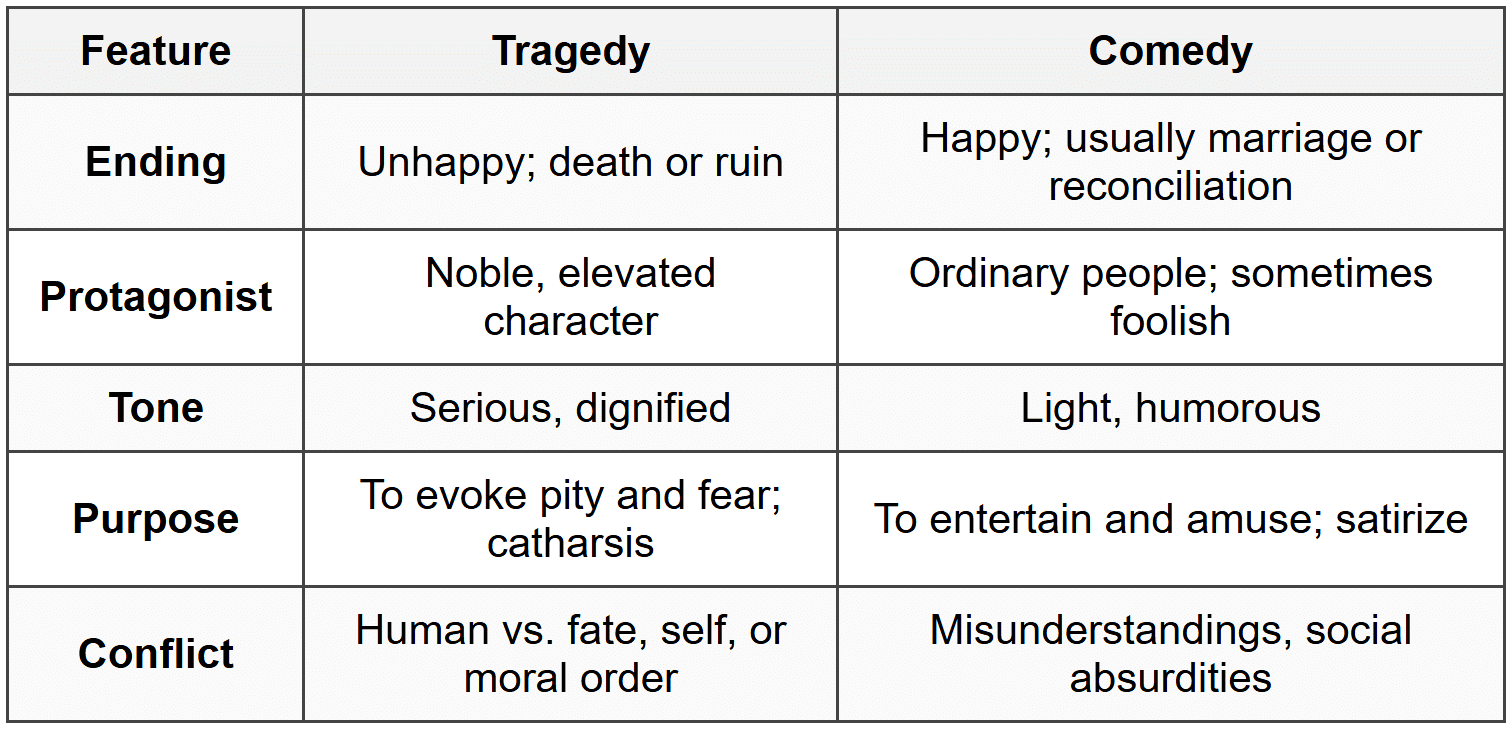
- Tragedy differs from comedy in tone, ending, character type, and purpose
Practice Questions
Q1: Which of the following is NOT a characteristic of a tragic hero?
(a) Noble birth or high social status
(b) Possession of a tragic flaw
(c) Always morally perfect throughout the play
(d) Experiences reversal of fortune
Q2: In tragedy, the term 'peripeteia' refers to:
(a) The hero's self-awareness and recognition of truth
(b) The emotional release experienced by the audience
(c) A sudden reversal of the hero's fortune
(d) The use of a chorus to comment on action
Q3: Read the following excerpt:
"Methought I heard a voice cry, 'Sleep no more!
Macbeth does murder sleep'-the innocent sleep."
This passage illustrates Macbeth's:
(a) Hubris
(b) Guilt and psychological torment
(c) Moment of triumph
(d) Comic relief
Q4: According to Aristotle, tragedy should arouse which two emotions in the audience?
(a) Joy and satisfaction
(b) Anger and disgust
(c) Pity and fear
(d) Love and admiration
Q5: Which of the following plays is an example of domestic tragedy?
(a) Sophocles' Oedipus Rex
(b) Shakespeare's Macbeth
(c) Arthur Miller's Death of a Salesman
(d) Christopher Marlowe's Doctor Faustus
Q6: The main difference between the ending of tragedy and comedy is that:
(a) Tragedy ends happily while comedy ends sadly
(b) Tragedy ends in death or ruin while comedy ends happily
(c) Tragedy uses verse while comedy uses prose
(d) Tragedy features supernatural elements while comedy does not
Answer Key and Explanations
Q1: Answer: (c)
The tragic hero is not morally perfect. In fact, the hero must have a hamartia (tragic flaw) that contributes to their downfall. Options (a), (b), and (d) are all genuine characteristics of tragic heroes. This question tests whether you understand that tragic heroes are complex, flawed characters rather than perfect saints.
Q2: Answer: (c)
Peripeteia means a sudden reversal of fortune or circumstances. Option (a) describes anagnorisis, option (b) describes catharsis, and option (d) refers to a convention of classical Greek tragedy. JAMB frequently tests your knowledge of these specific technical terms, so memorize them carefully.
Q3: Answer: (b)
This famous passage from Macbeth shows the character's guilt and psychological suffering after murdering King Duncan. He hallucinates a voice condemning him and realizes he has destroyed his own peace. This is not hubris (excessive pride), triumph, or comic relief. Questions like this require you to analyze tone and psychological state from textual evidence.
Q4: Answer: (c)
According to Aristotle's definition, tragedy should arouse pity (sympathy for the hero's suffering) and fear (recognition that similar fates could befall anyone). These emotions lead to catharsis. This is fundamental knowledge about tragedy that appears regularly in JAMB questions.
Q5: Answer: (c)
Domestic tragedy features ordinary people rather than nobility and deals with everyday social issues. Arthur Miller's Death of a Salesman focuses on a common salesman, Willy Loman, making it a domestic tragedy. The other options feature kings, princes, or scholars-characters of elevated status typical of classical or Shakespearean tragedy.
Q6: Answer: (b)
The most fundamental difference is in the ending: tragedy ends in death, ruin, or suffering, while comedy ends happily, usually with marriage or reconciliation. Option (a) reverses this. Options (c) and (d) are not consistent distinguishing features-both genres can use verse or prose, and both can include supernatural elements. This tests your understanding of genre conventions.



