Constitutional Developments: Clifford (1922), Richards (1946), Macpherson (1951), Lyttleton (1954)

Opening Section
This topic takes you through the major constitutional changes that shaped Nigeria's journey toward independence. You'll study four key constitutions introduced by British colonial governors between 1922 and 1954, each building on the previous one and gradually giving Nigerians more political participation. Understanding these constitutions is critical because JAMB regularly tests on who introduced each constitution, what year it came, the key features that made each one different, and the specific problems or criticisms each constitution faced. After studying this note, you'll be able to identify which constitution introduced elective principle, which created regional governments, which brought federalism, and the unique contributions of each colonial governor. You'll also master the timeline and be able to compare the features of these constitutions side-by-side, which is exactly how JAMB often frames questions on this topic.
Core Examination Concepts
1. The Clifford Constitution (1922)
Full Name: Sir Hugh Clifford Constitution
Year Introduced: 1922
Who Introduced It: Governor Sir Hugh Clifford
What It Replaced: The 1914 Lord Lugard Constitution
Key Features of Clifford Constitution:
- First constitution to introduce the elective principle in Nigeria - Nigerians could vote for representatives for the first time
- Created a Legislative Council of 46 members (27 official members and 19 unofficial members)
- Only 4 elected members - 3 from Lagos and 1 from Calabar
- Franchise (voting right) was limited to adult males in Lagos and Calabar who earned at least £100 per annum
- The North was excluded from elective representation - governed separately through a system of indirect rule
- Established Nigerian Council as an advisory body
- The Governor retained veto power - could reject any decision by the Legislative Council
Remember: Clifford Constitution is famous for introducing elections in Nigeria for the first time, but only Lagos and Calabar participated. The North was left out completely.
Criticisms/Weaknesses of Clifford Constitution:
- Very limited franchise - only few wealthy men could vote
- Excluded the Northern region from legislative representation
- Only 4 elected members out of 46 meant Nigerians had very little real power
- Official members (appointed by Governor) outnumbered unofficial members
- The Governor's veto power made Nigerian representatives powerless
- Did not promote national unity because it divided Nigeria into North and South
2. The Richards Constitution (1946)
Full Name: Sir Arthur Richards Constitution
Year Introduced: 1946
Who Introduced It: Governor Sir Arthur Richards (later Lord Milverton)
What It Replaced: The 1922 Clifford Constitution
Key Features of Richards Constitution:
- First constitution to divide Nigeria into three regions: Northern, Western, and Eastern regions
- Brought the North into the Legislative Council for the first time
- Created Regional Houses of Assembly (also called Regional Councils) in each of the three regions
- Established a Central Legislative Council with 45 members (28 unofficial and 17 official members)
- Introduced unofficial majority in the Legislative Council for the first time
- The Northern region had more representatives than the other two regions combined
- Regional councils could only discuss regional matters and make recommendations
Remember: Richards Constitution created the THREE REGIONS and brought the NORTH into national politics. Think "Richards = Regions".
Stated Objectives (Goals) of Richards Constitution:
- Promote the unity of Nigeria
- Provide adequate representation for all sections of the country
- Secure greater participation by Nigerians in discussions of their own affairs
Criticisms/Weaknesses of Richards Constitution:
- Constitution was imposed without consulting Nigerians - nationalist leaders were not involved in drafting it
- Regional assemblies had no legislative powers - only advisory functions
- Instead of promoting unity, it actually promoted regionalism and tribalism
- Northern dominance was built into the structure - North had as many representatives as East and West combined
- Governor still retained veto power
- No provision for ministerial positions for Africans
- The constitution was to last for 9 years without review, which nationalists rejected
3. The Macpherson Constitution (1951)
Full Name: Sir John Macpherson Constitution
Year Introduced: 1951
Who Introduced It: Governor Sir John Macpherson
What It Replaced: The 1946 Richards Constitution
Key Features of Macpherson Constitution:
- First time Nigerians were consulted before a constitution was introduced - involved village, provincial, regional, and national levels
- Introduced quasi-federalism (semi-federal system) - regions got more powers
- Established the Council of Ministers at the center with 6 official and 12 unofficial members
- Created regional executive councils with ministerial positions
- The House of Representatives (central legislature) had 148 members
- Regional Houses of Assembly were given legislative powers - not just advisory
- Introduced residual powers to the regions
- Created exclusive, concurrent, and residual legislative lists
- Portfolio system introduced - Nigerian ministers headed government departments
Remember: Macpherson is the first constitution that involved NIGERIANS in its making. It also introduced MINISTERS and made the regions more powerful.
Criticisms/Weaknesses of Macpherson Constitution:
- Although it claimed to be federal, the center was still too strong - not truly federal
- Led to serious conflicts between central and regional governments
- The 1953 crisis over self-government motion exposed its weaknesses - Northern and Southern leaders clashed
- Regional representation system created more ethnic divisions
- Governor-General still had reserve powers and could veto decisions
- Ministers were responsible to the Governor, not to the people or legislature
- The crisis it created led to its early collapse - lasted only about 3 years
4. The Lyttleton Constitution (1954)
Full Name: Oliver Lyttleton Constitution
Year Introduced: 1954
Who Introduced It: Oliver Lyttleton (British Secretary of State for the Colonies)
What It Replaced: The 1951 Macpherson Constitution
Background: The 1953 constitutional crisis and the violent clashes in Kano made it clear that Nigeria needed a new constitution. A constitutional conference was held in London in 1953 and another in Lagos in 1954. The Lyttleton Constitution came out of these conferences.
Key Features of Lyttleton Constitution:
- Established a full federal system of government in Nigeria for the first time
- Federal and regional governments were coordinate and independent in their areas of authority
- Created exclusive federal legislative list and concurrent list, with residual powers to the regions
- Established the position of Federal Prime Minister (though still under the Governor-General)
- Created a Council of Ministers at the federal level with full ministerial responsibility
- Each region had its own Premier and Executive Council
- Lagos was separated from the Western Region and made the Federal Capital Territory
- Introduced an independent judiciary - established the Federal Supreme Court
- Public Service Commission was established for federal civil service
- Regions gained more financial powers and could generate their own revenue
Remember: Lyttleton brought TRUE FEDERALISM to Nigeria. It also made LAGOS the federal capital and created the position of PRIME MINISTER.
Significance of Lyttleton Constitution:
- It was the last constitution before independence
- Laid the foundation for the 1960 Independence Constitution
- Reduced tensions between regions by making them truly independent of each other
- Gave regions control over their resources
- Created the federal structure Nigeria still uses today (though with modifications)
Comparison Table of the Four Constitutions
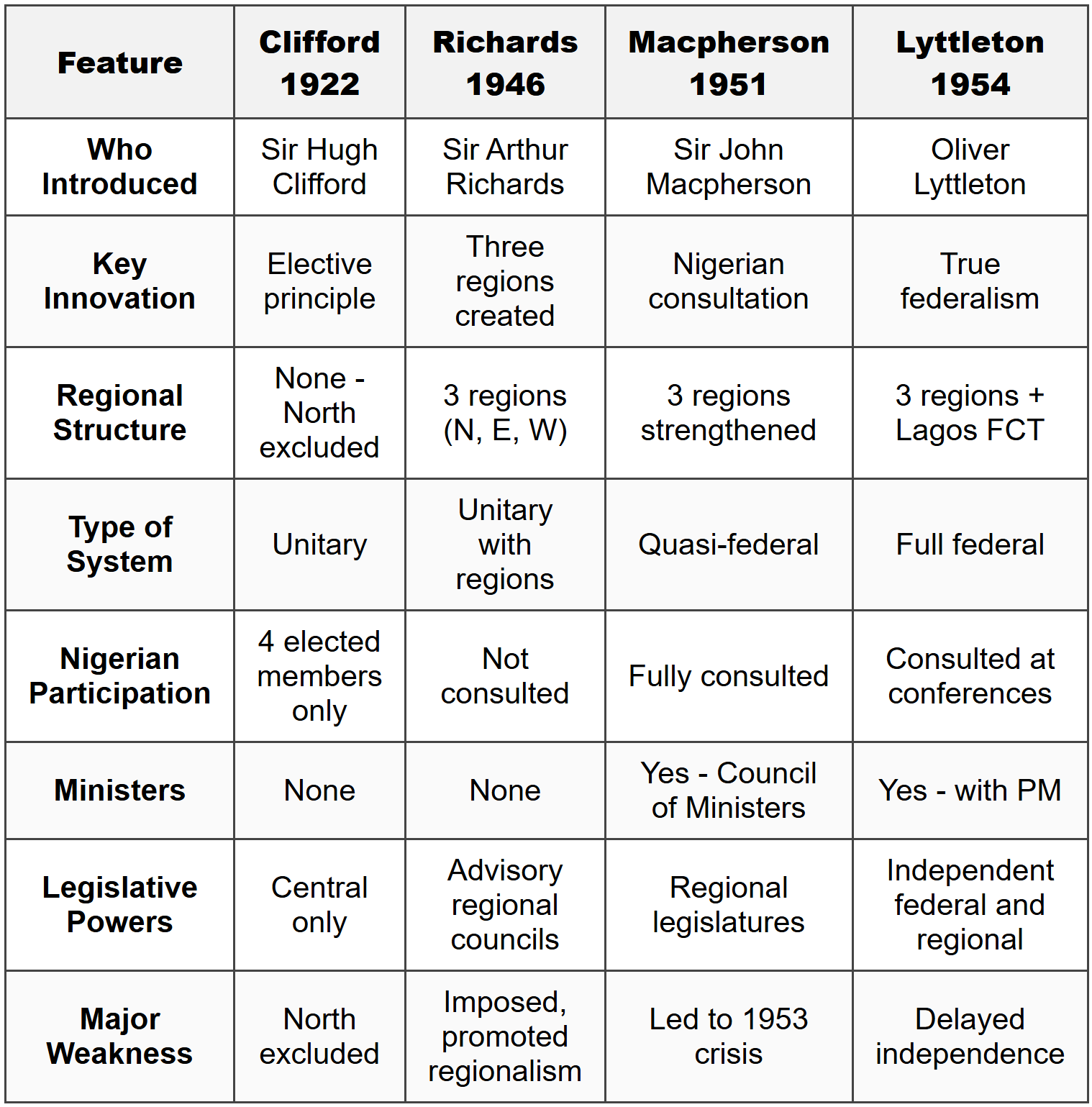
Important Dates to Memorize
- 1922 - Clifford Constitution (elective principle)
- 1946 - Richards Constitution (three regions)
- 1951 - Macpherson Constitution (Nigerian consultation, ministers)
- 1953 - Constitutional crisis; London conference
- 1954 - Lyttleton Constitution (true federalism)
- 1960 - Nigeria's Independence (this came after Lyttleton)
Remember: The dates follow a pattern - 1922, 1946 (24 years later), 1951 (5 years later), 1954 (3 years later). Notice how the gaps get shorter as Nigeria moves toward independence.
Common Themes Across All Constitutions
Progressive Elements:
- Each constitution gave Nigerians more participation than the previous one
- Movement from unitary to federal system
- Gradual reduction of Governor's powers
- Increasing legislative powers for Nigerians
Persistent Problems:
- All four constitutions were still imposed by the British colonial government
- The Governor (or Governor-General) retained veto power in all of them
- All promoted regionalism which created ethnic divisions
- None gave Nigeria full independence - that came in 1960
Quick Summary
- Clifford Constitution (1922): Sir Hugh Clifford; first elective principle in Nigeria; 4 elected members (3 Lagos, 1 Calabar); North excluded; voting for males earning £100+ annually; created Legislative Council; Governor had veto power
- Richards Constitution (1946): Sir Arthur Richards; created three regions (North, East, West); brought North into Legislative Council; regional assemblies had only advisory powers; imposed without consulting Nigerians; promoted regionalism; led to ethnic divisions
- Macpherson Constitution (1951): Sir John Macpherson; first constitution where Nigerians were consulted; introduced Council of Ministers; quasi-federal system; regional legislatures got law-making powers; created exclusive, concurrent, and residual lists; led to 1953 crisis over self-government motion
- Lyttleton Constitution (1954): Oliver Lyttleton (British Colonial Secretary); established true federalism; created position of Federal Prime Minister; Lagos became Federal Capital Territory; independent federal and regional governments; Federal Supreme Court established; last constitution before independence in 1960
- Timeline: 1922 (Clifford) → 1946 (Richards) → 1951 (Macpherson) → 1954 (Lyttleton) → 1960 (Independence)
- Key Firsts: Clifford = elections; Richards = regions; Macpherson = Nigerian consultation and ministers; Lyttleton = true federalism and Lagos as FCT
- Common weaknesses: All were imposed by Britain; all gave Governor/Governor-General veto powers; all promoted regionalism and ethnic divisions
- 1953 Crisis: Happened under Macpherson Constitution when Southern politicians moved for self-government in 1956 but Northern politicians opposed it; led to riots in Kano; exposed weaknesses of Macpherson Constitution; led to Lyttleton Constitution
Practice Questions
Q1: Which constitution introduced the elective principle in Nigeria for the first time?
(a) Richards Constitution 1946
(b) Macpherson Constitution 1951
(c) Clifford Constitution 1922
(d) Lyttleton Constitution 1954
Ans: (c)
The Clifford Constitution of 1922 was the first to introduce elections in Nigeria, allowing 4 Nigerians to be elected (3 from Lagos and 1 from Calabar).
Q2: The Richards Constitution of 1946 divided Nigeria into how many regions?
(a) Two
(b) Three
(c) Four
(d) Five
Ans: (b)
Richards Constitution created three regions: Northern, Eastern, and Western regions, and brought the North into the Legislative Council for the first time.
Q3: Which constitution was the first to consult Nigerians before its introduction?
(a) Clifford Constitution
(b) Richards Constitution
(c) Macpherson Constitution
(d) Lyttleton Constitution
Ans: (c)
The Macpherson Constitution of 1951 was the first to involve Nigerians in its drafting through consultations at village, provincial, regional, and national levels.
Q4: The Lyttleton Constitution made which city the Federal Capital Territory?
(a) Ibadan
(b) Enugu
(c) Kaduna
(d) Lagos
Ans: (d)
The Lyttleton Constitution of 1954 separated Lagos from the Western Region and made it the Federal Capital Territory.
Q5: One major criticism of the Clifford Constitution was that it
(a) Created too many regions
(b) Excluded the Northern region from elective representation
(c) Abolished the Legislative Council
(d) Made Nigeria a republic
Ans: (b)
The Clifford Constitution excluded the North from voting and legislative participation, allowing only Lagos and Calabar to elect representatives.
Q6: The 1953 constitutional crisis that led to the collapse of the Macpherson Constitution was caused by disagreement over
(a) Revenue allocation
(b) Self-government motion
(c) Creation of more regions
(d) Appointment of ministers
Ans: (b)
The crisis occurred when Southern politicians moved for self-government in 1956 but Northern politicians opposed it, leading to riots in Kano and exposing the weaknesses of the Macpherson Constitution.



