Public Corporations

Public corporations are one of the most important ways governments in Nigeria and around the world provide essential services to citizens. When you study this topic, you'll understand why government chooses to create these special bodies, how they operate, and what makes them different from regular government departments or private companies. JAMB loves to test students on the differences between public corporations and other forms of public enterprises, the reasons for establishing them, their sources of funding, and the problems they face in Nigeria. After mastering this chapter, you'll be able to identify examples of Nigerian public corporations, explain their features, and analyze why some succeed while others struggle with inefficiency and corruption.
Core Examination Concepts
1. Meaning of Public Corporations
A public corporation (also called statutory corporation or public enterprise) is a business organization owned and controlled by the government to provide essential services to the public. Think of it this way: when government wants to run a business that serves the people rather than just make profit, it creates a public corporation.
Key characteristics:
- Established by an Act of Parliament or Decree (law)
- Has a separate legal identity - can sue and be sued in its own name
- Owned and funded by government but operates with some independence
- Managed by a Board of Directors appointed by government
- Provides essential services, though profit may also be an objective
- Enjoys some level of autonomy in day-to-day operations
Examples in Nigeria:
- Nigerian National Petroleum Corporation (NNPC)
- Nigerian Ports Authority (NPA)
- Nigerian Railway Corporation (NRC)
- Power Holding Company of Nigeria (PHCN) - now privatized
- Nigerian Television Authority (NTA)
- Federal Airports Authority of Nigeria (FAAN)
- Central Bank of Nigeria (CBN)
Remember: Public corporations are NOT the same as government ministries or departments. They have more operational freedom and can make business decisions without waiting for ministry approval on every matter.
2. Reasons for Establishing Public Corporations
Government creates public corporations for several important reasons. JAMB often asks why government chooses this method instead of using regular ministries or allowing private companies to handle these services.
Main reasons include:
- To provide essential services - Services like electricity, water, railways that citizens need but may not be profitable enough for private companies
- To control strategic sectors - Government wants direct control over important areas like petroleum, ports, and airports for national security
- To prevent exploitation - Protecting citizens from being overcharged by private monopolies in essential services
- To create employment - Public corporations employ thousands of Nigerians directly and indirectly
- To achieve balanced development - Ensuring services reach rural areas where private companies won't invest because of low profit
- To generate revenue for government - Some public corporations like NNPC contribute significantly to national income
- To manage natural resources - Government controls resources like oil, gas, and minerals through public corporations
- To implement government policies - Using corporations as tools to achieve economic and social objectives
- To promote national unity - Services like NTA and NRC connect different parts of the country
- To achieve economies of scale - Large operations like national broadcasting or railways are more efficient under single management
Remember: The primary motive is service, not profit. Even when profit is made, the main goal remains providing essential services to citizens.
3. Features/Characteristics of Public Corporations
Understanding these features helps you distinguish public corporations from other organizations in exam questions.
Main features:
- Legal backing - Created by special law (Act of Parliament, Decree, or Edict)
- Separate legal personality - Can own property, enter contracts, sue and be sued in its own name
- Government ownership - Fully or majority owned by federal, state, or local government
- Board of Directors - Managed by a board appointed by the President, Governor, or relevant minister
- Financial autonomy - Can raise funds through loans, grants, and internally generated revenue, though mainly funded by government
- Operational autonomy - Freedom to make daily business decisions without constant government interference
- Public accountability - Must submit annual reports and accounts to government and sometimes to parliament
- Staff employment - Usually recruits its own staff, though senior appointments may require government approval
- Service orientation - Primary focus on public service rather than profit maximization
- Monopoly status - Often enjoys monopoly or near-monopoly in its area of operation
- Government subsidy - May receive financial support from government when running at a loss
- Immunity from some taxes - Often exempt from certain taxes and duties
4. Types of Public Corporations in Nigeria
Public corporations can be classified based on ownership level and function.
Based on Ownership:
- Federal Public Corporations - Owned by federal government (e.g., NNPC, NPA, CBN, FAAN)
- State Public Corporations - Owned by state governments (e.g., Lagos State Water Corporation, Ogun State Property and Investment Corporation)
- Local Government Public Corporations - Rare, but some local governments own small-scale enterprises
Based on Function:
- Commercial/Trading Corporations - Engage in buying and selling (e.g., Nigerian National Supply Company)
- Industrial Corporations - Produce goods (e.g., Nigerian Steel Company)
- Service Corporations - Provide services (e.g., PHCN for electricity, NRC for transport)
- Financial Corporations - Deal with money and banking (e.g., CBN, Nigerian Export-Import Bank)
- Social/Cultural Corporations - Provide social services (e.g., NTA for broadcasting)
5. Sources of Revenue/Funding for Public Corporations
Public corporations get money from various sources to finance their operations.
Main sources include:
- Government grants and subventions - Direct funding from government budget, especially for non-profitable essential services
- Internally generated revenue - Income from selling services or goods (e.g., NPA from port charges, NRC from ticket sales)
- Loans from government - Borrowing from federal or state government at favorable interest rates
- Commercial bank loans - Borrowing from private banks
- International loans and grants - Funding from World Bank, African Development Bank, and donor countries
- Sale of bonds and securities - Raising money from the public through bond issues
- Retained profits - Using profits from previous years for expansion or operations
- Sale of assets - Disposing of old or unused property and equipment
- Public-Private Partnership (PPP) - Joint funding with private investors
Remember: Most Nigerian public corporations rely heavily on government funding because many don't generate enough revenue to cover costs.
6. Advantages of Public Corporations
Why this system is beneficial for government and citizens:
- Provision of essential services - Citizens get vital services that private sector might not provide profitably
- Prevention of monopoly exploitation - Government control stops private companies from overcharging
- Revenue generation - Profitable corporations contribute to national income
- Employment creation - Thousands of jobs provided directly and indirectly
- Economic development - Infrastructure like ports and railways boost overall economic growth
- Balanced regional development - Services extended to less profitable rural areas
- Government control of strategic sectors - National security and sovereignty protected
- Economies of scale - Large-scale operations reduce unit costs
- Social welfare - Services provided at affordable rates or subsidized prices
- Policy implementation tool - Government can use corporations to achieve economic objectives
- Price stability - Government can control prices of essential goods and services
- National integration - Services like broadcasting promote unity
7. Disadvantages/Problems of Public Corporations
Despite their importance, public corporations in Nigeria face serious challenges. JAMB frequently tests this area.
Major problems include:
- Inefficiency and waste - Poor management leading to high costs and low productivity
- Political interference - Government officials interfering in daily operations, especially appointments
- Corruption and embezzlement - Widespread fraud and mismanagement of funds
- Lack of accountability - Poor record-keeping and failure to publish accurate accounts
- Overstaffing - Too many workers employed for political reasons, increasing wage costs
- Poor maintenance culture - Equipment and facilities allowed to deteriorate
- Inadequate funding - Government often fails to provide sufficient capital
- Heavy debt burden - Many corporations owe huge debts to banks and suppliers
- Low staff morale - Poor working conditions, delayed salaries, and lack of motivation
- Absence of profit motive - No real drive for efficiency since losses are covered by government
- Bureaucracy and red tape - Slow decision-making processes
- Poor quality of service - Many corporations provide substandard services
- Conflict of objectives - Confusion between social service and profit-making goals
- Obsolete equipment - Using outdated technology due to lack of investment
- Lack of competition - Monopoly status reduces incentive to improve
Remember: These problems led to the privatization policy of the 1980s and 1990s, where government sold many public corporations to private investors. Examples include NITEL (now defunct) and PHCN (now divided and sold).
8. Control and Supervision of Public Corporations
Government monitors public corporations through various mechanisms to ensure proper functioning.
Methods of control:
- Parliamentary/Legislative control - National or State Assembly reviews annual reports, budgets, and can summon management for questioning
- Ministerial supervision - Relevant minister oversees the corporation and reports to government
- Appointment of Board members - President or Governor appoints directors who set policies
- Financial audits - Auditor-General examines accounts annually
- Annual reports and accounts - Corporations must submit detailed reports to government
- Budgetary control - Government approves major expenditures and capital projects
- Public Accounts Committee - Parliamentary committee investigates financial irregularities
- EFCC and ICPC oversight - Anti-corruption agencies investigate fraud allegations
- Privatization and Commercialization - Government can restructure or sell poorly performing corporations
- Setting performance targets - Government establishes goals and evaluates achievement
9. Comparison: Public Corporations vs Government Departments vs Private Companies
JAMB loves to test your ability to distinguish between these three organizational types.
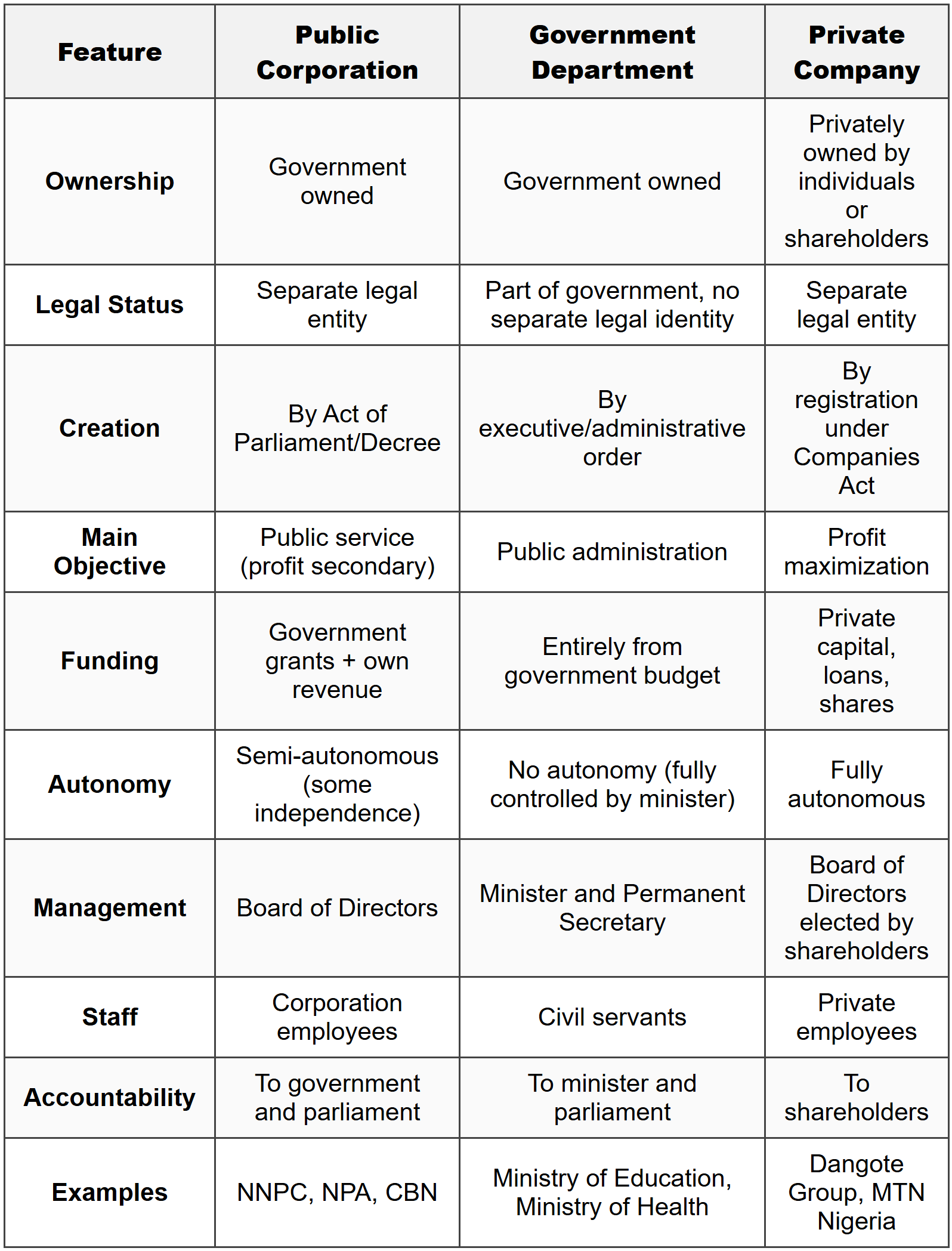
10. Privatization and Commercialization
Due to the persistent problems of public corporations, Nigerian government adopted privatization and commercialization policies.
Privatization
Privatization means transferring ownership and control of public corporations from government to private individuals or organizations. Simply put, government sells its companies to private investors.
Reasons for privatization:
- Reduce government financial burden
- Improve efficiency and service quality
- Eliminate corruption and political interference
- Raise revenue for government through sales
- Introduce competition and innovation
- Reduce government involvement in business
Examples in Nigeria:
- NITEL - Nigerian Telecommunications Limited (privatized but later failed)
- PHCN - Power Holding Company (unbundled and sold to private investors)
- Ajaokuta Steel Company - Concession to private management
- Several oil refineries are being privatized
Commercialization
Commercialization means reorganizing a public corporation to operate on business principles while government retains ownership. The corporation must generate enough revenue to cover costs without government subsidy.
Key features:
- Government still owns the corporation
- Management focuses on profit and efficiency
- Must be financially self-sustaining
- Operates like a private business
Examples: CBN, NNPC (partly commercialized)
Remember: Privatization = government sells ownership. Commercialization = government keeps ownership but demands business-like operation.
11. Public Corporations in Other Countries
Public corporations exist worldwide with varying degrees of success.
United Kingdom:
- BBC (British Broadcasting Corporation) - State-owned broadcaster
- UK privatized many corporations in the 1980s under Prime Minister Margaret Thatcher (British Gas, British Telecom, British Airways)
United States:
- USPS (United States Postal Service) - Government-owned mail service
- Amtrak - National railway service
- Generally, USA prefers private sector with government regulation over public corporations
France:
- SNCF - French National Railway
- EDF - Electricity provider
- France has many public corporations in strategic sectors
Remember: Most developed countries have reduced public corporations through privatization, while developing countries like Nigeria still rely heavily on them for essential services.
Quick Summary
- Public corporations are government-owned businesses created by law to provide essential services
- Examples in Nigeria: NNPC, NPA, NRC, FAAN, NTA, CBN
- Created by: Act of Parliament, Decree, or Edict
- Main features: Separate legal identity, government ownership, Board of Directors, operational autonomy, public accountability
- Primary objective: Public service, not profit maximization
- Reasons for establishment: Provide essential services, control strategic sectors, prevent exploitation, create employment, achieve balanced development, generate revenue
- Sources of funding: Government grants, internally generated revenue, loans, bonds, international assistance
- Advantages: Essential service provision, employment creation, prevents monopoly exploitation, economic development, balanced regional development
- Major problems in Nigeria: Inefficiency, political interference, corruption, overstaffing, poor maintenance, inadequate funding, heavy debts, low staff morale, bureaucracy
- Control mechanisms: Parliamentary oversight, ministerial supervision, appointment of Board, financial audits, annual reports, budgetary control
- Difference from government departments: Public corporations have separate legal identity and operational autonomy; departments don't
- Difference from private companies: Public corporations prioritize service over profit; private companies prioritize profit
- Privatization: Selling government corporations to private owners (e.g., NITEL, PHCN)
- Commercialization: Making public corporations operate on business principles while government retains ownership
- International examples: BBC (UK), USPS (USA), SNCF (France)
- Margaret Thatcher: UK Prime Minister who pioneered massive privatization in the 1980s
Practice Questions
Q1: Which of the following is the primary objective of public corporations?
(a) Profit maximization
(b) Provision of essential services
(c) Competition with private companies
(d) Generating foreign exchange
Ans: (b)
While public corporations may make profits and generate revenue, their primary objective is providing essential services to citizens. Profit is secondary to service delivery.
Q2: Public corporations are established by
(a) Presidential directive
(b) Ministerial order
(c) Act of Parliament or Decree
(d) Board resolution
Ans: (c)
Public corporations must be created by formal legislation - an Act of Parliament, Decree, or Edict. This gives them legal backing and separate legal identity.
Q3: Which of these is NOT a public corporation in Nigeria?
(a) Nigerian National Petroleum Corporation
(b) Nigerian Ports Authority
(c) Dangote Group
(d) Central Bank of Nigeria
Ans: (c)
Dangote Group is a private company owned by Aliko Dangote. The others (NNPC, NPA, CBN) are government-owned public corporations.
Q4: The main difference between privatization and commercialization is that
(a) Privatization involves selling to foreigners while commercialization involves local buyers
(b) Privatization transfers ownership to private sector while commercialization retains government ownership
(c) Privatization is cheaper than commercialization
(d) Privatization applies to small companies while commercialization applies to large ones
Ans: (b)
Privatization means government sells its ownership to private investors. Commercialization means government keeps ownership but demands the corporation operate like a profit-oriented business.
Q5: One major problem facing public corporations in Nigeria is
(a) Too much profit
(b) Excessive foreign investment
(c) Political interference in management
(d) Over-qualification of staff
Ans: (c)
Political interference is a major problem where government officials meddle in daily operations, make appointments based on political loyalty rather than merit, and disrupt professional management.
Q6: Which of the following controls is exercised over public corporations in Nigeria?
(a) Control by shareholders through Annual General Meetings
(b) Control by the National Assembly through examination of annual reports
(c) Control by trade unions through strike actions
(d) Control by customers through market competition
Ans: (b)
The National Assembly (or State House of Assembly) exercises parliamentary control by reviewing annual reports, examining budgets, and summoning management when necessary. Public corporations don't have shareholders like private companies.
