Main Idea & Supporting Details

Understanding how to identify the main idea and supporting details is a fundamental reading comprehension skill. The main idea is the central point or most important message the author wants to convey in a passage. Supporting details are the facts, examples, explanations, or descriptions that prove, illustrate, or explain the main idea. Mastering this skill helps you quickly grasp what a passage is about and how the author develops that central message.
1. Main Idea
The main idea is the overarching message or central point of a passage. It tells you what the passage is primarily about. Every other sentence in the passage should relate to or develop this central concept.
1.1 Characteristics of Main Idea
- Broad enough: Covers the entire passage, not just one paragraph or detail
- Specific enough: Not so general that it could apply to any passage on the topic
- Supported by details: Every major detail in the passage connects back to it
- Complete thought: Expresses a full idea, not just a topic word or phrase
1.2 Where to Find the Main Idea
The main idea can appear in different locations within a passage:
- Beginning (Topic Sentence): Most common placement; the first or second sentence often states the main idea directly
- End (Concluding Sentence): The author builds up evidence and states the main idea as a conclusion
- Middle: Less common; the author provides context first, states the main idea, then elaborates
- Implied (Unstated): The main idea is not directly written; you must infer it from all the details provided
1.3 Stated vs. Implied Main Idea
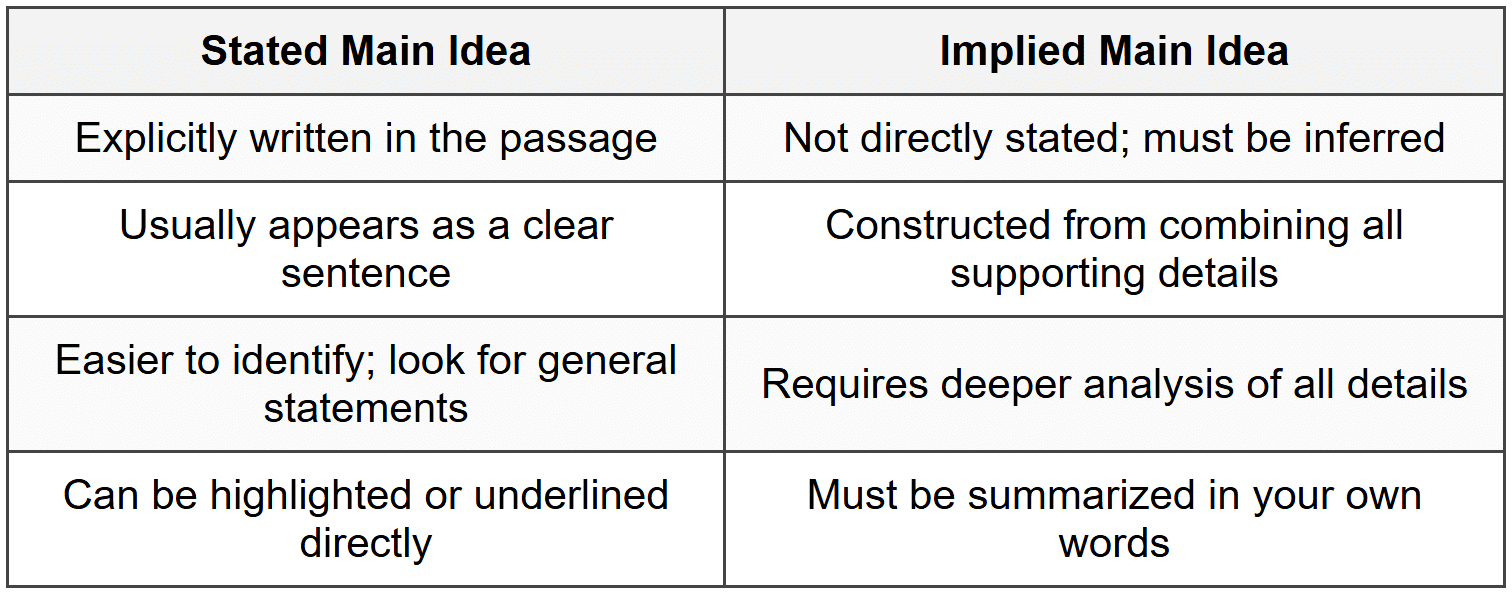
1.4 Steps to Identify the Main Idea
- Read the entire passage: Don't stop at the first sentence; the main idea may appear later or be implied
- Ask "What is this mostly about?": Identify the general topic first (one or two words)
- Ask "What point is the author making?": Determine what the author wants you to know about that topic
- Check for repetition: Ideas that appear multiple times or are emphasized are likely central
- Eliminate details: Cross out specific examples, facts, or descriptions to see what remains
- Test your answer: Does every major detail in the passage support or relate to your identified main idea?
1.5 Common Traps When Identifying Main Idea
- Trap 1 - Choosing a detail instead: Students often select an interesting fact rather than the overarching point. Details are too specific to be the main idea
- Trap 2 - Being too broad: Choosing a statement so general it could apply to many passages. The main idea should be specific to this passage
- Trap 3 - Stopping at the topic: Identifying only the subject (e.g., "bears") rather than what the author says about it (e.g., "bears hibernate to survive winter")
- Trap 4 - First sentence assumption: Assuming the first sentence is always the main idea. Check if all details support it
2. Supporting Details
Supporting details are specific pieces of information that explain, prove, describe, or illustrate the main idea. They answer questions like who, what, when, where, why, and how about the main idea.
2.1 Types of Supporting Details
- Facts and Statistics: Numerical data, dates, percentages, or verifiable information (e.g., "The population increased by 25% in 2020")
- Examples: Specific instances that illustrate the main idea (e.g., "For instance, polar bears hunt seals on ice")
- Explanations: Clarifications or reasons that help readers understand the main idea (e.g., "This happens because...")
- Descriptions: Sensory or characteristic details that paint a picture (e.g., "The room was cold and dimly lit")
- Anecdotes: Brief stories or personal accounts that support the point
- Expert opinions or quotations: Statements from authorities that lend credibility
2.2 Major vs. Minor Supporting Details
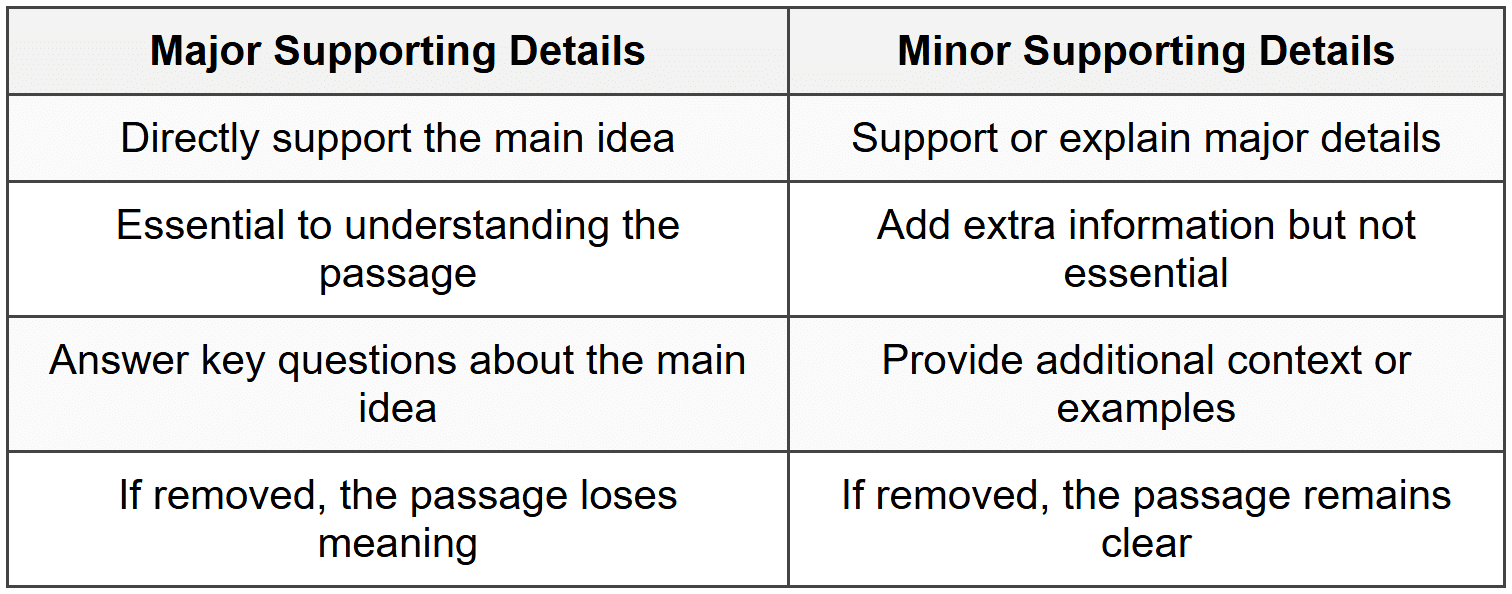
Example hierarchy: Main Idea → "Regular exercise improves health." Major Detail → "Exercise strengthens the heart." Minor Detail → "A strong heart pumps blood more efficiently."
2.3 Identifying Supporting Details
- Locate the main idea first: You cannot identify supporting details without knowing what they support
- Ask "What proves this?": Look for evidence, examples, or explanations for the main idea
- Look for signal words: Words like "for example," "such as," "including," "because," "additionally," "furthermore" often introduce details
- Identify relationships: Does this sentence explain, prove, describe, or illustrate the main idea?
- Distinguish major from minor: Ask if the detail directly relates to the main idea (major) or to another detail (minor)
2.4 Signal Words for Supporting Details
- For examples: for instance, such as, for example, to illustrate, specifically, including
- For reasons: because, since, due to, as a result, therefore, consequently
- For additions: also, furthermore, moreover, in addition, additionally, another
- For facts/statistics: according to, research shows, studies indicate, data reveals
3. Relationship Between Main Idea and Supporting Details
The main idea and supporting details work together to create meaning. The main idea provides the framework, while supporting details fill in the content.
3.1 How Supporting Details Develop Main Idea
- Proof/Evidence: Details provide facts or data that prove the main idea is true
- Clarification: Details explain complex aspects of the main idea in simpler terms
- Illustration: Details give concrete examples that make abstract main ideas tangible
- Elaboration: Details expand on the main idea by providing additional information
3.2 Common Organizational Patterns
Authors arrange main ideas and supporting details in predictable patterns:
- List/Simple Listing: Main idea followed by a series of related details (e.g., "Three benefits of reading are...")
- Cause and Effect: Main idea states a cause or effect; details explain the relationship
- Comparison and Contrast: Main idea presents two items; details show similarities and differences
- Problem and Solution: Main idea identifies a problem; details provide solutions
- Chronological/Sequential: Main idea relates to time or order; details follow a sequence
3.3 Testing Your Understanding
To verify you've correctly identified the main idea and supporting details:
- Coverage test: Does the main idea cover all the supporting details without being too broad?
- Relevance test: Does each supporting detail clearly relate to the main idea?
- Summary test: Can you create a brief summary using just the main idea and major details?
- Elimination test: If you remove a detail, does it weaken support for the main idea (major) or not (minor)?
4. Practice Strategy
4.1 Step-by-Step Approach for Passages
- First reading: Read the entire passage without stopping to get the general sense
- Identify the topic: Ask "What is this about?" in one or two words
- Find the main idea: Ask "What is the author's main point about this topic?"
- Underline or list details: Mark sentences that provide facts, examples, or explanations
- Categorize details: Determine which are major (directly support main idea) and which are minor
- Verify relationships: Confirm that all details connect logically to the main idea
4.2 Common Question Formats
- "What is the main idea of the passage?": Look for the broadest statement that all details support
- "Which sentence best expresses the main idea?": Find the sentence that summarizes the entire passage
- "The author's primary purpose is to...": Identify what the main idea accomplishes (inform, persuade, describe)
- "According to the passage..." or "The passage states...": These ask for supporting details, not main idea
- "Which detail supports the claim that...": Find a specific fact or example that proves a statement
4.3 Key Differences to Remember
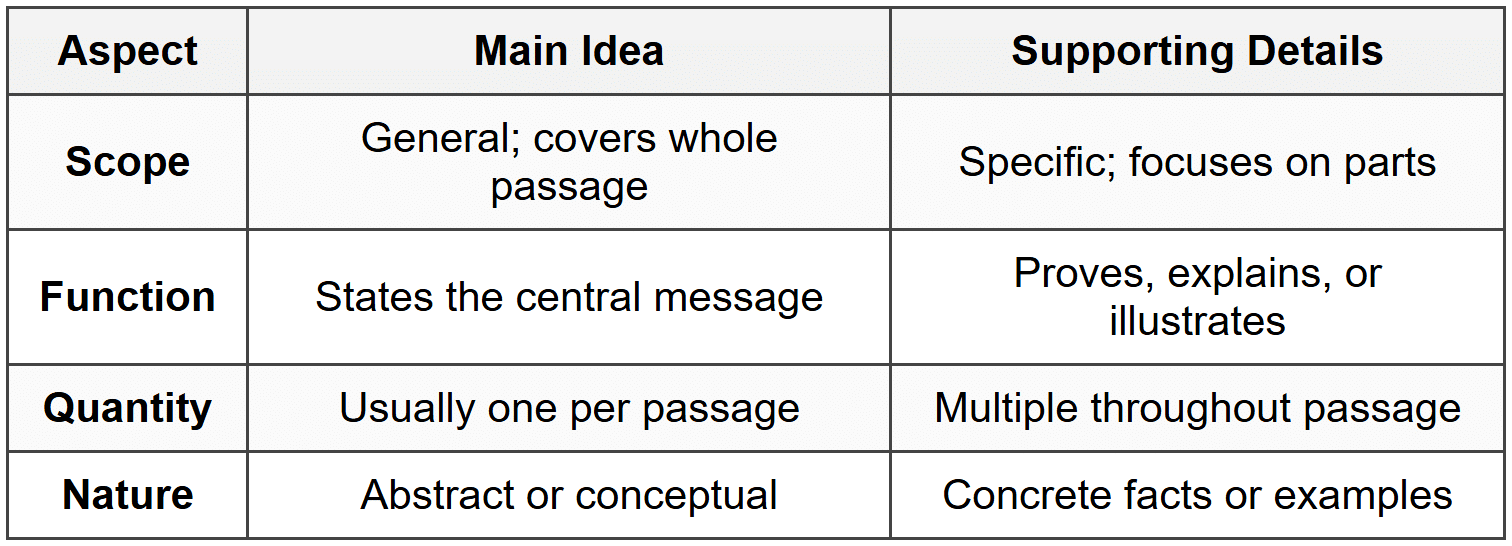
Mastering the identification of main ideas and supporting details requires consistent practice. Always read the entire passage before making judgments, distinguish between the broad central message and the specific evidence supporting it, and verify that your identified main idea is neither too general nor too specific. This skill forms the foundation for all advanced reading comprehension tasks, including making inferences, analyzing arguments, and evaluating author's purpose.