Author’s Tone and Purpose


Understanding an author's tone and purpose is essential for analyzing any written passage. Tone refers to the author's attitude toward the subject or audience, expressed through word choice, style, and perspective. Purpose refers to the author's reason for writing-what they aim to achieve. Recognizing these elements helps you interpret texts accurately and answer comprehension questions effectively.
1. Author's Tone
Tone is the emotional quality or attitude conveyed by the author through language choices. It reflects how the author feels about the topic, characters, or audience.
1.1 Identifying Tone
- Word Choice (Diction): Look at descriptive words and adjectives. Positive words (brilliant, thoughtful) suggest approval; negative words (reckless, absurd) suggest criticism.
- Sentence Structure: Short, sharp sentences may indicate urgency or anger. Long, flowing sentences often suggest calm or reflection.
- Figurative Language: Metaphors, similes, and imagery reveal emotional undertones and attitudes.
- Point of View: First person (I, we) can be personal or passionate; third person (he, she, they) may be objective or detached.
1.2 Common Tone Categories
Recognizing common tones helps you classify the author's attitude quickly:
- Positive/Supportive: Enthusiastic, optimistic, admiring, hopeful, encouraging, celebratory
- Negative/Critical: Skeptical, cynical, pessimistic, disapproving, scornful, indignant, bitter
- Neutral/Objective: Impartial, factual, detached, analytical, informative, clinical
- Emotional/Passionate: Urgent, passionate, sentimental, nostalgic, melancholic, reflective
- Humorous/Ironic: Satirical, sarcastic, ironic, playful, witty, mocking
1.3 Tone vs. Mood
Trap Alert: Students often confuse tone with mood. Tone is the author's attitude; mood is the feeling created in the reader.
- Tone: How the author feels (determined through author's word choices and style)
- Mood: How the reader feels (created by setting, imagery, and atmosphere)
- Example: An author may use a sarcastic tone (author's attitude) to create an amused mood (reader's feeling)
1.4 Multiple Tones in One Passage
- Tone Can Shift: Authors may change tone within a passage to reflect changing perspectives or emphasis different points.
- Identify Dominant Tone: Focus on the overall or prevailing tone unless asked specifically about a particular section.
- Transitional Markers: Words like "however," "but," "although" often signal tone shifts.
2. Author's Purpose
Purpose is the author's reason for writing. It answers the question: What does the author want to accomplish with this text?
2.1 Primary Purpose Categories
Most texts fall into one of four main purpose categories:
- To Inform/Explain: Present facts, explain processes, describe events objectively. Common in textbooks, news articles, encyclopedias.
- To Persuade/Argue: Convince readers to adopt a viewpoint, take action, or change beliefs. Common in editorials, advertisements, opinion pieces.
- To Entertain: Amuse, engage, or provide aesthetic pleasure. Common in fiction, humor writing, creative essays.
- To Describe: Paint a vivid picture using sensory details and imagery. Common in travel writing, descriptive essays, literature.
2.2 Secondary and Combined Purposes
- Multiple Purposes: A single text may serve several purposes simultaneously. A biographical article may inform while also entertaining.
- Secondary Purposes: Include to criticize, to warn, to inspire, to commemorate, to analyze, to compare, to reflect.
- Identify Primary Purpose: Focus on the most dominant purpose unless the question asks for all purposes.
2.3 Clues to Determine Purpose
- Genre/Text Type: Opinion editorials typically persuade; encyclopedia entries inform; novels entertain.
- Thesis Statement: The main claim often reveals persuasive intent.
- Use of Evidence: Statistical data and citations suggest informative purpose; emotional appeals suggest persuasive purpose.
- Call to Action: Phrases like "we must," "you should," or "it is essential to" indicate persuasive purpose.
- Descriptive Language: Rich sensory details and imagery suggest descriptive or entertainment purposes.
2.4 Author's Intended Audience
Purpose is closely linked to intended audience-the readers the author aims to reach:
- General Public: Broad, accessible language; common examples; basic explanations
- Specialists/Experts: Technical terminology; assumes prior knowledge; detailed analysis
- Students/Learners: Clear definitions; educational tone; step-by-step explanations
- Specific Group: Language and references tailored to that group's interests or concerns
Trap Alert: The intended audience influences both tone and purpose. A scientific article for experts uses objective tone and informative purpose, while one for the public may use engaging tone and dual inform-entertain purpose.
3. Relationship Between Tone and Purpose
Tone and purpose work together to achieve the author's goals. Understanding their connection helps predict author choices.
3.1 How Tone Supports Purpose
- Informative Purpose: Often uses neutral, objective, or formal tone to establish credibility and clarity
- Persuasive Purpose: May use passionate, urgent, or critical tone to motivate readers and emphasize importance
- Entertainment Purpose: Often employs humorous, playful, or dramatic tone to engage and amuse
- Descriptive Purpose: Uses vivid, sensory, or poetic tone to create imagery and immersion
3.2 Tone-Purpose Combinations Table
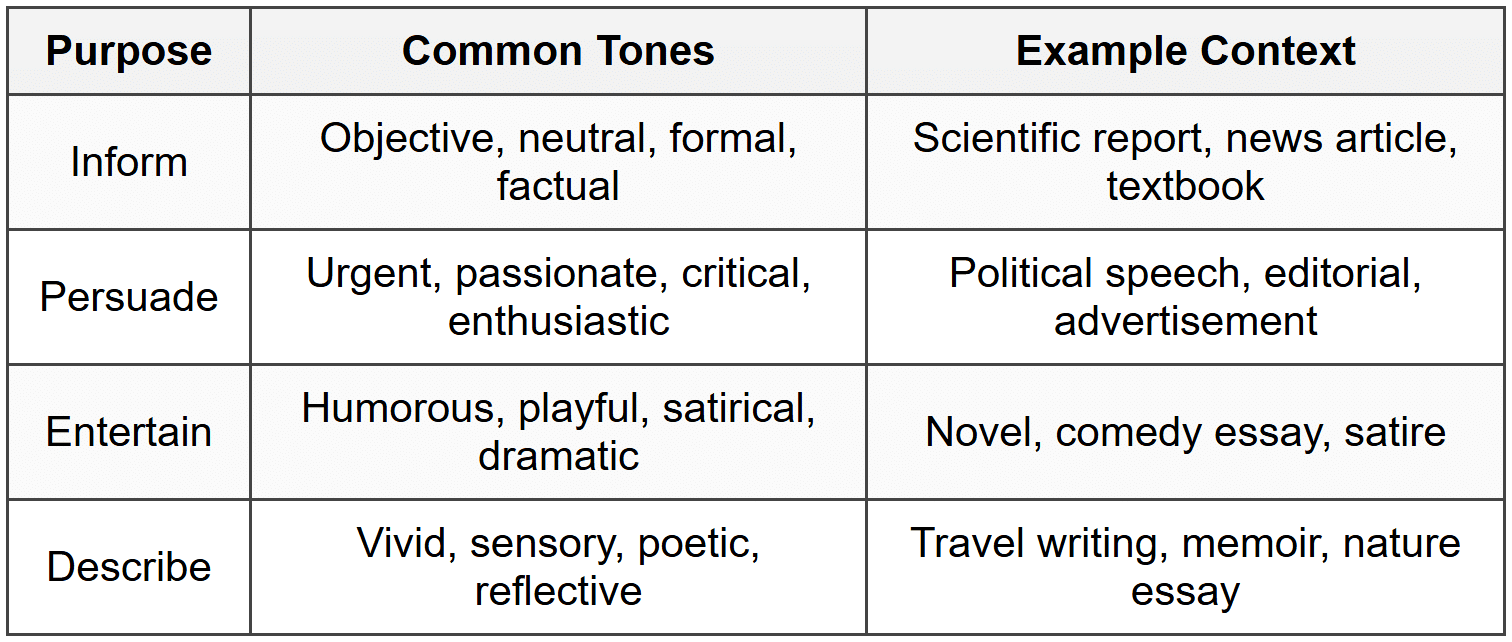
3.3 Mismatched Tone and Purpose
Irony and Satire: Authors sometimes deliberately use mismatched tone and purpose for effect:
- Satirical Writing: Uses humorous or playful tone to criticize or persuade (purpose is serious, tone is light)
- Ironic Commentary: States one thing but means the opposite, using tone to signal true intent
- Example: A satirical essay may use exaggerated praise (humorous tone) to actually criticize a policy (persuasive purpose)
4. Analyzing Tone and Purpose in Practice
Apply systematic strategies to identify tone and purpose accurately in any passage.
4.1 Step-by-Step Analysis Process
- Read the Entire Passage: Get overall context before focusing on specific elements
- Identify Key Words: Circle emotionally charged words, descriptive adjectives, and value-laden terms
- Note the Genre: Recognize text type (editorial, narrative, scientific article) as initial clue
- Find the Main Idea: Determine what the author is primarily discussing
- Look for Thesis or Claim: Identify if the author makes an argument or presents information neutrally
- Assess Word Choice: Determine if language is positive, negative, or neutral
- Determine Purpose: Ask "Why did the author write this?" (inform, persuade, entertain, describe)
- Determine Tone: Ask "How does the author feel about this topic?" (supportive, critical, neutral)
4.2 Common Student Mistakes
- Confusing Subject with Purpose: The subject is what the text is about; purpose is why it was written. A passage about pollution (subject) may aim to persuade readers to reduce waste (purpose).
- Overgeneralizing Tone: Calling every serious passage "formal" or every critical passage "angry." Use precise tone descriptors.
- Ignoring Context: A single negative word doesn't make the entire tone negative. Evaluate overall pattern.
- Assuming One Purpose Only: Many texts have layered purposes. Identify the primary purpose first.
- Personal Reaction vs. Author's Tone: Your feelings about the topic don't determine tone. Focus on author's word choices.
4.3 Question Types and Answer Strategies
Questions about tone and purpose appear in predictable formats:
- "The author's tone can best be described as..." → Eliminate extreme options; choose tone that matches overall passage, not isolated sentences
- "The primary purpose of the passage is to..." → Focus on main idea and what author does throughout (not just one paragraph)
- "The author's attitude toward [topic] is..." → Look for evaluative language and judgments about that specific topic
- "In line X, the tone shifts from ___ to ___" → Identify contrasting language before and after the specified line
5. Evidence and Support for Tone and Purpose
Always ground your identification of tone and purpose in specific textual evidence.
5.1 Types of Evidence for Tone
- Connotative Words: Words with emotional associations beyond literal meaning (e.g., "childlike" is positive; "childish" is negative)
- Modifiers and Intensifiers: Words like "extremely," "merely," "unfortunately" reveal attitude
- Rhetorical Questions: Questions not seeking answers often convey skepticism or emphasis
- Exclamations and Punctuation: Exclamation marks suggest strong emotion; ellipses suggest hesitation or reflection
5.2 Types of Evidence for Purpose
- Thesis Statements: Clear claims indicate persuasive purpose
- Topic Sentences: Reveal organizational structure and whether text explains or argues
- Use of Data/Statistics: Factual support suggests informative or persuasive purpose
- Emotional Appeals: Stories and anecdotes suggest persuasive or entertainment purpose
- Imperatives (Commands): "Consider," "imagine," "we must" indicate persuasive purpose
5.3 Matching Evidence to Claims
Trap Alert: Don't identify tone or purpose without being able to point to specific words or phrases that support your answer.
- Practice Justification: For each tone or purpose selection, identify at least two specific textual examples
- Avoid Assumptions: Don't assume tone based on topic alone (e.g., not all environmental writing is urgent or critical)
- Whole-Text Analysis: One paragraph may have different tone than the whole passage; focus on dominant patterns
6. Context and Author's Background
Sometimes understanding context helps clarify tone and purpose, but always prioritize textual evidence.
6.1 Historical and Cultural Context
- Time Period: Awareness of when text was written can clarify references and attitudes
- Social Issues: Understanding contemporary debates helps identify persuasive purpose
- Genre Conventions: Certain genres have expected tones (e.g., eulogies are typically respectful and commemorative)
6.2 When Background Information Is Provided
- Use It Sparingly: Background helps with context but doesn't replace textual analysis
- Author Credentials: A scientist writing about climate change likely has informative purpose; an activist has persuasive purpose
- Publication Source: Academic journal suggests formal, objective tone; blog may be informal and subjective
Trap Alert: Even when background is provided, answer questions based on what's in the passage itself, not what you assume about the author or topic.
Mastering tone and purpose analysis requires careful attention to word choice, structure, and evidence within the text. Always start by identifying the author's main idea and the language used to express it. Practice distinguishing between your personal reaction and the author's actual attitude. Remember that tone reveals how the author feels, while purpose reveals why the author wrote the passage. Together, these elements provide deep insight into any written work and form the foundation for critical reading comprehension.