Essay Writing


Essay writing is a critical skill that demonstrates your ability to organize thoughts, present arguments coherently, and communicate effectively. Mastering essay structure, development strategies, and writing techniques is essential for producing clear, well-reasoned responses within time constraints. These notes focus on practical techniques for planning, drafting, and refining essays efficiently.
1. Essay Structure and Organization
1.1 Standard Essay Components
- Introduction: Opens the essay with context, presents the thesis statement (main argument or position), and previews key points. Should be 3-5 sentences that engage the reader and establish direction.
- Body Paragraphs: Each paragraph develops one main idea supporting the thesis. Typically 3-4 body paragraphs for timed essays. Each contains a topic sentence, supporting evidence, explanation, and transition.
- Conclusion: Summarizes main points, restates thesis in fresh language, and provides closure. Should NOT introduce new arguments or evidence.
1.2 Thesis Statement Requirements
A thesis statement is a one-to-two sentence declaration of your essay's central argument or purpose.
- Specificity: Must be precise, not vague. "Technology affects education" is too broad; "Digital learning tools improve student engagement in mathematics" is specific.
- Arguable Position: Should present a claim that requires support, not a fact. "Water boils at 100°C" is factual; "Conservation efforts should prioritize freshwater resources" is arguable.
- Scope Control: Must match essay length. Narrow enough to develop fully within available space and time.
- Placement: Typically appears at the end of the introduction paragraph for maximum clarity.
1.3 Body Paragraph Structure (TEEL Method)
Each body paragraph follows a consistent internal structure for clarity:
- Topic Sentence (T): States the paragraph's main point, directly supporting the thesis. Should be the first sentence.
- Evidence/Example (E): Provides specific support-facts, statistics, examples, or quotations that validate the topic sentence.
- Explanation (E): Analyzes how the evidence supports the claim. Explains significance and connects back to thesis.
- Link (L): Transitions to the next paragraph or reinforces connection to thesis. Creates flow between ideas.
1.4 Organizational Patterns
Choose the pattern that best serves your thesis and evidence:
- Order of Importance: Present strongest argument first or last (emphatic positions). Weakest points in middle. Effective for persuasive essays.
- Chronological Order: Arrange points by time sequence. Useful for process explanations or historical analysis.
- Comparison-Contrast: Organize by similarities and differences. Use block method (discuss all aspects of A, then all of B) or point-by-point method (alternate between A and B for each criterion).
- Problem-Solution: First establish the problem with evidence, then present solution(s) with supporting reasoning.
2. Pre-Writing and Planning
2.1 Prompt Analysis
Before writing, decode the prompt completely:
- Identify Task Words: "Analyze" requires examination of components; "argue" demands a position with evidence; "compare" needs similarities and differences; "evaluate" requires judgment with criteria.
- Determine Scope: Note any restrictions-specific examples required, particular perspectives to address, or aspects to avoid.
- Recognize Multiple Parts: Some prompts contain 2-3 separate requirements. Address each explicitly to avoid incomplete responses.
2.2 Brainstorming Techniques
- Listing: Write all relevant ideas rapidly without judgment. Review list and group related concepts. Select 3-4 strongest points for development.
- Clustering/Mind Mapping: Place main topic in center circle. Draw branches for major subtopics, with smaller branches for supporting details. Reveals relationships between ideas.
- Freewriting: Write continuously for 3-5 minutes without stopping or editing. Generates raw material and uncovers unexpected connections.
- Questioning: Apply journalist's questions (Who? What? When? Where? Why? How?) to topic. Answers become potential paragraph content.
2.3 Outlining Methods
Formal Outline: Uses hierarchical structure with Roman numerals (I, II, III), capital letters (A, B, C), and Arabic numerals (1, 2, 3).
- I. Introduction with thesis
- II. First main point
- A. Supporting detail
- B. Supporting detail
- III. Second main point (same pattern)
- IV. Conclusion
Informal Outline: Lists main points and sub-points with indentation but no formal numbering. Faster for timed conditions.
Time Allocation: For a 30-minute essay, spend approximately 5 minutes planning, 20 minutes drafting, 5 minutes revising.
3. Development and Support
3.1 Types of Evidence
- Specific Examples: Concrete instances that illustrate abstract claims. "Rising sea levels threaten coastal cities like Miami and Jakarta" is stronger than "Climate change has effects."
- Facts and Statistics: Verifiable data that adds credibility. Use precise numbers when possible, but ensure accuracy or use qualified language ("approximately," "studies suggest").
- Expert Testimony: Reference authorities in the field. Even general attributions add weight: "Education researchers have found..." or "According to economic analysis..."
- Logical Reasoning: Use deductive reasoning (general principle to specific case) or inductive reasoning (specific observations to general conclusion) to connect claims.
3.2 Common Development Patterns
- Illustration: Use extended examples to clarify abstract concepts. Describe the example in sufficient detail to make the point vivid and convincing.
- Cause and Effect: Explain why something happened (causes) or what resulted (effects). Distinguish between immediate and underlying causes, direct and indirect effects.
- Definition: Explain key terms, especially when they're central to your argument. Provide formal definition, then elaborate with examples and distinctions.
- Classification: Divide topic into categories with clear criteria. Ensure categories are mutually exclusive and comprehensive.
3.3 Paragraph Unity and Coherence
Unity: Every sentence in a paragraph must relate directly to the topic sentence. Remove tangential information that doesn't advance the main point.
Coherence: Ideas flow logically through clear connections. Achieve coherence through:
- Transitional Words: Use addition (furthermore, additionally, moreover), contrast (however, nevertheless, conversely), causation (therefore, consequently, thus), illustration (for example, specifically, namely).
- Repetition of Key Terms: Echo important words from thesis and topic sentences throughout discussion for thematic consistency.
- Pronoun Reference: Use pronouns (it, they, this) to refer back to previously mentioned nouns, creating links between sentences.
- Parallel Structure: Express similar ideas in similar grammatical forms for rhythm and clarity.
4. Language and Style
4.1 Clarity and Precision
- Specific Word Choice: Prefer concrete, precise words over vague generalities. "The medication reduced symptoms by 40%" beats "The drug helped a lot."
- Active Voice Preference: "Researchers conducted the study" (active) is clearer than "The study was conducted by researchers" (passive). Passive voice obscures the actor and weakens impact.
- Eliminate Wordiness: Remove redundant phrases. "Due to the fact that" becomes "because"; "in the event that" becomes "if"; "at this point in time" becomes "now."
- Avoid Ambiguous Pronouns: Ensure "it," "this," "they" have clear antecedents. When unclear, repeat the noun or rephrase the sentence.
4.2 Sentence Variety
Mix sentence structures to maintain reader interest and emphasize key points:
- Simple Sentences: One independent clause. Use for emphasis and clarity of key points.
- Compound Sentences: Two independent clauses joined by coordinating conjunction (and, but, or, nor, for, so, yet) or semicolon. Show equal relationships between ideas.
- Complex Sentences: One independent clause plus one or more dependent clauses. Show subordinate relationships and add sophistication.
- Compound-Complex Sentences: Multiple independent clauses plus dependent clause(s). Reserve for intricate relationships between multiple ideas.
Trap Alert: Avoid strings of short, choppy sentences or excessively long, convoluted sentences. Balance is essential for readability.
4.3 Formal Academic Tone
- Avoid Contractions: Write "do not" instead of "don't," "cannot" instead of "can't" for formality.
- Limit Personal Pronouns: Minimize "I," "you," "we" unless the prompt specifically requests personal perspective. Focus on ideas rather than the writer.
- Eliminate Colloquialisms: Replace informal expressions ("a lot," "kind of," "stuff") with precise academic language ("numerous," "somewhat," "materials").
- Maintain Objectivity: Present balanced analysis even when arguing a position. Acknowledge counterarguments before refuting them to demonstrate fair consideration.
4.4 Avoiding Common Language Errors
- Subject-Verb Agreement: Singular subjects take singular verbs; plural subjects take plural verbs. "The group of students is" (group is singular) vs. "The students are."
- Pronoun-Antecedent Agreement: Pronouns must match their antecedents in number. "Each student must submit his or her work" (singular) or rephrase: "All students must submit their work."
- Modifier Placement: Place modifiers next to the words they modify. "Walking to school, the rain soaked me" (incorrect-rain wasn't walking). Correct: "Walking to school, I was soaked by rain."
- Parallel Structure: Items in a series must have the same grammatical form. "She enjoys reading, writing, and to jog" (incorrect). Correct: "She enjoys reading, writing, and jogging."
5. Introduction and Conclusion Strategies
5.1 Effective Introduction Techniques
- Broad-to-Specific Funnel: Begin with general context, narrow to specific focus, end with precise thesis. Most common and reliable pattern.
- Provocative Question: Pose a question that the essay will answer. Engages reader curiosity immediately. Ensure you actually answer it.
- Surprising Fact or Statistic: Open with compelling data that establishes significance. "Over 70% of marine species face extinction by 2100" grabs attention.
- Brief Anecdote: Short, relevant story that illustrates the issue. Keep to 2-3 sentences and connect explicitly to thesis.
- Quotation: Use when genuinely illuminating, not as filler. Explain relevance immediately after presenting the quote.
What to Avoid: Don't begin with "In this essay I will discuss..." or dictionary definitions unless specifically analyzing the term. These openings are weak and waste valuable words.
5.2 Strong Conclusion Techniques
- Thesis Restatement: Echo your main argument using different wording. Reinforces without repetition.
- Synthesis of Main Points: Briefly summarize how your body paragraphs supported the thesis. Show how pieces fit together.
- Broader Implications: Explain significance beyond the immediate topic. Answer "So what?" and "Why does this matter?"
- Call to Action: For persuasive essays, suggest specific steps readers should take. Make recommendations concrete and achievable.
- Return to Opening: Circle back to the question, quote, or anecdote from introduction, showing how the essay has answered or illuminated it.
What to Avoid: Never introduce new arguments or evidence in conclusions. Don't use phrases like "In conclusion" or "To summarize"-the position itself makes the function clear.
6. Revision and Editing Strategies
6.1 Content-Level Revision
Review for larger structural and logical issues first:
- Thesis Alignment: Verify every body paragraph clearly supports the thesis. Remove or revise paragraphs that drift from central argument.
- Evidence Sufficiency: Check each claim has adequate support. Add examples or reasoning where arguments feel thin or unsupported.
- Logical Flow: Ensure ideas progress in sensible order. Reorder paragraphs if a different sequence creates better logic.
- Balance: Compare paragraph lengths. Underdeveloped paragraphs (2-3 sentences) need expansion; overly long paragraphs (10+ sentences) may contain multiple ideas requiring division.
6.2 Sentence-Level Editing
- Clarity Check: Read each sentence individually. If you must reread for understanding, revise for simplicity.
- Conciseness: Eliminate unnecessary words. "In my opinion, I think that" reduces to "I believe" or remove entirely in academic writing.
- Variety: Check for repetitive sentence structures or lengths. Vary beginnings-not every sentence should start with the subject.
- Transition Review: Verify smooth connections between sentences and paragraphs. Add transitional words/phrases where jumps feel abrupt.
6.3 Proofreading for Mechanics
Address surface errors last, after content is solid:
- Grammar and Usage: Check subject-verb agreement, pronoun references, verb tenses, modifier placement.
- Punctuation: Verify comma usage (especially with introductory elements, compound sentences, series). Check apostrophe placement in possessives and contractions.
- Spelling: Watch for commonly confused words (their/there/they're, affect/effect, its/it's). Proofread backward (last sentence to first) to catch errors you'd miss reading normally.
- Capitalization: Proper nouns, sentence beginnings, and major words in titles require capitals. Common nouns and general references do not.
6.4 Time-Constrained Revision Priority
When time is limited, prioritize in this order:
- Thesis and Topic Sentences (30 seconds): Ensure these are clear and aligned. They're most critical for scoring.
- Conclusion Completeness (20 seconds): Verify you have a conclusion. An abrupt ending significantly damages impression.
- Glaring Errors (1-2 minutes): Scan for obvious mistakes-incomplete sentences, agreement errors, misspelled words in thesis or topic sentences.
- Flow and Transitions (1-2 minutes): Add quick transitional words where ideas jump awkwardly.
7. Argumentative vs. Informative Essays
7.1 Argumentative Essay Characteristics
- Purpose: Persuade readers to accept a specific position or take action. Requires clear stance.
- Thesis Type: Must be arguable-a claim that reasonable people could dispute. "Renewable energy policies should receive federal subsidies" is arguable; "Renewable energy exists" is not.
- Evidence Priority: Emphasize logical reasoning, credible sources, and factual support. Appeal to logic (logos) over emotion (pathos).
- Counterargument: Acknowledge opposing viewpoints, then refute them with stronger evidence. Demonstrates thorough understanding and strengthens your position.
- Tone: Assertive but respectful. Confident claims supported by evidence, not aggressive dismissal of alternatives.
7.2 Informative/Explanatory Essay Characteristics
- Purpose: Explain, clarify, or inform about a topic without persuading. Present information objectively.
- Thesis Type: Announces what will be explained, not what should be believed. "Photosynthesis involves three distinct stages" informs; it doesn't argue.
- Evidence Priority: Focus on accurate, comprehensive information. Definitions, processes, examples, and classifications dominate.
- Balanced Presentation: No need to refute alternatives-present multiple perspectives objectively if relevant. Avoid bias or loaded language.
- Tone: Neutral and objective. Use third person; avoid value judgments or persuasive language.
7.3 Comparison Table
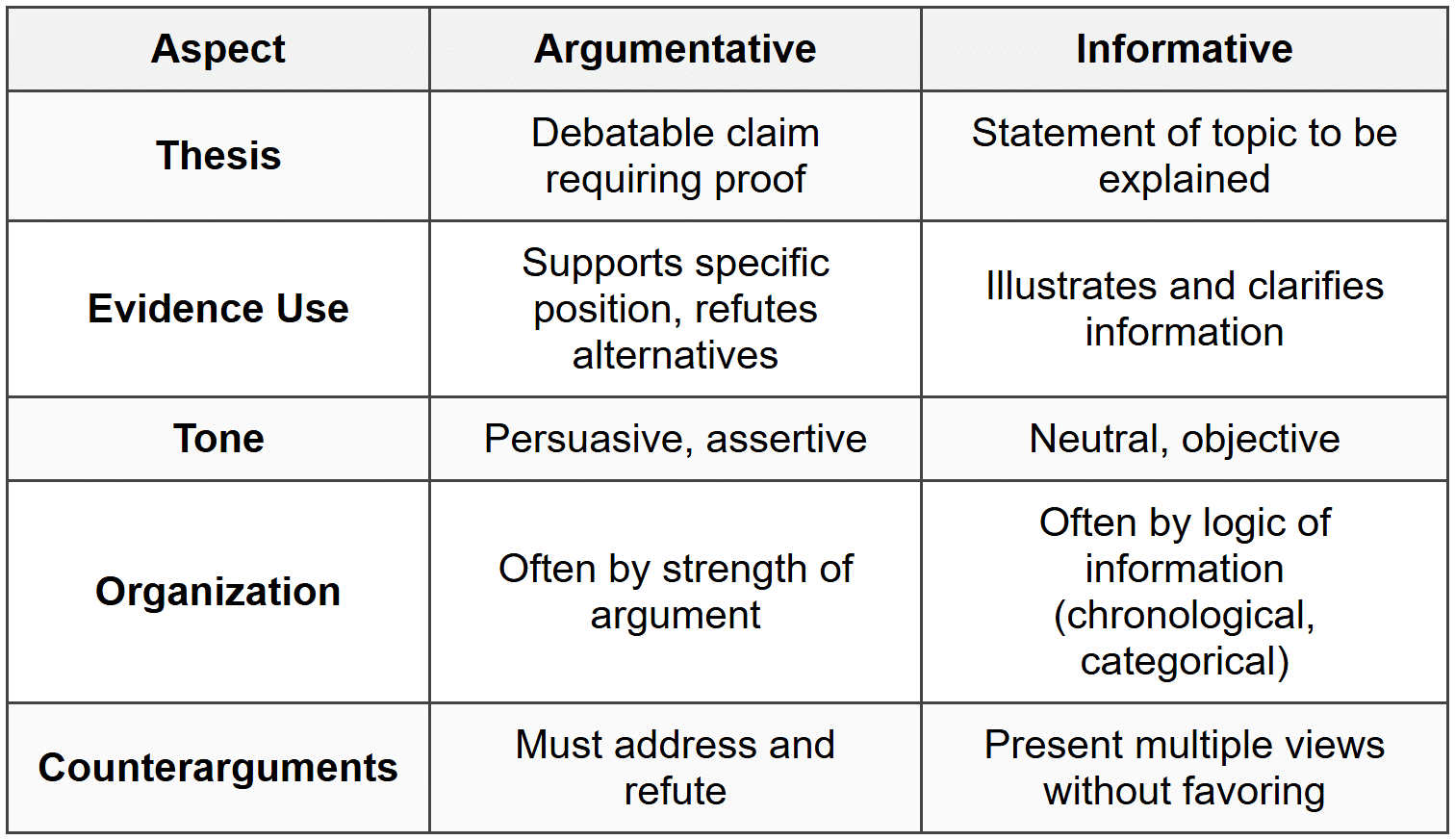
Trap Alert: Students often confuse informative essays with argumentative ones, inserting opinions when asked to explain. Check the prompt carefully-"analyze" and "explain" typically signal informative writing, while "argue," "defend," or "take a position" indicate argumentative.
8. Common Essay Pitfalls and Solutions
8.1 Structural Problems
- Weak or Missing Thesis: Problem-Introduction lacks clear main claim. Solution-End introduction with specific, assertive statement of your position or explanation focus.
- Off-Topic Paragraphs: Problem-Body paragraph doesn't support thesis. Solution-Begin each paragraph by explicitly connecting topic sentence to thesis. Cut tangential material.
- Abrupt Ending: Problem-Essay stops mid-thought without conclusion. Solution-Reserve final 2-3 minutes for a conclusion that restates thesis and synthesizes main points.
- Introduction Longer Than Body: Problem-Spending too much time on background/context. Solution-Limit introduction to 4-5 sentences. Develop ideas in body, not introduction.
8.2 Development Weaknesses
- Assertion Without Support: Problem-Claims made without evidence or examples. Solution-Follow each claim with "For example," "Specifically," or "Evidence shows" and provide concrete support.
- Example Without Explanation: Problem-Providing examples without analyzing how they prove your point. Solution-After each example, add 1-2 sentences explaining significance and connection to claim.
- Repetitive Content: Problem-Saying the same thing multiple ways without adding new information. Solution-Each sentence should advance the argument with new evidence, reasoning, or perspective.
- Underdeveloped Paragraphs: Problem-Body paragraphs of only 2-3 sentences. Solution-Expand with additional examples, deeper analysis, or counterargument consideration. Aim for 5-7 sentences per paragraph.
8.3 Language and Style Issues
- Vague Language: Problem-Using "things," "stuff," "a lot," "very" instead of precise terms. Solution-Replace with specific nouns, quantities, and descriptive adjectives. "Many" beats "a lot"; "numerous studies" beats "some things."
- Inconsistent Verb Tense: Problem-Switching between past, present, and future without reason. Solution-Use present tense for general truths and literary analysis; past tense for historical events; maintain consistency within paragraphs.
- Run-On Sentences: Problem-Multiple independent clauses incorrectly joined. Solution-Separate into distinct sentences or use proper conjunctions/semicolons. "I went to the store I bought milk" becomes "I went to the store, and I bought milk" or "I went to the store; I bought milk."
- Sentence Fragments: Problem-Incomplete sentences lacking subject or verb. Solution-Ensure each sentence has both subject and predicate. "Because it was raining" is a fragment; "Because it was raining, we stayed inside" is complete.
8.4 Logical Fallacies to Avoid
- Hasty Generalization: Drawing broad conclusion from insufficient evidence. "My friend succeeded without college, so college is unnecessary" ignores broader statistics.
- False Cause (Post Hoc): Assuming that because B followed A, A caused B. "Crime dropped after the new mayor took office, so the mayor's policies reduced crime" ignores other factors.
- Slippery Slope: Suggesting one action inevitably leads to extreme consequences without proving the chain. "If we allow one exception, soon there will be no rules at all."
- Ad Hominem: Attacking the person rather than addressing their argument. "The senator is untrustworthy, so her tax plan must be flawed" doesn't address the plan's merits.
- Straw Man: Misrepresenting an opposing view to make it easier to attack. Refute positions actually held, not exaggerated distortions.
Mastering essay writing requires understanding structure, developing clear arguments with strong evidence, using precise language, and revising strategically. Focus on clarity of thesis, unity of paragraphs, and logical flow throughout. Practice allocating time effectively-planning, drafting, and revising-to produce polished essays under time constraints. Remember that strong essays demonstrate both critical thinking and clear communication through well-organized, well-supported writing.
