Traffic Flow Theory


Fundamental Traffic Flow Parameters
Flow (Volume)
Flow (q) is defined as the number of vehicles passing a point on a roadway during a specified time interval. It is typically expressed in vehicles per hour (veh/h) or vehicles per hour per lane (veh/h/ln). \[ q = \frac{n}{t} \] where:\( q \) = flow rate (veh/h)
\( n \) = number of vehicles
\( t \) = time interval (hours)
Speed
Speed represents the rate of motion of vehicles, typically expressed in miles per hour (mph) or kilometers per hour (km/h). Time-Mean Speed (TMS) is the arithmetic mean of speeds of vehicles observed passing a point: \[ \bar{v}_t = \frac{1}{n}\sum_{i=1}^{n} v_i \] where:\( \bar{v}_t \) = time-mean speed
\( v_i \) = speed of individual vehicle \( i \)
\( n \) = number of observed vehicles Space-Mean Speed (SMS) is the harmonic mean of speeds, representing the average speed of all vehicles occupying a given section of roadway at an instant: \[ \bar{v}_s = \frac{n}{\sum_{i=1}^{n} \frac{1}{v_i}} = \frac{L}{\frac{1}{n}\sum_{i=1}^{n} t_i} \] where:
\( \bar{v}_s \) = space-mean speed
\( L \) = length of roadway section
\( t_i \) = travel time of vehicle \( i \) Relationship between TMS and SMS: \[ \bar{v}_t = \bar{v}_s + \frac{\sigma_s^2}{\bar{v}_s} \] where:
\( \sigma_s^2 \) = variance of space-mean speed Time-mean speed is always greater than or equal to space-mean speed.
Density (Concentration)
Density (k) is the number of vehicles occupying a unit length of roadway at a particular instant, expressed in vehicles per mile (veh/mi) or vehicles per mile per lane (veh/mi/ln). \[ k = \frac{n}{L} \] where:\( k \) = density (veh/mi)
\( n \) = number of vehicles
\( L \) = length of roadway (miles)
Headway and Spacing
Time Headway (h) is the time interval between successive vehicles passing a point, measured from head to head: \[ h = \frac{1}{q} \times 3600 \text{ (seconds)} \] Space Headway (Spacing, s) is the distance between successive vehicles, measured from head to head: \[ s = \frac{1}{k} \times 5280 \text{ (feet)} \]Fundamental Relationships
Basic Flow Equation
The fundamental equation of traffic flow relates flow, density, and space-mean speed: \[ q = k \times \bar{v}_s \] where:\( q \) = flow (veh/h)
\( k \) = density (veh/mi)
\( \bar{v}_s \) = space-mean speed (mph) This relationship is valid under all traffic conditions and forms the basis for traffic flow analysis.
Traffic Flow Models
Greenshields Model
The Greenshields model assumes a linear relationship between speed and density: \[ v = v_f - \frac{v_f}{k_j}k = v_f\left(1 - \frac{k}{k_j}\right) \] where:\( v \) = speed at density \( k \)
\( v_f \) = free-flow speed (speed at zero density)
\( k_j \) = jam density (density at zero speed) Flow-Density Relationship (Greenshields): \[ q = v \times k = v_f k - \frac{v_f}{k_j}k^2 \] Maximum Flow (Capacity): Taking the derivative and setting equal to zero: \[ \frac{dq}{dk} = v_f - \frac{2v_f}{k_j}k = 0 \] \[ k_{opt} = \frac{k_j}{2} \] \[ q_{max} = \frac{v_f k_j}{4} \] \[ v_{opt} = \frac{v_f}{2} \] where:
\( k_{opt} \) = optimum density at capacity
\( q_{max} \) = maximum flow (capacity)
\( v_{opt} \) = optimum speed at capacity
Greenberg Model
The Greenberg model uses a logarithmic relationship: \[ v = v_{opt} \ln\left(\frac{k_j}{k}\right) \] This model is more suitable for high-density conditions.Underwood Model
The Underwood model uses an exponential relationship: \[ v = v_f e^{-k/k_{opt}} \] This model better represents low-density, free-flow conditions.Shockwave Analysis
Shockwaves are boundaries between different traffic states that propagate through the traffic stream. They occur when traffic conditions change abruptly (e.g., queue formation, traffic light changes, incidents).Shockwave Speed
The speed of a shockwave between two traffic states is given by: \[ v_w = \frac{q_2 - q_1}{k_2 - k_1} \] where:\( v_w \) = shockwave speed (mph)
\( q_1, q_2 \) = flow rates upstream and downstream of shockwave (veh/h)
\( k_1, k_2 \) = densities upstream and downstream of shockwave (veh/mi) Sign Convention:
- Positive shockwave speed: wave travels in the direction of traffic flow
- Negative shockwave speed: wave travels opposite to traffic flow (backward-forming wave)
- Zero shockwave speed: stationary boundary
Queue Formation and Dissipation
When a bottleneck reduces capacity:- Forward recovery wave: propagates from bottleneck toward approaching traffic
- Backward recovery wave: propagates from bottleneck backward through queue as capacity is restored
Queuing Theory Applications
D/D/1 Queuing (Deterministic)
For deterministic arrivals and departures at a bottleneck: \[ Q(t) = (\lambda - \mu)t \] where:\( Q(t) \) = queue length at time \( t \)
\( \lambda \) = arrival rate (veh/h)
\( \mu \) = departure (service) rate (veh/h)
\( t \) = time (hours) Maximum queue length: \[ Q_{max} = \lambda T - \mu T = (\lambda - \mu)T \] where \( T \) is the duration of the bottleneck condition. Total delay: \[ D_{total} = \frac{(\lambda - \mu)T^2}{2} \] (in vehicle-hours) Time to clear queue after bottleneck ends: \[ t_{clear} = \frac{Q_{max}}{\mu - \lambda} = \frac{(\lambda - \mu)T}{\mu - \lambda} \]
Oversaturation and Undersaturation
- Oversaturated: \( \lambda > \mu \) - queue grows continuously
- Undersaturated: \( \lambda < \mu="" \)="" -="" system="" can="" process="" all="">
- Critical: \( \lambda = \mu \) - system at capacity
Level of Service and Capacity Analysis
Level of Service (LOS)
Level of Service is a qualitative measure describing operational conditions within a traffic stream, based on service measures such as speed, travel time, freedom to maneuver, traffic interruptions, comfort, and convenience. LOS is designated by letters A through F:- LOS A: Free-flow conditions, high speeds, low volumes
- LOS B: Reasonably free flow, slight restrictions
- LOS C: Stable flow, freedom to maneuver noticeably restricted
- LOS D: Approaching unstable flow, limited maneuverability
- LOS E: Unstable flow, operating at or near capacity
- LOS F: Forced flow, breakdown conditions, queuing
Highway Capacity Manual (HCM) Methodology
The HCM provides standardized procedures for analyzing capacity and level of service for various facility types. Key facility types include:- Basic freeway segments
- Multilane highways
- Two-lane highways
- Signalized intersections
- Unsignalized intersections
Basic Freeway Segments
Free-Flow Speed (FFS): \[ FFS = BFFS - f_{LW} - f_{LC} - f_{N} - f_{ID} \] where:\( BFFS \) = base free-flow speed (mph)
\( f_{LW} \) = adjustment for lane width
\( f_{LC} \) = adjustment for lateral clearance
\( f_{N} \) = adjustment for number of lanes
\( f_{ID} \) = adjustment for interchange density Density Calculation: \[ D = \frac{v_p}{S} \] where:
\( D \) = density (pc/mi/ln)
\( v_p \) = flow rate in passenger cars per hour per lane (pc/h/ln)
\( S \) = average passenger car speed (mph) Flow Rate (Demand): \[ v_p = \frac{V}{PHF \times N \times f_{HV} \times f_p} \] where:
\( V \) = hourly volume (veh/h)
\( PHF \) = peak hour factor
\( N \) = number of lanes
\( f_{HV} \) = heavy vehicle adjustment factor
\( f_p \) = driver population factor Heavy Vehicle Adjustment: \[ f_{HV} = \frac{1}{1 + P_T(E_T - 1) + P_R(E_R - 1)} \] where:
\( P_T \) = proportion of trucks and buses
\( P_R \) = proportion of recreational vehicles
\( E_T \) = passenger car equivalent for trucks and buses
\( E_R \) = passenger car equivalent for recreational vehicles LOS Criteria for Basic Freeway Segments (HCM): LOS is determined by density thresholds (pc/mi/ln).
Two-Lane Highways
For two-lane highways, service measures include:- Average Travel Speed (ATS)
- Percent Time Spent Following (PTSF)
Gap Acceptance Theory
Gap is the time interval between successive vehicles in a traffic stream. Critical Gap (\( t_c \)): The minimum time interval in the major street traffic stream that allows a minor street vehicle to safely complete a maneuver. Follow-up Time (\( t_f \)): The time between the departure of one vehicle from the minor street and the departure of the next vehicle using the same gap. Capacity of minor movement: \[ c = \frac{3600}{t_f} \times e^{-\lambda t_c / 3600} \] where:\( c \) = capacity (veh/h)
\( \lambda \) = major street flow rate (veh/h)
\( t_c \) = critical gap (seconds)
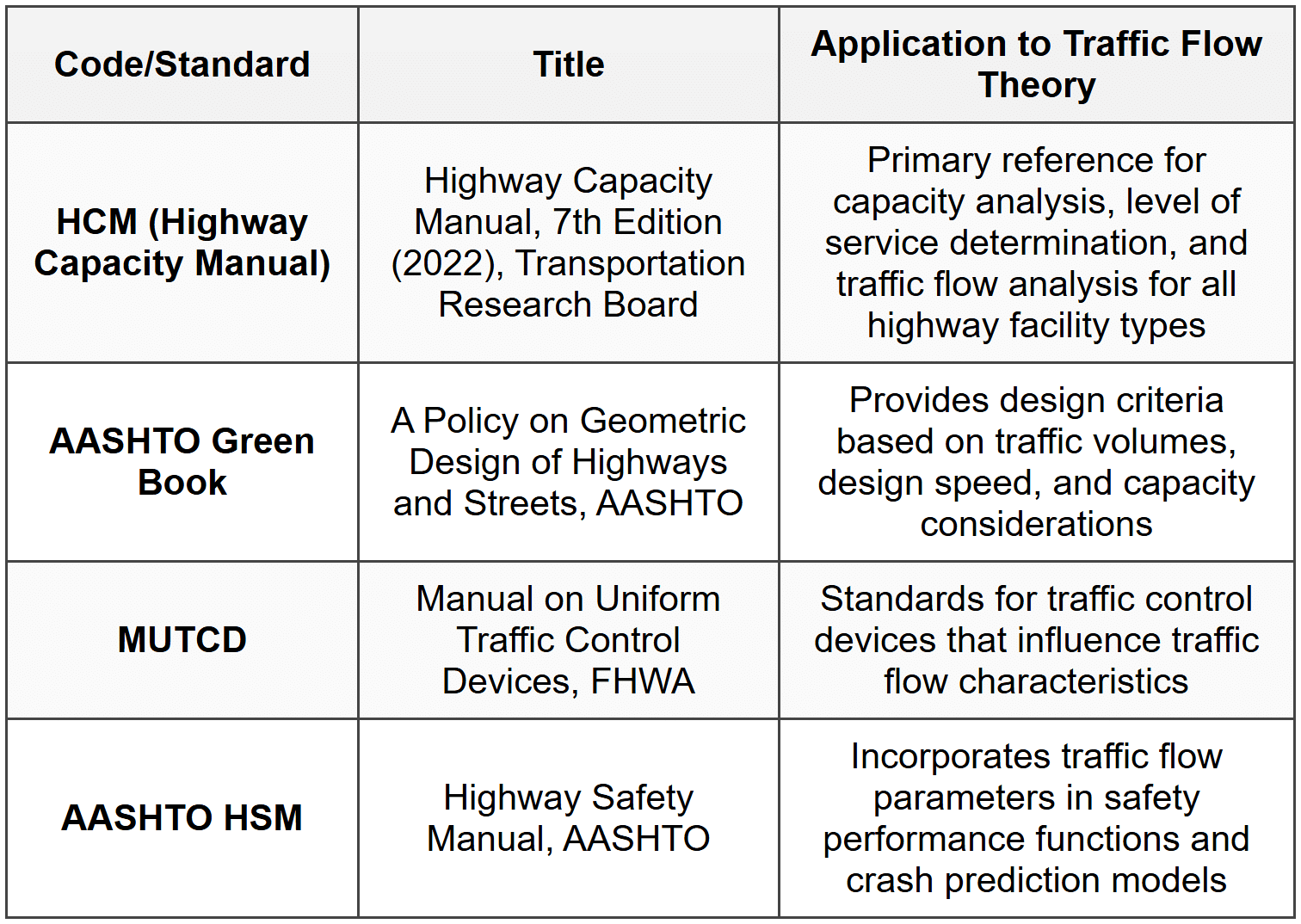
\( t_f \) = follow-up time (seconds) # Standard Codes, Standards & References
 # Solved Examples
Example 1: Fundamental Traffic Flow Parameters and Greenshields Model
Problem Statement: A traffic study on a freeway section yielded the following speed-density data that fits the Greenshields model. The free-flow speed was observed to be 65 mph, and the jam density was estimated at 180 veh/mi/ln. A traffic engineer needs to determine: (a) the capacity of one lane, (b) the speed at capacity, (c) the density at capacity, and (d) the flow rate when the density is 100 veh/mi/ln. Given Data:- Free-flow speed, \( v_f = 65 \) mph
- Jam density, \( k_j = 180 \) veh/mi/ln
- Greenshields model applies
- (a) Capacity per lane, \( q_{max} \)
- (b) Speed at capacity, \( v_{opt} \)
- (c) Density at capacity, \( k_{opt} \)
- (d) Flow rate when \( k = 100 \) veh/mi/ln
- (a) Capacity = 2,925 veh/h/ln
- (b) Speed at capacity = 32.5 mph
- (c) Density at capacity = 90 veh/mi/ln
- (d) Flow at k = 100 veh/mi/ln = 2,889 veh/h/ln
Example 2: Shockwave Analysis and Queuing
Problem Statement: A traffic incident reduces the capacity of a two-lane freeway (one direction) from 4,000 veh/h to 2,000 veh/h for a duration of 30 minutes. The demand flow approaching the incident is 3,600 veh/h. Traffic conditions upstream of the incident operate at a density of 45 veh/mi, and traffic in the queue operates at a density of 120 veh/mi. Determine: (a) the speed of the backward-forming shockwave, (b) the maximum length of the queue, (c) the maximum number of vehicles in the queue, and (d) the time required to dissipate the queue after the incident is cleared (assume capacity returns to 4,000 veh/h). Given Data:- Normal capacity, \( q_1 = 4,000 \) veh/h
- Reduced capacity during incident, \( q_2 = 2,000 \) veh/h
- Demand flow, \( q_0 = 3,600 \) veh/h
- Duration of incident, \( T = 30 \) min = 0.5 h
- Density upstream, \( k_1 = 45 \) veh/mi
- Density in queue, \( k_2 = 120 \) veh/mi
- (a) Backward-forming shockwave speed, \( v_w \)
- (b) Maximum queue length, \( L_{max} \)
- (c) Maximum number of vehicles in queue, \( N_{max} \)
- (d) Time to dissipate queue, \( t_{clear} \)
- (a) Backward-forming shockwave speed = 21.33 mph (traveling backward)
- (b) Maximum queue length = 10.67 miles
- (c) Maximum number of vehicles in queue = 800 vehicles
- (d) Time to dissipate queue = 2.0 hours
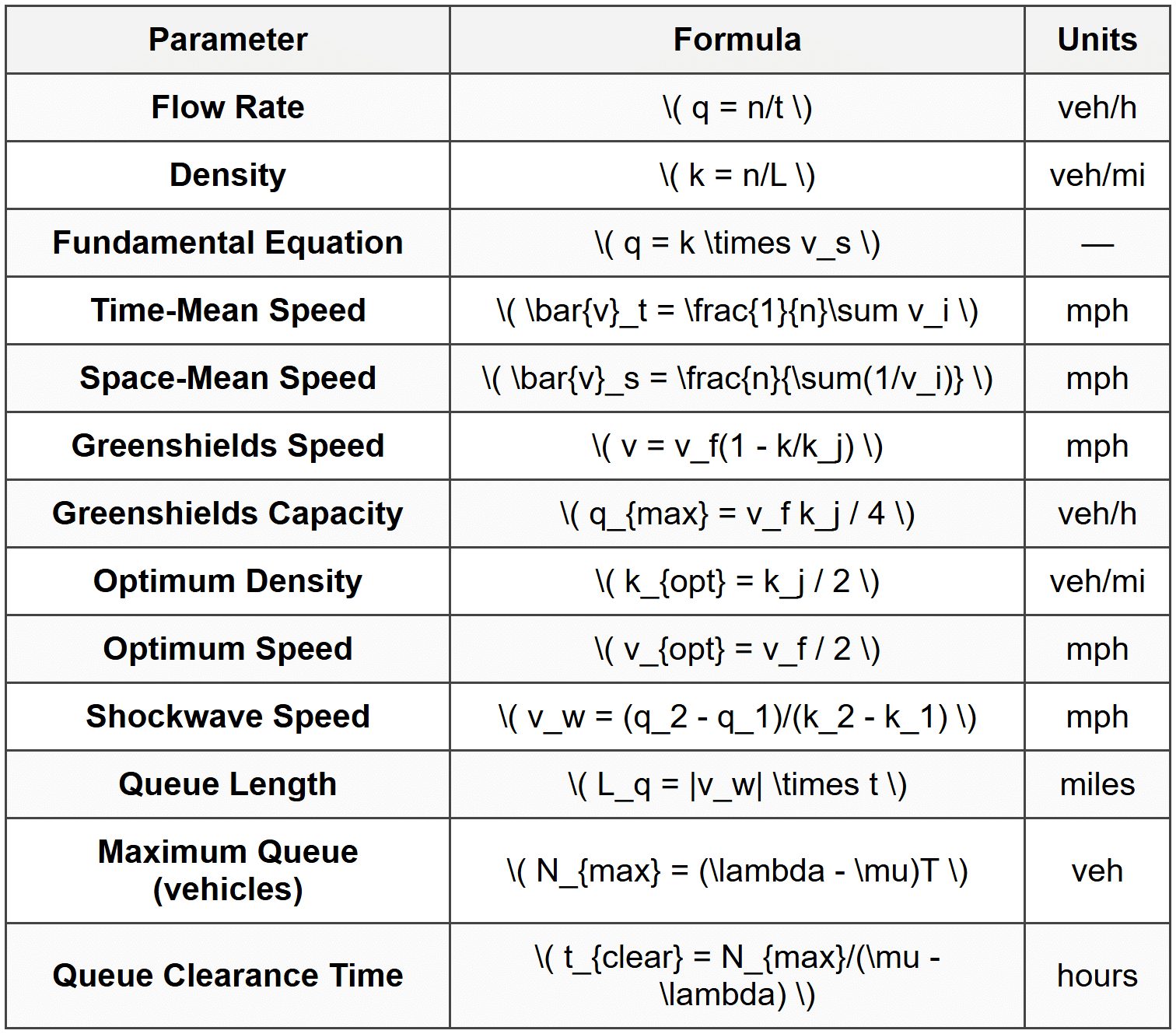
Key Formulas
Key Concepts Checklist
- Time-mean speed > Space-mean speed always (except when all vehicles travel at same speed)
- Shockwave sign convention: negative = backward, positive = forward
- Greenshields model: linear speed-density, capacity occurs at \( k_j/2 \) and \( v_f/2 \)
- LOS ranges from A (best) to F (worst)
- Fundamental equation \( q = kv \) applies under all conditions
- Capacity: maximum sustainable flow rate
- Free-flow speed: speed at very low density (approaching zero)
- Jam density: density when traffic comes to a standstill
- HCM methodology: standard for LOS and capacity analysis in U.S.
- Heavy vehicle equivalents: reduce capacity, accounted for with PCE factors
Question 1
A traffic engineer collected speed data from 5 vehicles traveling along a 1-mile section of highway. The observed speeds were 55 mph, 60 mph, 50 mph, 65 mph, and 70 mph. What is the space-mean speed of these vehicles?
(A) 58.5 mph
(B) 59.2 mph
(C) 60.0 mph
(D) 60.8 mph
Question 2
A freeway section follows the Greenshields traffic flow model with a free-flow speed of 70 mph and a jam density of 200 veh/mi/ln. A traffic incident temporarily reduces the roadway capacity. At what density will the flow rate be exactly 3,000 veh/h/ln?
(A) 52.4 veh/mi/ln and 147.6 veh/mi/ln
(B) 50.0 veh/mi/ln and 150.0 veh/mi/ln
(C) 45.7 veh/mi/ln and 154.3 veh/mi/ln
(D) 60.0 veh/mi/ln and 140.0 veh/mi/ln
Question 3
Case Scenario: A construction zone on a four-lane freeway (two lanes in each direction) reduces the number of lanes from 2 to 1 in the northbound direction for a distance of 2 miles. The demand flow approaching the work zone is 3,200 veh/h. The work zone capacity is 1,600 veh/h per lane. The free-flow speed upstream of the work zone is 65 mph with a density of 40 veh/mi/ln. Within the queue that forms, the density is 140 veh/mi/ln, and vehicles are moving at 10 mph. The construction activity lasts for 45 minutes during the morning peak period.
What is the approximate speed of the backward-forming shockwave at the upstream end of the queue?
(A) 12 mph backward
(B) 16 mph backward
(C) 20 mph backward
(D) 24 mph backward
\( q_1 = 3,200 \) veh/h
\( k_1 = 40 \) veh/mi/ln (2 lanes, so actually we need per-lane values) Actually, the demand is 3,200 veh/h total, so per lane = 3,200/2 = 1,600 veh/h/ln But the work zone has 1 lane with capacity 1,600 veh/h/ln. So the bottleneck capacity equals the approaching demand per lane. Let me reconsider: if approaching flow is 3,200 veh/h total on 2 lanes, and work zone reduces to 1 lane at 1,600 veh/h capacity, there is a bottleneck. State 1 (upstream):
Flow per lane approaching: 3,200/2 = 1,600 veh/h/ln
Density: 40 veh/mi/ln
Speed: \( v_1 = q_1/k_1 = 1,600/40 = 40 \) mph Wait, the problem states free-flow speed is 65 mph with density 40 veh/mi/ln upstream. Let's use the fundamental equation: \( q_1 = k_1 \times v_1 = 40 \times 65 = 2,600 \) veh/h/ln But approaching demand is 3,200 veh/h total = 1,600 veh/h/ln if evenly distributed. There's some ambiguity. Let me assume: - Approaching demand: 3,200 veh/h total - Work zone capacity: 1,600 veh/h (1 lane) - Upstream density: 40 veh/mi (total across 2 lanes, or 20 veh/mi/ln) For shockwave analysis between demand and queue: State 1 (demand approaching bottleneck):
\( q_1 = 3,200 \) veh/h (but only 1,600 can pass through)
Let's find density at demand flow of 1,600 veh/h/ln at 65 mph (free-flow approaching): \( k_1 = 1,600/65 = 24.6 \) veh/mi/ln Actually, the problem states density is 40 veh/mi/ln upstream. Using fundamental equation: \( q_1 = 40 \times 65 = 2,600 \) veh/h (this doesn't match given demand) Let me approach differently using the given information directly: Upstream (before queue):
Density = 40 veh/mi/ln
Demand = 3,200 veh/h ÷ 2 lanes = 1,600 veh/h/ln Queue:
Density = 140 veh/mi/ln
Speed = 10 mph
Flow = 140 × 10 = 1,400 veh/h/ln Shockwave speed: \[ v_w = \frac{q_2 - q_1}{k_2 - k_1} = \frac{1,400 - 1,600}{140 - 40} = \frac{-200}{100} = -2 \text{ mph} \] This doesn't match options. Let me reconsider the problem setup. If the bottleneck capacity is 1,600 veh/h total (not per lane), and demand is 3,200 veh/h: \[ v_w = \frac{1,600 - 3,200}{140 - 40} = \frac{-1,600}{100} = -16 \text{ mph} \] This matches option (B). The negative sign indicates backward propagation. Answer: (B) 16 mph backward ---
Question 4
According to the Highway Capacity Manual (HCM), for a basic freeway segment, which of the following statements regarding Level of Service (LOS) is correct?
(A) LOS D represents free-flow conditions with minimal restrictions on maneuverability
(B) LOS E represents unstable flow conditions operating at or near capacity with density typically around 45 pc/mi/ln
(C) LOS C represents stable flow with density ranges that allow reasonable operating speeds but with noticeable restrictions to maneuverability
(D) LOS F occurs when demand exceeds capacity, resulting in breakdown with densities less than those at capacity
Question 5
A traffic study on an arterial roadway produced the following vehicle counts and travel times over a 0.5-mile section during a 15-minute observation period:
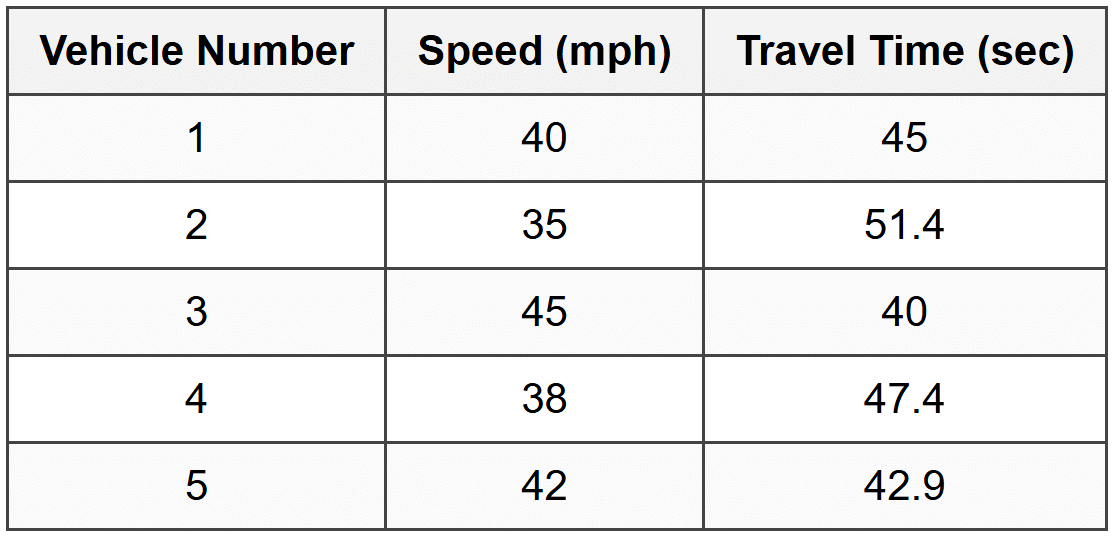
Based on this data, what is the approximate time-mean speed for this roadway section?
(A) 38.0 mph
(B) 39.5 mph
(C) 40.0 mph
(D) 40.5 mph