Radiation

Fundamental Radiation Principles
Thermal radiation is energy emitted by matter due to its temperature, propagating through space as electromagnetic waves without requiring a medium. All surfaces at temperatures above absolute zero emit thermal radiation. Electromagnetic Spectrum: Thermal radiation occupies wavelengths primarily between 0.1 and 100 μm, including ultraviolet, visible, and infrared regions. The wavelength range 0.1-100 μm contains most thermal radiation energy at temperatures encountered in engineering applications.Blackbody Radiation
A blackbody is an ideal surface that absorbs all incident radiation regardless of wavelength and direction, and emits the maximum possible radiation at any given temperature. Planck's Distribution Law describes spectral emissive power of a blackbody: \[ E_{\lambda b}(\lambda, T) = \frac{C_1}{\lambda^5[\exp(C_2/\lambda T) - 1]} \] where:- \( E_{\lambda b} \) = spectral emissive power (W/m²·μm)
- \( \lambda \) = wavelength (μm)
- \( T \) = absolute temperature (K)
- \( C_1 = 3.742 \times 10^8 \) W·μm⁴/m²
- \( C_2 = 1.439 \times 10^4 \) μm·K
- \( E_b \) = total emissive power (W/m²)
- \( \sigma = 5.670 \times 10^{-8} \) W/(m²·K⁴) = Stefan-Boltzmann constant
- \( T \) = absolute temperature (K)
Real Surface Properties
Emissivity (\( \varepsilon \)) is the ratio of radiation emitted by a real surface to that emitted by a blackbody at the same temperature: \[ \varepsilon = \frac{E}{E_b} = \frac{E}{\sigma T^4} \] For real surfaces, emissivity ranges from 0 to 1, where \( \varepsilon = 1 \) represents a perfect blackbody. Absorptivity (\( \alpha \)) is the fraction of incident radiation absorbed by a surface: \[ \alpha = \frac{G_{abs}}{G} \] where \( G \) is incident radiation (irradiation) and \( G_{abs} \) is absorbed radiation. Reflectivity (\( \rho \)) is the fraction of incident radiation reflected: \[ \rho = \frac{G_{ref}}{G} \] Transmissivity (\( \tau \)) is the fraction of incident radiation transmitted through the material: \[ \tau = \frac{G_{trans}}{G} \] Energy balance at a surface requires: \[ \alpha + \rho + \tau = 1 \] For opaque surfaces (\( \tau = 0 \)): \[ \alpha + \rho = 1 \] Kirchhoff's Law states that for a surface in thermal equilibrium with its surroundings, the total hemispherical emissivity equals the total hemispherical absorptivity: \[ \varepsilon = \alpha \] This holds strictly when the surface and radiation source are at the same temperature. Gray Surface: A surface for which spectral properties are independent of wavelength. For gray surfaces, \( \varepsilon_{\lambda} = \varepsilon = \text{constant} \) and \( \alpha_{\lambda} = \alpha = \text{constant} \). Diffuse Surface: A surface that emits and reflects radiation uniformly in all directions (Lambertian surface).Radiation Heat Exchange Between Surfaces
Radiosity (\( J \)) is the total radiation leaving a surface per unit area, including both emitted and reflected radiation: \[ J = E + \rho G = \varepsilon E_b + \rho G \] For an opaque, diffuse, gray surface: \[ J = \varepsilon \sigma T^4 + (1 - \varepsilon) G \] Net Radiation Heat Flux from a surface is the difference between radiosity and irradiation: \[ q''_{net} = J - G \] This can also be expressed using surface resistance concept: \[ q_{net} = \frac{E_b - J}{(1-\varepsilon)/(\varepsilon A)} \] where the denominator represents surface resistance.View Factors (Configuration Factors)
The view factor \( F_{i-j} \) (also called configuration factor or shape factor) is the fraction of radiation leaving surface \( i \) that directly strikes surface \( j \). Key Properties of View Factors: Summation Rule: For an enclosure with \( N \) surfaces: \[ \sum_{j=1}^{N} F_{i-j} = 1 \] Reciprocity Relation: \[ A_i F_{i-j} = A_j F_{j-i} \] View Factor Algebra: For subdivided surfaces: \[ A_i F_{i-(j+k)} = A_i F_{i-j} + A_i F_{i-k} \] Common View Factor Configurations:- Infinite parallel plates: \( F_{1-2} = 1 \)
- Small surface to large enclosure: \( F_{small-large} \approx 1 \), \( F_{large-small} \approx 0 \)
- Flat or convex surface to itself: \( F_{i-i} = 0 \)
- Concave surface to itself: \( F_{i-i} > 0 \)
Radiation Exchange in Enclosures
Two-Surface Enclosure: For two diffuse, gray surfaces forming an enclosure, the net radiation heat transfer from surface 1 to surface 2 is: \[ q_{1-2} = \frac{\sigma(T_1^4 - T_2^4)}{\frac{1-\varepsilon_1}{\varepsilon_1 A_1} + \frac{1}{A_1 F_{1-2}} + \frac{1-\varepsilon_2}{\varepsilon_2 A_2}} \] This expression includes:- Surface resistance at surface 1: \( \frac{1-\varepsilon_1}{\varepsilon_1 A_1} \)
- Geometric (space) resistance: \( \frac{1}{A_1 F_{1-2}} \)
- Surface resistance at surface 2: \( \frac{1-\varepsilon_2}{\varepsilon_2 A_2} \)
Radiation Shields
Radiation shields are thin, low-emissivity surfaces placed between two radiating surfaces to reduce radiation heat transfer. Shields do not add thermal resistance through conduction (being thin) but add surface resistances that significantly reduce radiative exchange. For \( N \) identical shields with emissivity \( \varepsilon_s \) placed between two large parallel plates with emissivities \( \varepsilon_1 \) and \( \varepsilon_2 \): \[ q_{with \, shields} = \frac{q_{without \, shields}}{N + 1} \] This assumes the shields have the same emissivity on both sides and that \( \varepsilon_s \) is much smaller than \( \varepsilon_1 \) and \( \varepsilon_2 \). For a single shield between large parallel plates: \[ q = \frac{\sigma A (T_1^4 - T_2^4)}{\frac{1}{\varepsilon_1} + \frac{1}{\varepsilon_2} - 1 + \frac{1}{\varepsilon_{s1}} + \frac{1}{\varepsilon_{s2}} - 1} \] where \( \varepsilon_{s1} \) and \( \varepsilon_{s2} \) are emissivities of the two sides of the shield.Radiation Combined with Convection
In many practical situations, both radiation and convection occur simultaneously. The total heat transfer is: \[ q_{total} = q_{conv} + q_{rad} \] \[ q_{total} = h_c A (T_s - T_{\infty}) + \varepsilon \sigma A (T_s^4 - T_{surr}^4) \] where:- \( h_c \) = convective heat transfer coefficient (W/m²·K)
- \( T_s \) = surface temperature (K)
- \( T_{\infty} \) = ambient fluid temperature (K)
- \( T_{surr} \) = surrounding surface temperature (K)
Gas Radiation
Unlike solid surfaces, gases such as CO₂, H₂O, CO, and other polyatomic molecules emit and absorb radiation in specific wavelength bands rather than continuously. Monatomic and diatomic gases (N₂, O₂, air) are essentially transparent to thermal radiation. Gas emissivity depends on:- Gas temperature
- Partial pressure of absorbing species
- Path length through the gas
Example 1: Radiation Between Parallel Plates with Shield
Problem Statement: Two large parallel plates are maintained at temperatures T₁ = 800 K and T₂ = 400 K. Both plates have emissivity ε = 0.6. A thin aluminum radiation shield with emissivity ε_s = 0.05 on both sides is placed between the plates. Determine: (a) the heat transfer rate per unit area without the shield, and (b) the heat transfer rate per unit area with the shield. (c) Calculate the equilibrium temperature of the shield. Given Data:- Plate 1 temperature: T₁ = 800 K
- Plate 2 temperature: T₂ = 400 K
- Emissivity of both plates: ε₁ = ε₂ = 0.6
- Shield emissivity: ε_s = 0.05 (both sides)
- Stefan-Boltzmann constant: σ = 5.670 × 10⁻⁸ W/(m²·K⁴)
(b) Heat transfer rate per unit area with shield
(c) Shield equilibrium temperature Solution: (a) Without shield: For large parallel plates, the heat transfer per unit area is: \[ q'' = \frac{\sigma(T_1^4 - T_2^4)}{\frac{1}{\varepsilon_1} + \frac{1}{\varepsilon_2} - 1} \] Calculating: \[ \frac{1}{\varepsilon_1} + \frac{1}{\varepsilon_2} - 1 = \frac{1}{0.6} + \frac{1}{0.6} - 1 = 1.667 + 1.667 - 1 = 2.333 \] \[ T_1^4 - T_2^4 = (800)^4 - (400)^4 = 4.096 \times 10^{11} - 2.56 \times 10^{10} \] \[ T_1^4 - T_2^4 = 3.84 \times 10^{11} \text{ K}^4 \] \[ q'' = \frac{5.670 \times 10^{-8} \times 3.84 \times 10^{11}}{2.333} \] \[ q'' = \frac{21,773}{2.333} = 9,333 \text{ W/m}^2 \] (b) With shield: For one shield with emissivity ε_s on both sides: \[ q''_{shield} = \frac{\sigma(T_1^4 - T_2^4)}{\frac{1}{\varepsilon_1} + \frac{1}{\varepsilon_2} - 1 + \frac{1}{\varepsilon_s} + \frac{1}{\varepsilon_s} - 1} \] \[ \frac{1}{\varepsilon_s} + \frac{1}{\varepsilon_s} - 1 = \frac{1}{0.05} + \frac{1}{0.05} - 1 = 20 + 20 - 1 = 39 \] Total resistance: \[ R_{total} = 2.333 + 39 = 41.333 \] \[ q''_{shield} = \frac{5.670 \times 10^{-8} \times 3.84 \times 10^{11}}{41.333} \] \[ q''_{shield} = \frac{21,773}{41.333} = 527 \text{ W/m}^2 \] (c) Shield temperature: At steady state, the heat transfer from plate 1 to shield equals the heat transfer from shield to plate 2. Using the left side: \[ q''_{shield} = \frac{\sigma(T_1^4 - T_s^4)}{\frac{1}{\varepsilon_1} + \frac{1}{\varepsilon_s} - 1} \] \[ 527 = \frac{5.670 \times 10^{-8}(800^4 - T_s^4)}{1.667 + 20 - 1} \] \[ 527 = \frac{5.670 \times 10^{-8}(4.096 \times 10^{11} - T_s^4)}{20.667} \] \[ 527 \times 20.667 = 5.670 \times 10^{-8}(4.096 \times 10^{11} - T_s^4) \] \[ 10,891 = 5.670 \times 10^{-8}(4.096 \times 10^{11} - T_s^4) \] \[ \frac{10,891}{5.670 \times 10^{-8}} = 4.096 \times 10^{11} - T_s^4 \] \[ 1.921 \times 10^{11} = 4.096 \times 10^{11} - T_s^4 \] \[ T_s^4 = 4.096 \times 10^{11} - 1.921 \times 10^{11} = 2.175 \times 10^{11} \] \[ T_s = (2.175 \times 10^{11})^{0.25} = 681 \text{ K} \] Answer:
(a) q'' without shield = 9,333 W/m²
(b) q'' with shield = 527 W/m²
(c) Shield temperature = 681 K The shield reduces radiation heat transfer by approximately 94%, demonstrating the effectiveness of low-emissivity radiation shields.
Example 2: Combined Radiation and Convection from a Pipe
Problem Statement: A horizontal steam pipe with outer diameter D = 0.3 m and length L = 5 m has a surface temperature of 450 K. The pipe is exposed to ambient air at 300 K. The surroundings are also at 300 K. The pipe surface has an emissivity of 0.75. The convective heat transfer coefficient is 12 W/(m²·K). Calculate: (a) the heat loss by convection, (b) the heat loss by radiation, and (c) the total heat loss from the pipe. Given Data:- Pipe outer diameter: D = 0.3 m
- Pipe length: L = 5 m
- Surface temperature: T_s = 450 K
- Ambient and surrounding temperature: T_∞ = T_surr = 300 K
- Surface emissivity: ε = 0.75
- Convective heat transfer coefficient: h = 12 W/(m²·K)
- Stefan-Boltzmann constant: σ = 5.670 × 10⁻⁸ W/(m²·K⁴)
(b) Radiative heat loss
(c) Total heat loss Solution: First, calculate the surface area of the pipe: \[ A = \pi D L = \pi \times 0.3 \times 5 = 4.712 \text{ m}^2 \] (a) Convective heat loss: \[ q_{conv} = h A (T_s - T_{\infty}) \] \[ q_{conv} = 12 \times 4.712 \times (450 - 300) \] \[ q_{conv} = 12 \times 4.712 \times 150 \] \[ q_{conv} = 8,481 \text{ W} = 8.48 \text{ kW} \] (b) Radiative heat loss: For a small object (pipe) in large surroundings: \[ q_{rad} = \varepsilon A \sigma (T_s^4 - T_{surr}^4) \] Calculate the temperature terms: \[ T_s^4 = (450)^4 = 4.100625 \times 10^{10} \text{ K}^4 \] \[ T_{surr}^4 = (300)^4 = 8.1 \times 10^9 \text{ K}^4 \] \[ T_s^4 - T_{surr}^4 = 4.100625 \times 10^{10} - 0.81 \times 10^{10} = 3.290625 \times 10^{10} \text{ K}^4 \] \[ q_{rad} = 0.75 \times 4.712 \times 5.670 \times 10^{-8} \times 3.290625 \times 10^{10} \] \[ q_{rad} = 0.75 \times 4.712 \times 1,866 \] \[ q_{rad} = 6,596 \text{ W} = 6.60 \text{ kW} \] (c) Total heat loss: \[ q_{total} = q_{conv} + q_{rad} \] \[ q_{total} = 8,481 + 6,596 = 15,077 \text{ W} = 15.08 \text{ kW} \] Percentage analysis: Convection percentage: \[ \frac{8,481}{15,077} \times 100\% = 56.2\% \] Radiation percentage: \[ \frac{6,596}{15,077} \times 100\% = 43.8\% \] Answer:
(a) Convective heat loss = 8.48 kW
(b) Radiative heat loss = 6.60 kW
(c) Total heat loss = 15.08 kW At this moderate temperature (450 K), both convection and radiation contribute significantly to total heat loss, with convection being slightly dominant. Radiation becomes increasingly important at higher temperatures due to the T⁴ dependence. ## QUICK SUMMARY Fundamental Laws and Constants:
- Stefan-Boltzmann constant: σ = 5.670 × 10⁻⁸ W/(m²·K⁴)
- Blackbody emissive power: \( E_b = \sigma T^4 \)
- Wien's displacement law: \( \lambda_{max} T = 2897.8 \) μm·K
- Kirchhoff's law: ε = α (at thermal equilibrium)
- Energy balance at surface: α + ρ + τ = 1 (opaque: α + ρ = 1)
- Emissivity: ε = E/E_b (ratio of actual to blackbody emission)
- Absorptivity: α = fraction of incident radiation absorbed
- Reflectivity: ρ = fraction of incident radiation reflected
- Gray surface: properties independent of wavelength
- Diffuse surface: properties independent of direction
- Summation rule: Σ F_{i-j} = 1
- Reciprocity: A_i F_{i-j} = A_j F_{j-i}
- Flat/convex surface to itself: F_{i-i} = 0
- Small object in large enclosure: F_{small-large} ≈ 1
- One shield between parallel plates reduces heat transfer by approximately 50%
- N identical shields: q_{with shields} = q_{no shields}/(N + 1)
- Most effective when shield emissivity < plate="">
- Total heat transfer: q_{total} = q_{conv} + q_{rad}
- Radiation heat transfer coefficient: h_r ≈ 4εσT_m³ (for small ΔT)
- Radiation becomes dominant at high temperatures (T⁴ dependence)
- Always use absolute temperature (K) in radiation calculations
- Check whether surface is gray and diffuse before applying simplified equations
- Identify correct geometry to select appropriate view factor or heat transfer formula
- For enclosures, verify view factor summation as a check
- Consider both radiation and convection when both mechanisms are present
- Use reciprocity to find unknown view factors from known ones
Question 1: Two very large parallel steel plates are maintained at temperatures of 900 K and 600 K. The hot plate has an emissivity of 0.8 and the cold plate has an emissivity of 0.6. What is the net radiation heat transfer per unit area between the plates?
(A) 12,500 W/m²
(B) 15,200 W/m²
(C) 18,700 W/m²
(D) 21,400 W/m²
Question 2: Which of the following statements regarding radiation heat transfer is MOST accurate?
(A) A gray surface has emissivity that varies with wavelength but is independent of direction
(B) Kirchhoff's law states that emissivity always equals absorptivity regardless of temperature conditions
(C) Radiosity includes both emitted and reflected radiation leaving a surface
(D) The view factor from a convex surface to itself is always greater than zero
Question 3: A thermocouple is used to measure the temperature of hot gas flowing through a duct. The thermocouple bead has a surface temperature of 550 K and an emissivity of 0.7. The duct walls are at 450 K. The convective heat transfer coefficient between the gas and thermocouple is 125 W/(m²·K). Assuming steady-state conditions and that the thermocouple is small compared to the duct, determine the actual gas temperature. The thermocouple can be modeled as a small sphere with negligible conduction along its leads.
(A) 568 K
(B) 575 K
(C) 583 K
(D) 592 K
Question 4: An engineer is designing a radiant heating system for an industrial process. The following data are available for different surface coating options being considered for the heating elements:
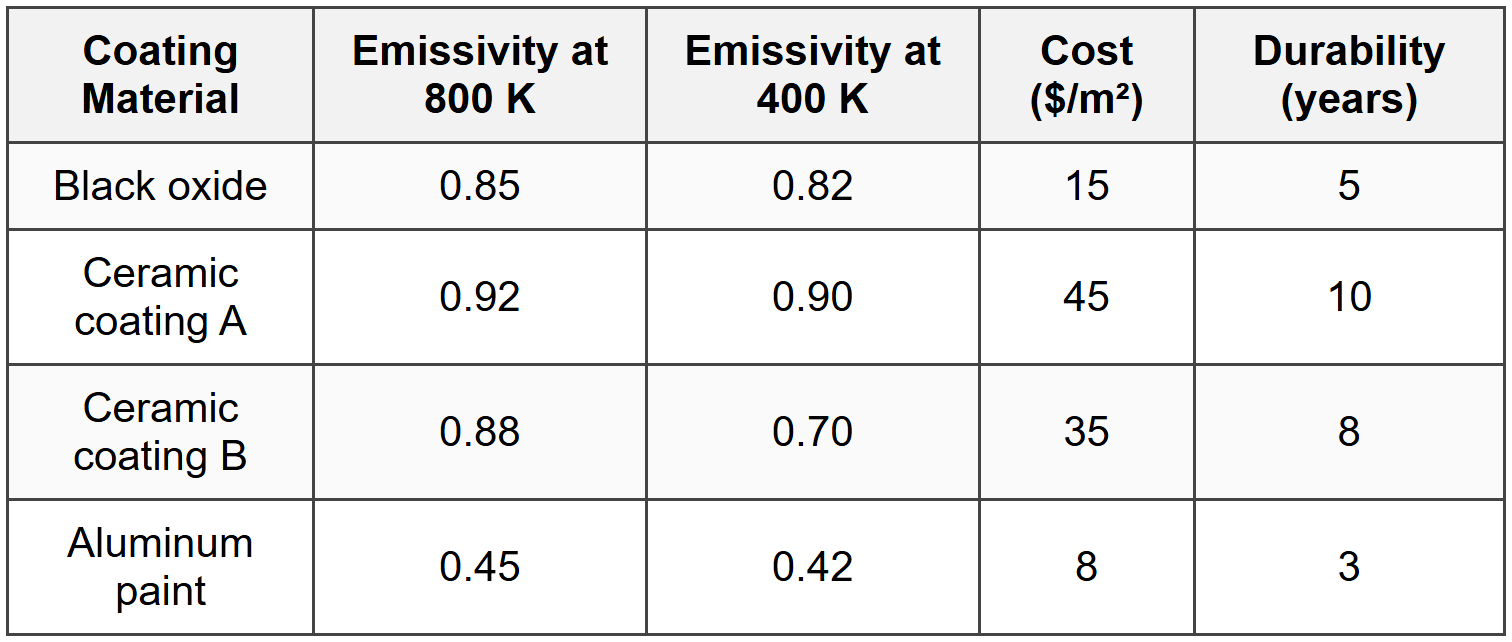
The heating elements will operate at approximately 800 K and radiate to surfaces at approximately 400 K. The application requires maximum heat transfer and the coating must be considered a gray surface. Which coating should be selected?
(A) Black oxide, because it provides good emissivity at reasonable cost
(B) Ceramic coating A, because it has the highest emissivity at operating temperature
(C) Ceramic coating B, because it provides the best cost-performance balance
(D) Aluminum paint, because it has the lowest cost per square meter
Question 5: Two concentric spheres are maintained at uniform temperatures. The inner sphere has a diameter of 0.4 m and is at 700 K with an emissivity of 0.6. The outer sphere has a diameter of 0.8 m and is at 400 K with an emissivity of 0.4. What is the net rate of radiation heat transfer from the inner sphere to the outer sphere?
(A) 3.2 kW
(B) 4.8 kW
(C) 6.4 kW
(D) 7.9 kW
- D₁ = 0.4 m, r₁ = 0.2 m, T₁ = 700 K, ε₁ = 0.6
- D₂ = 0.8 m, r₂ = 0.4 m, T₂ = 400 K, ε₂ = 0.4
- σ = 5.670 × 10⁻⁸ W/(m²·K⁴)