HVAC Systems

Psychrometrics
Psychrometrics is the study of the thermodynamic properties of moist air and the processes that affect these properties. The psychrometric chart is a graphical representation of these properties and is essential for analyzing HVAC processes.Fundamental Properties of Moist Air
- Dry-bulb temperature (DBT or Tdb): The temperature of air measured by a standard thermometer, expressed in °F or °C
- Wet-bulb temperature (WBT or Twb): The temperature measured by a thermometer with its bulb covered by a water-saturated wick, indicating evaporative cooling potential
- Dew point temperature (DPT or Tdp): The temperature at which water vapor in the air begins to condense when cooled at constant pressure
- Relative humidity (φ or RH): The ratio of actual water vapor pressure to saturation vapor pressure at the same temperature, expressed as a percentage
- Humidity ratio (W or ω): The mass of water vapor per unit mass of dry air, expressed in lbw/lbda or grains/lbda (7000 grains = 1 lb)
- Specific volume (v): The volume of moist air per unit mass of dry air, expressed in ft³/lbda
- Enthalpy (h): The total heat content of moist air per unit mass of dry air, expressed in Btu/lbda
Key Psychrometric Relationships
The humidity ratio can be calculated from partial pressures: \[ W = 0.622 \frac{p_w}{p - p_w} \] where:\( p_w \) = partial pressure of water vapor (psia)
\( p \) = total atmospheric pressure (psia)
0.622 = ratio of molecular weights (18.015/28.965) The enthalpy of moist air is given by: \[ h = h_a + W \cdot h_g \] or approximately: \[ h = 0.240 \cdot T_{db} + W(1061 + 0.444 \cdot T_{db}) \] where:
\( h_a \) = enthalpy of dry air (Btu/lbda)
\( W \) = humidity ratio (lbw/lbda)
\( h_g \) = enthalpy of water vapor (Btu/lbw)
\( T_{db} \) = dry-bulb temperature (°F) The degree of saturation (μ) is: \[ \mu = \frac{W}{W_s} \] where \( W_s \) is the humidity ratio at saturation. The relative humidity relates to degree of saturation approximately as: \[ \phi \approx \frac{\mu}{1 + (1 - \mu)\frac{W_s}{0.622}} \] For practical purposes at normal conditions: \[ \phi \approx \frac{W}{W_s} \]
Common Psychrometric Processes
- Sensible heating: Increasing dry-bulb temperature at constant humidity ratio (horizontal line to the right on psychrometric chart)
- Sensible cooling: Decreasing dry-bulb temperature at constant humidity ratio until dew point is reached (horizontal line to the left)
- Cooling and dehumidification: Cooling below dew point, removing moisture; follows cooling coil condition line with slope determined by sensible heat ratio
- Heating and humidification: Adding heat and moisture simultaneously
- Evaporative cooling: Adding moisture at approximately constant wet-bulb temperature (follows line of constant enthalpy for adiabatic saturation)
- Mixing of airstreams: Properties of mixed air lie on straight line connecting state points of two streams, divided by mass flow rate ratio
Sensible Heat Ratio
The sensible heat ratio (SHR) is the ratio of sensible heat to total heat: \[ SHR = \frac{Q_s}{Q_s + Q_l} = \frac{Q_s}{Q_t} \] where:\( Q_s \) = sensible heat load (Btu/hr)
\( Q_l \) = latent heat load (Btu/hr)
\( Q_t \) = total heat load (Btu/hr) The SHR determines the condition line slope on the psychrometric chart for cooling processes.
Heating and Cooling Load Calculations
Heat Transfer Through Building Envelope
The conduction heat gain/loss through walls, roofs, floors, and glass is calculated using: \[ Q = U \cdot A \cdot \Delta T \] where:\( Q \) = heat transfer rate (Btu/hr)
\( U \) = overall heat transfer coefficient (Btu/hr·ft²·°F)
\( A \) = area (ft²)
\( \Delta T \) = temperature difference (°F) For composite walls, the overall U-value is: \[ U = \frac{1}{R_{total}} = \frac{1}{R_{out} + \sum R_{layers} + R_{in}} \] where \( R \) values represent thermal resistance (hr·ft²·°F/Btu).
Solar Heat Gain
Solar heat gain through windows is calculated as: \[ Q_{solar} = A \cdot SHGC \cdot SHGF \cdot CLF \] where:\( A \) = glazing area (ft²)
\( SHGC \) = solar heat gain coefficient (dimensionless, replaces older shading coefficient SC)
\( SHGF \) = solar heat gain factor (Btu/hr·ft²)
\( CLF \) = cooling load factor (accounts for thermal storage) Alternatively, using the older method: \[ Q_{solar} = A \cdot SC \cdot SCL \] where \( SCL \) is the solar cooling load.
Internal Heat Gains
Occupant heat gain: \[ Q_{people} = N \cdot q_{sensible} + N \cdot q_{latent} \] where:\( N \) = number of occupants
\( q_{sensible} \) = sensible heat per person (typically 225-275 Btu/hr depending on activity)
\( q_{latent} \) = latent heat per person (typically 155-205 Btu/hr) Lighting heat gain: \[ Q_{lights} = 3.41 \cdot W \cdot F_{use} \cdot F_{special} \] where:
\( W \) = installed lighting power (watts)
3.41 = conversion factor (Btu/hr per watt)
\( F_{use} \) = usage factor
\( F_{special} \) = special allowance factor (for ballasts, etc.) Equipment heat gain: \[ Q_{equip} = 3.41 \cdot W \cdot F_{load} \cdot F_{use} \] for electrical equipment, or manufacturer's rated heat output for other equipment.
Infiltration and Ventilation Loads
Sensible heat from ventilation/infiltration: \[ Q_s = 1.08 \cdot CFM \cdot \Delta T \] where:\( CFM \) = volumetric air flow rate (ft³/min)
\( \Delta T \) = temperature difference (°F)
1.08 = constant combining air density, specific heat, and unit conversions Latent heat from ventilation/infiltration: \[ Q_l = 0.68 \cdot CFM \cdot \Delta W \] where:
\( \Delta W \) = humidity ratio difference (grains/lbda)
0.68 = conversion constant Alternatively, using mass flow rate: \[ Q_s = \dot{m} \cdot c_p \cdot \Delta T = 0.240 \cdot \dot{m} \cdot \Delta T \] \[ Q_l = \dot{m} \cdot h_{fg} \cdot \Delta W = \dot{m} \cdot 1061 \cdot \Delta W \] where \( \dot{m} \) is in lbda/hr.
Heating Load Calculation
The design heating load consists primarily of:- Transmission losses through building envelope at design conditions
- Infiltration losses through cracks and openings
- Ventilation air heating requirements
- Pickup load to raise building temperature after setback (if applicable)
Cooling Load Calculation
The design cooling load includes:- Transmission gains through building envelope
- Solar gains through fenestration
- Internal gains from occupants, lights, and equipment
- Infiltration and ventilation loads (both sensible and latent)
HVAC Equipment and Systems
Air Handling Systems
Air handling unit (AHU) components typically include:- Supply fan: moves conditioned air through ductwork
- Cooling coil: removes sensible and latent heat
- Heating coil: adds sensible heat
- Filters: remove particulates
- Dampers: control airflow and mixing
- Humidifier: adds moisture (winter operation)
Refrigeration Cycles
The vapor-compression refrigeration cycle consists of four main components:- Evaporator: absorbs heat from space or fluid to be cooled
- Compressor: increases refrigerant pressure and temperature
- Condenser: rejects heat to ambient or cooling water
- Expansion valve: reduces refrigerant pressure
\( Q_L \) = refrigeration effect (Btu/lb or kW)
\( W_{comp} \) = compressor work input (Btu/lb or kW)
\( h_1 \) = enthalpy at evaporator outlet (Btu/lb)
\( h_2 \) = enthalpy at compressor outlet (Btu/lb)
\( h_4 \) = enthalpy at expansion valve outlet (Btu/lb) Energy Efficiency Ratio (EER): \[ EER = \frac{Q_L (Btu/hr)}{W_{input} (watts)} \] Refrigeration capacity in tons: \[ \text{Tons} = \frac{Q_L (Btu/hr)}{12,000} \] One ton of refrigeration equals 12,000 Btu/hr or 200 Btu/min. Compressor power: \[ W_{comp} = \dot{m}_r (h_2 - h_1) \] where \( \dot{m}_r \) is refrigerant mass flow rate.
Chillers
Chilled water system capacity: \[ Q = \dot{m} \cdot c_p \cdot \Delta T = 500 \cdot GPM \cdot \Delta T \] where:\( GPM \) = water flow rate (gallons per minute)
\( \Delta T \) = temperature difference across chiller (°F)
500 = constant (62.4 lb/gal × 60 min/hr × 1.0 Btu/lb·°F ÷ 60 min/hr ≈ 500) Standard chilled water systems operate with supply temperature of 42-45°F and return temperature of 54-58°F (typically 10-12°F ΔT).
Boilers and Heating Systems
Boiler capacity for hot water systems: \[ Q = \dot{m} \cdot c_p \cdot \Delta T = 500 \cdot GPM \cdot \Delta T \] Standard hot water heating systems typically operate at 180-200°F supply and 160-170°F return. Steam heating load: \[ Q = \dot{m}_s \cdot h_{fg} \] where:\( \dot{m}_s \) = steam mass flow rate (lb/hr)
\( h_{fg} \) = latent heat of vaporization at operating pressure (Btu/lb) Boiler efficiency: \[ \eta = \frac{Q_{output}}{Q_{input}} = \frac{Q_{output}}{\dot{m}_{fuel} \cdot HHV} \]
Cooling Towers
Cooling tower heat rejection: \[ Q_{CT} = Q_{evaporator} + W_{comp} \] The heat rejected equals the chiller capacity plus compressor power. Water flow rate through cooling tower: \[ GPM = \frac{Q_{CT}}{500 \cdot \Delta T} \] where \( \Delta T \) is typically 10°F (e.g., 95°F entering, 85°F leaving). Cooling tower performance parameters:- Range: Temperature difference between entering and leaving water (typically 10°F)
- Approach: Difference between leaving water temperature and entering air wet-bulb temperature (typically 5-10°F)
- Effectiveness: \( \varepsilon = \frac{\text{Range}}{\text{Range + Approach}} \)
Duct and Pipe Sizing
Duct Design Methods
Equal friction method: Maintains constant pressure loss per unit length throughout the system. Pressure drop in ducts: \[ \Delta P = \frac{f \cdot L \cdot \rho \cdot V^2}{2 \cdot D_h \cdot 12} \] or using simplified form: \[ \Delta P = \frac{\Delta P}{100 ft} \cdot L \] where friction rate (ΔP/100 ft) is obtained from duct friction charts. Velocity method: Selects duct sizes based on maximum allowable velocities:- Main ducts: 1,000-2,000 fpm
- Branch ducts: 600-1,000 fpm
- Return ducts: 800-1,200 fpm
Duct Sizing Calculations
For rectangular ducts, the equivalent round diameter is: \[ D_e = 1.30 \frac{(a \cdot b)^{0.625}}{(a + b)^{0.250}} \] where \( a \) and \( b \) are rectangular duct dimensions (inches). Air velocity: \[ V = \frac{CFM}{A} = \frac{CFM}{\frac{\pi D^2}{4 \cdot 144}} = \frac{183.3 \cdot CFM}{D^2} \] where \( V \) is in fpm, \( CFM \) is volumetric flow rate, and \( D \) is diameter in inches.Piping System Design
Pressure drop in pipes (Darcy-Weisbach): \[ \Delta P = f \cdot \frac{L}{D} \cdot \frac{\rho V^2}{2} \] For water at 60°F: \[ \Delta P (psi) = 0.000216 \cdot f \cdot \frac{L (ft)}{D (in)} \cdot V^2 (fps) \] Hazen-Williams equation (for water): \[ V = 1.318 \cdot C \cdot R^{0.63} \cdot S^{0.54} \] where:\( C \) = Hazen-Williams coefficient (120-150 for typical piping)
\( R \) = hydraulic radius (ft)
\( S \) = slope of energy grade line (ft/ft) Simplified for full pipes: \[ \Delta P (psi/100 ft) = \frac{0.2083 \cdot (100/C)^{1.852} \cdot GPM^{1.852}}{D^{4.866}} \] Pump head requirement: \[ H_{pump} = H_{static} + \Delta P_{friction} + \Delta P_{fittings} + H_{velocity} \] where head is expressed in feet of water. Pipe sizing for chilled/hot water: Typical design velocities:
- 2-4 fps for small pipes (< 2="">
- 4-10 fps for large pipes (> 2 inches)
- Maximum 4 ft/100 ft pressure drop
Ventilation and Indoor Air Quality
Outdoor Air Requirements
ASHRAE Standard 62.1 specifies minimum ventilation rates based on:- People outdoor air rate (cfm/person)
- Area outdoor air rate (cfm/ft²)
\( V_{oz} \) = outdoor air flow required in zone (cfm)
\( R_p \) = outdoor air rate per person (cfm/person)
\( P_z \) = zone population
\( R_a \) = outdoor air rate per unit area (cfm/ft²)
\( A_z \) = zone floor area (ft²)
Economizer Operation
An air-side economizer uses outdoor air for cooling when conditions permit, reducing mechanical cooling energy. Enthalpy-based control: Uses outdoor air when \( h_{outdoor} < h_{return}="" \)="">Temperature-based control: Uses outdoor air when \( T_{outdoor} < t_{return}="" \)="" and="" below="" a="" high="" limit="" (typically="" 65-75°f)="">Energy Recovery
Heat Recovery Effectiveness
Sensible effectiveness: \[ \varepsilon_s = \frac{T_{supply} - T_{outdoor}}{T_{exhaust} - T_{outdoor}} \] Latent effectiveness: \[ \varepsilon_l = \frac{W_{supply} - W_{outdoor}}{W_{exhaust} - W_{outdoor}} \] Total effectiveness: \[ \varepsilon_t = \frac{h_{supply} - h_{outdoor}}{h_{exhaust} - h_{outdoor}} \] Energy recovered: \[ Q_{recovered} = \dot{m} \cdot c_p \cdot \varepsilon_s \cdot (T_{exhaust} - T_{outdoor}) \]Types of Energy Recovery Devices
- Rotary wheel (enthalpy wheel): Recovers both sensible and latent heat; effectiveness 70-85%
- Fixed plate heat exchanger: Sensible heat recovery only; effectiveness 50-75%
- Heat pipe: Sensible heat recovery; effectiveness 45-65%
- Run-around loop: Sensible heat recovery for non-adjacent airstreams; effectiveness 45-65%
Example 1: Psychrometric Process Analysis and Cooling Coil Selection
PROBLEM STATEMENT: An air conditioning system must condition 5,000 cfm of outdoor air at 95°F dry-bulb and 75°F wet-bulb to supply air at 55°F and 90% relative humidity. The atmospheric pressure is 14.7 psia. Using psychrometric principles, determine: (a) the sensible heat removal rate, (b) the latent heat removal rate, (c) the total cooling capacity required in tons of refrigeration, and (d) the sensible heat ratio of the process. GIVEN DATA:- Volumetric flow rate: \( CFM = 5,000 \) ft³/min
- Outdoor air condition: \( T_{db1} = 95°F \), \( T_{wb1} = 75°F \)
- Supply air condition: \( T_{db2} = 55°F \), \( \phi_2 = 90\% \)
- Atmospheric pressure: \( p = 14.7 \) psia
(b) Latent heat removal rate (Btu/hr)
(c) Total cooling capacity (tons)
(d) Sensible heat ratio SOLUTION: Step 1: Determine psychrometric properties at state 1 (outdoor air) From psychrometric chart or tables at 95°F DB, 75°F WB:
- \( h_1 = 38.2 \) Btu/lbda
- \( W_1 = 0.0136 \) lbw/lbda = 95.2 grains/lbda
- \( v_1 = 14.2 \) ft³/lbda
- \( h_2 = 21.8 \) Btu/lbda
- \( W_2 = 0.0083 \) lbw/lbda = 58.1 grains/lbda
(b) Latent heat removal = 143,500 Btu/hr
(c) Total cooling capacity = 28.9 tons
(d) Sensible heat ratio = 0.59 ---
Example 2: Chiller System Sizing and Refrigeration Cycle Analysis
PROBLEM STATEMENT: A water-cooled chiller serves a building with a peak cooling load of 250 tons. The chilled water system operates with a supply temperature of 42°F and return temperature of 54°F. The chiller uses refrigerant R-134a with an evaporator temperature of 38°F and a condenser temperature of 105°F. The refrigerant exits the evaporator as saturated vapor and exits the condenser as saturated liquid. The isentropic efficiency of the compressor is 85%. The condenser is cooled by a cooling tower with water entering at 85°F and leaving at 95°F. Determine: (a) the required chilled water flow rate in GPM, (b) the refrigerant mass flow rate, (c) the actual compressor power required, (d) the actual COP of the chiller, and (e) the required condenser water flow rate in GPM. GIVEN DATA:- Cooling capacity: \( Q_L = 250 \) tons = 3,000,000 Btu/hr
- Chilled water supply temperature: \( T_{chs} = 42°F \)
- Chilled water return temperature: \( T_{chr} = 54°F \)
- Evaporator temperature: \( T_{evap} = 38°F \)
- Condenser temperature: \( T_{cond} = 105°F \)
- Refrigerant: R-134a
- Evaporator outlet: saturated vapor
- Condenser outlet: saturated liquid
- Compressor isentropic efficiency: \( \eta_c = 0.85 \)
- Condenser water entering: \( T_{cw,in} = 85°F \)
- Condenser water leaving: \( T_{cw,out} = 95°F \)
(b) Refrigerant mass flow rate (lb/hr)
(c) Actual compressor power (hp)
(d) Actual COP
(e) Condenser water flow rate (GPM) SOLUTION: Step 1: Calculate chilled water flow rate (part a) Using the chilled water equation: \[ Q_L = 500 \times GPM_{chw} \times \Delta T_{chw} \] \[ 3,000,000 = 500 \times GPM_{chw} \times (54 - 42) \] \[ 3,000,000 = 500 \times GPM_{chw} \times 12 \] \[ GPM_{chw} = \frac{3,000,000}{6,000} = 500 \text{ GPM} \] Answer (a): 500 GPM Step 2: Determine refrigerant properties from R-134a tables At \( T_{evap} = 38°F \):
- State 1 (evaporator outlet, saturated vapor): \( h_1 = 103.08 \) Btu/lb, \( s_1 = 0.2227 \) Btu/lb·°R
- Saturation pressure: \( P_1 = 50.0 \) psia
- State 3 (condenser outlet, saturated liquid): \( h_3 = 45.26 \) Btu/lb
- Saturation pressure: \( P_2 = 138.9 \) psia
- \( s_{2s} = s_1 = 0.2227 \) Btu/lb·°R
- At 138.9 psia and \( s = 0.2227 \), interpolating superheated vapor tables: \( h_{2s} = 112.5 \) Btu/lb
(b) Refrigerant mass flow rate = 51,900 lb/hr
(c) Actual compressor power = 226 hp (168.5 kW)
(d) Actual COP = 5.22
(e) Condenser water flow rate = 715 GPM ## QUICK SUMMARY
Essential Formulas and Relationships
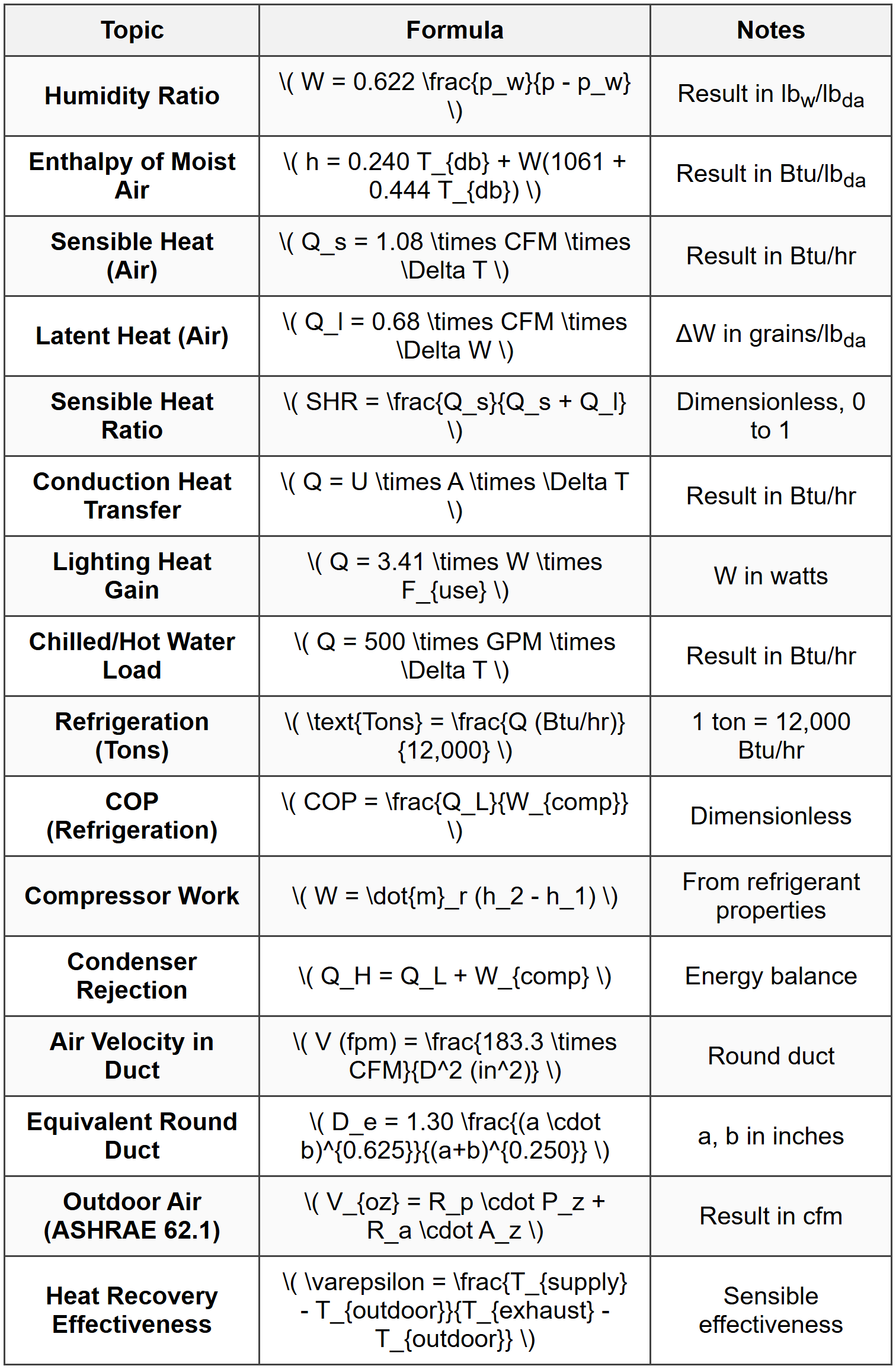
Key Design Values
- Standard air density: 0.075 lb/ft³ at 70°F
- Specific heat of air: 0.240 Btu/lb·°F
- Specific heat of water: 1.0 Btu/lb·°F
- Latent heat of water vaporization: ~1061 Btu/lb at typical conditions
- One ton of refrigeration: 12,000 Btu/hr or 200 Btu/min
- Power conversion: 1 hp = 2,545 Btu/hr; 1 kW = 3,412 Btu/hr
- Grains to pounds: 7,000 grains = 1 lb
- Standard atmospheric pressure: 14.7 psia or 29.92 in Hg
- Chilled water typical ΔT: 10-12°F (42-45°F supply, 54-58°F return)
- Hot water typical ΔT: 20°F (180-200°F supply, 160-170°F return)
- Condenser water typical ΔT: 10°F (85°F supply, 95°F return)
- Supply air temperature rise (cooling): 15-25°F below room temperature
Critical Reminders
- Always use absolute pressure for refrigerant property lookups
- Check whether humidity ratio is in lbw/lbda or grains/lbda
- Verify units throughout calculations (cfm vs ft³/hr, °F vs °R, Btu/hr vs tons)
- For psychrometric processes, use dry air mass flow rate as basis
- Expansion process in refrigeration cycle is isenthalpic (h₄ = h₃)
- Total heat in moist air processes = sensible + latent components
- Cooling tower approach cannot be less than zero (water cannot be colder than wet-bulb)
- Duct friction losses depend on both velocity and duct size
- Always account for both people-based and area-based ventilation requirements
Question 1:
An office space requires 3,200 cfm of supply air to maintain 75°F and 50% relative humidity. The space has a sensible cooling load of 96,000 Btu/hr and a latent cooling load of 24,000 Btu/hr. What is the required supply air dry-bulb temperature to satisfy the sensible load?
(A) 47°F
(B) 53°F
(C) 57°F
(D) 61°F
Question 2:
Which of the following statements about psychrometric processes is correct?
(A) During sensible cooling, both the dry-bulb temperature and humidity ratio decrease
(B) The wet-bulb temperature remains constant during an adiabatic humidification process
(C) The dew point temperature increases during a cooling and dehumidification process
(D) Mixing two airstreams always results in a mixture state with enthalpy equal to the arithmetic average of the two inlet stream enthalpies
Question 3:
A commercial building has the following daily operational profile for its HVAC system. The building is located in a region where the outdoor air temperature varies throughout the day as shown below:

The HVAC system has an air-side economizer with a high-limit setpoint of 70°F. The system maintains an indoor temperature of 75°F. During which time period(s) can the economizer provide the greatest energy savings by using outdoor air for cooling?
(A) 6:00 AM - 9:00 AM only
(B) 6:00 AM - 9:00 AM and 3:00 PM - 6:00 PM
(C) 9:00 AM - 12:00 PM only
(D) No period allows economizer operation due to high-limit lockout
Outdoor temperature = 65°F
This is below both the indoor temperature (75°F) and the high-limit setpoint (70°F).
The economizer can operate, providing "free cooling" by bringing in outdoor air that is cooler than the indoor air.
Indoor load = 180 kBtu/hr (relatively light)
The economizer can provide significant cooling benefit during this period. 9:00 AM - 12:00 PM:
Outdoor temperature = 78°F
This exceeds the high-limit setpoint of 70°F.
The economizer is locked out and cannot operate.
Additionally, outdoor air at 78°F is warmer than indoor air at 75°F, so it would add to the cooling load rather than reduce it. 12:00 PM - 3:00 PM:
Outdoor temperature = 85°F
This is well above the high-limit setpoint (70°F) and above indoor temperature (75°F).
The economizer cannot operate. 3:00 PM - 6:00 PM:
Outdoor temperature = 82°F
This exceeds the high-limit setpoint of 70°F.
The economizer is locked out and cannot operate. Therefore, only during the 6:00 AM - 9:00 AM period can the economizer operate and provide energy savings. During this time, cool outdoor air at 65°F can be used to meet the 180 kBtu/hr cooling load, reducing or eliminating the need for mechanical cooling. The economizer provides the greatest benefit when:
- Outdoor temperature is significantly below indoor temperature
- Outdoor temperature is below the high-limit setpoint
- There is a cooling load to be met
Question 4:
A water-cooled chiller operates with refrigerant R-134a. The evaporator operates at 40°F (saturated) and the condenser operates at 100°F (saturated). The refrigerant exits the evaporator as saturated vapor and exits the condenser as saturated liquid. Using the following properties for R-134a, determine the theoretical COP of this refrigeration cycle.

(A) 4.8
(B) 5.6
(C) 6.2
(D) 7.5
- State 1 (evaporator outlet): saturated vapor at 40°F, h₁ = 103.3 Btu/lb
- State 2 (compressor outlet): superheated vapor at 131.9 psia after isentropic compression, h₂ = 111.2 Btu/lb
- State 3 (condenser outlet): saturated liquid at 100°F, h₃ = 43.6 Btu/lb
- State 4 (expansion valve outlet): two-phase mixture at 51.7 psia, h₄ = h₃ = 43.6 Btu/lb (isenthalpic expansion)
Question 5:
A hospital operating room requires precise environmental control. The design conditions specify 68°F and 50% relative humidity with six complete air changes per hour. The room dimensions are 20 ft × 24 ft × 10 ft (height). The space has a sensible cooling load of 18,000 Btu/hr and a sensible heating load of 12,000 Btu/hr (during winter). No latent load is generated within the space. A constant volume reheat system is used where supply air is delivered at 55°F and reheated as necessary to maintain room temperature. What is the required reheat capacity during the cooling mode to maintain the 68°F room temperature?
(A) 3,740 Btu/hr
(B) 5,620 Btu/hr
(C) 8,210 Btu/hr
(D) 10,450 Btu/hr