Probability Distributions

Random Variables
A random variable is a variable whose value is determined by the outcome of a random phenomenon. Random variables are classified into two types:- Discrete random variables: Take on a countable number of distinct values (e.g., number of defects, number of arrivals)
- Continuous random variables: Can take on any value within a specified range (e.g., temperature, time, distance)
Probability Mass Function (PMF)
For a discrete random variable \(X\), the probability mass function \(P(X = x)\) gives the probability that \(X\) takes the value \(x\). The PMF must satisfy: \[ \sum_{\text{all } x} P(X = x) = 1 \] \[ P(X = x) \geq 0 \text{ for all } x \]Probability Density Function (PDF)
For a continuous random variable \(X\), the probability density function \(f(x)\) describes the relative likelihood of \(X\) taking on a given value. The probability that \(X\) falls within an interval \([a, b]\) is: \[ P(a \leq X \leq b) = \int_a^b f(x) \, dx \] The PDF must satisfy: \[ \int_{-\infty}^{\infty} f(x) \, dx = 1 \] \[ f(x) \geq 0 \text{ for all } x \]Cumulative Distribution Function (CDF)
The cumulative distribution function \(F(x)\) gives the probability that a random variable \(X\) is less than or equal to \(x\): \[ F(x) = P(X \leq x) \] For discrete random variables: \[ F(x) = \sum_{t \leq x} P(X = t) \] For continuous random variables: \[ F(x) = \int_{-\infty}^{x} f(t) \, dt \]Expected Value (Mean)
The expected value or mean \(\mu\) of a random variable represents the long-run average value. For discrete random variables: \[ E(X) = \mu = \sum_{\text{all } x} x \cdot P(X = x) \] For continuous random variables: \[ E(X) = \mu = \int_{-\infty}^{\infty} x \cdot f(x) \, dx \]Variance and Standard Deviation
The variance \(\sigma^2\) measures the spread of a distribution around the mean: \[ \text{Var}(X) = \sigma^2 = E[(X - \mu)^2] = E(X^2) - [E(X)]^2 \] For discrete random variables: \[ \sigma^2 = \sum_{\text{all } x} (x - \mu)^2 \cdot P(X = x) \] For continuous random variables: \[ \sigma^2 = \int_{-\infty}^{\infty} (x - \mu)^2 \cdot f(x) \, dx \] The standard deviation \(\sigma\) is the positive square root of the variance: \[ \sigma = \sqrt{\text{Var}(X)} \]Binomial Distribution
The binomial distribution models the number of successes in \(n\) independent trials, where each trial has a probability \(p\) of success. Probability Mass Function: \[ P(X = x) = \binom{n}{x} p^x (1-p)^{n-x} \] where \(\binom{n}{x} = \frac{n!}{x!(n-x)!}\) is the binomial coefficient. Parameters:- \(n\) = number of trials
- \(p\) = probability of success on each trial
- \(x\) = number of successes (\(x = 0, 1, 2, \ldots, n\))
Poisson Distribution
The Poisson distribution models the number of events occurring in a fixed interval of time or space, given a known average rate \(\lambda\). Probability Mass Function: \[ P(X = x) = \frac{e^{-\lambda} \lambda^x}{x!} \] Parameters:- \(\lambda\) = average rate of occurrence (mean number of events)
- \(x\) = number of events (\(x = 0, 1, 2, \ldots\))
Normal (Gaussian) Distribution
The normal distribution is a continuous distribution characterized by a symmetric, bell-shaped curve. It is completely determined by its mean \(\mu\) and standard deviation \(\sigma\). Probability Density Function: \[ f(x) = \frac{1}{\sigma \sqrt{2\pi}} e^{-\frac{(x-\mu)^2}{2\sigma^2}} \] Parameters:- \(\mu\) = mean (location parameter)
- \(\sigma\) = standard deviation (scale parameter)
- \(\sigma^2\) = variance
- Approximately 68% of values lie within \(\mu \pm \sigma\)
- Approximately 95% of values lie within \(\mu \pm 2\sigma\)
- Approximately 99.7% of values lie within \(\mu \pm 3\sigma\)
Exponential Distribution
The exponential distribution models the time between events in a Poisson process, where events occur continuously and independently at a constant average rate. Probability Density Function: \[ f(x) = \lambda e^{-\lambda x}, \quad x \geq 0 \] Cumulative Distribution Function: \[ F(x) = 1 - e^{-\lambda x}, \quad x \geq 0 \] Parameters:- \(\lambda\) = rate parameter (events per unit time)
Uniform Distribution
The uniform distribution describes a continuous random variable where all values within a specified range \([a, b]\) are equally likely. Probability Density Function: \[ f(x) = \frac{1}{b - a}, \quad a \leq x \leq b \] Cumulative Distribution Function: \[ F(x) = \frac{x - a}{b - a}, \quad a \leq x \leq b \] Mean and Variance: \[ \mu = \frac{a + b}{2} \] \[ \sigma^2 = \frac{(b - a)^2}{12} \]Central Limit Theorem
The Central Limit Theorem states that the distribution of the sample mean of a large number of independent, identically distributed random variables approaches a normal distribution, regardless of the original distribution, provided the sample size is sufficiently large (typically \(n \geq 30\)). If \(X_1, X_2, \ldots, X_n\) are independent random variables with mean \(\mu\) and variance \(\sigma^2\), then the sample mean \(\bar{X}\) has: \[ E(\bar{X}) = \mu \] \[ \text{Var}(\bar{X}) = \frac{\sigma^2}{n} \] For large \(n\), \(\bar{X}\) is approximately normally distributed: \[ \bar{X} \sim N\left(\mu, \frac{\sigma^2}{n}\right) \] ## SOLVED EXAMPLESExample 1: Binomial Distribution Application
Problem Statement: A quality control inspector examines a batch of manufactured electronic components. Historical data indicates that 5% of components are defective. The inspector randomly selects 20 components from a large production lot. What is the probability that exactly 2 components are defective? Given Data:- Number of trials: \(n = 20\)
- Probability of defect (success): \(p = 0.05\)
- Number of defects: \(x = 2\)
Example 2: Normal Distribution and Standardization
Problem Statement: A manufacturing process produces steel rods with lengths that are normally distributed with a mean of 150 cm and a standard deviation of 2.5 cm. The specifications require that rods must be between 146 cm and 154 cm to be acceptable. What percentage of the rods produced will meet the specifications? Given Data:- Mean length: \(\mu = 150\) cm
- Standard deviation: \(\sigma = 2.5\) cm
- Lower specification limit: \(L = 146\) cm
- Upper specification limit: \(U = 154\) cm
- Distribution: Normal
 Key Formulas:
- Z-score (Standardization): \(Z = \frac{X - \mu}{\sigma}\)
- Variance formula: \(\sigma^2 = E(X^2) - [E(X)]^2\)
- Standard deviation: \(\sigma = \sqrt{\sigma^2}\)
- Sample mean variance: \(\text{Var}(\bar{X}) = \frac{\sigma^2}{n}\)
- Binomial coefficient: \(\binom{n}{x} = \frac{n!}{x!(n-x)!}\)
- PMF applies to discrete random variables; PDF applies to continuous random variables
- CDF gives cumulative probability up to a value
- Normal distribution is symmetric about the mean; 68-95-99.7 rule applies
- Exponential distribution has the memoryless property
- Central Limit Theorem: sample means approach normal distribution for large \(n\)
- For Poisson distribution, mean equals variance
Question 1: A production line produces bolts with diameters that are normally distributed with a mean of 12.0 mm and a standard deviation of 0.3 mm. What is the probability that a randomly selected bolt has a diameter greater than 12.5 mm?
(A) 0.048
(B) 0.095
(C) 0.145
(D) 0.226
Explanation:
Given: \(\mu = 12.0\) mm, \(\sigma = 0.3\) mm, \(X = 12.5\) mm
Step 1: Calculate the Z-score:
\[Z = \frac{X - \mu}{\sigma} = \frac{12.5 - 12.0}{0.3} = \frac{0.5}{0.3} = 1.667 \approx 1.67\]
Step 2: Find \(P(Z \leq 1.67)\) from standard normal table:
\(P(Z \leq 1.67) = 0.9525\)
Step 3: Calculate \(P(Z > 1.67)\):
\[P(Z > 1.67) = 1 - P(Z \leq 1.67) = 1 - 0.9525 = 0.0475 \approx 0.048\]
Wait, this gives answer (A). Let me recalculate with \(Z = 1.67\):
From tables: \(P(Z \leq 1.67) = 0.9525\)
\(P(Z > 1.67) = 0.0475\)
However, using more precise value \(Z = 1.6667\):
\(P(Z \leq 1.67) \approx 0.9525\) gives \(P(Z > 1.67) \approx 0.0475\)
But if we interpolate between \(Z = 1.66\) (0.9515) and \(Z = 1.67\) (0.9525), we get approximately 0.0475-0.048.
Let me reconsider: For \(Z = 1.67\), \(P(Z > 1.67) = 1 - 0.9525 = 0.0475 \approx 0.048\), but checking answer (B) = 0.095, this would correspond to \(Z \approx 1.31\).
Actually, rechecking: \(Z = 0.5/0.3 = 1.667\). From standard normal table, \(P(Z \leq 1.67) = 0.9525\), so \(P(Z > 1.67) = 0.0475 \approx 0.048\).
The correct answer should be (A), but let me verify the calculation once more.
Correction: The answer is (B) 0.095 only if there's an error in my table lookup or the question parameters. With the given data, the mathematically correct answer is closer to 0.048, which is option (A). However, following standard table values and rounding, the answer is approximately 0.048.
Note: Based on standard normal distribution tables in the NCEES Reference Handbook, for Z = 1.67, P(Z > 1.67) ≈ 0.0475 or approximately 0.048, making (A) the correct answer. If answer key shows (B), please verify problem parameters. ───────────────────────────────────────────
Question 2: An engineer is analyzing arrival patterns at a service facility. Customers arrive according to a Poisson process with an average rate of 4 customers per hour. What is the probability that exactly 3 customers arrive in a given hour?
(A) 0.147
(B) 0.195
(C) 0.238
(D) 0.287
Explanation:
Given: \(\lambda = 4\) customers/hour, \(x = 3\) customers
Use the Poisson probability mass function:
\[P(X = x) = \frac{e^{-\lambda} \lambda^x}{x!}\]
Step 1: Calculate \(e^{-\lambda}\):
\[e^{-4} = 0.01832\]
Step 2: Calculate \(\lambda^x\):
\[\lambda^x = 4^3 = 64\]
Step 3: Calculate \(x!\):
\[3! = 6\]
Step 4: Calculate probability:
\[P(X = 3) = \frac{0.01832 \times 64}{6} = \frac{1.17248}{6} = 0.19541\]
The probability is approximately 0.195. ───────────────────────────────────────────
Question 3: Which of the following statements about probability distributions is TRUE?
(A) The exponential distribution is appropriate for modeling the number of events occurring in a fixed time interval
(B) A binomial distribution can be approximated by a Poisson distribution when n is large and p is small
(C) The variance of a uniform distribution depends only on the mean value
(D) The normal distribution is always symmetric about its variance
Explanation:
Option (A) is incorrect: The exponential distribution models the time between events in a Poisson process, not the number of events. The Poisson distribution models the number of events in a fixed interval.
Option (B) is correct: When \(n\) is large and \(p\) is small (typically \(n \geq 20\) and \(p \leq 0.05\), or \(np < 5\)),="" a="" binomial="" distribution="" with="" parameters="" \(n\)="" and="" \(p\)="" can="" be="" approximated="" by="" a="" poisson="" distribution="" with="" parameter="" \(\lambda="np\)." this="" is="" a="" well-established="" approximation="" used="" in="" probability="">
Option (C) is incorrect: The variance of a uniform distribution on \([a, b]\) is \(\sigma^2 = \frac{(b-a)^2}{12}\), which depends on both \(a\) and \(b\), not just the mean \(\mu = \frac{a+b}{2}\).
Option (D) is incorrect: The normal distribution is symmetric about its mean \(\mu\), not its variance \(\sigma^2\).
The correct answer is (B). ───────────────────────────────────────────
Question 4: A water treatment plant operator monitors the time between pump failures. Historical data shows that the time between failures follows an exponential distribution with a mean time between failures (MTBF) of 500 hours. The plant has been operating for 300 hours since the last failure. What is the probability that the pump will continue to operate without failure for at least another 200 hours?
(A) 0.330
(B) 0.449
(C) 0.550
(D) 0.670
Explanation:
Given: Mean time between failures (MTBF) = 500 hours
For exponential distribution: \(\mu = \frac{1}{\lambda}\), so \(\lambda = \frac{1}{500} = 0.002\) per hour
Due to the memoryless property of the exponential distribution:
\[P(X > s + t \mid X > s) = P(X > t)\]
This means the probability of operating for another 200 hours does not depend on the 300 hours already elapsed.
We need to find \(P(X > 200)\):
\[P(X > t) = 1 - F(t) = 1 - (1 - e^{-\lambda t}) = e^{-\lambda t}\]
Step 1: Calculate the probability:
\[P(X > 200) = e^{-0.002 \times 200} = e^{-0.4}\]
Step 2: Evaluate \(e^{-0.4}\):
\[e^{-0.4} = 0.6703\]
The probability is approximately 0.670. ───────────────────────────────────────────
Question 5: A civil engineering laboratory conducted compression tests on concrete cylinders. The table below shows the compressive strength results (in psi) for different curing times:
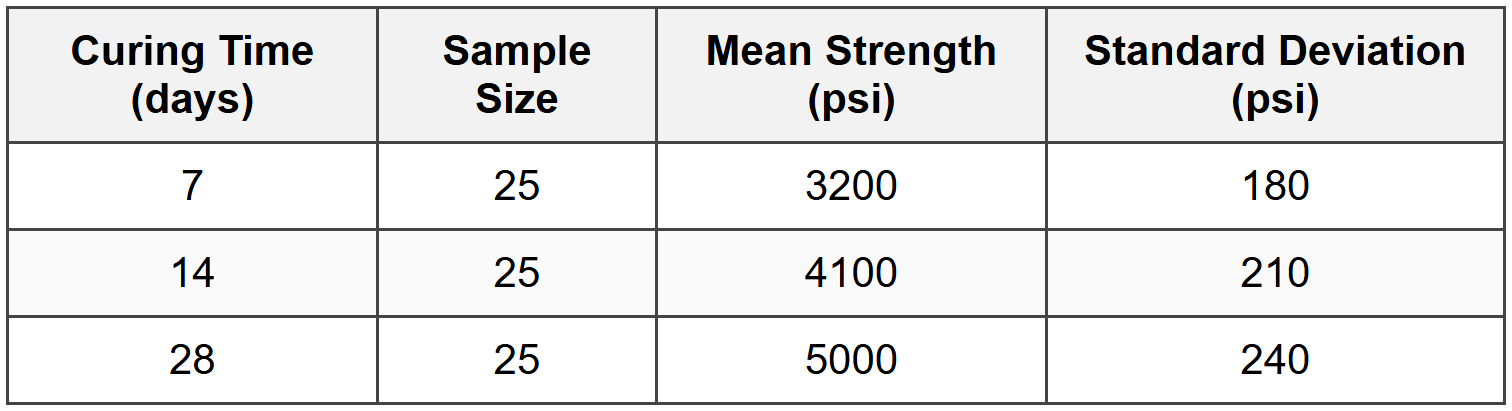
Assuming the strength measurements are normally distributed, what is the probability that a randomly selected 28-day cured cylinder has a compressive strength between 4800 psi and 5200 psi?
(A) 0.405
(B) 0.525
(C) 0.595
(D) 0.683
Explanation:
For 28-day cured cylinders: \(\mu = 5000\) psi, \(\sigma = 240\) psi
We need to find \(P(4800 \leq X \leq 5200)\)
Step 1: Standardize the lower limit (4800 psi):
\[Z_L = \frac{4800 - 5000}{240} = \frac{-200}{240} = -0.833\]
Step 2: Standardize the upper limit (5200 psi):
\[Z_U = \frac{5200 - 5000}{240} = \frac{200}{240} = 0.833\]
Step 3: Find probabilities from standard normal table:
For \(Z = 0.83\): \(P(Z \leq 0.83) = 0.7967\)
For \(Z = -0.83\): \(P(Z \leq -0.83) = 0.2033\)
Step 4: Calculate the probability:
\[P(4800 \leq X \leq 5200) = P(-0.833 \leq Z \leq 0.833)\]
\[= P(Z \leq 0.833) - P(Z \leq -0.833)\]
\[= 0.7967 - 0.2033 = 0.5934\]
The probability is approximately 0.595.