Licensure Laws in the U.S.

Purpose and Authority of Engineering Licensure
State Regulation of Engineering Practice: Engineering licensure in the United States is regulated at the state level under the authority of each state's police powers to protect public health, safety, and welfare. Each state establishes its own engineering licensing board (often called the Board of Professional Engineers or similar title) that administers and enforces licensure laws. Model Law and Model Rules: The National Council of Examiners for Engineering and Surveying (NCEES) develops the Model Law and Model Rules to provide a template for consistent licensure requirements across states. While not legally binding, most states base their licensure statutes and regulations on these model documents. The Model Law addresses fundamental requirements including definitions, qualifications for licensure, examination requirements, renewal provisions, and grounds for disciplinary action. The Model Rules provide detailed procedures for implementing the Model Law. Protection of Public Welfare: The primary purpose of engineering licensure is to ensure that individuals practicing engineering possess minimum levels of competency, thereby protecting the public from unqualified practitioners. Only licensed Professional Engineers may offer engineering services directly to the public and take legal responsibility for engineering work.Types of Engineering Credentials
Engineer Intern (EI) or Engineer-in-Training (EIT): This is the initial certification granted to individuals who have completed an ABET-accredited engineering degree (or equivalent) and passed the Fundamentals of Engineering (FE) examination. The EI/EIT designation does not authorize independent practice but represents completion of the educational and examination requirements preliminary to full licensure. Different states use different terminology (EI vs. EIT), but the designation is functionally equivalent. Professional Engineer (PE): This is the full license to practice engineering, granted to individuals who have:- Obtained EI/EIT certification
- Completed the required engineering experience (typically four years of progressive engineering work under the supervision of a licensed PE)
- Passed the Principles and Practice of Engineering (PE) examination in their discipline
- Met character and ethical requirements
Educational Requirements
ABET Accreditation: The preferred pathway to licensure requires graduation from an engineering program accredited by ABET (Accreditation Board for Engineering and Technology). ABET accreditation ensures that the program meets minimum standards for curriculum, faculty, facilities, and outcomes. Graduation from an ABET-accredited program in the discipline for which licensure is sought generally satisfies the educational requirement without further evaluation. Non-ABET Degrees: Applicants with degrees from non-ABET accredited programs (including many international degrees) may still qualify for licensure, but their education must be evaluated for equivalency. Most states accept evaluations from NCEES Credentials Evaluations or similar services. Additional coursework or examinations may be required to demonstrate equivalency. Alternative Pathways: Some states allow individuals without engineering degrees to qualify for licensure through extended experience (often 8-12 years of progressively responsible engineering work) combined with passage of the FE and PE examinations. These pathways vary significantly by state and are becoming less common.Examination Requirements
Fundamentals of Engineering (FE) Examination: The FE exam is typically taken near the completion of a bachelor's degree in engineering. It is a computer-based examination lasting 6 hours (with an optional scheduled break) containing 110 multiple-choice questions covering fundamental engineering knowledge across mathematics, science, and engineering disciplines. The exam is offered in several discipline-specific versions (Chemical, Civil, Electrical and Computer, Environmental, Industrial and Systems, Mechanical, and Other Disciplines). A passing score on the FE exam is required for EI/EIT certification. Principles and Practice of Engineering (PE) Examination: The PE exam is the final examination requirement for licensure and is taken after completing the required engineering experience. It is a discipline-specific examination that tests competency in the actual practice of engineering in that discipline. Most PE exams are 8 hours long (with a scheduled lunch break between two 4-hour sessions) and contain both multiple-choice and scenario-based questions. Some disciplines (such as Civil and Mechanical) offer subdiscipline-specific exams. Examination Administration: NCEES develops, administers, and scores both the FE and PE examinations. Computer-based exams are offered year-round at approved testing centers (for the FE exam and some PE exams). Paper-and-pencil exams for certain PE disciplines are offered twice annually in controlled testing windows.Experience Requirements
Duration and Quality: Most states require four years of acceptable engineering experience after obtaining the bachelor's degree (or after passing the FE exam, depending on state rules). The experience must be of a character that demonstrates increasing levels of responsibility and application of engineering principles. Routine work that does not require engineering judgment, such as sales, construction observation without design responsibility, or technician-level work, typically does not qualify. Supervised Experience: Experience must generally be gained under the supervision of a licensed Professional Engineer who can verify the nature and quality of the work. Some states have specific requirements regarding how much experience must be directly supervised versus generally supervised. Progressive Responsibility: Qualifying experience should demonstrate advancement in complexity, judgment, and responsibility. Early career experience may involve more routine engineering tasks under direct supervision, while later experience should demonstrate independent application of engineering principles, design decision-making, and project responsibility. Pre-Graduation Experience: Some states allow limited credit (typically one year maximum) for cooperative education programs, internships, or relevant work experience gained before graduation, provided the work was of engineering character and properly supervised. Experience Verification: Applicants must document their experience through detailed descriptions of work performed and verification by supervisors (preferably licensed PEs). Reference forms are typically required from multiple supervisors covering the entire experience period.Responsible Charge
Definition: "Responsible charge" means direct control and personal supervision of engineering work. A Professional Engineer in responsible charge has the authority to make engineering decisions, accepts responsibility for the work, and exercises detailed professional knowledge of the project. This is distinct from administrative control or general oversight. Requirements for Responsible Charge: To be in responsible charge, the PE must:- Have detailed professional knowledge of the work being performed
- Exercise control over the engineering decisions
- Review and approve engineering work before it is released
- Be available for consultation during design and construction
- Accept legal and ethical responsibility for the work
Seals and Signatures
Seal Requirements: Each state prescribes the format and content of the PE seal (also called a stamp). The seal typically includes the PE's name, license number, state of licensure, and the designation "Professional Engineer." Modern regulations allow both physical embossing seals and digital seals for electronic documents. Signature and Date Requirements: In addition to the seal, the PE must sign and date all documents. The signature may be handwritten (on physical documents) or digital (on electronic documents). The date indicates when the PE signed and sealed the document, signifying responsibility at that time. When Sealing is Required: Engineering documents that are submitted to regulatory authorities, issued for construction, or provided to clients generally must be sealed by the PE in responsible charge. This includes final design drawings, specifications, calculations, reports, and other engineering documents that represent finished engineering work intended for implementation. Prohibited Seal Use: It is a violation of professional practice laws to:- Seal work not prepared under the PE's responsible charge
- Seal work the PE is not competent to perform
- Allow others to use your seal
- Apply the seal to incomplete or preliminary work without clear indication of its status
- Apply the seal to work prepared after the license has expired or been suspended
Industrial Exemption
Exemption Scope: Most state licensure laws include an "industrial exemption" (sometimes called the "manufacturing exemption") that exempts certain engineering activities from the licensure requirement. This exemption typically applies to employees of manufacturing or industrial companies who perform engineering work on products, processes, or facilities owned and operated by their employer, provided the work is not offered to the public. Rationale: The industrial exemption recognizes that in industrial settings, engineering work is subject to internal review processes, and products are typically subject to market forces and other regulatory oversight (such as product safety regulations). The exemption does not apply when engineering services are offered to external clients or the public. Limitations: The industrial exemption does not apply to:- Buildings, structures, or facilities intended for public use or occupancy
- Engineering work that affects public safety, health, or welfare
- Engineering services offered directly to the public or external clients
- Work in fields requiring licensure (such as civil, structural, and some electrical work in most states)
Comity and Reciprocity
Licensure by Comity: Comity allows a PE licensed in one state to obtain licensure in another state without retaking the PE examination, provided the applicant's qualifications meet or exceed the requirements of the new state. Comity recognizes substantially equivalent qualifications and is the most common method for obtaining licensure in additional states. NCEES Record: The NCEES Record is a centralized, verified record of an engineer's education, experience, examination scores, and licensure history. Maintaining an NCEES Record facilitates licensure by comity in multiple states, as the receiving state board can rely on NCEES's verification rather than independently verifying each element. Requirements for Comity: To obtain licensure by comity, applicants typically must:- Hold a current license in good standing in another jurisdiction
- Meet the educational requirements of the new state
- Have passed the FE and PE examinations (or equivalent)
- Meet the experience requirements
- Have no disciplinary history or pending actions
- Pay required fees and submit applications
Continuing Professional Competency (CPC)
Mandatory Continuing Education: Many states require licensed PEs to complete continuing professional development activities to maintain and renew their licenses. These requirements, often called Continuing Professional Competency (CPC) or Continuing Professional Development (CPD), ensure that licensed engineers remain current with technological advances, codes and standards, and professional practice. PDH Requirements: Most states that require continuing education measure it in Professional Development Hours (PDHs). A PDH is equivalent to one contact hour (60 minutes) of instruction or presentation. Typical requirements range from 15 to 30 PDHs per biennial renewal period, though requirements vary by state. Acceptable Activities: Qualifying CPC activities generally include:- Formal education (college courses, seminars, workshops)
- Presenting technical papers or teaching engineering courses
- Authoring published technical papers or books
- Self-study courses with assessments
- Active participation in professional societies
- Webinars and online courses
Code of Ethics and Professional Conduct
NCEES Model Rules of Professional Conduct: The NCEES Model Rules establish fundamental ethical principles for the engineering profession. Most state boards adopt rules substantially similar to the NCEES model. The fundamental principles include:- Hold paramount the safety, health, and welfare of the public
- Perform services only in areas of competence
- Issue public statements only in an objective and truthful manner
- Act for each employer or client as faithful agents or trustees
- Avoid deceptive acts
- Conduct themselves honorably, responsibly, ethically, and lawfully
Violations and Disciplinary Actions
Grounds for Disciplinary Action: State licensing boards have authority to investigate complaints and take disciplinary action against licensees. Common grounds for discipline include:- Negligence, incompetence, or misconduct in professional practice
- Fraud or deceit in obtaining licensure
- Violations of the code of ethics or rules of professional conduct
- Criminal conviction related to professional practice
- Use of the PE title or seal without a valid license
- Aiding unlicensed practice
- Failure to comply with continuing education requirements
- Reprimand or censure (formal criticism placed in the licensee's record)
- Probation (continued licensure under specified conditions and monitoring)
- Suspension (temporary loss of license for a specified period)
- Revocation (permanent termination of license)
- Civil penalties or fines
- Required additional education or examination
Licensure Renewal
Renewal Period: PE licenses must be renewed periodically, typically every one or two years depending on state requirements. Renewal requires payment of fees, attestation of compliance with continuing education requirements (where applicable), and confirmation that there are no grounds for denial of renewal. Inactive or Retired Status: Many states offer inactive, retired, or emeritus status for PEs who are not actively practicing. This status typically reduces or eliminates renewal fees and continuing education requirements but does not authorize practice. The license can usually be reactivated by meeting specified requirements. Lapsed License: Failure to renew a license by the deadline results in expiration or lapsing of the license. Some states provide a grace period for late renewal with penalties. Practicing with a lapsed license is typically treated as unlicensed practice. ## Quick Summary- Licensure Purpose: State-level regulation to protect public health, safety, and welfare through minimum competency standards for engineering practice
- NCEES Role: Develops Model Law and Model Rules; administers FE and PE examinations; provides Records service for multi-state licensure
- EI/EIT Certification: Initial credential after ABET degree and passing FE exam; allows supervised practice but not independent engineering work
- PE License Requirements: ABET degree (or equivalent), EI/EIT certification, 4 years qualifying experience under PE supervision, passing PE exam, good character
- FE Examination: 6-hour computer-based exam with 110 questions covering fundamental engineering knowledge; required for EI/EIT certification
- PE Examination: Discipline-specific exam (typically 8 hours) testing competency in actual practice; required for full licensure
- Responsible Charge: Direct control and personal supervision of engineering work; requires detailed knowledge, control of decisions, and acceptance of responsibility
- Seal and Signature: Required on final engineering documents; indicates PE responsibility; prohibited on work not under responsible charge or outside competence
- Industrial Exemption: Exempts some internal industrial/manufacturing engineering from licensure requirements; does not apply to work affecting public safety or offered to public
- Comity: Licensure in additional states based on substantially equivalent qualifications; facilitated by NCEES Record
- Continuing Professional Competency: Many states require 15-30 PDHs per renewal period; includes technical and ethics training; documentation required
- Paramount Duty: Hold paramount the safety, health, and welfare of the public; supersedes all other obligations
- Competency Requirement: Undertake work only in areas of qualification; disclose limitations; obtain expertise or decline work as necessary
- Conflict Disclosure: Must disclose conflicts of interest to clients and employers; no dual compensation without disclosure and consent
- Disciplinary Actions: Boards may reprimand, suspend, revoke licenses, or impose fines for violations; procedures include investigation, hearing, and appeal rights
- Renewal Requirements: Periodic renewal (typically 1-2 years) with fees and CPC compliance; inactive status available for non-practicing PEs
Example 1: Experience Qualification Analysis
Problem Statement: An engineering graduate is applying for PE licensure and must document qualifying experience. Evaluate the following work history and determine the total qualifying experience credit in years. Given Data:- Position 1 (12 months, during senior year): Cooperative education program at a manufacturing facility performing process monitoring, data collection, and equipment testing under supervision of a PE. Work involved application of engineering principles and progressive responsibility.
- Position 2 (18 months, post-graduation): Engineering technician role involving drafting, routine calculations using standard procedures, construction observation, and material testing. Some work supervised by a PE, some by senior technicians.
- Position 3 (30 months, continuing): Design engineer position involving independent application of engineering principles, design of systems, engineering calculations requiring judgment, and preparation of construction documents. All work reviewed and approved by supervising PE who is in responsible charge.
- Maximum 12 months credit for pre-graduation cooperative education experience
- Experience must be of engineering character requiring application of engineering principles and judgment
- Routine technical work does not qualify
- Experience should demonstrate progressive responsibility
- Qualifying experience must be verified by a PE supervisor
This is pre-graduation cooperative education experience. The work involved application of engineering principles and was supervised by a PE. The state allows maximum 12 months credit for such experience.
Credit for Position 1 = 12 months (maximum allowed, even though 12 months were worked) Position 2 Analysis:
This position involved primarily technical work: drafting, routine calculations using standard procedures, construction observation, and testing. While some of these tasks support engineering work, the description indicates routine application of established procedures rather than engineering judgment. Additionally, not all work was supervised by a PE (some supervision by senior technicians does not meet the requirement).
The portion of work that might qualify would be limited to tasks requiring engineering judgment performed under PE supervision. Given the description emphasizes routine and standard procedures, this experience would likely receive only partial credit or possibly no credit.
Conservative estimate: 0 to 6 months credit
For this analysis, assume 6 months credit for the portions that may have involved some engineering judgment under PE supervision. Position 3 Analysis:
This position clearly involves engineering work: independent application of engineering principles, design requiring judgment, engineering calculations, and preparation of construction documents. All work was reviewed by a supervising PE in responsible charge. This is qualifying experience.
Duration: 30 months = 2.5 years
Credit for Position 3 = 30 months Total Qualifying Experience Calculation:
Total credit = Position 1 + Position 2 + Position 3
Total credit = 12 months + 6 months + 30 months = 48 months
Total credit = 48 ÷ 12 = 4.0 years Answer: The applicant should claim 4.0 years of qualifying experience, consisting of 12 months pre-graduation cooperative education credit, 6 months from the technician position (for portions involving engineering judgment under PE supervision), and 30 months from the design engineer position. Since most states require 4 years, this applicant would meet the minimum experience requirement. However, the applicant should document Position 2 carefully and be prepared to justify the claimed credit, as the technician work may be subject to board scrutiny. A more conservative approach would claim only the clearly qualifying experience (Position 1 and 3 = 3.5 years) and continue in Position 3 for an additional 6 months before applying.
Example 2: Multi-State Licensure and Responsible Charge
Problem Statement: A Professional Engineer licensed in State A (license obtained 8 years ago with a degree from an ABET-accredited program, passage of FE and PE exams, and 4 years of qualifying experience) is hired by a consulting firm with offices in States A, B, and C. The firm assigns the PE to a project involving design of a water treatment facility located in State B. The PE has never been licensed in State B. State B's licensure law includes the following provisions:- Licensure by comity available to PEs licensed in other states with equivalent qualifications
- Temporary practice provision: Out-of-state PEs may practice in State B for up to 30 days per year on a specific project without licensure, provided they notify the board and hold a valid license in their home state
- All engineering documents for projects in State B must be sealed by a PE licensed in State B
- Professional corporations offering engineering services must have a licensed PE in responsible charge for all work
- PE licensed in State A for 8 years with ABET degree, passed FE and PE exams, qualified experience
- Project located in State B; PE not licensed in State B
- State B allows comity licensure and temporary practice (max 30 days/year with notification)
- State B requires documents to be sealed by State B licensed PE
- Design work duration: 6 months from State A office; three site visits to State B (3-4 days each)
- Does the PE meet the requirements to obtain licensure by comity in State B?
- Can the PE rely on the temporary practice provision for this project?
- What must the PE do to seal the final design documents for submittal to State B authorities?
- If the PE performs the design work but is not licensed in State B, who can seal the documents?
To qualify for licensure by comity in State B, the PE must demonstrate qualifications equivalent to State B's requirements. Standard requirements for comity include:
- Current, valid license in good standing in another jurisdiction ✓ (State A license for 8 years)
- ABET-accredited engineering degree ✓ (given)
- Passage of FE examination ✓ (required for State A licensure)
- Passage of PE examination ✓ (required for State A licensure)
- Qualifying engineering experience (typically 4 years) ✓ (required for State A licensure)
- No disciplinary actions or pending complaints ✓ (assumed, not stated otherwise)
State B allows temporary practice for up to 30 days per year without licensure, with notification. Analyze the PE's physical presence in State B:
Site Visit 1: 3-4 days
Site Visit 2: 3-4 days
Site Visit 3: 3-4 days
Maximum total days in State B: 12 days
Since 12 days < 30="" days,="" the="" temporary="" practice="" provision="" appears="" to="" apply="" to="" the="" physical="" presence="" in="" state="" b.="" however,="" critical="" issue:="" the="" design="" work="" is="" being="" performed="" for="" a="" project="" located="" in="" state="" b,="" and="" the="" final="" documents="" will="" be="" submitted="" to="" state="" b="" authorities.="" many="" states'="" temporary="" practice="" provisions="" are="" intended="" for="" brief="" consultative="" services="" or="" emergency="" work,="" not="" ongoing="" design="" of="" in-state="" projects.="" furthermore,="" state="" b="" requires="" documents="" to="" be="" sealed="" by="" a="" state="" b="" licensed="" pe,="" which="" makes="" the="" temporary="" provision="" insufficient="" for="" this="" project.="">Conclusion for Part (b): The temporary practice provision may cover the brief site visits (12 days < 30="" days),="" but="" it="" does="" not="" authorize="" the="" pe="" to="" take="" responsible="" charge="" of="" the="" project="" or="" seal="" documents="" for="" state="" b="" submittal.="" the="" temporary="" practice="" provision="" is="" insufficient="" for="" this="" project.="">Part (c): Sealing Requirements for the PE
State B law explicitly requires that engineering documents for projects in State B be sealed by a PE licensed in State B. The PE currently holds only a State A license. To seal the documents, the PE must:
- Apply for and obtain licensure by comity in State B before completing the final design documents
- Once licensed in State B, the PE may seal the documents with the State B seal
- The seal must include the PE's State B license number and comply with State B seal format requirements
If the PE performs design work but does not obtain State B licensure, the documents cannot be sealed by the PE. In this scenario, the firm has several options:
- Another PE who is licensed in State B and employed by the firm (or retained as a consultant) could review the work and, if satisfied that it meets professional standards and is within their competence, take responsible charge and seal the documents. This PE must have sufficient involvement and knowledge to be truly in responsible charge, not merely acting as a "seal for hire."
- The firm could associate with a State B licensed PE who participates in the design process, reviews all work, and takes responsible charge.
- Yes, the PE meets requirements for comity licensure in State B based on ABET degree, FE and PE passage, qualifying experience, and current State A license in good standing.
- No, while the temporary practice provision may cover brief site visits (12 days < 30-day="" limit),="" it="" does="" not="" authorize="" responsible="" charge="" or="" sealing="" of="" documents="" for="" state="" b="">
- The PE must apply for and obtain licensure by comity in State B, then seal documents with the State B license and seal.
- Only a PE who is licensed in State B and who is in responsible charge of the work (with detailed knowledge, control, and acceptance of responsibility) may seal the documents. A "seal for hire" arrangement without responsible charge is prohibited.
Question 1: An engineer graduated from an ABET-accredited civil engineering program 5 years ago and passed the FE exam during the senior year. After graduation, the engineer worked for 2 years at a municipal public works department performing design of water distribution systems under the supervision of a licensed PE. The engineer then worked for 2.5 years at a private consulting firm performing structural design of commercial buildings, also under PE supervision. Both positions involved independent application of engineering principles, design calculations requiring judgment, and preparation of construction documents. The engineer recently passed the PE exam in civil engineering. How many years of qualifying experience should this engineer claim for licensure purposes in a state that requires 4 years of post-graduation engineering experience under PE supervision?
(A) 3.5 years, because only post-FE experience counts
(B) 4.0 years, because both positions involved qualifying engineering work
(C) 4.5 years, because all experience after graduation counts regardless of discipline
(D) 2.5 years, because only the consulting firm experience in the discipline of the PE exam counts
Question 2: Which of the following statements about the NCEES Model Law and Model Rules is most accurate?
(A) The Model Law is legally binding on all states and must be adopted without modification
(B) The Model Law and Model Rules are developed by NCEES to provide a template for consistent licensure requirements, but states have authority to adopt, modify, or reject provisions
(C) Only states that are members of NCEES are required to follow the Model Law provisions
(D) The Model Rules supersede state-specific regulations when conflicts arise between the two
Question 3: A Professional Engineer licensed in State X for 12 years receives a request to provide engineering consulting services for a manufacturing facility expansion project in State Y, where the PE is not currently licensed. The PE's scope of work includes process engineering design for proprietary manufacturing equipment and process optimization, but does not include building structural design, HVAC systems, or electrical systems (which will be designed by others). The facility is owned and operated by the manufacturing company and is not open to the public. The PE will work from the State X office and make two brief site visits to State Y. State Y's industrial exemption provides that employees of industrial or manufacturing companies are exempt from licensure for engineering work on the employer's own products and facilities, provided the work is not offered to the public and does not involve buildings or structures for public use.
Which of the following is the most appropriate course of action for the PE?
(A) Proceed with the work under State Y's industrial exemption, since the work involves manufacturing processes
(B) Proceed with the work under State Y's temporary practice provision if available, with proper notification
(C) Obtain licensure by comity in State Y before performing the work
(D) Decline the work unless the PE is an employee of the manufacturing company
Question 4: The table below shows the continuing professional development activities completed by a Professional Engineer during a two-year license renewal period. The state requires 30 PDHs per two-year renewal period, with a minimum of 2 PDHs in professional ethics.
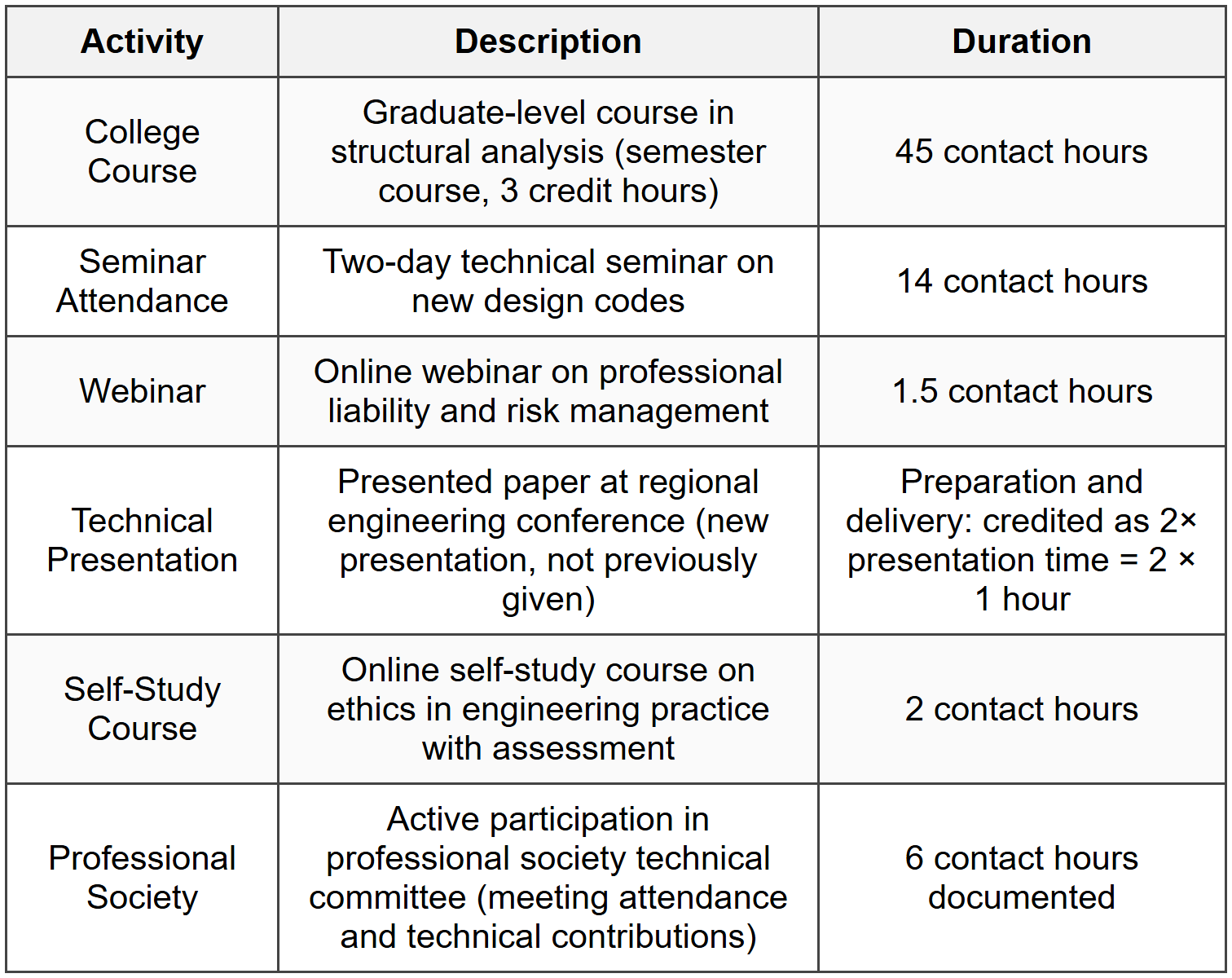
Based on typical state board rules for PDH calculation, does the PE meet the renewal requirements, and how many ethics PDHs has the PE earned?
(A) No, the PE has only 25.5 PDHs and does not meet the 30 PDH requirement
(B) Yes, the PE has 70.5 PDHs total with 3.5 PDHs in ethics
(C) Yes, the PE has 32 PDHs total with 2 PDHs in ethics
(D) No, the PE meets the total PDH requirement but has only 1.5 PDHs in ethics, which is insufficient
- College Course: 45 contact hours, but typically capped. Assume 15 PDHs maximum for course credit (50% cap common).
- Seminar: 14 contact hours = 14 PDHs
- Webinar: 1.5 contact hours = 1.5 PDHs
- Technical Presentation: Credited at 2× presentation time = 2 × 1 = 2 PDHs
- Self-Study Course: 2 contact hours = 2 PDHs
- Professional Society: 6 contact hours = 6 PDHs
- Webinar on professional liability and risk management: This topic relates to professional practice but may not be specifically "ethics." Assume not counted as ethics unless explicitly labeled. = 0 ethics PDHs (conservative interpretation)
- Self-Study Course on ethics in engineering practice: Explicitly ethics content. = 2 ethics PDHs
- College course: 3 credit hours. Some states use: college credit hours × conversion factor. If conversion is 1 credit hour = 10 PDH: 3 × 10 = 30 PDHs, but this seems too high.
- If conversion is: semester credit hours directly without multiplier, or with cap: perhaps 3 PDHs for a 3 credit course? This seems too low.
- College/university courses: 1 semester hour = 30 PDH, or 1 quarter hour = 20 PDH (very generous), OR more commonly: 1 semester credit hour = 15 PDH
- Using 1 semester credit = 15 PDH: 3 credits × 15 = 45 PDH, but this often exceeds the total requirement, so a cap applies.
- Some states: 1 semester credit = 10 PDH: 3 × 10 = 30 PDH
- Some states cap course credit at 50% of requirement = 15 PDH max for this renewal period
- College: 15 PDH (capped)
- Seminar: 14 PDH
- Webinar: 1.5 PDH
- Presentation: 2 PDH
- Self-study: 2 PDH
- Society: 6 PDH
Question 5: A Professional Engineer has been in responsible charge of the structural design for a 5-story commercial office building. Near the end of the design phase, the client requests that the PE seal and sign the architectural drawings (prepared by an unlicensed designer employed by the client) along with the structural drawings, stating that the building department requires a PE seal on all construction documents. The PE reviews the architectural drawings and notes that they appear generally consistent with the structural design, but the PE has no training or experience in architectural design, space planning, or building code compliance for architectural elements.
Which of the following actions is consistent with the PE's ethical and legal obligations?
(A) Seal and sign all drawings including the architectural drawings, since the PE is in responsible charge of the structural design which is the most critical safety element
(B) Seal and sign only the structural drawings, and advise the client that sealing architectural drawings would violate professional practice rules because the PE is not competent in architecture and was not in responsible charge of that work
(C) Seal and sign all drawings after consulting with an architect to verify that the architectural drawings are acceptable
(D) Seal and sign the architectural drawings with a disclaimer statement such as "Architectural design by others - PE seal for submittal purposes only"
- Detailed professional knowledge of the work
- Control over engineering decisions during preparation
- Personal review and approval of the work
- Acceptance of professional responsibility
- Hire a licensed architect to prepare and seal the architectural drawings
- In states that allow it, hire a PE with competency in building design to review, take responsibility for, and seal the architectural work
