PRAXIS Exam > PRAXIS Notes > Constructed Response Training > Cheatsheet: Linking Theory to Classroom Scenarios
Cheatsheet: Linking Theory to Classroom Scenarios


1. Foundational Learning Theories
1.1 Behaviorism
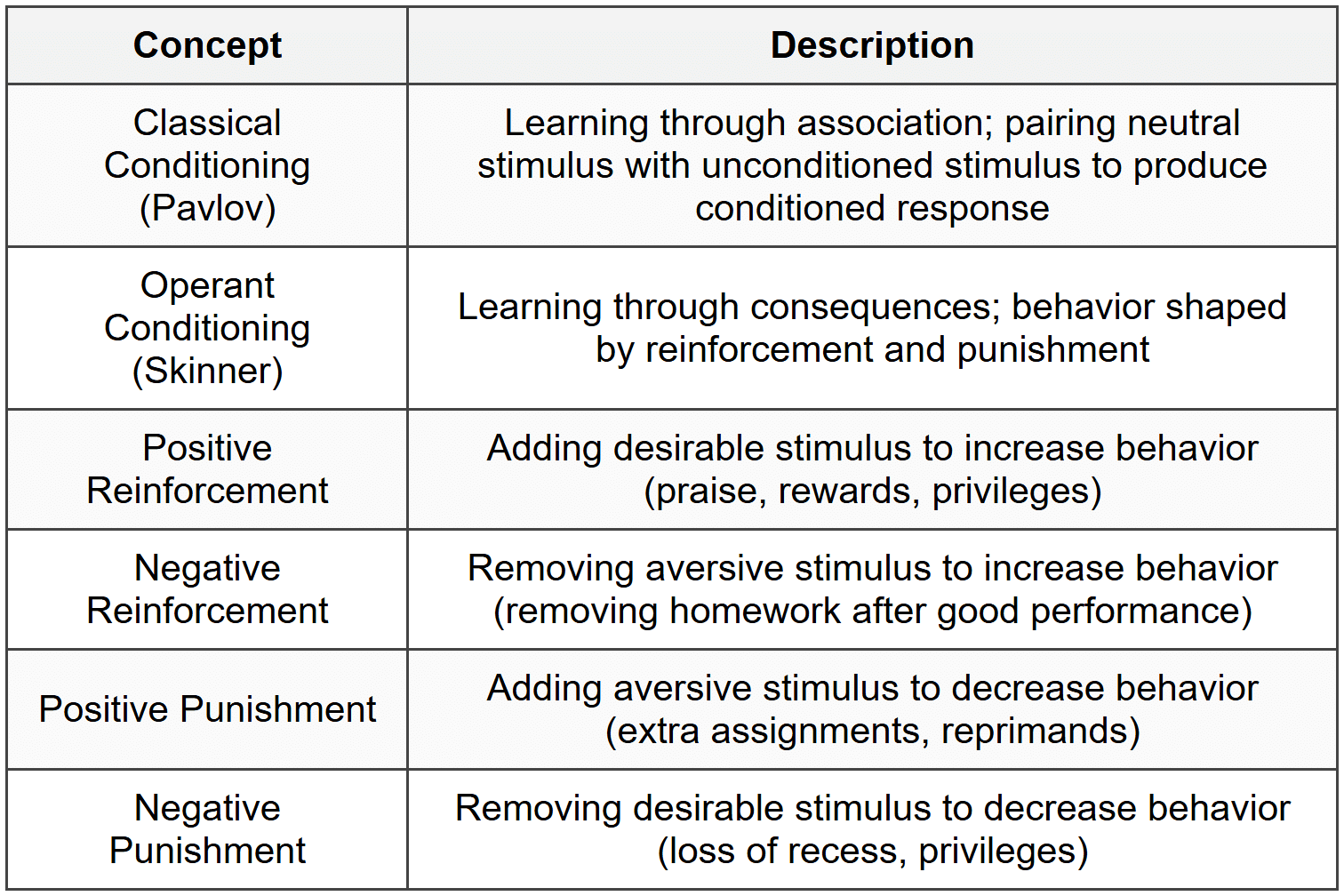
1.1.1 Classroom Applications
- Token economy systems: points, stickers, or tokens exchanged for rewards
- Behavior contracts: written agreements specifying expected behaviors and consequences
- Immediate feedback on performance to strengthen desired responses
- Shaping: reinforcing successive approximations toward desired behavior
- Modeling appropriate behaviors for students to observe and imitate
1.2 Cognitivism
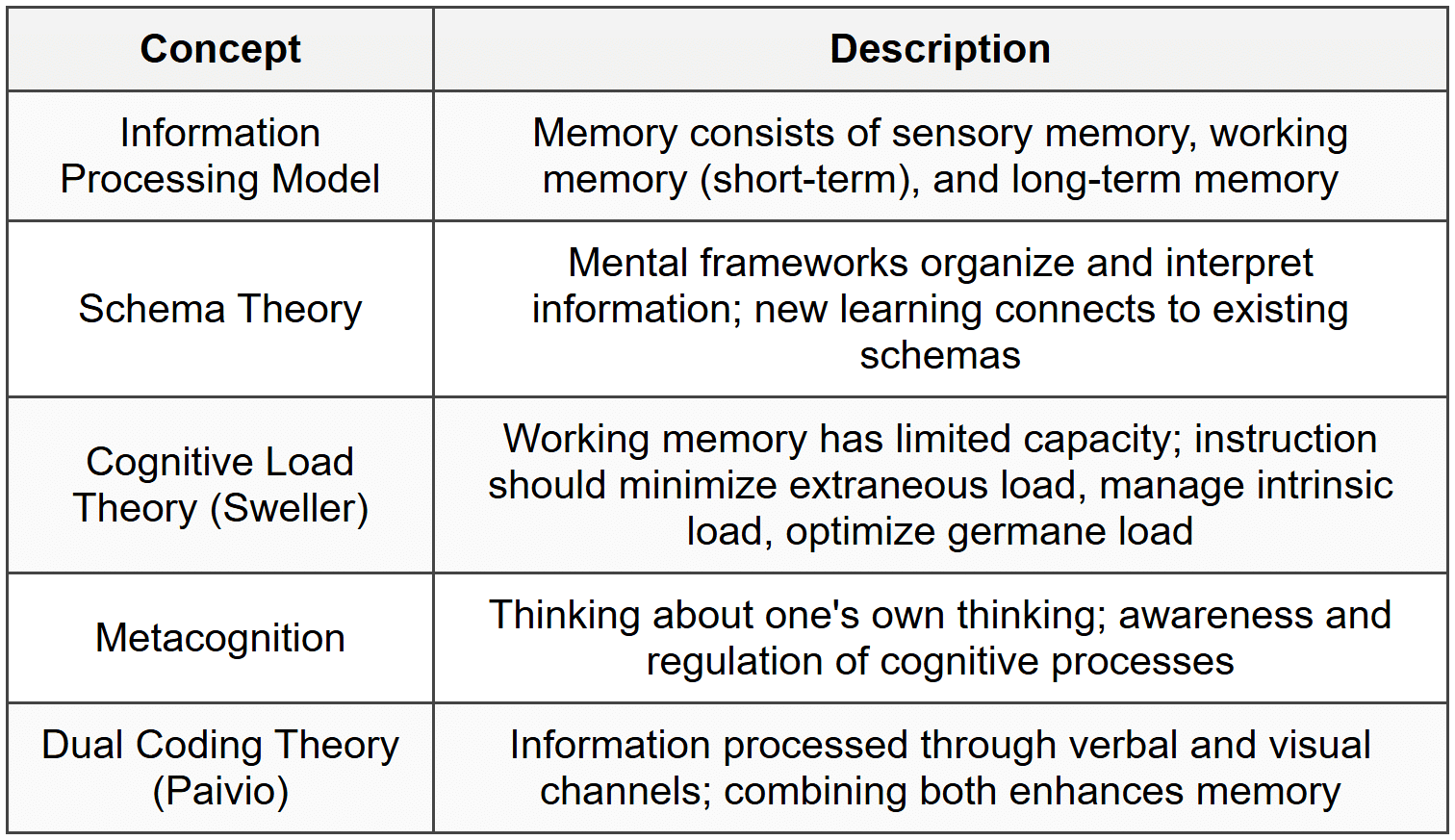
1.2.1 Classroom Applications
- Chunking information into manageable units (5-9 items)
- Graphic organizers to visualize relationships between concepts
- Advance organizers to activate prior knowledge before new content
- Think-alouds to model metacognitive processes
- Worked examples to reduce cognitive load for novice learners
- Mnemonic devices to aid memory retention
- Scaffolding complex tasks by breaking into steps
1.3 Constructivism
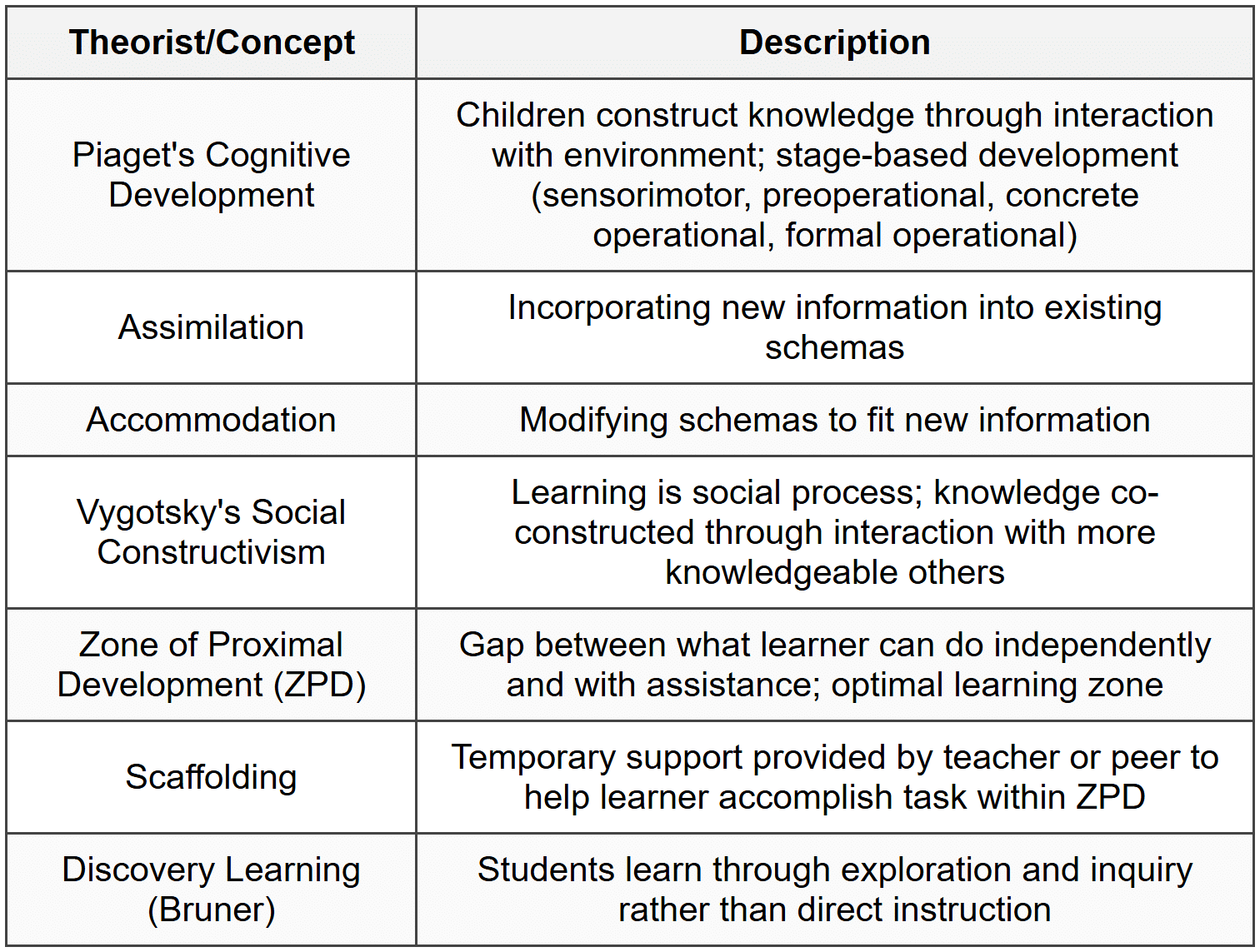
1.3.1 Classroom Applications
- Problem-based learning: authentic problems drive inquiry and learning
- Collaborative group work with heterogeneous grouping
- Peer tutoring and reciprocal teaching
- Inquiry-based activities where students generate questions and investigate
- Hands-on experiments and manipulatives
- Gradual release of responsibility: I do, we do, you do
- Questioning techniques that promote critical thinking
2. Social and Motivational Theories
2.1 Social Learning Theory (Bandura)
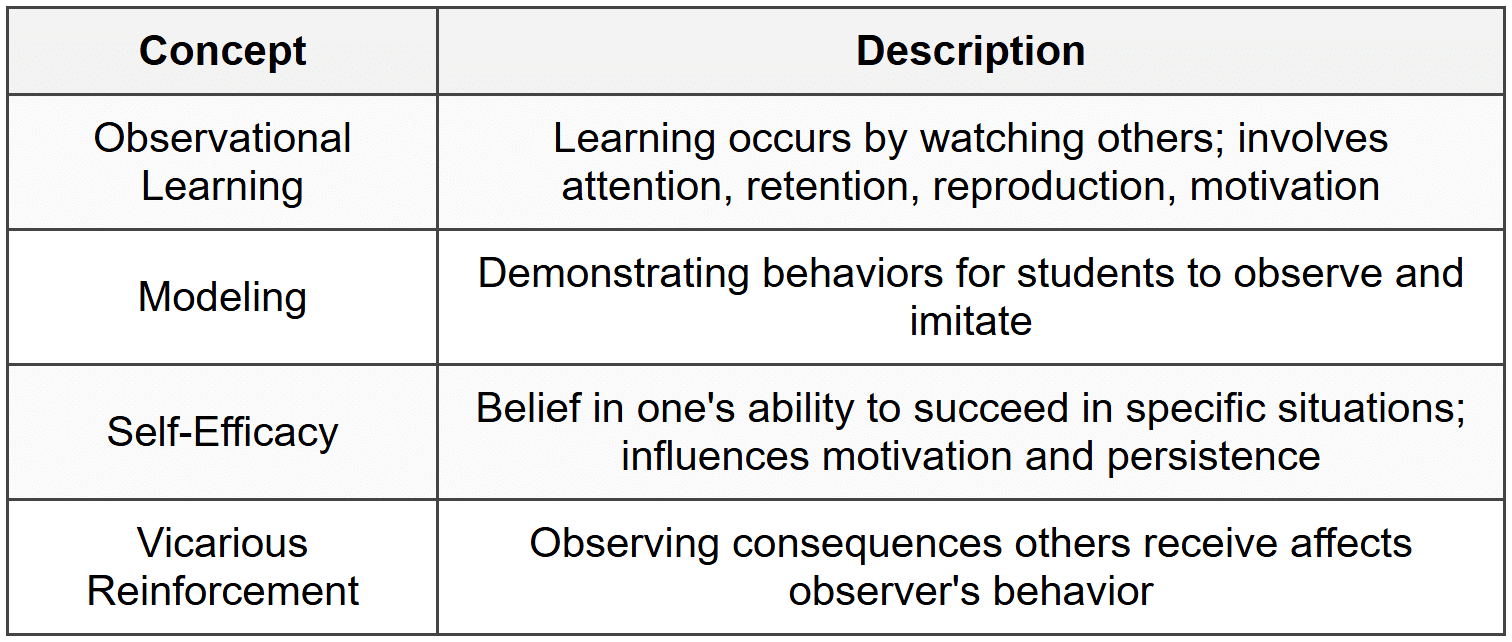
2.1.1 Classroom Applications
- Teacher models problem-solving strategies and thinking processes
- Use peer models for academic and social behaviors
- Build self-efficacy through mastery experiences and verbal persuasion
- Provide specific, attributional feedback linking effort to success
- Show videos of successful strategies or role models
2.2 Motivation Theories
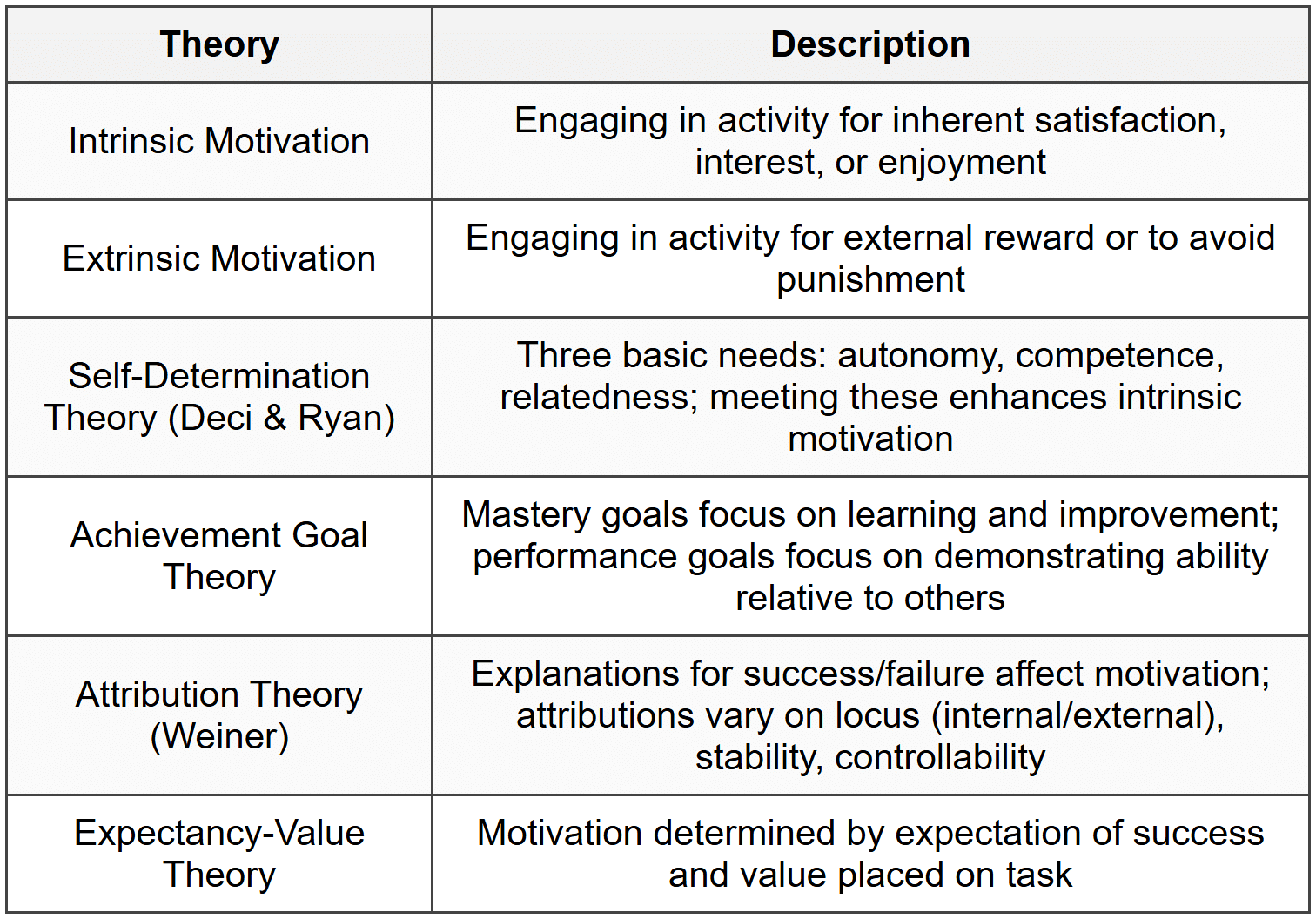
2.2.1 Classroom Applications
- Provide choices to support autonomy (topic selection, project format)
- Create appropriately challenging tasks to build competence
- Foster positive relationships and classroom community
- Emphasize mastery goals: effort, progress, improvement
- Help students make adaptive attributions (effort, strategy use)
- Increase task value through relevance, utility, real-world connections
- Set specific, proximal goals rather than distant, vague goals
3. Developmental Theories
3.1 Piaget's Stages of Cognitive Development
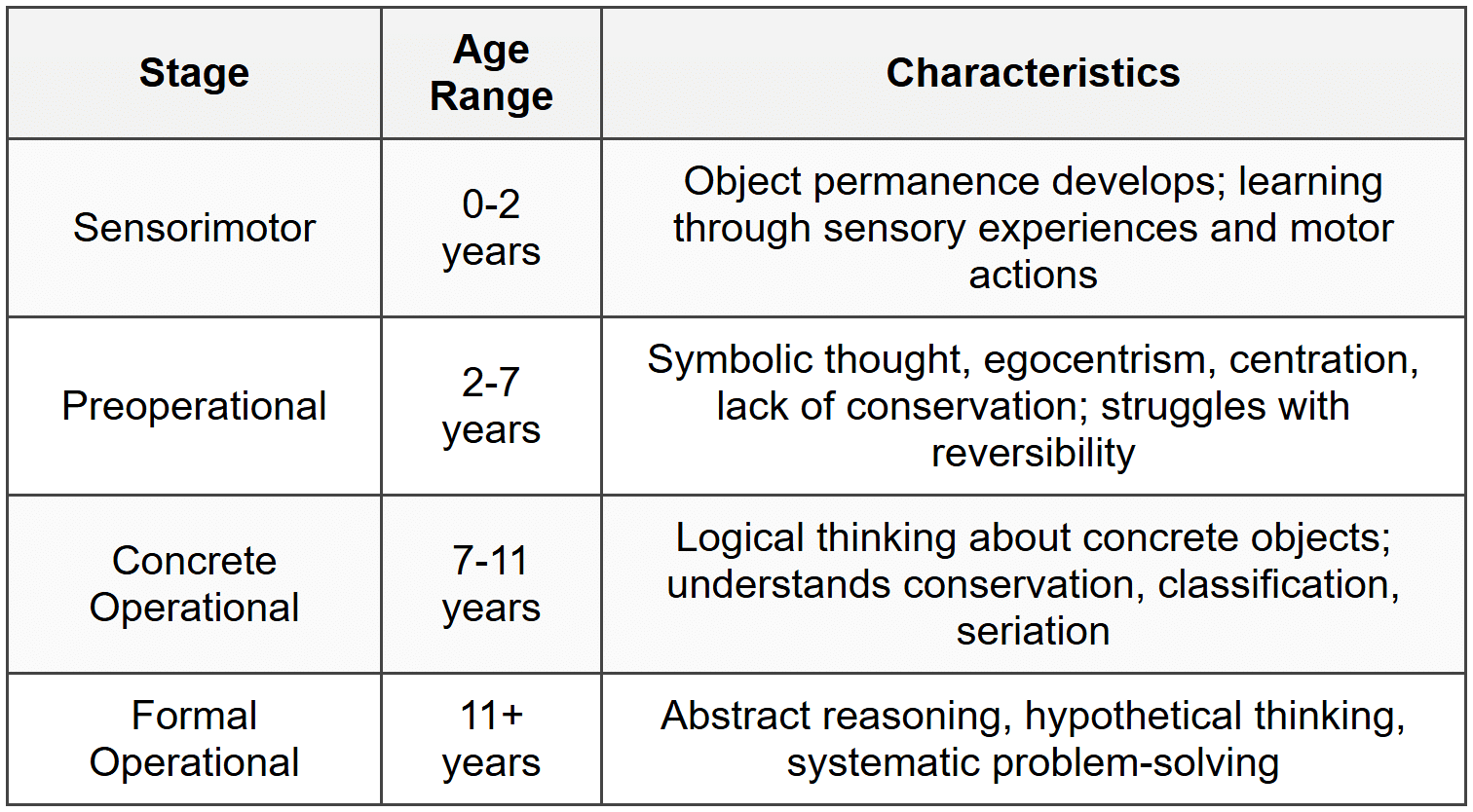
3.1.1 Classroom Applications
- Use concrete manipulatives for elementary students (base-10 blocks, fraction bars)
- Introduce abstract concepts gradually with concrete examples first
- Design activities appropriate for developmental stage
- Recognize not all students reach formal operations simultaneously
- Use visual aids and hands-on activities for concrete operational learners
3.2 Erikson's Psychosocial Development
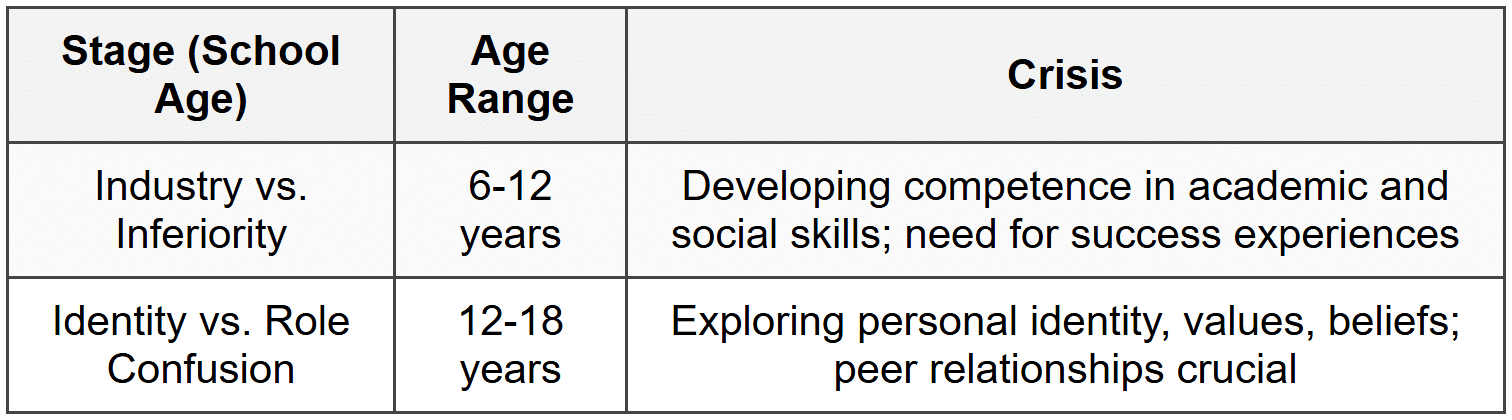
3.2.1 Classroom Applications
- Provide opportunities for success to build sense of industry
- Offer diverse activities so all students can demonstrate competence
- Support identity exploration through discussion, writing, projects
- Create safe environment for adolescents to express ideas and perspectives
- Recognize peer influence in adolescent decision-making
3.3 Kohlberg's Moral Development
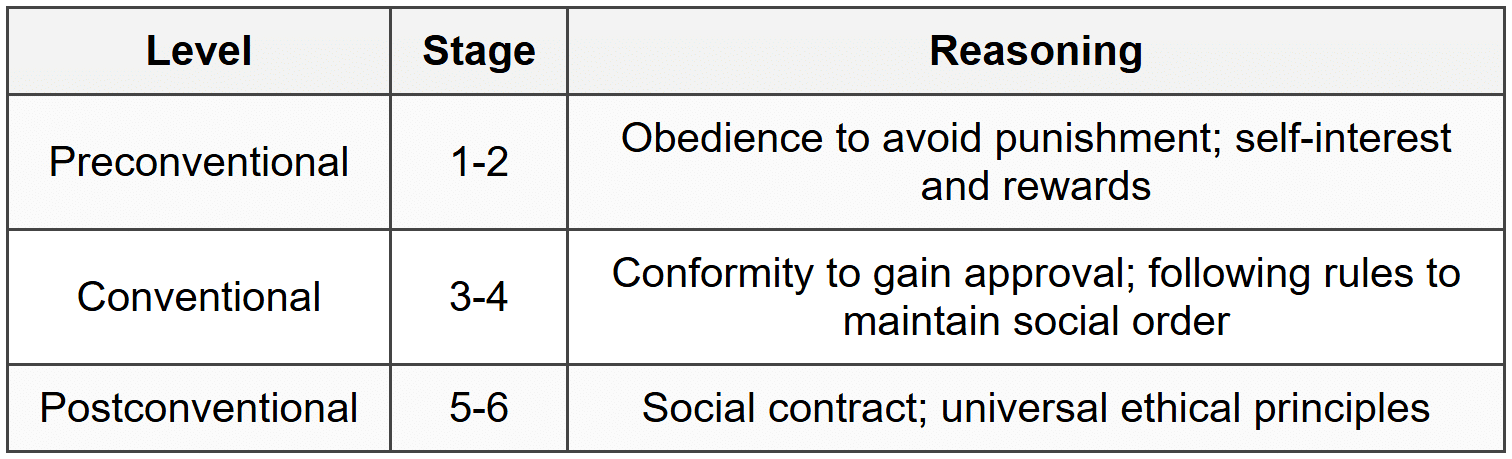
3.3.1 Classroom Applications
- Use moral dilemmas to promote higher-level reasoning
- Facilitate discussions about fairness, justice, and rights
- Model and discuss reasoning behind rules and decisions
- Encourage perspective-taking activities
4. Instructional Design and Differentiation
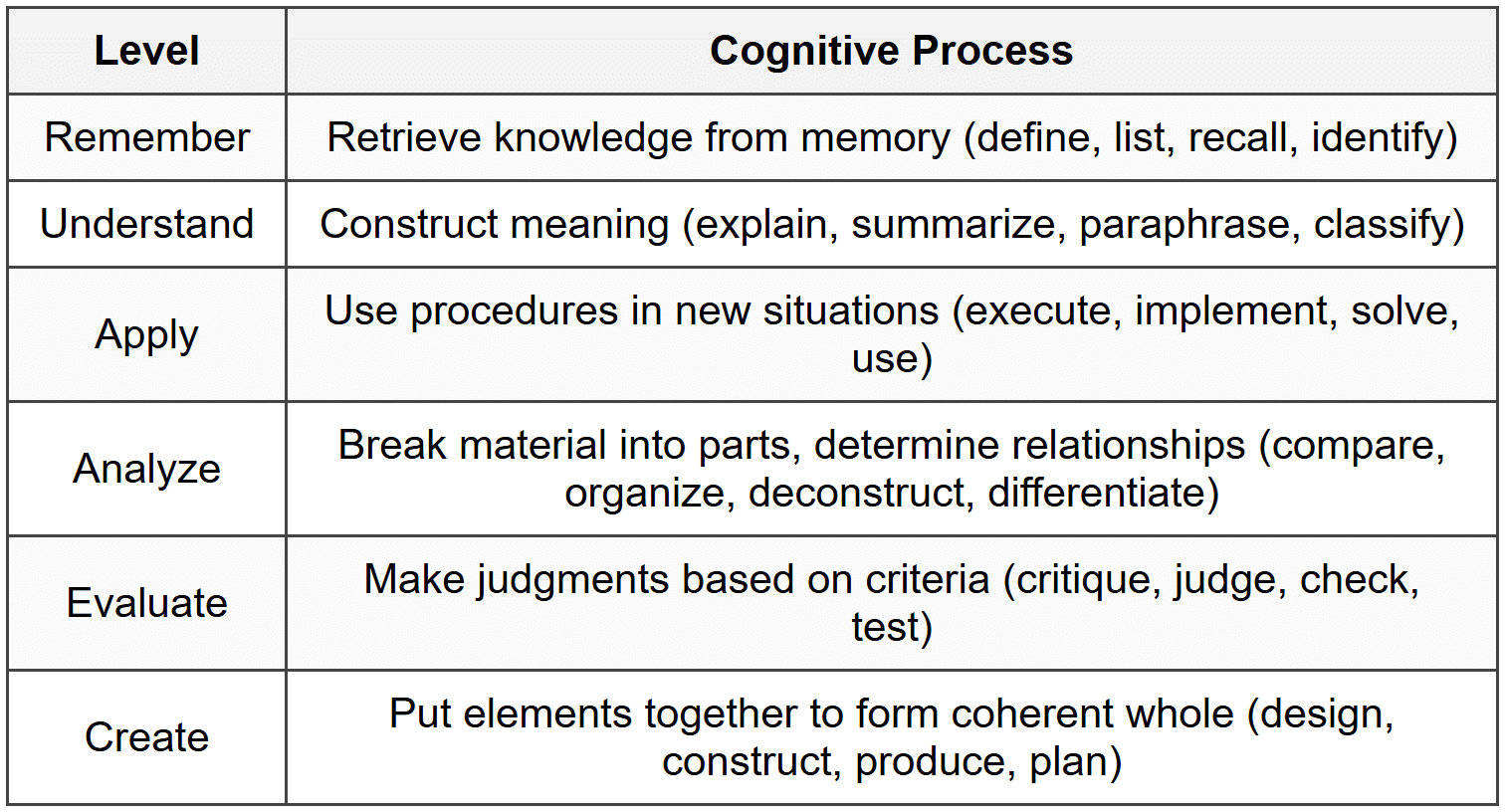
4.1 Bloom's Taxonomy (Revised)
4.1.1 Classroom Applications
- Design lessons progressing from lower to higher-order thinking
- Use varied question types to address multiple cognitive levels
- Create assessments measuring different levels of understanding
- Differentiate tasks by cognitive complexity
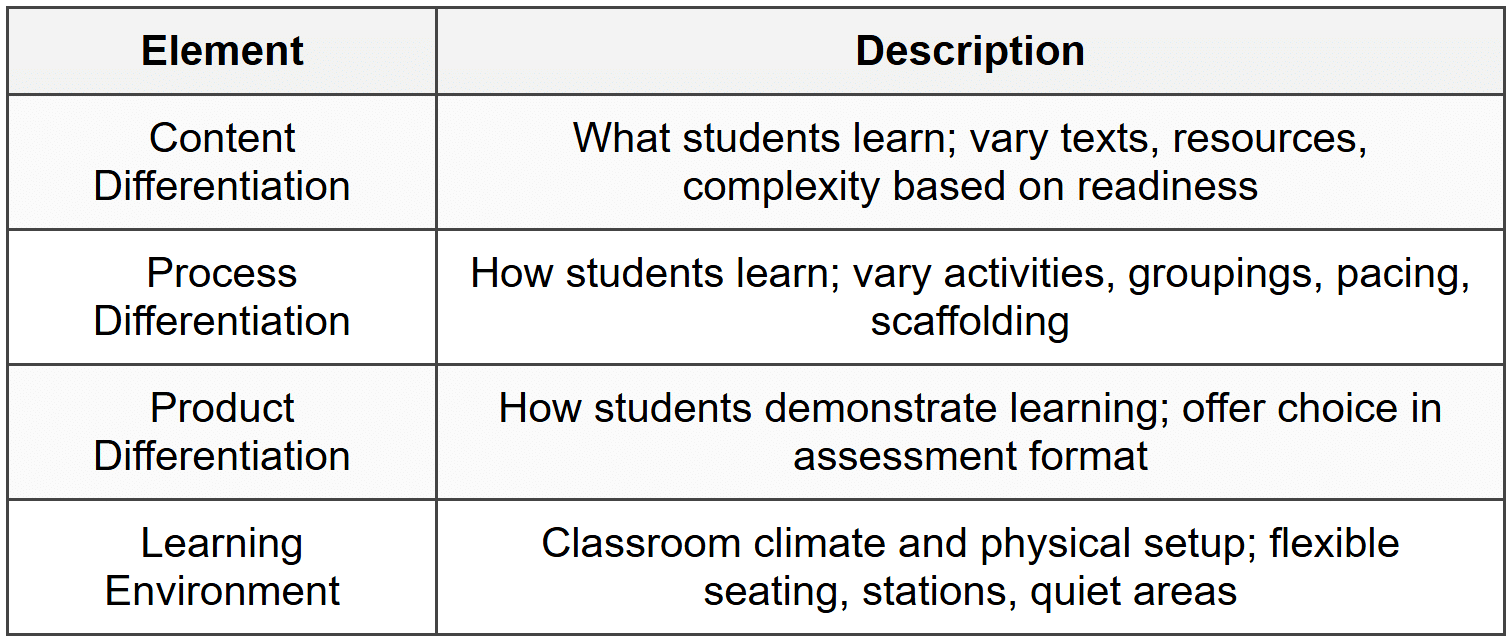
4.2 Differentiated Instruction (Tomlinson)
4.2.1 Differentiation Strategies
- Tiered assignments: same concept, different complexity levels
- Learning centers/stations with varied activities
- Flexible grouping: readiness, interest, learning profile
- Compacting: pretest and provide alternatives for mastered content
- Anchor activities for students who finish early
- Choice boards offering multiple paths to demonstrate understanding
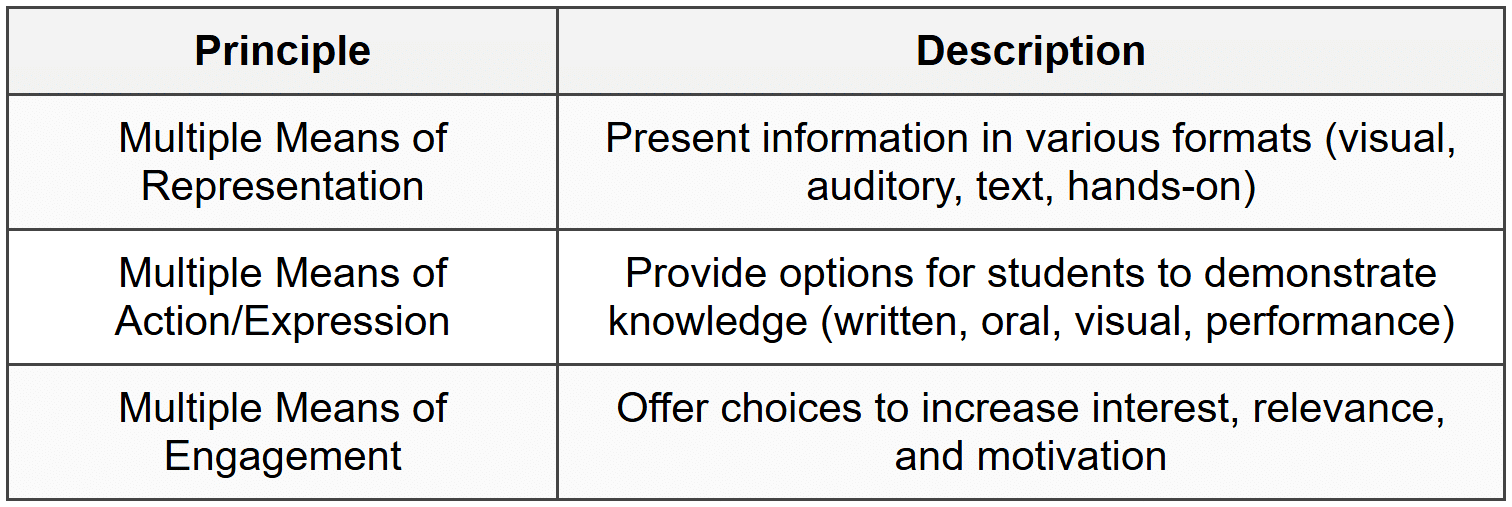
4.3 Universal Design for Learning (UDL)
4.3.1 Classroom Applications
- Provide text in digital and print formats; include audio versions
- Use captions, transcripts, and visual supports
- Offer assistive technology options
- Allow varied response modes for assignments
- Build in choice and autonomy
- Connect content to student interests and cultural backgrounds
5. Classroom Management Theories
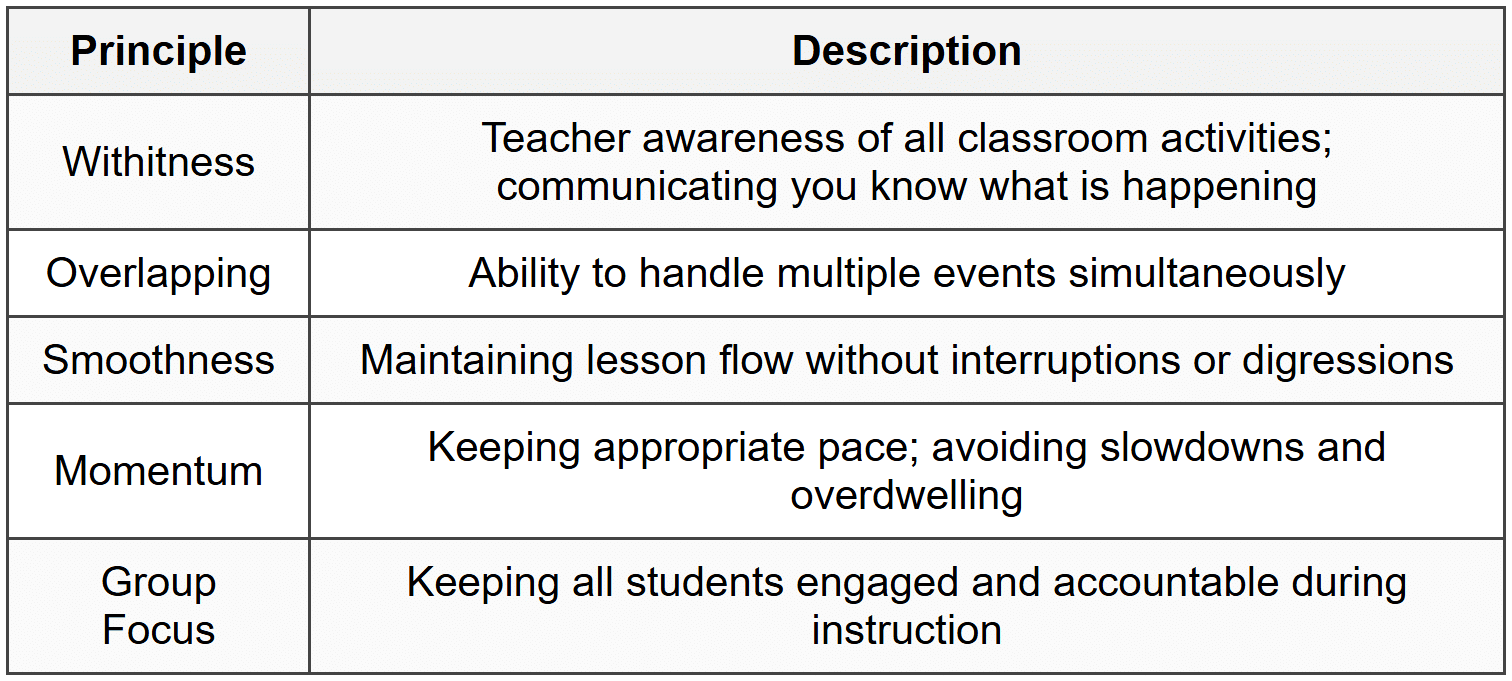
5.1 Kounin's Classroom Management Principles
5.1.1 Classroom Applications
- Scan classroom regularly while teaching
- Address minor disruptions without stopping instruction
- Use non-verbal cues and proximity control
- Prepare transitions to minimize downtime
- Use random calling and group accountability strategies
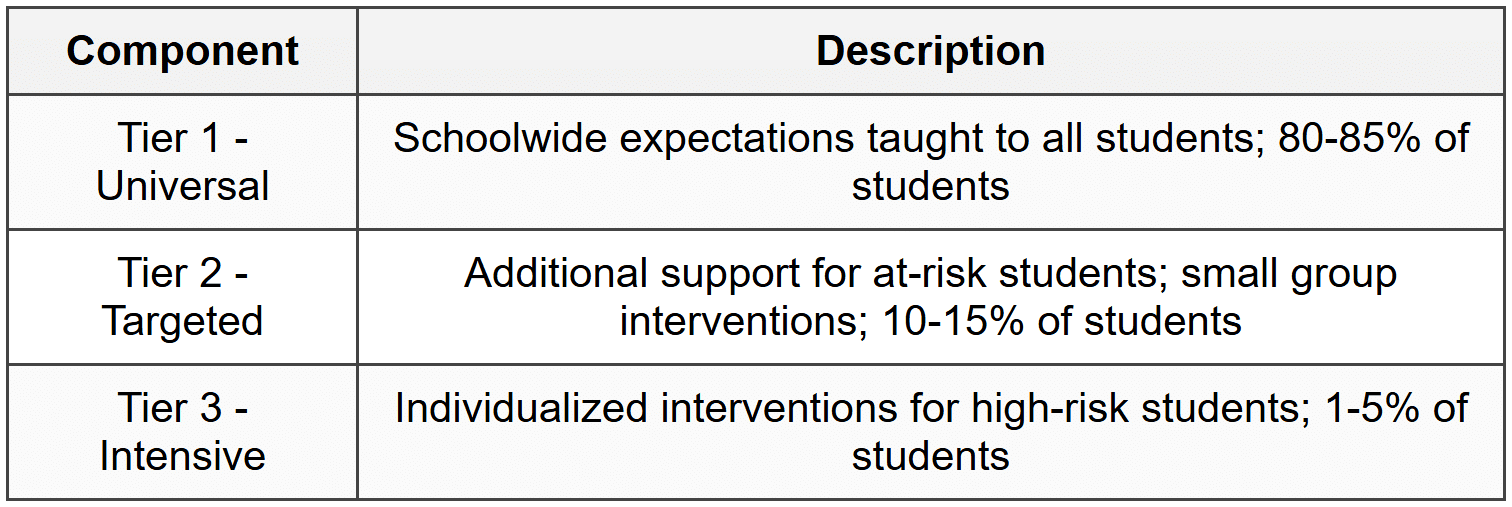
5.2 Positive Behavior Interventions and Supports (PBIS)
5.2.1 Classroom Applications
- Establish 3-5 positively stated classroom expectations
- Explicitly teach and practice expected behaviors
- Provide specific positive feedback (4:1 ratio positive to corrective)
- Use data to identify students needing additional support
- Implement check-in/check-out systems for Tier 2 students
- Develop individualized behavior plans for Tier 3 students
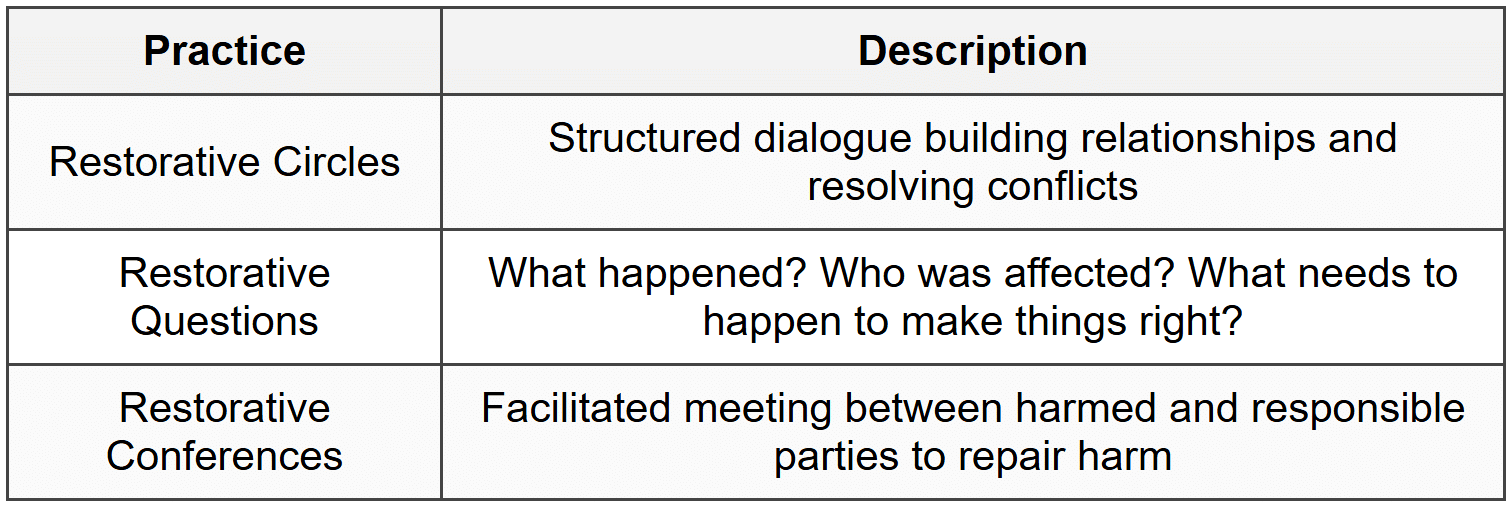
5.3 Restorative Practices
5.3.1 Classroom Applications
- Build community through regular class circles
- Focus on repairing harm rather than punishment
- Teach students to take responsibility for actions
- Facilitate peer mediation and problem-solving
- Emphasize empathy and perspective-taking
6. Assessment and Feedback
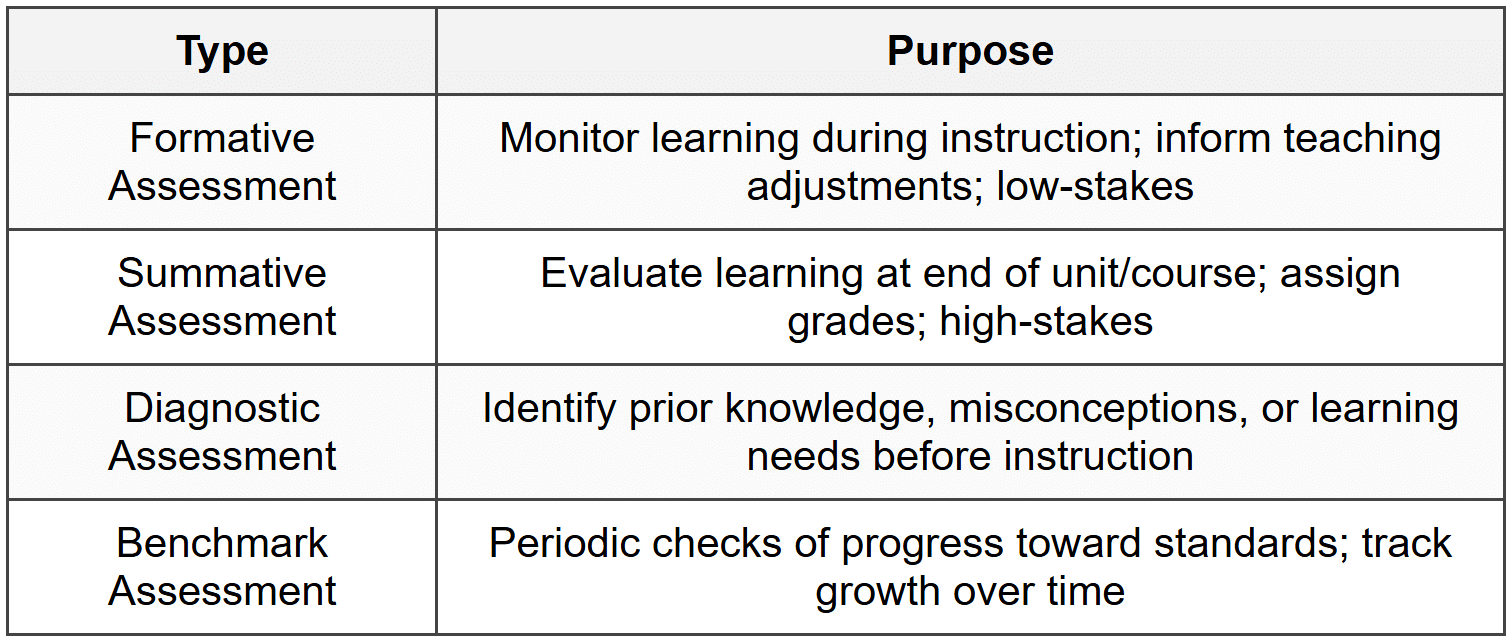
6.1 Assessment Types
6.1.1 Formative Assessment Strategies
- Exit tickets: brief end-of-lesson responses
- Think-pair-share to check understanding
- Thumbs up/down or color cards for quick checks
- Questioning techniques: wait time, cold calling, probing
- Observation and anecdotal notes
- Student self-assessment and peer feedback
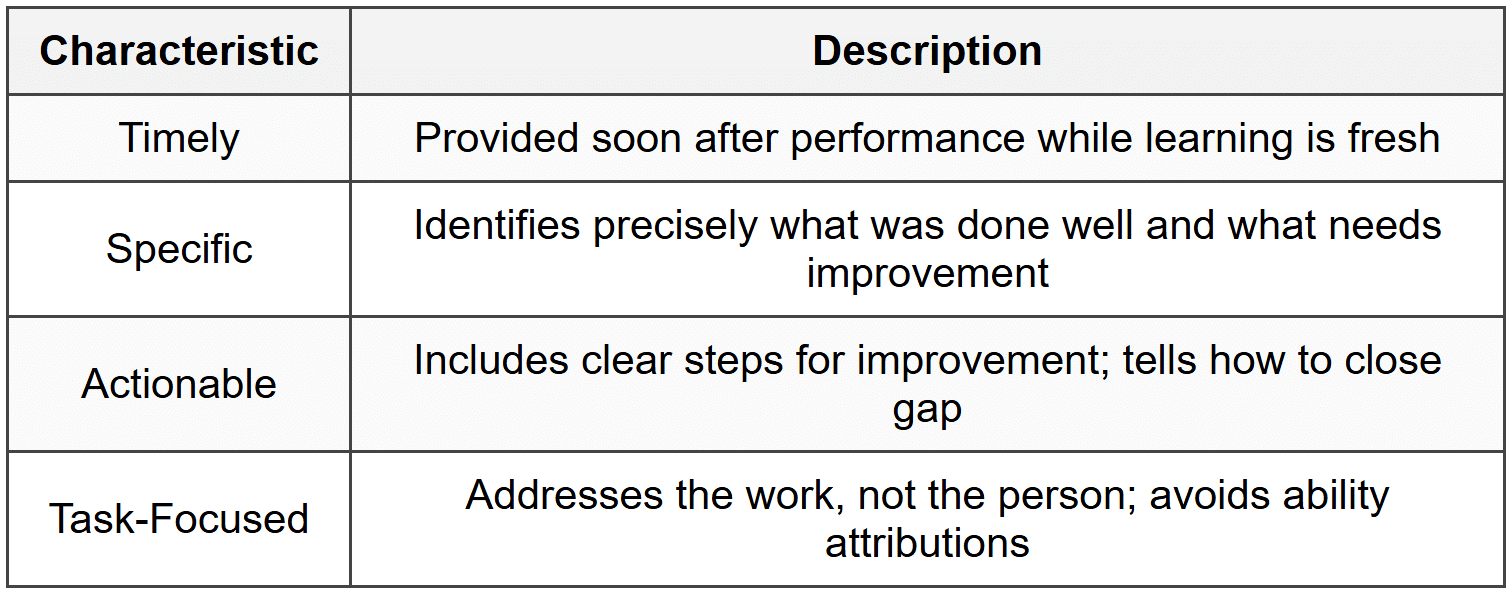
6.2 Feedback Principles
6.2.1 Effective Feedback Strategies
- Describe what you observe rather than evaluating
- Focus on effort, strategy use, and progress
- Provide models or examples of quality work
- Use rubrics to clarify expectations and performance levels
- Conference individually to discuss strengths and growth areas
- Teach students to give and receive peer feedback
7. Linking Theory to Practice Framework
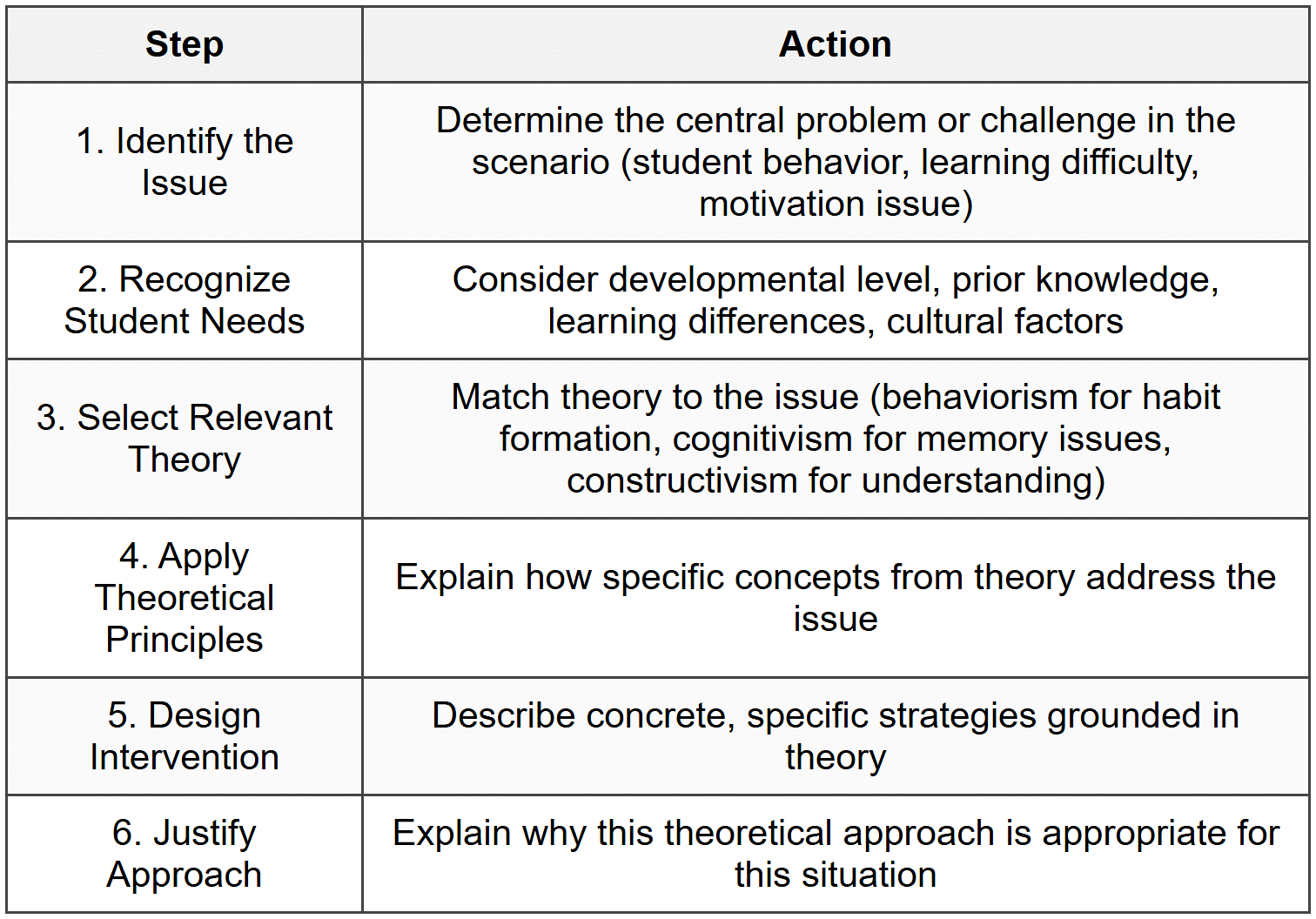
7.1 Steps for Applying Theory to Scenarios
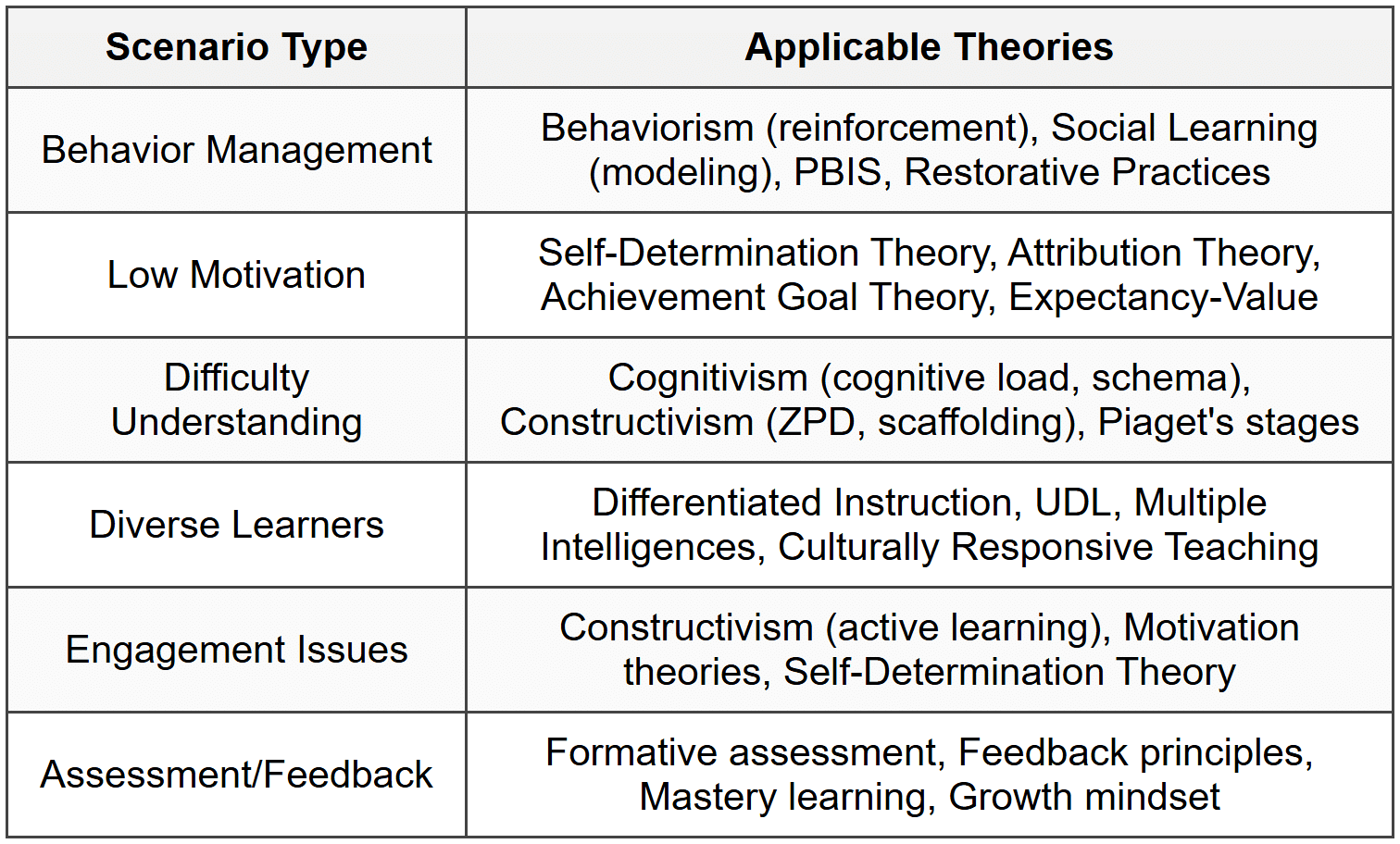
7.2 Common Scenario Types and Applicable Theories
7.3 Response Structure Guidelines
- Begin with clear identification of the core issue or challenge
- Name the specific theory or theorist being applied
- Explain relevant theoretical concepts in context
- Describe 2-3 specific, actionable strategies grounded in theory
- Connect strategies explicitly back to theoretical principles
- Consider student developmental level and individual needs
- Address how intervention supports learning goals
- Use precise educational terminology appropriately
7.4 Key Vocabulary for Constructed Responses
- Activate prior knowledge, schema, ZPD, scaffolding
- Differentiation, modification, accommodation
- Formative/summative assessment, diagnostic assessment
- Intrinsic/extrinsic motivation, self-efficacy, attribution
- Positive/negative reinforcement, punishment
- Metacognition, cognitive load, working memory
- Mastery goal, performance goal, growth mindset
- Modeling, observational learning, self-regulation
- Explicit instruction, guided practice, independent practice
- Formative feedback, descriptive feedback, corrective feedback
The document Cheatsheet: Linking Theory to Classroom Scenarios is a part of the PRAXIS Course Constructed Response Training.
All you need of PRAXIS at this link: PRAXIS
FAQs on Cheatsheet: Linking Theory to Classroom Scenarios
| 1. What are foundational learning theories? |  |
Ans. Foundational learning theories encompass the essential principles and frameworks that guide our understanding of how learning occurs. Key theories include behaviourism, which focuses on observable behaviours and responses to stimuli; constructivism, which emphasises the active role of learners in constructing their own understanding; and cognitivism, which highlights the mental processes involved in learning, such as memory and problem-solving.
| 2. How do social and motivational theories influence learning? | |
Ans. Social and motivational theories suggest that learning is significantly impacted by social interactions and intrinsic or extrinsic motivations. Theories such as Vygotsky's Social Development Theory emphasise the importance of social context and collaboration in learning, while Maslow's Hierarchy of Needs highlights how motivation is influenced by individuals' needs. Understanding these theories helps educators create supportive learning environments that foster engagement and motivation.
| 3. What role do developmental theories play in education? | |
Ans. Developmental theories, such as Piaget's stages of cognitive development and Erikson's psychosocial stages, provide insights into the typical progression of learners' abilities and challenges at different ages. These theories inform educators about the cognitive and emotional needs of students, allowing them to tailor instruction and support to suit developmental stages, ensuring that learning activities are age-appropriate and effective.
| 4. How can instructional design and differentiation improve learning outcomes? | |
Ans. Instructional design involves creating educational experiences that facilitate learning, while differentiation refers to tailoring instruction to meet the diverse needs of all learners. By applying principles of instructional design, educators can develop clear objectives, engaging materials, and varied instructional strategies. Differentiation allows teachers to adjust content, processes, and assessments based on students' readiness, interests, and learning profiles, thus enhancing overall learning outcomes.
| 5. Why is assessment and feedback important in the learning process? | |
Ans. Assessment and feedback are critical components of the learning process as they help measure student understanding and progress. Effective assessment identifies areas of strength and weakness, informing instruction and guiding future learning. Constructive feedback provides students with specific information on their performance, encouraging reflection and improvement. Together, they foster a growth mindset and enhance student engagement and achievement.
About this Document

Apr 22, 2026 Last updated
Related Exams
Document Description: Cheatsheet: Linking Theory to Classroom Scenarios for PRAXIS 2026 is part of Constructed Response Training preparation. The notes and questions for Cheatsheet: Linking Theory to Classroom Scenarios have been prepared according to the PRAXIS exam syllabus. Information about Cheatsheet: Linking Theory to Classroom Scenarios covers topics like and Cheatsheet: Linking Theory to Classroom Scenarios Example, for PRAXIS 2026 Exam. Find important definitions, questions, notes, meanings, examples, exercises and tests below for Cheatsheet: Linking Theory to Classroom Scenarios.
Introduction of Cheatsheet: Linking Theory to Classroom Scenarios in English is available as part of our Constructed Response Training for PRAXIS & Cheatsheet: Linking Theory to Classroom Scenarios in Hindi for Constructed Response Training course. Download more important topics related with notes, lectures and mock test series for PRAXIS Exam by signing up for free. PRAXIS: Cheatsheet: Linking Theory to Classroom Scenarios
Description
Cheatsheet: Linking Theory to Classroom Scenarios of Constructed Response Training to help you remember important concepts with short tricks. Start learning for PRAXIS exam & improve retention with EduRev.
Information about Cheatsheet: Linking Theory to Classroom Scenarios
In this doc you can find the meaning of Cheatsheet: Linking Theory to Classroom Scenarios defined & explained in the simplest way possible. Besides explaining types of Cheatsheet: Linking Theory to Classroom Scenarios theory, EduRev gives you an ample number of questions to practice Cheatsheet: Linking Theory to Classroom Scenarios tests, examples and also practice PRAXIS tests



Related Searches
Exam, Free, ppt, Previous Year Questions with Solutions, shortcuts and tricks, study material, Extra Questions, MCQs, Cheatsheet: Linking Theory to Classroom Scenarios, practice quizzes, pdf , mock tests for examination, Viva Questions, Summary, Cheatsheet: Linking Theory to Classroom Scenarios, video lectures, Semester Notes, past year papers, Cheatsheet: Linking Theory to Classroom Scenarios, Objective type Questions, Important questions, Sample Paper;