Stakeholder Engagement Assessment Matrix

The Stakeholder Engagement Assessment Matrix is a tool used by project managers to systematically analyze and document the current and desired engagement levels of stakeholders throughout the project lifecycle. It directly supports stakeholder management strategies and appears frequently on exam questions about stakeholder analysis, communication planning, and engagement optimization. Understanding how to interpret, update, and act on this matrix is essential for situational judgment questions in the People domain.
Core Concepts
What the Stakeholder Engagement Assessment Matrix Is
The Stakeholder Engagement Assessment Matrix is a grid that compares each stakeholder's current engagement level with their desired engagement level. The matrix identifies gaps between where stakeholders are now and where the project manager needs them to be to support project success. It uses five distinct engagement classifications to categorize stakeholder positions.
The matrix typically shows stakeholder names or groups in rows and the five engagement levels in columns. Current engagement is marked with a "C" and desired engagement with a "D". When a stakeholder's current and desired levels differ, this signals the need for targeted engagement activities.
When to Use This
- When exam questions ask how to identify which stakeholders need more attention or different communication approaches
- When you need to determine what action to take after stakeholder analysis is complete
- When deciding how to allocate communication resources and effort across different stakeholder groups
- When the question involves monitoring stakeholder engagement effectiveness or updating engagement strategies
The Five Engagement Levels
Every stakeholder in the matrix must be classified using exactly one of these five levels for both current and desired states:
- Unaware: Stakeholder does not know about the project or its potential impacts on them. This is the lowest engagement level and typically undesirable for most stakeholders once a project begins.
- Resistant: Stakeholder is aware of the project but opposed to it or its outcomes. They may actively work against project success or refuse to support necessary changes.
- Neutral: Stakeholder is aware of the project but neither supportive nor opposed. They are indifferent and will not actively help or hinder progress.
- Supportive: Stakeholder is aware of the project and supports its objectives and outcomes. They are willing to help when asked but do not proactively champion the project.
- Leading: Stakeholder is actively engaged and working to ensure project success. They champion the project, influence others positively, and proactively contribute resources or advocacy.
When to Use This
- When an exam question describes stakeholder behavior or attitudes and asks you to classify their engagement level
- When determining the appropriate engagement goal for key stakeholders like sponsors, senior management, or critical end users
- When a question asks what engagement level is most appropriate for a particular stakeholder role-sponsors and champions typically need to be "Leading," while some peripheral stakeholders may only need to be "Supportive" or "Neutral"
- When interpreting whether a stakeholder's engagement status represents a risk to the project
How to Read and Interpret the Matrix
When you encounter a Stakeholder Engagement Assessment Matrix on the exam, follow this interpretation approach:
- A stakeholder with C and D in the same column requires no immediate action-their current engagement matches the desired level
- A stakeholder with C to the left of D needs increased engagement-the project manager must move them right along the scale
- A stakeholder with C to the right of D may be over-engaged or the desired level needs reconsideration-this is rare but possible when resources are limited
- The distance between C and D indicates effort required-moving someone from Resistant to Leading requires significantly more effort than moving from Neutral to Supportive
- Multiple stakeholders showing gaps in the same direction indicate systemic engagement issues that may require broad strategy changes
When to Use This
- When exam questions provide a matrix excerpt and ask what action the PM should prioritize
- When deciding between engaging multiple stakeholders and the question includes their current and desired states
- When a question asks about the effectiveness of stakeholder engagement efforts-look for whether C has moved closer to D
- When determining if stakeholder engagement is a current project risk
Creating and Updating the Matrix
The project manager develops the initial Stakeholder Engagement Assessment Matrix during project planning, specifically as part of the Plan Stakeholder Engagement process. However, the matrix is a living document that requires regular updates throughout the project.
Key facts about matrix maintenance:
- Update the matrix when stakeholder attitudes change due to project events, decisions, or external factors
- Reassess engagement levels after major communications, milestones, or conflicts
- The "C" marking moves as engagement activities succeed or fail; the "D" may also change if project circumstances shift
- Updates to the matrix should trigger updates to the Stakeholder Engagement Plan and potentially the Communications Management Plan
- Regular monitoring of the matrix helps identify early warning signs that key stakeholders are disengaging
When to Use This
- When a question asks when to update stakeholder-related documents or what triggers updates
- When determining what to do after a significant project event affects stakeholder perception
- When asked about the relationship between the matrix and other stakeholder or communication planning documents
- When the scenario involves stakeholder resistance increasing or support waning
Relationship to Other Stakeholder Tools
The Stakeholder Engagement Assessment Matrix works alongside other stakeholder analysis tools but serves a distinct purpose:
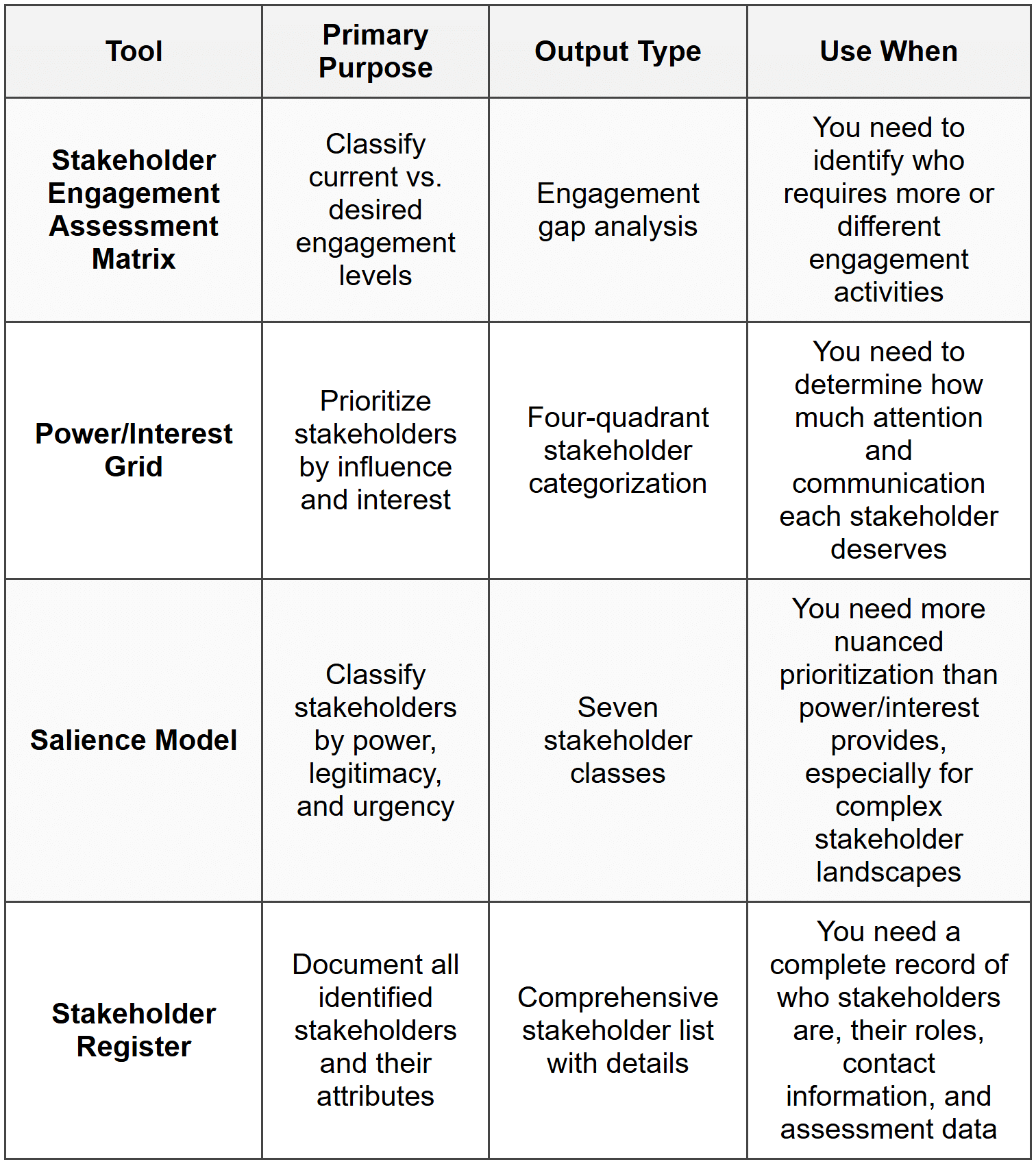
When to Use This
- When an exam question asks which tool to use for a specific stakeholder management scenario
- When you need to distinguish between identifying stakeholders, prioritizing them, and planning their engagement
- When a question references multiple stakeholder documents and asks about relationships or sequence
- When determining what information source to reference for different stakeholder decisions
Common Matrix Patterns and Their Meanings
Certain patterns in the matrix indicate specific project situations:
- Sponsor showing Neutral when Desired is Leading: Critical risk-sponsor engagement must be addressed immediately as this threatens project viability
- Multiple key stakeholders Resistant: Indicates fundamental project issues, possible lack of proper initiation, or insufficient stakeholder involvement in planning
- End users Unaware late in project: Signals communication breakdown and high risk of adoption failure or resistance during implementation
- Functional managers Neutral or Resistant: Resource allocation risks; PM may struggle to obtain or retain team members
- Subject matter experts showing Supportive when Leading is desired: May indicate need for more involvement in decision-making or greater recognition of their contributions
When to Use This
- When exam scenarios describe stakeholder situations and ask you to identify the primary concern or risk
- When determining what action to prioritize among multiple stakeholder engagement issues
- When asked which stakeholder engagement gap represents the greatest threat to project success
- When deciding what to escalate or report to senior management
Commonly Tested Scenarios / Pitfalls
1. Scenario: The exam presents a situation where the project sponsor's current engagement is marked as "Supportive" but the desired level is "Leading." The project is experiencing scope creep and budget pressure. The question asks what the PM should do first.
Correct Approach: Engage the sponsor directly to move them from Supportive to Leading by involving them in addressing the scope and budget issues. The sponsor needs to actively champion decisions and provide organizational support, not just passively approve requests.
Check first: Identify the gap between current (Supportive) and desired (Leading) engagement for the sponsor specifically, and recognize that sponsor engagement level directly impacts the PM's ability to address scope and budget challenges.
Do NOT do first: Do not immediately escalate to the sponsor's manager or attempt to solve scope creep through change control alone. Many candidates incorrectly think process adherence solves engagement problems, but without the sponsor actively leading, change control becomes reactive rather than strategic.
Why other options are wrong: Options suggesting documenting the issue, updating the stakeholder register, or communicating with the team do not address the fundamental engagement gap that is allowing scope creep to continue unchecked.
2. Scenario: A key functional manager is currently marked as "Resistant" while the desired engagement level is "Supportive." The PM has sent several emails explaining project benefits. The exam asks what the PM should do next.
Correct Approach: Use personal, face-to-face communication to understand the root cause of resistance and address specific concerns. Moving from Resistant to Supportive requires relationship-building and issue resolution, not more one-way communication.
Check first: Recognize that the current approach (emails) has not worked and that Resistant stakeholders require different engagement tactics than Neutral or Unaware stakeholders.
Do NOT do first: Do not send more emails, create more presentations, or involve higher management immediately. Candidates often choose "escalate" when facing resistance, but escalation typically hardens resistance rather than resolving it unless the root cause is understood first.
Why other options are wrong: More documentation or formal communication does not address resistance, which is fundamentally about concerns, fears, or competing interests that require dialogue and potentially negotiation.
3. Scenario: During project execution, the PM reviews the Stakeholder Engagement Assessment Matrix and notices that three previously Supportive stakeholders have become Neutral. The question asks what this indicates.
Correct Approach: This indicates declining engagement that requires investigation and corrective action. The PM must determine what caused the change and implement targeted engagement activities to restore support before stakeholders move further to Resistant.
Check first: Identify that a negative trend (movement from right to left on the matrix) has occurred with multiple stakeholders, suggesting a systemic issue rather than isolated incidents.
Do NOT do first: Do not assume this is normal fluctuation or that Neutral is acceptable because it's not Resistant. Candidates sometimes underestimate the significance of declining engagement, but Neutral stakeholders provide no active support when challenges arise.
Why other options are wrong: Options suggesting no action is needed or that Neutral is sufficient for non-critical stakeholders miss that movement away from desired levels requires response, and multiple stakeholders changing simultaneously indicates a project-level issue.
4. Scenario: The exam shows a partial matrix where end users are marked as "Unaware" currently and "Supportive" is desired. The project is in the executing phase and nearing a major deliverable. What should the PM do first?
Correct Approach: Immediately implement awareness and engagement activities for end users, as they are still Unaware despite the project being well underway. This represents a critical gap that threatens deliverable acceptance and adoption.
Check first: Recognize the timing issue-end users should not be Unaware during execution, especially near a deliverable. This indicates a significant oversight in stakeholder engagement planning and execution.
Do NOT do first: Do not wait until just before delivery or assume training during implementation will be sufficient. Candidates often underestimate how long it takes to move stakeholders from Unaware through the engagement levels, especially to Supportive.
Why other options are wrong: Options suggesting continuing with the current plan or addressing this during transition ignore that Unaware stakeholders cannot become Supportive quickly, and lack of awareness typically leads to resistance when deliverables arrive unexpectedly.
5. Scenario: A question presents a scenario where the PM has successfully moved a critical stakeholder from Neutral to Supportive. The exam asks what the PM should do with the Stakeholder Engagement Assessment Matrix.
Correct Approach: Update the matrix to reflect the current engagement level change by moving the "C" marking from Neutral to Supportive, documenting that the desired level has been achieved for this stakeholder.
Check first: Confirm that this is a documentation and monitoring question about maintaining the matrix as a living document, not about next engagement steps.
Do NOT do first: Do not leave the matrix unchanged or wait until a formal review period. Candidates sometimes treat the matrix as a static planning document rather than a dynamic monitoring tool that should reflect current reality.
Why other options are wrong: Options suggesting creating a new matrix, only updating the Stakeholder Register, or no action fail to recognize that the matrix must be kept current to remain useful for ongoing stakeholder management decisions.
Step-by-Step Procedures or Methods
Creating a Stakeholder Engagement Assessment Matrix
Task: Develop an initial Stakeholder Engagement Assessment Matrix during planning
- Obtain the complete Stakeholder Register with all identified stakeholders
- For each stakeholder, assess their current engagement level through observation, interviews, historical data, or direct assessment conversations
- Mark the current engagement level with a "C" in the appropriate column (Unaware, Resistant, Neutral, Supportive, or Leading)
- Determine the desired engagement level based on the stakeholder's influence, impact on project success, and required contribution level
- Mark the desired engagement level with a "D" in the appropriate column
- For stakeholders where C and D differ, identify the engagement gap that must be closed
- Prioritize stakeholders with the largest gaps or whose gaps pose the greatest risk to project success
- Use the matrix to inform development of the Stakeholder Engagement Plan and specific engagement strategies
- Obtain approval or validation from the sponsor or key stakeholders on the desired engagement levels for critical stakeholders
- Establish a review schedule for updating the matrix throughout the project lifecycle
Using the Matrix to Drive Engagement Actions
Task: Translate matrix gaps into specific engagement activities
- Identify all stakeholders where current (C) and desired (D) engagement levels differ
- Calculate the engagement distance-how many levels separate C from D (e.g., Resistant to Supportive = 2 levels)
- Assess the stakeholder's importance using power/interest or other prioritization data from the Stakeholder Register
- Prioritize engagement efforts on stakeholders who are both high-importance and have large engagement gaps
- For each prioritized stakeholder, design specific engagement activities appropriate to moving them from their current to desired level
- Select communication methods and frequency based on the stakeholder's preferences and the engagement level you're targeting
- Document these activities in the Stakeholder Engagement Plan
- Execute the engagement activities and monitor for changes in stakeholder behavior or attitude
- Update the matrix when stakeholder engagement levels change
- Adjust strategies if engagement levels are not moving toward desired states
Practice Questions
Q1: A project manager reviews the Stakeholder Engagement Assessment Matrix and notices that the project sponsor is currently at the "Supportive" level but needs to be at "Leading." The sponsor has been approving decisions but not actively advocating for the project with senior leadership. What should the PM do?
(a) Document the gap in the issues log and continue monitoring
(b) Meet with the sponsor to discuss specific ways they can champion the project and address barriers
(c) Update the Communications Management Plan to send more frequent reports to the sponsor
(d) Escalate to the sponsor's manager to request more active involvement
Ans: (b)
Moving a sponsor from Supportive to Leading requires direct engagement to clarify expectations and enable active championship. Option (a) only documents without taking action. Option (c) assumes more information will change behavior, but Supportive stakeholders already have information-they need motivation and clarity on how to lead. Option (d) escalates prematurely without first attempting direct engagement, which could damage the sponsor relationship.
Q2: During project execution, several team members report that key end users are surprised by upcoming changes and expressing concerns. The PM checks the Stakeholder Engagement Assessment Matrix and sees end users are marked as "Unaware" currently, with "Supportive" as the desired level. What does this situation indicate?
(a) The project is on track because the matrix accurately reflects current reality
(b) There is a critical gap in stakeholder engagement that requires immediate action
(c) The end users should be moved to "Resistant" in the current assessment
(d) The desired level should be changed from "Supportive" to "Neutral"
Ans: (b)
End users being Unaware during execution represents a critical engagement failure that will likely lead to resistance and adoption issues. Immediate awareness and engagement activities are required. Option (a) is wrong because accuracy doesn't mean the situation is acceptable-it reveals a serious problem. Option (c) might become true if action isn't taken, but the question describes surprise and concern, not active resistance yet. Option (d) avoids the problem instead of solving it; end users need to be Supportive for successful implementation.
Q3: A PM is creating the initial Stakeholder Engagement Assessment Matrix. For a functional manager who will need to provide three team members for the project duration, what is typically the most appropriate desired engagement level?
(a) Neutral-they only need to not oppose the project
(b) Resistant-this reflects typical functional manager attitudes
(c) Supportive-they need to willingly provide and support the team members
(d) Leading-they must actively champion the project to their teams
Ans: (c)
Functional managers who provide resources need to be Supportive to willingly allocate team members and support them during the project. Option (a) is insufficient-Neutral stakeholders won't actively help secure or maintain resources. Option (b) confuses current state with desired state; while managers might currently be Resistant, that's never the desired level. Option (d) is excessive for most functional managers unless they have a critical role beyond resource provision; Leading requires significant time and energy that may not be necessary.
Q4: After implementing targeted engagement activities, a PM updates the Stakeholder Engagement Assessment Matrix to show that a previously Resistant stakeholder is now Neutral. The desired level is Supportive. What should the PM do next?
(a) Continue current engagement activities since progress is being made
(b) Reduce engagement efforts since the stakeholder is no longer Resistant
(c) Design new engagement activities appropriate for moving from Neutral to Supportive
(d) Mark the stakeholder as complete and focus on other gaps
Ans: (c)
Moving from Resistant to Neutral is progress, but a gap remains to Supportive. Different engagement tactics are needed-Neutral stakeholders need to see value and benefits, while Resistant stakeholders needed concerns addressed. Option (a) assumes the same activities work at all levels, but engagement strategies must adapt. Option (b) risks losing the progress made. Option (d) ignores that the desired level hasn't been achieved yet.
Q5: A question shows a partial Stakeholder Engagement Assessment Matrix with these entries: Stakeholder A (C=Leading, D=Leading), Stakeholder B (C=Resistant, D=Supportive), Stakeholder C (C=Neutral, D=Supportive), Stakeholder D (C=Unaware, D=Neutral). The PM has limited time this week. Which stakeholder should receive the highest priority for engagement activities?
(a) Stakeholder A, to maintain their Leading engagement
(b) Stakeholder B, because Resistant stakeholders pose the most risk
(c) Stakeholder C, because they are closest to achieving desired engagement
(d) Stakeholder D, because they are completely unaware
Ans: (b)
Resistant stakeholders who need to become Supportive represent both the largest gap and the highest risk-they can actively work against the project. This requires priority attention. Option (a) is wrong because Stakeholder A has no gap to close. Option (c) applies faulty logic-easy wins don't necessarily equal high priority; you must consider risk and impact. Option (d) is incorrect because moving from Unaware to Neutral is less critical than converting active resistance to support, assuming relative stakeholder importance is similar.
Q6: During a project review, the sponsor asks the PM to explain the difference between the Stakeholder Engagement Assessment Matrix and the Power/Interest Grid. What is the correct explanation?
(a) They are the same tool with different names
(b) The matrix shows current vs. desired engagement levels; the grid prioritizes stakeholders by power and interest
(c) The matrix is created first during identification; the grid is created during engagement planning
(d) The matrix is qualitative; the grid uses quantitative metrics
Ans: (b)
The Stakeholder Engagement Assessment Matrix specifically compares current and desired engagement levels to identify gaps, while the Power/Interest Grid categorizes stakeholders to determine appropriate management strategies. Option (a) is factually incorrect-they are distinct tools. Option (c) reverses the relationship; both are created during planning, and the grid might inform desired engagement levels in the matrix. Option (d) mischaracterizes both tools-both use qualitative assessments, though the grid may incorporate relative scales.
Quick Review
- The Stakeholder Engagement Assessment Matrix compares current (C) and desired (D) engagement levels to identify gaps requiring action
- The five engagement levels in order are: Unaware → Resistant → Neutral → Supportive → Leading
- When C and D are in the same column, no immediate action is needed; when they differ, the gap must be closed through targeted engagement
- The matrix is a living document updated throughout the project as stakeholder engagement levels change
- Sponsors typically need to be at Leading level; resource providers usually need Supportive; peripheral stakeholders may only need Neutral
- Moving stakeholders from Resistant to Supportive requires understanding and addressing root concerns through dialogue, not just more communication
- End users being Unaware during execution is a critical red flag indicating engagement failure and risk of adoption problems
- The matrix informs the Stakeholder Engagement Plan and triggers updates to communication strategies when gaps are identified
- Different engagement levels require different tactics-strategies that work for Neutral stakeholders won't work for Resistant ones
- The matrix works alongside the Power/Interest Grid and Stakeholder Register but serves the distinct purpose of gap analysis rather than identification or prioritization