Economic and Religious Changes

This topic covers the economic and religious transformations that occurred in the Philippines during the Spanish, American, and Japanese colonial periods. Understanding these shifts is essential for the LET exam, as questions typically test your ability to identify the defining features, policies, and consequences of each period's economic and religious systems, and how they shaped Philippine society.
Core Concepts
Spanish Period: Economic Changes
The Spanish colonial economy was characterized by mercantilism, a system where the colony existed primarily to benefit Spain economically. The Philippines served as a trading hub connecting Asia and the Americas through the Galleon Trade, which lasted from 1565 to 1815. This trade route linked Manila to Acapulco, Mexico, exchanging Asian goods (silk, porcelain, spices) for Mexican silver.
Key economic systems and policies under Spain:
- Encomienda System (1570s-1700s): Spanish colonizers were granted territories and the right to collect tribute from natives in exchange for providing protection and religious instruction. This system led to widespread abuse and exploitation of Filipinos.
- Tribute (Buwis): Filipinos were required to pay taxes to the Spanish crown, initially in goods, later in cash. Adult males aged 16-60 paid tribute annually.
- Polo y Servicios: Forced labor system requiring Filipino males aged 16-60 to work for the government for 40 days per year (reduced to 15 days in 1884). Workers could pay the falla to be exempted.
- Bandala System: Forced sale of local products to the government at fixed prices below market value, particularly affecting rice and other agricultural goods.
- Monopolies: Spain established monopolies on tobacco (1782-1882), alcohol, and other commodities to maximize profits and control.
- Hacienda System: Large estates owned by Spanish friars and elite landowners emerged, creating a feudal-like agricultural economy where tenant farmers (kasamas) worked the land.
When to Use This
- Questions asking about the primary purpose of Spanish colonial economic policies will center on extraction of wealth and exploitation of labor
- When comparing colonial economic systems, Spanish period questions focus on forced labor and tribute systems as distinguishing features
- Scenario questions about Filipino resistance often stem from economic grievances like the Bandala or Polo y Servicios
- If asked about the longest-running trade route in Philippine history, the answer is the Manila-Acapulco Galleon Trade
Spanish Period: Religious Changes
The Spanish colonization was inseparable from Christianization. The Catholic Church became the most powerful institution in the Philippines, shaping not just religious life but also education, social structure, and governance. The primary goal was to convert Filipinos to Roman Catholicism and eradicate indigenous beliefs.
Major religious developments:
- Reducción Policy: Scattered indigenous communities were relocated into centralized towns (pueblos) built around churches to facilitate conversion and Spanish control. Each pueblo had a church (simbahan), town plaza (plaza), and government building (tribunal).
- Religious Orders: Five major orders established missions and parishes: Augustinians (1565), Franciscans (1578), Jesuits (1581), Dominicans (1587), and Recollects (1606).
- Friar Authority: Parish priests (curas párrocos) wielded enormous power as spiritual leaders, educators, record-keepers, and local administrators. They became known as the principalía's counterpart in influence.
- Education Under the Church: Schools were established primarily to train religious leaders and educate elite Filipinos. Universities like Universidad de Santo Tomás (1611) were founded by religious orders.
- Syncretism: Despite forced conversion, Filipinos blended Catholic practices with indigenous beliefs, creating unique Filipino Catholic traditions (e.g., Holy Week observances, veneration of saints combined with animistic practices).
- Secularization Controversy: The movement to replace Spanish friars with native Filipino secular priests created tensions. The execution of Gomburza (Fathers Mariano Gómez, José Burgos, Jacinto Zamora) in 1872 during this controversy sparked nationalist sentiment.
When to Use This
- Questions about Spanish colonial social structure emphasize the Church's dominance alongside civil government
- When asked about the most significant unifying force across the Philippine archipelago during Spanish times, the answer is Roman Catholicism
- Scenario questions linking religious conflict to nationalism point to the Secularization Movement and Gomburza execution
- If asked what policy physically reorganized Filipino communities, the answer is Reducción
American Period: Economic Changes
American colonization (1898-1946) introduced free trade policies and integrated the Philippine economy into the U.S. market system. The focus shifted from mercantile extraction to creating a market for American goods and a source of raw materials for American industries.
Key economic policies and developments:
- Philippine Bill of 1902: Established civil government and opened the Philippines to American investment and free trade.
- Payne-Aldrich Act (1909): Established free trade between the Philippines and U.S., allowing unlimited duty-free entry of Philippine products to America and vice versa. This created economic dependence on the U.S.
- Underwood-Simmons Act (1913): Expanded free trade provisions, further tying Philippine exports (sugar, coconut, hemp/abaca) to the American market.
- Land Ownership Policies: The Public Land Act limited individual land ownership to 16 hectares and corporate ownership to 1,024 hectares, but American corporations exploited loopholes to acquire vast lands for plantation agriculture.
- Export-Oriented Economy: The Philippines became primarily an exporter of agricultural raw materials (sugar, abaca, coconut, tobacco) and an importer of American manufactured goods, creating trade imbalance and stunting local industrial development.
- Infrastructure Development: Americans built roads, bridges, ports, and railways to facilitate trade and resource extraction. The education system was designed to produce English-speaking workers for government and commercial needs.
- Currency and Banking: The gold standard peso was established (1903), pegged to the U.S. dollar. American banks dominated the financial system.
When to Use This
- Questions contrasting Spanish and American economic systems focus on the shift from tribute/forced labor to free trade/wage labor
- When asked about the root cause of Philippine economic dependence on the U.S. after independence, cite the Payne-Aldrich and Underwood-Simmons Acts
- Scenario questions about the Philippine economy becoming export-dependent point to American free trade policies
- If asked which colonial power most integrated the Philippine economy into its own, the answer is the United States
American Period: Religious Changes
The American period marked the separation of Church and State in the Philippines, a radical departure from Spanish practice. While religious freedom was guaranteed, Protestantism was introduced, and the Catholic Church's institutional power was significantly reduced.
Major religious developments:
- Separation of Church and State: The Philippine Bill of 1902 and the Jones Law (1916) institutionalized this separation. Church properties were purchased by the government, and civil authority replaced church authority in governance.
- Friar Lands Question: The U.S. government purchased 166,000 hectares of friar-owned lands and redistributed them to Filipino tenants (though many lands eventually ended up with wealthy Filipino elites).
- Protestant Missions: American Protestant denominations (Methodists, Presbyterians, Baptists, Episcopalians) established missions, schools, and hospitals, introducing religious pluralism.
- Independent Churches: The Iglesia Filipina Independiente (Aglipayan Church), founded by Gregorio Aglipay in 1902, emerged as a nationalist alternative to Roman Catholicism. The Iglesia ni Cristo, founded by Felix Manalo in 1914, also gained followers.
- Public Education System: Schools became secular institutions. The Thomasites (American teachers) established public schools teaching in English, replacing religious instruction with civic education.
- Religious Freedom: Constitutional guarantees allowed diverse faiths to coexist, weakening the Catholic Church's monopoly but maintaining its cultural influence.
When to Use This
- Questions about the most significant religious change under American rule focus on the separation of Church and State
- When comparing Spanish and American religious policies, emphasize Spanish unification through forced conversion versus American pluralism and freedom
- Scenario questions about the rise of independent Filipino churches link to nationalist sentiment and rejection of foreign religious control
- If asked about the origin of religious diversity in the Philippines, credit the American period's religious freedom policies
Japanese Period: Economic Changes
The Japanese occupation (1942-1945) disrupted the Philippine economy severely. Japanese policies focused on extracting resources for the war effort, leading to economic collapse, hyperinflation, and widespread scarcity.
Key economic characteristics:
- Military Economy: All economic activity was redirected to support Japanese military operations in the Pacific War. Agricultural production shifted from export crops to food for troops.
- Fiat Currency: Japanese occupation forces issued Mickey Mouse money (Japanese war notes), which caused severe hyperinflation because it had no real backing. By 1945, prices increased thousands of times over pre-war levels.
- Forced Labor and Requisitioning: Filipinos were forced to work on military projects, farms, and infrastructure. Food, livestock, and materials were requisitioned without fair compensation.
- Economic Collapse: Disruption of trade, destruction of infrastructure, and hyperinflation led to food shortages, black markets, and economic paralysis. Manufacturing and commerce ground to a halt.
- KALIBAPI: The Kapisanan sa Paglilingkod sa Bagong Pilipinas (Association for Service to the New Philippines) was the sole political party allowed, controlling economic and social life under Japanese supervision.
When to Use This
- Questions about the shortest colonial period with the most severe economic impact refer to the Japanese occupation
- When asked about hyperinflation in Philippine history, the answer is the Japanese-issued Mickey Mouse money
- Scenario questions about economic collapse due to war link to Japanese occupation policies
- If asked which colonial period was most extractive and destructive, the answer is Japanese occupation due to war economy demands
Japanese Period: Religious Changes
The Japanese occupation had minimal lasting religious impact, but the period was marked by suppression of Western religious influence and promotion of Japanese values. The Catholic Church became a site of resistance.
Key religious aspects:
- Suppression of Western Religion: American Protestant missionaries were imprisoned or expelled. Catholic clergy faced suspicion, and some were executed for supporting guerrilla resistance.
- Japanese Ideology: The occupiers promoted Shintoism and the worship of the Japanese emperor, but with limited success due to strong Filipino Catholic identity and the short occupation period.
- Catholic Resistance: Many Filipino clergy and lay Catholics supported the resistance movement. Churches became centers for underground communication and aid to guerrillas.
- Religious Continuity: Despite wartime disruptions, Filipino Catholicism remained the dominant faith. The occupation was too brief to fundamentally alter religious practices or beliefs.
When to Use This
- Questions about religious changes during the Japanese period emphasize the lack of lasting transformation due to the short occupation
- When asked about religious resistance to colonial rule, the Japanese period offers examples of Catholic clergy supporting guerrilla movements
- Scenario questions about failed religious conversion attempts point to Japanese promotion of Shintoism
- If asked which colonial period had the least religious impact, the answer is the Japanese occupation
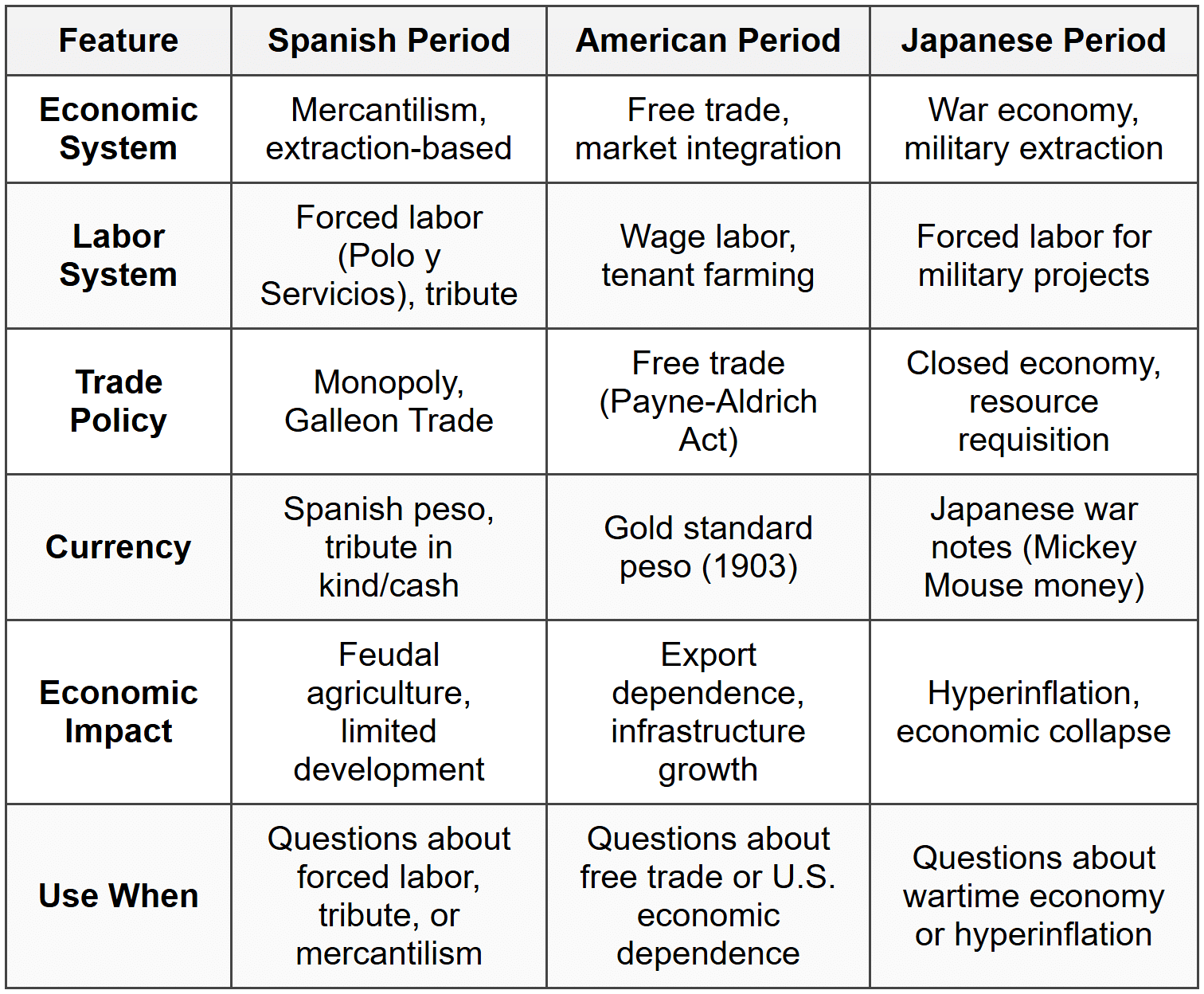
Comparative Table: Economic Systems Across Colonial Periods
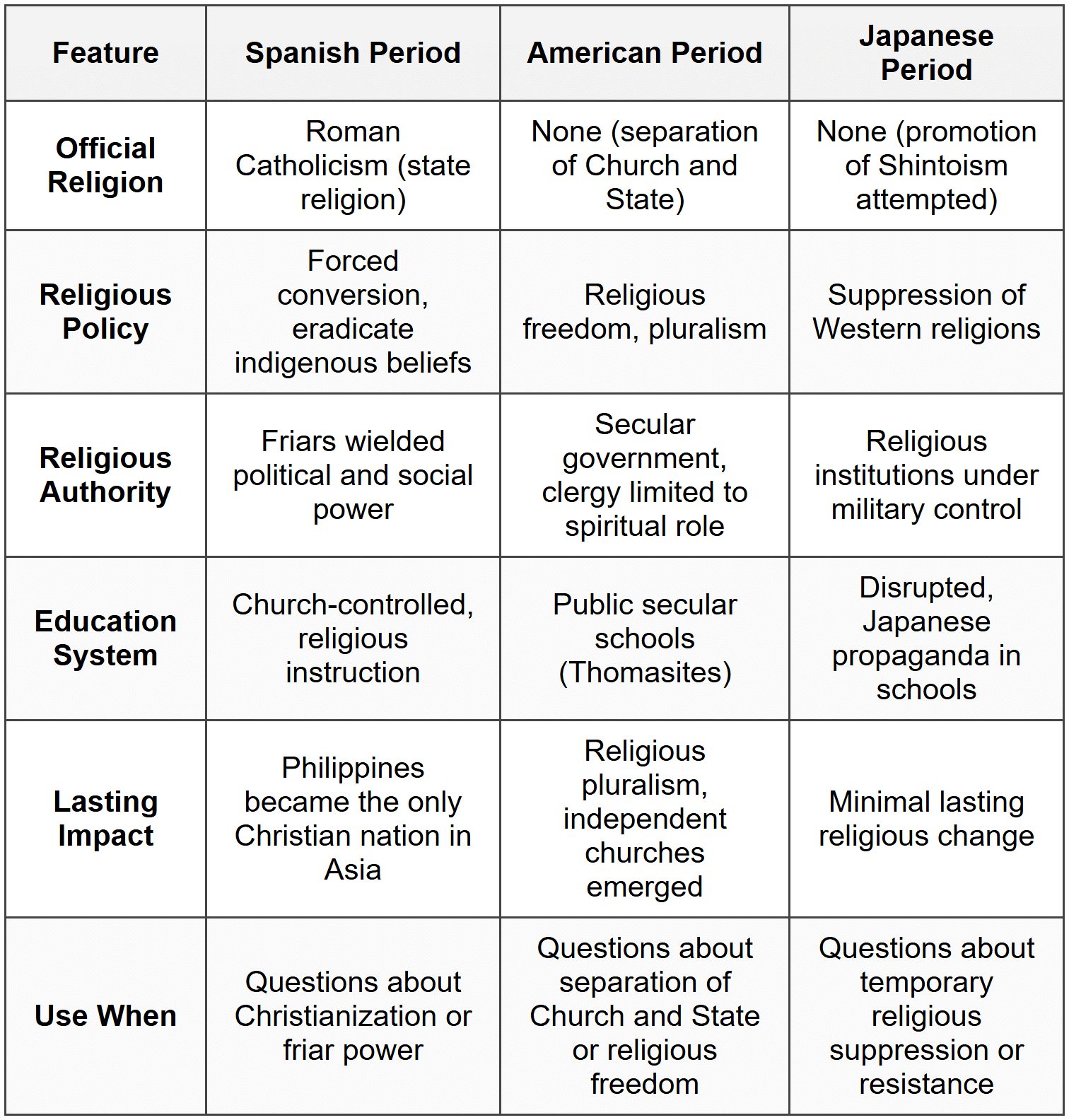
Comparative Table: Religious Systems Across Colonial Periods
Commonly Tested Scenarios / Pitfalls
1. Scenario: A question asks which economic system most directly exploited Filipino labor during Spanish times, offering options like Galleon Trade, Encomienda, Bandala, and Hacienda.
Correct Approach: Encomienda is the answer because it directly institutionalized forced labor and tribute collection from Filipinos assigned to Spanish encomenderos.
Check first: Identify which system involves direct control over Filipino labor and tribute rather than trade or agricultural production systems.
Do NOT do first: Do not immediately choose Galleon Trade because it was prominent; the Galleon Trade involved commercial exchange between continents, not direct exploitation of Filipino workers.
Why other options are wrong: Bandala was forced sale (not labor), Hacienda involved tenant farming (indirect exploitation), while Encomienda directly assigned Filipinos as labor sources to colonizers.
2. Scenario: A question asks what best explains why the Philippines remained economically dependent on the U.S. even after independence, with options including colonial education, free trade agreements, military bases, and religious ties.
Correct Approach: Free trade agreements (Payne-Aldrich Act and Underwood-Simmons Act) are the answer because they structurally tied the Philippine economy to U.S. markets as a supplier of raw materials and consumer of American goods.
Check first: Look for the option that explains structural economic integration rather than cultural, military, or educational factors.
Do NOT do first: Do not select colonial education first; while English instruction facilitated economic ties, it did not create the structural dependence that trade policies did.
Why other options are wrong: Military bases provided security but not economic integration; religious ties were minimal under American secular policy; only free trade created lasting economic dependence.
3. Scenario: A question asks which colonial power introduced the separation of Church and State in the Philippines, offering Spain, America, Japan, and Britain as options.
Correct Approach: America is the answer because the Philippine Bill of 1902 and Jones Law of 1916 institutionalized this separation, ending the Spanish fusion of religious and civil authority.
Check first: Identify which power's legal frameworks explicitly separated religious and governmental authority.
Do NOT do first: Do not choose Spain because the question asks about separation, not establishment of religion; Spain fused Church and State.
Why other options are wrong: Spain enforced Catholicism as state religion; Japan suppressed religion during occupation but had no lasting policy; Britain never colonized the Philippines.
4. Scenario: A question describes hyperinflation and worthless currency during a specific period and asks students to identify the currency, with options including Spanish peso, gold standard peso, Mickey Mouse money, and U.S. dollar.
Correct Approach: Mickey Mouse money (Japanese war notes) is the answer because it was fiat currency issued during the Japanese occupation with no backing, causing extreme hyperinflation by 1945.
Check first: Identify the time period and the characteristic of fiat currency without backing causing hyperinflation.
Do NOT do first: Do not assume the gold standard peso is correct just because it sounds more official; the gold standard peso was stable and backed by reserves.
Why other options are wrong: Spanish peso and gold standard peso were backed currencies with stable value; the U.S. dollar was not Philippine currency; only Mickey Mouse money caused hyperinflation.
5. Scenario: A question asks what the primary purpose of the Reducción policy was during Spanish colonization, with options including military defense, religious conversion, economic taxation, and land redistribution.
Correct Approach: Religious conversion is the answer because Reducción concentrated scattered populations into central pueblos built around churches to facilitate mass Christianization and control by friars.
Check first: Identify the policy's primary goal as stated by Spanish authorities, which was conversion and administration, not defense or economics.
Do NOT do first: Do not choose economic taxation first; while taxation became easier with concentrated populations, the explicit purpose was evangelization.
Why other options are wrong: Military defense was secondary; land redistribution did not occur (land was seized); economic taxation benefited from the policy but was not its stated purpose.
Practice Questions
Q1: Which economic policy during the American period directly created the Philippines' dependence on exporting agricultural raw materials to the United States?
(a) Philippine Bill of 1902
(b) Payne-Aldrich Act of 1909
(c) Public Land Act
(d) Jones Law of 1916
Ans: (b)
The Payne-Aldrich Act established free trade between the Philippines and the U.S., allowing unlimited duty-free entry of Philippine products (sugar, abaca, coconut) and American manufactured goods, which structurally tied the Philippine economy to U.S. markets. (a) established civil government but not trade terms; (c) regulated land ownership; (d) focused on political autonomy, not economic policy.
Q2: What was the most significant religious change introduced during the American colonial period?
(a) Mandatory conversion to Protestantism
(b) Separation of Church and State
(c) Abolition of all religious orders
(d) Establishment of Islam as a recognized religion
Ans: (b)
The Philippine Bill of 1902 and Jones Law of 1916 institutionalized the separation of Church and State, ending the Spanish practice of fusing religious and civil authority and guaranteeing religious freedom. (a) is incorrect as conversion was not mandatory; (c) is wrong as religious orders continued operating; (d) is irrelevant as Islam was already present in Mindanao before colonization.
Q3: During the Spanish period, Filipino males aged 16-60 were required to provide forced labor for 40 days per year. What was this system called?
(a) Encomienda
(b) Bandala
(c) Polo y Servicios
(d) Reducción
Ans: (c)
Polo y Servicios was the forced labor system requiring adult males to work for the government for 40 days annually (reduced to 15 days in 1884). Workers could pay the falla to be exempted. (a) was a tribute and land grant system; (b) was forced sale of goods; (d) was the resettlement policy for religious conversion.
Q4: The Japanese occupation of the Philippines caused severe economic problems. What was the primary cause of hyperinflation during this period?
(a) Disruption of the Galleon Trade
(b) Overproduction of agricultural goods
(c) Issuance of unbacked Japanese war notes
(d) American economic sanctions
Ans: (c)
The Japanese issued fiat currency called "Mickey Mouse money" that had no real backing, causing extreme hyperinflation as prices increased thousands of times by 1945. (a) is incorrect as the Galleon Trade ended in 1815; (b) is wrong as there was underproduction and scarcity; (d) is irrelevant as sanctions cannot cause internal currency collapse.
Q5: Which of the following best describes the primary goal of the Spanish Reducción policy?
(a) To create military fortifications against foreign invasion
(b) To facilitate religious conversion by concentrating populations around churches
(c) To distribute agricultural land equally among Filipinos
(d) To establish trade centers for the Galleon Trade
Ans: (b)
Reducción concentrated scattered indigenous communities into central pueblos built around churches to facilitate mass Christianization and control by Spanish friars. (a) is secondary to the religious goal; (c) is incorrect as land was seized, not distributed; (d) confuses the policy with trade infrastructure development.
Q6: The execution of Fathers Gómez, Burgos, and Zamora (Gomburza) in 1872 was connected to which religious controversy during the Spanish period?
(a) The spread of Protestantism
(b) The Secularization Movement
(c) The abolition of the Reducción policy
(d) The establishment of independent churches
Ans: (b)
Gomburza were executed during the Secularization Movement, which sought to replace Spanish friars with native Filipino secular priests in parish positions. Their martyrdom sparked nationalist sentiment. (a) is incorrect as Protestantism came with American rule; (c) is unrelated to the controversy; (d) refers to events during the American period.
Quick Review
- Spanish economic system was based on mercantilism, forced labor (Polo y Servicios), tribute (buwis), and monopolies; the Galleon Trade (1565-1815) linked Manila to Acapulco
- Encomienda directly exploited Filipino labor through tribute collection assigned to Spanish colonizers
- Spanish religious policy enforced Roman Catholicism as state religion; friars wielded enormous political and social power alongside civil authorities
- Reducción policy relocated scattered populations into central pueblos around churches to facilitate Christianization and control
- Payne-Aldrich Act (1909) established free trade between Philippines and U.S., creating structural economic dependence on American markets
- American period introduced separation of Church and State through the Philippine Bill of 1902 and Jones Law of 1916, ending Spanish fusion of religious and civil power
- Japanese occupation economy was characterized by military extraction, forced labor, and Mickey Mouse money (fiat currency) causing severe hyperinflation by 1945
- Gomburza execution (1872) during the Secularization Movement sparked Filipino nationalist sentiment against Spanish friar dominance
- Iglesia Filipina Independiente (Aglipayan Church) founded in 1902 as a nationalist alternative to Roman Catholicism during American period
- Japanese religious impact was minimal due to the short occupation period (1942-1945) and strong Filipino Catholic identity resisting Shinto promotion
