American Colonization of the Philippines

The American colonization of the Philippines (1898-1946) marks a critical period in Philippine history that fundamentally transformed the nation's political, educational, and cultural landscape. This topic is heavily tested in the LET exam, focusing on key events, policies, educational reforms, and figures that shaped the Filipino-American relationship. Understanding the chronology, significant legislation, and educational initiatives is essential for exam success.
Core Concepts
Treaty of Paris (1898)
The Treaty of Paris signed on December 10, 1898, formally ended the Spanish-American War and transferred Philippine sovereignty from Spain to the United States for $20 million. This treaty marked the official beginning of American colonial rule in the Philippines, though Filipinos were not consulted in the negotiations. The treaty stipulated that Spain would cede the Philippines, Guam, and Puerto Rico to the United States.
When to Use This
- When identifying the legal basis or starting point of American colonization
- When questions ask about the amount paid for the Philippines or the parties involved in the transaction
- When comparing how colonial powers changed hands in Philippine history
- When the exam asks about events immediately following the Spanish-American War
Philippine-American War (1899-1902)
The Philippine-American War, also called the Filipino-American War or Philippine Insurrection, began on February 4, 1899, when Filipino forces under General Emilio Aguinaldo resisted American occupation. The war officially ended on July 4, 1902, though sporadic resistance continued in some regions until 1913. Key figures include General Emilio Aguinaldo (Filipino leader), General Antonio Luna (military strategist), and American generals Arthur MacArthur and Elwell Otis.
- Estimated Filipino casualties: 200,000 to 1 million (mostly civilians)
- American casualties: approximately 4,200 soldiers killed
- Aguinaldo was captured on March 23, 1901, in Palanan, Isabela
- The war involved guerrilla tactics by Filipino forces
- Americans employed reconcentration policies similar to Spanish methods
When to Use This
- When questions address Filipino resistance to American rule
- When identifying key military figures during early American period
- When asked about the duration or casualty figures of the conflict
- When comparing methods of resistance across different colonial periods
American Colonial Government Structure
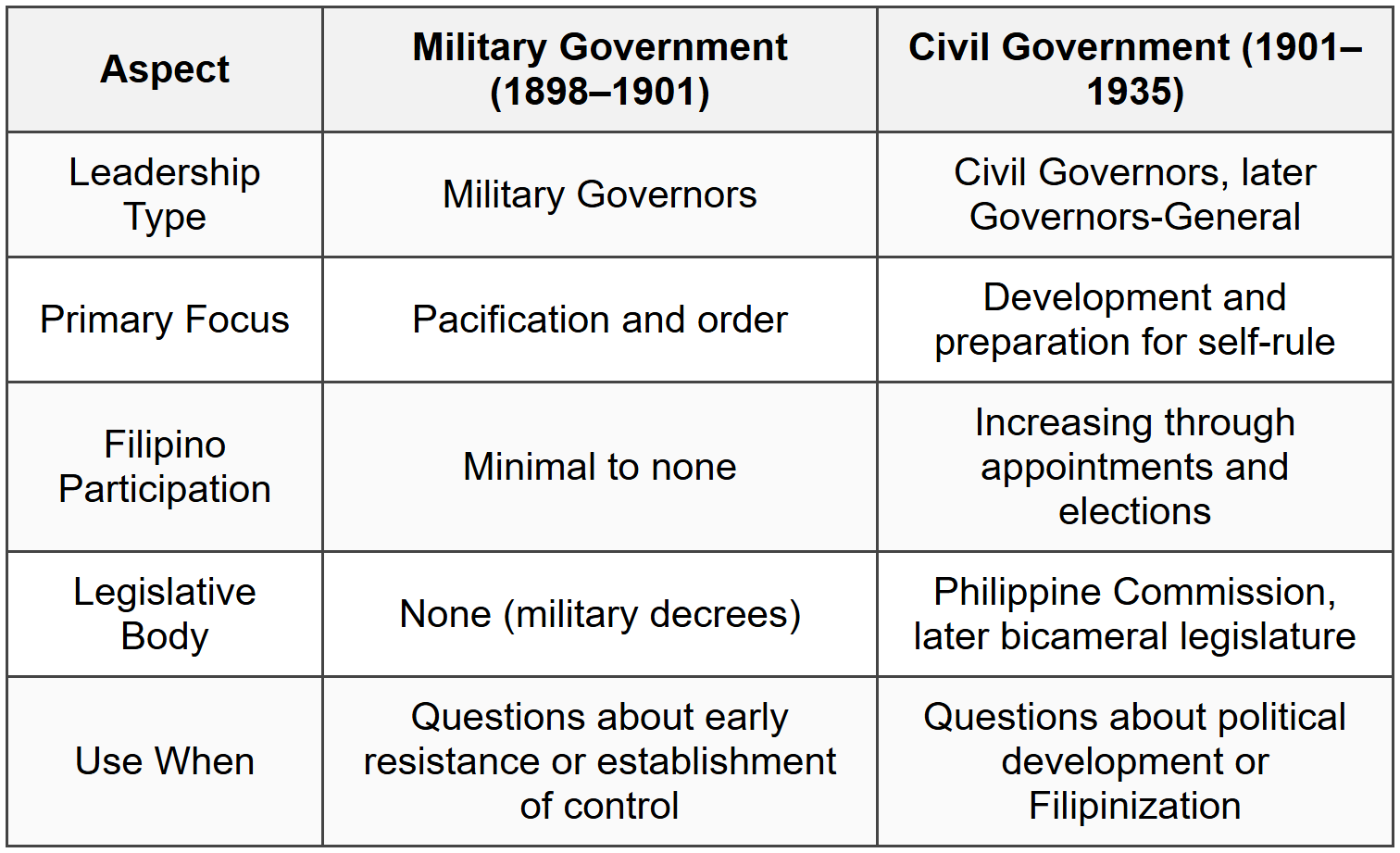
The American colonial government evolved through several phases, each with distinct characteristics and leadership structures designed to gradually prepare Filipinos for self-governance while maintaining American control.
Military Government (1898-1901)
The initial phase under military governors focused on establishing order and suppressing resistance. General Wesley Merritt was the first American military governor, followed by General Elwell Otis and General Arthur MacArthur. This period emphasized military pacification and the establishment of basic administrative structures.
Civil Government (1901-1935)
On July 4, 1901, civil government was established with William Howard Taft as the first American Civil Governor. The Philippine Commission served as the executive and legislative body. Key features included:
- Taft's policy of "Philippines for the Filipinos" and "benevolent assimilation"
- Appointment of Filipinos to the Philippine Commission starting in 1901
- Creation of the Philippine Assembly in 1907 as the lower legislative house
- Gradual Filipinization of government positions
When to Use This
- When questions ask about the transition from military to civilian rule
- When identifying first American governors or their policies
- When asked about the structure of early American government in the Philippines
- When comparing governance structures across colonial periods
Significant American Legislation for the Philippines
Philippine Bill of 1902 (Philippine Organic Act)
The Philippine Bill of 1902, also known as the Cooper Act, served as the first organic law for the Philippines under American rule. It established the foundations of civil government and defined the rights of Filipinos.
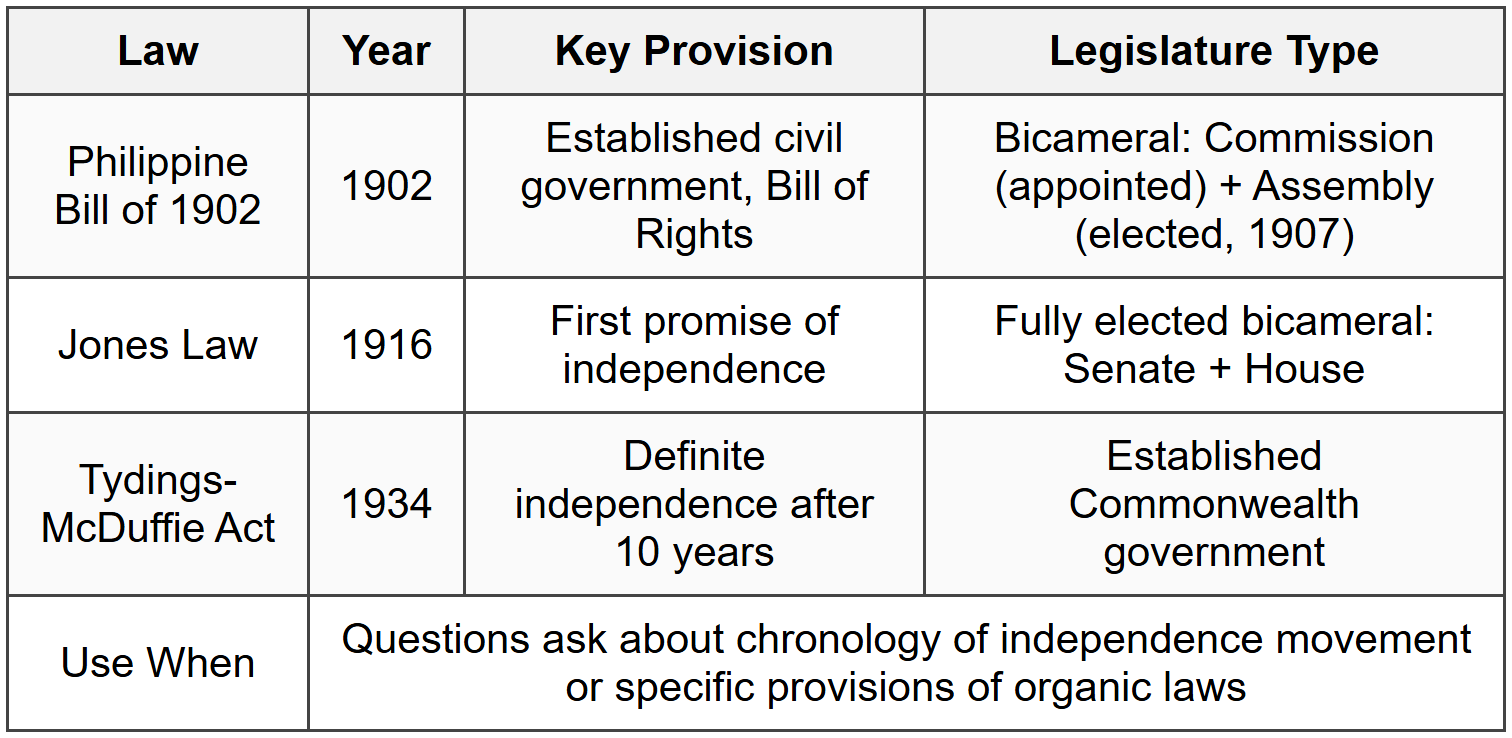
- Created a bicameral legislature: Philippine Commission (upper house) and Philippine Assembly (lower house, established 1907)
- Extended the Philippine Bill of Rights to Filipinos (except trial by jury and right to bear arms)
- Provided for two non-voting resident commissioners to the U.S. Congress
- Separated church and state
- Made English the official language of government
Jones Law of 1916 (Philippine Autonomy Act)
The Jones Law replaced the Philippine Bill of 1902 and granted greater autonomy to Filipinos. It is particularly significant for its promise of eventual independence.
- First official American promise of Philippine independence "as soon as a stable government can be established"
- Created a fully elected bicameral Philippine Legislature: Senate (upper house) and House of Representatives (lower house)
- All members were elected by Filipino voters
- Increased Filipino control over executive departments
- Expanded the Philippine Bill of Rights
- Governor-General retained veto power
Tydings-McDuffie Act of 1934 (Philippine Independence Act)
The Tydings-McDuffie Act provided the definitive legal framework for Philippine independence, setting a specific timeline and establishing the Commonwealth period as a transition phase.
- Granted Philippine independence after a 10-year transition period (Commonwealth period)
- Independence date set for July 4, 1946
- Required the Philippines to draft and ratify a constitution
- Established trade relations and immigration quotas
- Limited Filipino immigration to the U.S. to 50 persons annually
When to Use This
- When identifying which law granted specific rights or established particular government structures
- When asked about the first promise of independence versus the definitive independence law
- When questions compare different organic acts and their provisions
- When determining which legislation introduced specific reforms or democratic features
American Educational System in the Philippines
The establishment of a public education system was the most enduring legacy of American colonization. Education served dual purposes: practical preparation for democratic participation and cultural assimilation to American values.
The Thomasites
The Thomasites were American teachers who arrived aboard the USS Thomas on August 21, 1901, to establish the public school system. This group of approximately 540 teachers pioneered American-style education throughout the archipelago.
- Named after the transport ship USS Thomas
- Arrived on August 21, 1901
- Initially around 540 teachers, expanded to over 1,000 in subsequent years
- Introduced English as the medium of instruction
- Established normal schools for training Filipino teachers
- Spread throughout provinces, often living in rural communities
Key Educational Policies and Institutions
Act No. 74 (1901) established the Department of Public Instruction with the goal of providing free primary education. English became the primary medium of instruction, replacing Spanish.
Major educational institutions founded during American period:
- Philippine Normal School (1901) - trained Filipino teachers; now Philippine Normal University
- University of the Philippines (1908) - established by Act No. 1870 as the national university
- Philippine Medical School (1907) - later integrated into UP
- Trade and vocational schools - emphasized practical skills
Educational principles emphasized:
- Practical and vocational education over classical education
- Democratic citizenship training
- Mass literacy through free public elementary education
- English language proficiency as key to advancement
- Separation of church and state in education (secular public schools)
When to Use This
- When questions ask about the most significant American contribution to Philippine development
- When identifying the Thomasites or their arrival date
- When asked about the medium of instruction during American period
- When comparing educational systems across colonial periods
- When questions reference the founding of major Philippine universities
Economic Policies and Development
American economic policy aimed to integrate the Philippine economy with American markets, creating dependency while developing infrastructure and introducing modern commercial practices.
Free Trade and Economic Relations
The Payne-Aldrich Tariff Act of 1909 established free trade between the Philippines and the United States, with certain quota limitations. The Underwood-Simmons Tariff Act of 1913 expanded free trade by removing most quota restrictions.
- Made the Philippines economically dependent on the U.S. market
- Encouraged production of export crops: sugar, hemp (abaca), copra, tobacco
- Discouraged industrialization and diversification
- Benefited large landowners and American business interests
Land Policies
The Public Land Act and Friar Lands Act redistributed Spanish friar estates, though implementation often favored wealthy Filipinos and corporations rather than tenant farmers.
- Limited individual ownership to 16 hectares
- Limited corporate ownership to 1,024 hectares
- Purchased 166,000 hectares of friar lands for redistribution
- Created landed elite class (cacique class) due to tenant farmers' inability to purchase land
Infrastructure Development
- Construction of roads, bridges, and port facilities
- Expansion of railroad systems
- Improvement of communication systems (telegraph, postal service)
- Public health initiatives (sanitation, vaccination programs)
- Establishment of civil service system based on merit
When to Use This
- When questions address economic dependency or free trade relations
- When identifying major American economic policies or tariff acts
- When asked about land ownership limits or agrarian issues
- When comparing economic structures across colonial periods
Social and Cultural Changes
American colonization introduced significant social reforms and cultural shifts that transformed Filipino society, often creating lasting tensions between traditional values and American influences.
Democratic Institutions and Practices
- Introduction of elections and representative government
- Municipal and provincial governments with elected officials
- Political parties emerged (Nacionalista Party, 1907)
- Civil liberties and freedoms (speech, press, assembly)
- Judicial system based on American common law principles
Social Reforms
- Women's suffrage - Filipino women granted voting rights in 1937 plebiscite
- Public health programs - eradication of diseases like cholera, smallpox
- Civil service - merit-based government employment
- Religious freedom - separation of church and state enforced
- Improvement in mortality rates due to health initiatives
Cultural Impact
- English became widely spoken, creating bilingual population
- American popular culture influenced fashion, entertainment, sports
- Introduction of basketball, baseball as popular sports
- American-style education emphasized individual achievement
- Gradual shift from Hispanic to American orientation in urban areas
When to Use This
- When questions ask about democratic practices introduced by Americans
- When identifying social reforms or women's rights milestones
- When comparing cultural influences of different colonial powers
- When asked about lasting American legacies in Philippine society
Notable American Governors-General
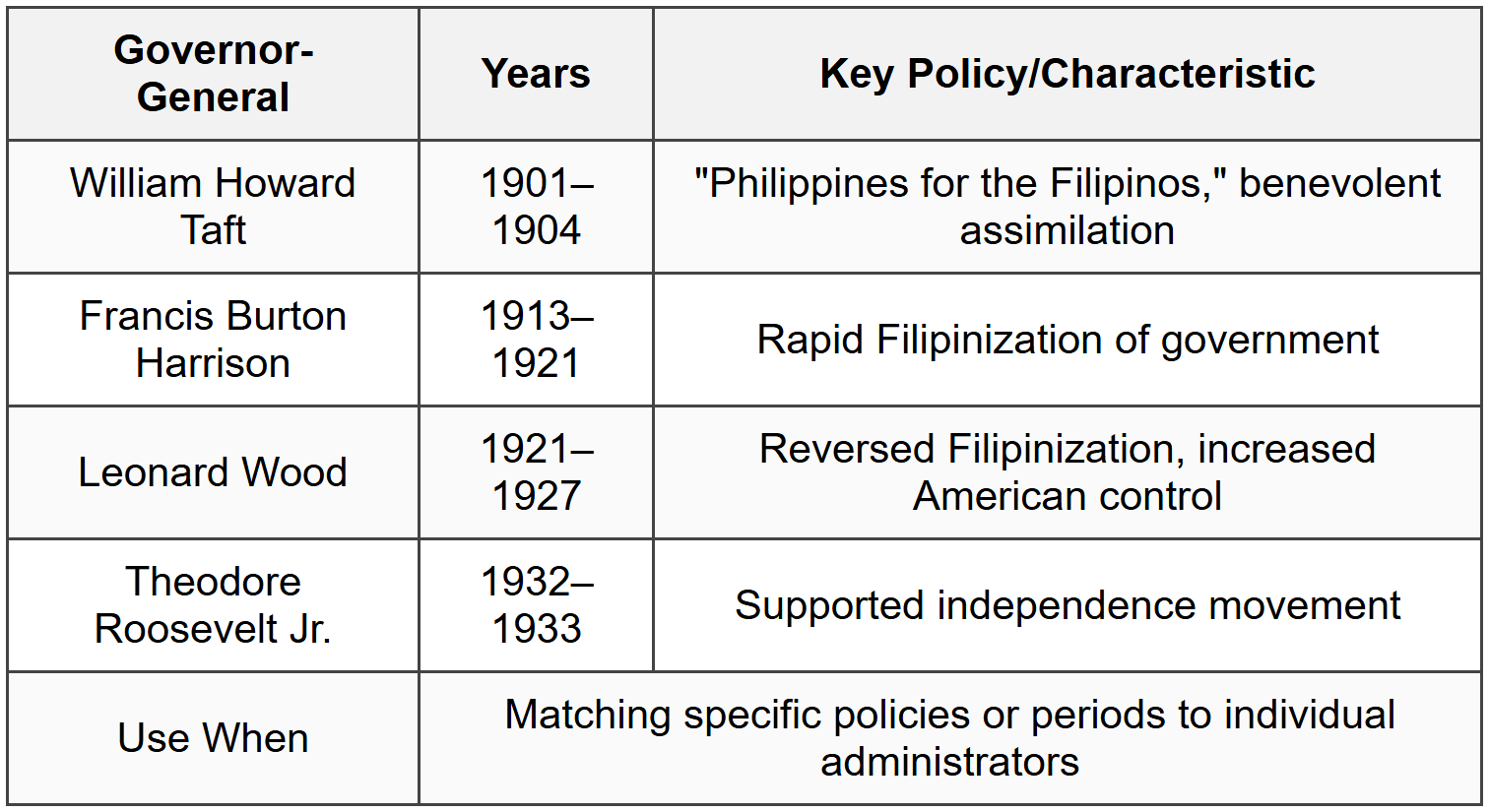
William Howard Taft (1901-1904) - First Civil Governor, implemented "benevolent assimilation" policy and "Philippines for the Filipinos" principle.
Francis Burton Harrison (1913-1921) - Accelerated Filipinization of government; by 1921, Filipinos held majority of civil service positions and cabinet posts.
Leonard Wood (1921-1927) - Reversed Filipinization policies, increased American control, clashed with Filipino leaders; his policies sparked independence movement momentum.
Henry L. Stimson (1927-1929) - Adopted conciliatory approach, improved relations with Filipino leaders after Wood's controversial tenure.
Theodore Roosevelt Jr. (1932-1933) - Supported independence movement, helped pave way for Tydings-McDuffie Act.
When to Use This
- When questions ask about specific governors and their policies
- When identifying who implemented Filipinization or who opposed it
- When asked about American officials who supported Philippine independence
- When matching policies to specific colonial administrators
Independence Missions and Nationalist Movement
Filipino leaders sent multiple independence missions to the United States to lobby for self-governance and eventual independence.
- First Independence Mission (1919) - Led by Manuel L. Quezon and Sergio Osmeña
- OsRox Mission (1931-1933) - Quezon and Manuel Roxas lobbied for independence legislation
- Hare-Hawes-Cutting Act (1932) - Passed by U.S. Congress but rejected by Philippine Senate due to objectionable provisions (military bases, trade restrictions)
- Rivalry between Quezon and Osmeña over independence strategy
- Tydings-McDuffie Act (1934) replaced Hare-Hawes-Cutting with similar but more acceptable terms
When to Use This
- When questions ask about Filipino efforts to achieve independence
- When identifying leaders involved in independence missions
- When asked why Hare-Hawes-Cutting was rejected versus Tydings-McDuffie acceptance
- When comparing different independence bills and their provisions
Commonwealth Period (1935-1946)
The Commonwealth of the Philippines served as a transitional government preparing for full independence. Manuel L. Quezon was elected first President in September 1935 under the 1935 Constitution.
- Commonwealth inaugurated on November 15, 1935
- Quezon as President, Osmeña as Vice President
- Internal autonomy with U.S. control over foreign affairs and defense
- National Defense Act - prepared military defense under General Douglas MacArthur
- Social Justice Program - land reform, labor rights, economic development
- Interrupted by Japanese occupation (1942-1945)
- Independence granted on July 4, 1946
When to Use This
- When questions identify the transition government before independence
- When asked about Quezon's presidency or the 1935 Constitution
- When identifying the date Commonwealth was established versus independence date
- When questions address preparations for independence
Commonly Tested Scenarios / Pitfalls
1. Scenario: A question presents multiple laws and asks which one first promised Philippine independence or which established a specific government structure.
Correct Approach: The Jones Law of 1916 provided the first official American promise of independence, while the Philippine Bill of 1902 established the initial civil government structure. The Tydings-McDuffie Act of 1934 gave the definite independence date.
Check first: What specific provision is being asked about-promise of independence (Jones Law), establishment of civil government (Philippine Bill of 1902), or definite independence timeline (Tydings-McDuffie).
Do NOT do first: Do not assume all laws dealt with independence. The Philippine Bill of 1902 established government structure and rights but made no independence promise. Jumping to the most famous law (Tydings-McDuffie) without reading what specific provision is asked will lead to errors.
Why other options are wrong: The Treaty of Paris transferred sovereignty but wasn't Philippine legislation; Hare-Hawes-Cutting was rejected; earlier acts addressed government structure, not independence promises.
2. Scenario: The exam asks about the Thomasites-their arrival date, purpose, or the name origin.
Correct Approach: The Thomasites arrived on August 21, 1901 aboard the USS Thomas as American teachers to establish the public school system. They numbered approximately 540 initially and introduced English as the medium of instruction.
Check first: Whether the question asks for the date, the ship name (USS Thomas), the number of teachers, or their primary function (establishing public education).
Do NOT do first: Do not confuse Thomasites with military personnel or confuse their arrival date with other significant 1901 events like the establishment of civil government (July 4, 1901).
Why other options are wrong: Other American groups (military, administrators) came at different times and for different purposes; the name specifically derives from the USS Thomas transport ship, not a person.
3. Scenario: A question asks which American governor-general implemented or reversed Filipinization policies.
Correct Approach: Francis Burton Harrison (1913-1921) aggressively implemented Filipinization, placing Filipinos in majority government positions. Leonard Wood (1921-1927) reversed this policy, increasing American control and creating conflict with Filipino leaders.
Check first: Whether the question asks who implemented Filipinization (Harrison) or who opposed/reversed it (Wood), and the specific years of their tenure.
Do NOT do first: Do not assume Taft implemented Filipinization just because he promoted "Philippines for the Filipinos"-this was a philosophy, not the massive personnel policy Harrison implemented. Do not confuse Wood's opposition with simple conservatism.
Why other options are wrong: Taft established civil government but didn't aggressively Filipinize positions; other governors had different priorities; Wood is the only one who notably reversed Filipinization.
4. Scenario: The exam presents a question about the amount paid for the Philippines or the treaty that transferred sovereignty from Spain to America.
Correct Approach: The Treaty of Paris (1898) transferred Philippine sovereignty to the United States for $20 million. The treaty was signed on December 10, 1898, and did not include Filipino representation.
Check first: Whether the question asks for the treaty name, the date, the amount paid, or the parties involved (Spain and U.S., excluding Filipinos).
Do NOT do first: Do not confuse the Treaty of Paris with other treaties or agreements (Pact of Biak-na-Bato involved Spain and Filipino revolutionaries). Do not misremember the amount as $2 million or $200 million.
Why other options are wrong: The Pact of Biak-na-Bato was between Spain and Filipino revolutionaries; other amounts are incorrect; other dates don't match the actual signing.
5. Scenario: A question asks why the Hare-Hawes-Cutting Act was rejected while Tydings-McDuffie Act was accepted, or asks which provided definite independence.
Correct Approach: The Hare-Hawes-Cutting Act (1932) was rejected by the Philippine Senate because of objectionable provisions regarding military bases and trade restrictions. The Tydings-McDuffie Act (1934) was essentially similar but politically more acceptable and provided for independence after a 10-year Commonwealth transition period.
Check first: Whether the question asks which law was rejected (Hare-Hawes-Cutting), which was accepted (Tydings-McDuffie), or the specific objectionable provisions (military bases, trade terms).
Do NOT do first: Do not assume they were completely different laws-they were very similar. Do not think acceptance was based on content alone; political factors and leadership rivalries (Quezon vs. Osmeña) played significant roles.
Why other options are wrong: Both laws provided for independence; the rejection wasn't about refusing independence but about specific terms; Jones Law promised but didn't provide a timeline.
Practice Questions
Q1: Which American legislation first officially promised Philippine independence?
(a) Treaty of Paris (1898)
(b) Philippine Bill of 1902
(c) Jones Law (1916)
(d) Tydings-McDuffie Act (1934)
Ans: (c)
The Jones Law of 1916, also known as the Philippine Autonomy Act, contained the first official American promise of independence "as soon as a stable government can be established." The Treaty of Paris transferred sovereignty but made no independence promise; the Philippine Bill of 1902 established civil government and rights but not independence; the Tydings-McDuffie Act provided the definite timeline but came later.
Q2: How much did the United States pay Spain for the Philippines under the Treaty of Paris?
(a) $2 million
(b) $20 million
(c) $50 million
(d) $200 million
Ans: (b)
The Treaty of Paris, signed December 10, 1898, transferred the Philippines from Spain to the United States for $20 million. This amount is frequently tested. The other amounts are incorrect and represent common misconceptions or confusion with other historical transactions.
Q3: The American teachers who arrived aboard the USS Thomas on August 21, 1901, were known as:
(a) Peace Corps volunteers
(b) Thomasites
(c) Missionaries
(d) Carlists
Ans: (b)
The Thomasites were named after their transport ship, the USS Thomas, and arrived on August 21, 1901. Approximately 540 American teachers came to establish the public school system and introduce English as the medium of instruction. Peace Corps didn't exist until 1961; missionaries came separately; Carlists refers to a different historical group entirely.
Q4: Which American Governor-General is known for aggressively implementing the Filipinization of government positions between 1913-1921?
(a) William Howard Taft
(b) Leonard Wood
(c) Francis Burton Harrison
(d) Henry L. Stimson
Ans: (c)
Francis Burton Harrison (1913-1921) rapidly placed Filipinos in government positions, achieving majority Filipino representation in civil service and cabinet posts by 1921. Taft established civil government but didn't aggressively Filipinize; Leonard Wood reversed Filipinization policies; Stimson came later and focused on reconciliation.
Q5: The Philippine-American War officially ended in what year, though sporadic resistance continued in some areas?
(a) 1899
(b) 1901
(c) 1902
(d) 1913
Ans: (c)
The Philippine-American War officially ended on July 4, 1902, though resistance continued in some regions until 1913. The war began February 4, 1899; 1901 was when Aguinaldo was captured; 1913 marks the end of all resistance in remote areas like Mindanao.
Q6: What was the primary medium of instruction introduced in the Philippine public school system during the American period?
(a) Spanish
(b) Tagalog
(c) English
(d) Latin
Ans: (c)
English was established as the primary medium of instruction throughout the American colonial period, introduced by the Thomasites and mandated through the Department of Public Instruction. Spanish was the previous colonial language; Tagalog was a vernacular but not the official medium; Latin was never used as a medium of instruction in Philippine public schools.
Quick Review
- Treaty of Paris (December 10, 1898) - Spain ceded Philippines to U.S. for $20 million; Filipinos excluded from negotiations
- Philippine-American War (1899-1902) - February 4, 1899, started; Aguinaldo captured March 23, 1901; officially ended July 4, 1902
- Thomasites arrived August 21, 1901 - approximately 540 American teachers on USS Thomas; established public education with English as medium
- Philippine Bill of 1902 - First organic law; established civil government, Philippine Bill of Rights, bicameral legislature (Commission + Assembly from 1907)
- Jones Law of 1916 - First official promise of independence; created fully elected bicameral Philippine Legislature (Senate + House of Representatives)
- Tydings-McDuffie Act of 1934 - Provided definite independence after 10-year Commonwealth period; set independence for July 4, 1946
- Francis Burton Harrison (1913-1921) - Implemented aggressive Filipinization; Leonard Wood (1921-1927) reversed it
- Commonwealth inaugurated November 15, 1935 - Manuel L. Quezon first President under 1935 Constitution; independence achieved July 4, 1946
- University of the Philippines founded 1908 - Established as national university; Philippine Normal School founded 1901 for teacher training
- Hare-Hawes-Cutting Act (1932) rejected - Philippine Senate refused due to objectionable military base and trade provisions; Tydings-McDuffie accepted as replacement
