Prioritization Techniques

Prioritization techniques help project managers and teams determine which tasks, requirements, features, or risks should receive attention, resources, and action first. For the PMP exam, you must understand multiple prioritization methods, when each applies, and how to select the right technique based on stakeholder needs, project context, and product delivery approach. These techniques appear in scenario-based questions testing your ability to choose appropriate tools for requirements, backlog items, risks, and deliverables.
Core Concepts
MoSCoW Method
MoSCoW is a collaborative prioritization technique that categorizes items into four groups based on necessity and urgency. The acronym stands for Must have, Should have, Could have, and Won't have this time. Project managers use this method with stakeholders to align on what is critical for success versus what can be deferred.
- Must have: Non-negotiable requirements without which the project fails or delivers no value
- Should have: Important but not vital; can be delayed if necessary without breaking core functionality
- Could have: Desirable but not necessary; included only if time and resources permit
- Won't have this time: Agreed to be excluded from current scope; prevents scope creep and manages expectations
- Typically used in product development, requirements management, and iterative delivery approaches
- Helps balance stakeholder desires against project constraints
- Requires clear definition of "must have" to prevent everything being labeled critical
When to Use This
- When stakeholders disagree on requirements priority and need a structured conversation framework
- When working in agile or hybrid environments where backlog refinement requires stakeholder consensus
- When the exam scenario describes managing scope with limited time or budget and stakeholders presenting competing demands
- Choose MoSCoW over value-based methods when the question emphasizes stakeholder agreement and managing expectations rather than quantitative value measurement
Weighted Shortest Job First (WSJF)
WSJF is a quantitative prioritization technique from Scaled Agile Framework (SAFe) that calculates priority as the ratio of cost of delay to job duration. Items with higher WSJF scores deliver more value per unit of time invested and should be executed first. This method optimizes economic outcomes by sequencing work to minimize overall delay costs.
The formula is:
\[ \text{WSJF} = \frac{\text{Cost of Delay}}{\text{Job Duration}} \]Where Cost of Delay combines:
- User/Business Value: Direct value to users or business outcomes
- Time Criticality: How value decays over time or urgency based on deadlines
- Risk Reduction/Opportunity Enablement: Value from reducing risks or enabling future capabilities
Job Duration represents the effort or time required to complete the work item, typically estimated in relative units like story points or weeks.
- Higher WSJF score means higher priority; work on these items first
- Encourages breaking large items into smaller pieces to reduce duration and increase WSJF
- Commonly used in SAFe, Lean portfolio management, and large-scale agile environments
- Requires estimation of both value components and duration
- More complex than simple value-based ranking but accounts for delay costs
When to Use This
- When the exam scenario involves optimizing flow of value or minimizing cost of delay in agile delivery
- When the question mentions SAFe, Lean principles, or economic decision-making in prioritization
- When multiple features have different value profiles and durations, and you need to sequence them optimally
- Choose WSJF over simple value ranking when both value components and time/effort are explicitly mentioned in the scenario
Kano Model
The Kano Model classifies features based on how they affect customer satisfaction. It recognizes that not all features contribute equally: some are expected, some increase satisfaction linearly, and some delight customers unexpectedly. This model helps teams invest appropriately in different feature types rather than treating all requirements as equal.
The five Kano categories are:
- Must-be (Basic/Threshold): Expected features that cause dissatisfaction if absent but do not increase satisfaction when present; customers assume these exist
- One-dimensional (Performance): Features where satisfaction increases linearly with performance; more is better
- Attractive (Delighters): Unexpected features that greatly increase satisfaction when present but cause no dissatisfaction when absent
- Indifferent: Features that do not affect satisfaction either way; customers do not care
- Reverse: Features that some customers want but others actively dislike
- Prioritize must-be features first to avoid dissatisfaction, then one-dimensional for competitive performance, then attractive if resources allow
- Helps avoid over-investing in indifferent features or features customers expect as baseline
When to Use This
- When the exam scenario focuses on customer satisfaction, product features, or balancing stakeholder expectations
- When the question describes features that stakeholders expect versus features that would delight them
- When you must decide between investing in baseline functionality versus innovative enhancements
- Choose Kano over other methods when satisfaction, customer experience, or feature categorization by impact type is the focus
Multi-Voting
Multi-voting is a group decision-making technique where each participant receives a limited number of votes to distribute among options. It reduces large lists of ideas or priorities to a manageable subset quickly and democratically. This method is collaborative, inclusive, and helps build consensus without requiring full agreement on a single choice.
- Each team member typically receives 3-5 votes depending on the number of options
- Participants can allocate multiple votes to one option or spread votes across several
- Options receiving the most votes rise to the top for further action or refinement
- Often used iteratively: first round narrows from many to moderate, second round narrows further
- Quick, simple, and requires no complex calculations
- Does not consider weighted criteria or economic value; purely democratic
- Useful in brainstorming sessions, risk identification workshops, and retrospective action planning
When to Use This
- When the scenario involves team workshops, brainstorming, or group consensus activities
- When stakeholders have equal say and the goal is democratic input rather than authority-driven decisions
- When the exam question describes narrowing a large list quickly without detailed analysis
- Choose multi-voting over weighted scoring when speed and inclusiveness matter more than quantitative rigor
Dot Voting
Dot voting is a specific form of multi-voting where participants place physical or virtual dots on options displayed visually. Each dot represents one vote. This technique is highly visual, fast, and effective for engaging teams in prioritization during workshops or collaborative planning sessions.
- Each participant receives a fixed number of dots (often 3-5)
- Dots are placed directly on flip charts, boards, or digital collaboration tools
- Options with the most dots become priorities
- Can allow or prohibit placing multiple dots on one item depending on rules
- Immediately visible results foster discussion and transparency
- Commonly used in agile retrospectives, PI planning, and requirements workshops
When to Use This
- When the scenario involves visual collaboration, workshops, or team-based decision-making
- When the exam question describes a facilitated session with multiple participants voting simultaneously
- When speed, engagement, and transparency are emphasized over detailed analysis
- Choose dot voting over other methods when the question highlights visual collaboration or workshop facilitation
Priority Matrix (Eisenhower Matrix)
The priority matrix categorizes items along two dimensions: urgency and importance. This creates four quadrants that guide action: do first, schedule, delegate, or eliminate. It helps project managers and teams distinguish between what feels urgent but is not important versus what is truly critical.
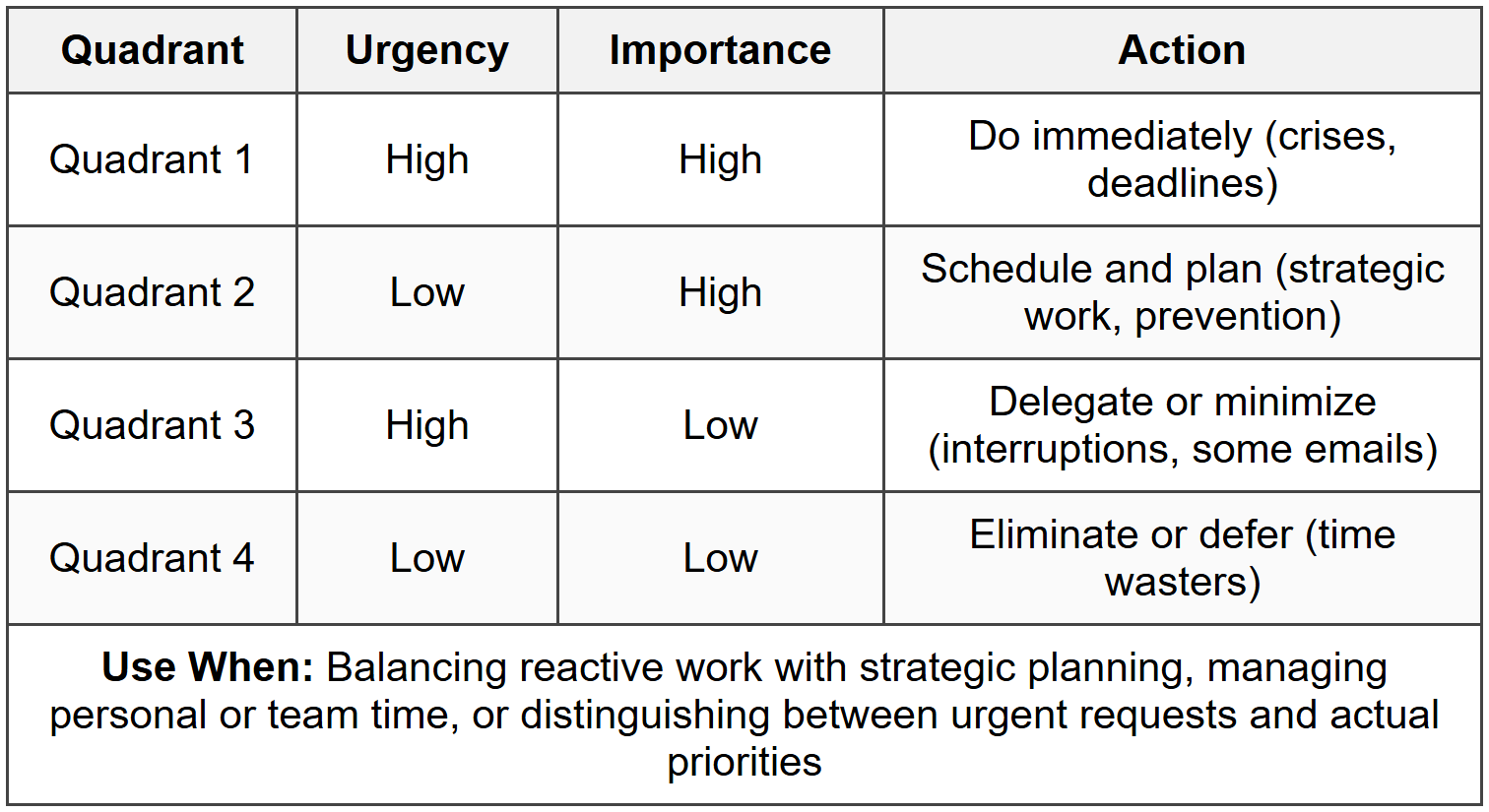
- Quadrant 2 is where proactive project management happens: planning, risk management, relationship building
- Quadrant 1 items should be minimized through good Quadrant 2 practices
- Quadrant 3 items often masquerade as Quadrant 1 due to external pressure
- Effective prioritization increases Quadrant 2 time and reduces Quadrant 1 firefighting
When to Use This
- When the scenario involves managing conflicting demands, firefighting versus planning, or stakeholder requests
- When the exam question describes urgent requests that may not be truly important
- When you must advise a team member or stakeholder on how to allocate time or focus
- Choose the priority matrix when urgency and importance are both explicitly or implicitly part of the decision criteria
Value-Based Prioritization
Value-based prioritization ranks items by their expected contribution to business value, customer satisfaction, or strategic objectives. Items delivering the highest value are addressed first to maximize return on investment and stakeholder satisfaction. This approach aligns project work with organizational goals.
- Value may be defined as revenue, cost savings, customer satisfaction, market share, strategic alignment, or other organizational metrics
- Requires stakeholder input to define and quantify value criteria
- Can be simple ranking or use weighted scoring with multiple value dimensions
- Common in product backlogs, feature prioritization, and benefit realization planning
- Directly supports incremental delivery of value in agile and iterative approaches
- May not account for effort or cost; high-value items might also be high-effort
When to Use This
- When the exam scenario emphasizes maximizing business outcomes, customer value, or ROI
- When stakeholders care most about which features or deliverables provide the greatest benefit
- When the question involves product backlog ordering, benefits realization, or business case justification
- Choose value-based prioritization over effort-based or urgency-based when value or benefit is the primary concern stated in the question
Risk-Based Prioritization
Risk-based prioritization sequences work based on risk exposure: the combination of probability and impact. Items with the highest risk scores are addressed first to reduce threats or capitalize on opportunities early. This technique is critical in risk management and when uncertainties dominate project planning.
- Risk exposure = Probability × Impact (in qualitative or quantitative terms)
- High-probability, high-impact risks receive immediate attention
- Can prioritize both threats (negative risks) and opportunities (positive risks)
- Often combined with value-based prioritization: high-value, high-risk items may be prioritized or de-prioritized depending on risk appetite
- Used in risk response planning, iteration planning with technical uncertainty, and compliance-driven projects
- Supports proactive risk management rather than reactive firefighting
When to Use This
- When the scenario involves uncertainty, threats, opportunities, or risk management activities
- When the question describes high-impact risks that need mitigation or high-value opportunities requiring early action
- When compliance, safety, or technical uncertainty is a dominant project factor
- Choose risk-based prioritization when the exam question explicitly or implicitly focuses on managing uncertainty or reducing exposure
Cost of Delay
Cost of delay quantifies the economic impact of not delivering a feature, product, or capability by a certain time. It helps teams understand the financial penalty of delaying decisions or deliveries. Items with the highest cost of delay should be prioritized to minimize lost value or revenue.
- Cost of delay can include lost revenue, missed market opportunities, regulatory penalties, or competitive disadvantage
- Often expressed in currency per unit time (e.g., $50,000 per week)
- Used as the numerator in WSJF calculations
- Encourages teams to deliver high-impact items quickly rather than perfecting low-impact work
- Requires estimation and business input to quantify delay costs accurately
- Supports economic decision-making in Lean and agile frameworks
When to Use This
- When the scenario involves time-sensitive opportunities, market windows, or financial impacts of delay
- When the question mentions lost revenue, competitive positioning, or regulatory deadlines
- When you must decide between two valuable items and need to understand which delay is costlier
- Choose cost of delay when economic impact over time is the decision factor rather than static value or urgency alone
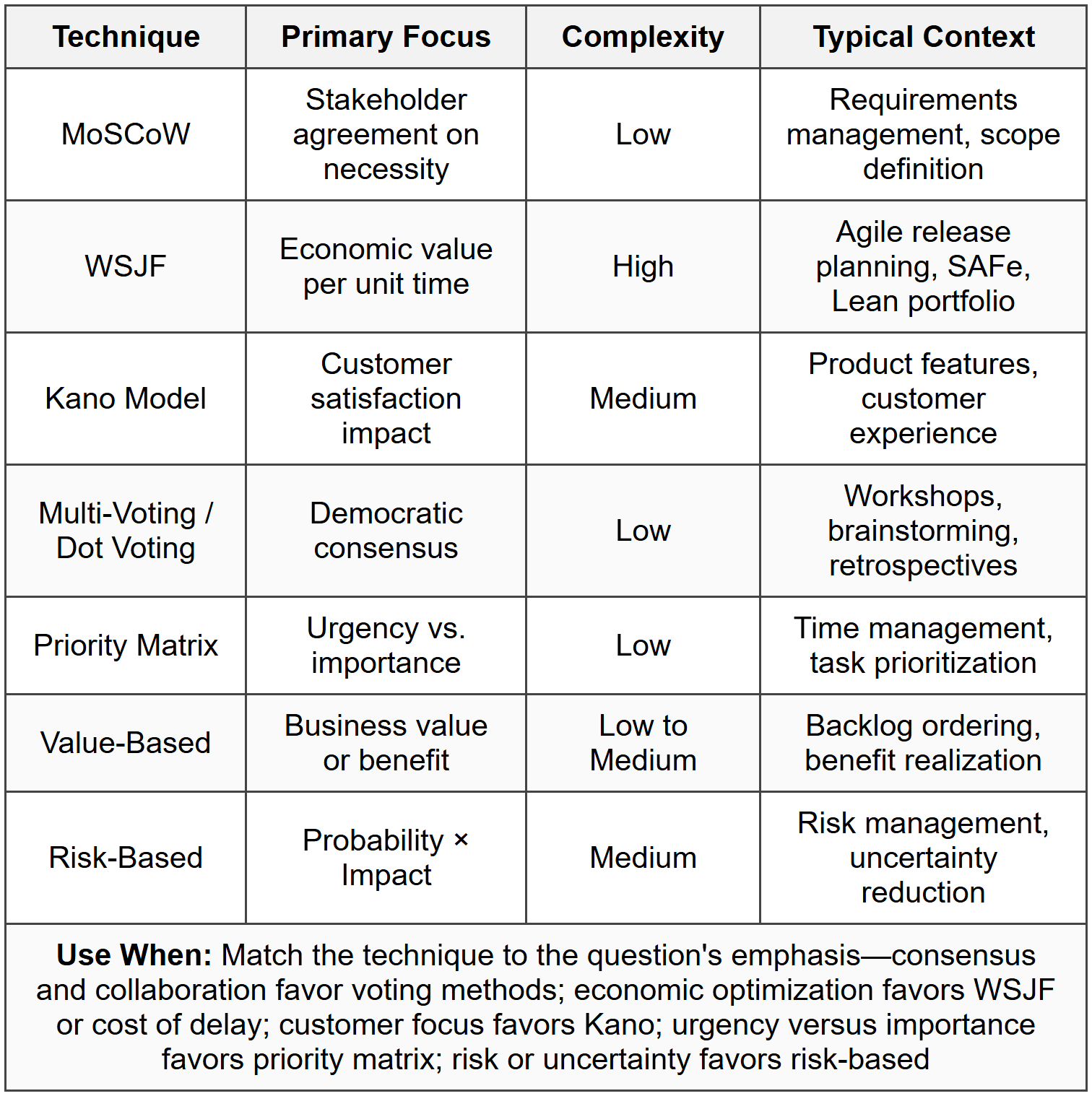
Commonly Tested Scenarios / Pitfalls
1. Scenario: A product owner asks the project manager to prioritize backlog items. Stakeholders disagree on what is most important. Some items are high-value but complex, others are low-value but quick. The sponsor wants the team to maximize value delivery in the next iteration.
Correct Approach: Use WSJF to balance value and duration, calculating the cost of delay divided by job size for each item. This ensures the team delivers the most economic value per unit of time, not just the highest-value item or the quickest win.
Check first: Whether the scenario emphasizes economic optimization and includes both value and effort/duration information. If both are present, WSJF is often the right tool.
Do NOT do first: Immediately select the highest-value item without considering effort, or the shortest item without considering value. This leads to suboptimal sequencing and lower overall value delivery.
Why other options are wrong: Simple value ranking ignores effort and may sequence a six-month, high-value item before three two-week, medium-value items that collectively deliver more. Shortest-job-first ignores value and may deliver low-impact work quickly while delaying critical features.
2. Scenario: During a requirements workshop, stakeholders present 30 potential features. The project manager needs to quickly narrow these to a top 10 for further analysis. The team and stakeholders are all present in the room.
Correct Approach: Use multi-voting or dot voting to democratically and quickly reduce the list. Give each stakeholder 5 votes and tally results. This engages everyone, builds consensus, and delivers fast results suitable for workshops.
Check first: Whether the scenario emphasizes speed, group participation, and workshop facilitation rather than detailed analysis or quantitative scoring.
Do NOT do first: Attempt to perform detailed WSJF calculations or Kano analysis in a live workshop with 30 items. This is too slow and requires more information than is typically available in real time.
Why other options are wrong: Detailed scoring methods require estimation and analysis that cannot be performed quickly in a group setting. Authority-based decisions (sponsor chooses) do not leverage group wisdom or build stakeholder buy-in.
3. Scenario: A team is constantly firefighting issues and struggling to complete strategic planning activities. Team members report feeling reactive and unable to focus on important but non-urgent work like risk management and process improvement.
Correct Approach: Use the priority matrix to categorize work into urgent/important quadrants. Coach the team to protect time for Quadrant 2 (important but not urgent) activities to reduce future Quadrant 1 firefighting.
Check first: Whether the scenario describes a balance between urgent interruptions and important strategic work. The priority matrix is designed specifically for this urgency-importance tension.
Do NOT do first: Implement WSJF or value-based prioritization without addressing the root cause. The problem is not value sequencing but time management and lack of proactive planning.
Why other options are wrong: Value or risk prioritization does not address the urgency-importance dynamic. Adding more resources does not solve the structural problem of insufficient Quadrant 2 time allocation.
4. Scenario: Stakeholders expect certain product features as baseline requirements (e.g., security, login). The team is debating whether to invest additional effort to make these features exceptional versus adding innovative features that stakeholders have not requested but may delight them.
Correct Approach: Use the Kano Model to categorize baseline expectations as must-be features (deliver to standard, do not over-invest) and innovative features as attractive delighters (invest selectively for differentiation).
Check first: Whether the question focuses on customer satisfaction, feature categorization by impact type, or balancing baseline versus innovative work. Kano is ideal for this framing.
Do NOT do first: Prioritize all features by value alone. This misses the Kano insight that exceeding expectations on must-be features does not increase satisfaction proportionally, while adding delighters can dramatically boost satisfaction.
Why other options are wrong: WSJF does not distinguish between must-be, performance, and delighter categories. MoSCoW categorizes by necessity but not by satisfaction impact type. Value-based ranking may over-invest in expected features.
5. Scenario: A project team must decide whether to deliver Feature A (high value, high uncertainty, 8 weeks) or Feature B (medium value, low uncertainty, 2 weeks) first. A major risk exists in Feature A that could invalidate assumptions if not addressed early.
Correct Approach: Use risk-based prioritization to address Feature A first despite longer duration, because the high-impact risk requires early validation. Reducing uncertainty early prevents wasted effort later if assumptions are wrong.
Check first: Whether the scenario highlights risk, uncertainty, or the need to validate assumptions. Risk-based prioritization is appropriate when reducing exposure or learning fast is the goal.
Do NOT do first: Choose Feature B because it is shorter and delivers value faster. This ignores the risk that Feature A's uncertainty could invalidate the entire project direction, making Feature B's value irrelevant.
Why other options are wrong: Pure value-based or WSJF approaches may favor shorter, lower-risk work without accounting for the strategic need to retire high-impact risks early. Delaying high-risk items increases overall project exposure and potential rework.
Step-by-Step Procedures or Methods
Task: Calculating WSJF for Multiple Backlog Items
- Identify the items to prioritize (e.g., features, epics, user stories).
- For each item, estimate User/Business Value on a relative scale (e.g., 1-10 or Fibonacci: 1, 2, 3, 5, 8, 13).
- Estimate Time Criticality on the same scale, representing urgency or decay of value over time.
- Estimate Risk Reduction/Opportunity Enablement on the same scale, representing value from reducing risks or enabling future work.
- Sum the three value components to get Cost of Delay:
Cost of Delay = User Value + Time Criticality + Risk Reduction - Estimate Job Duration (effort or time required) on the same relative scale.
- Divide Cost of Delay by Job Duration to calculate WSJF:
\[ \text{WSJF} = \frac{\text{Cost of Delay}}{\text{Job Duration}} \] - Rank items by WSJF score from highest to lowest.
- Schedule the highest WSJF items first to optimize economic value delivery.
Example Calculation:
Feature X:
User Value = 8
Time Criticality = 5
Risk Reduction = 3
Cost of Delay = 8 + 5 + 3 = 16
Job Duration = 4
WSJF = 16 ÷ 4 = 4
Feature Y:
User Value = 5
Time Criticality = 8
Risk Reduction = 5
Cost of Delay = 5 + 8 + 5 = 18
Job Duration = 3
WSJF = 18 ÷ 3 = 6
Feature Y has a higher WSJF score (6 vs. 4), so prioritize Feature Y first even though Feature X has higher user value. Feature Y delivers more economic value per unit of time.
Task: Applying the Priority Matrix (Eisenhower Matrix)
- List all tasks, issues, or work items requiring attention.
- For each item, assess urgency: Is there a deadline or time pressure? Will delay cause immediate problems?
- For each item, assess importance: Does this contribute to strategic goals, key deliverables, or critical success factors?
- Plot each item into one of four quadrants:
- Quadrant 1 (Urgent + Important): Do immediately.
- Quadrant 2 (Not Urgent + Important): Schedule and plan; allocate dedicated time.
- Quadrant 3 (Urgent + Not Important): Delegate or minimize time spent.
- Quadrant 4 (Not Urgent + Not Important): Eliminate or defer.
- Focus effort on Quadrant 1 items first, then protect time for Quadrant 2 activities.
- Reduce Quadrant 3 interruptions by delegating or setting boundaries.
- Eliminate or defer Quadrant 4 items to free capacity for strategic work.
- Regularly review and reclassify items as urgency and importance change over time.
Task: Facilitating Multi-Voting in a Workshop
- Display all options visually (on a board, flip chart, or digital collaboration tool).
- Explain the voting rules: each participant receives a fixed number of votes (typically 3-5 depending on the number of options).
- Clarify whether participants can place multiple votes on a single option or must spread votes across different options.
- Allow participants to silently or simultaneously place their votes (dots, marks, or digital clicks).
- Tally the votes for each option and display results.
- Identify the top-voted items (e.g., top 5 or top 10 depending on goal).
- Facilitate discussion on surprising results or close ties if needed.
- Use the results to proceed with further analysis, planning, or decision-making on the prioritized items.
Practice Questions
Q1: A product owner has 10 features to prioritize for the next release. Stakeholders disagree on which features are most important. Some features deliver high business value but require significant effort, while others are quick wins with moderate value. What prioritization technique should the project manager recommend to optimize value delivery per unit of time?
(a) MoSCoW method
(b) Weighted Shortest Job First (WSJF)
(c) Kano Model
(d) Multi-voting
Ans: (b)
WSJF balances cost of delay (value) against job duration (effort), optimizing economic outcomes by sequencing work to deliver the most value per unit of time. MoSCoW categorizes by necessity but does not optimize for effort. Kano focuses on customer satisfaction types, not value-per-effort optimization. Multi-voting is democratic but does not quantitatively optimize economic value.
Q2: During a retrospective, a team identifies 20 potential improvement actions. The project manager wants to quickly narrow the list to the top 5 actions to implement in the next sprint. All team members are present. What should the project manager do first?
(a) Calculate WSJF for each action
(b) Categorize actions using MoSCoW
(c) Conduct dot voting with the team
(d) Analyze each action using the Kano Model
Ans: (c)
Dot voting is fast, democratic, and ideal for group workshops where the goal is to quickly narrow a large list with full team participation. WSJF requires more detailed estimation and is too complex for this context. MoSCoW categorizes but does not narrow to a specific number. Kano is suited for customer satisfaction features, not retrospective actions.
Q3: A team is constantly interrupted by urgent requests and struggling to complete important strategic activities like risk planning and process improvement. Team morale is low due to reactive firefighting. What prioritization approach should the project manager use?
(a) Value-based prioritization
(b) Risk-based prioritization
(c) Priority matrix (Eisenhower Matrix)
(d) Weighted Shortest Job First
Ans: (c)
The priority matrix distinguishes between urgent and important work, helping teams allocate time to Quadrant 2 (important but not urgent) activities to reduce future firefighting. Value-based prioritization does not address urgency-importance balance. Risk-based prioritization focuses on risk exposure, not time management. WSJF optimizes economic sequencing but does not solve the structural urgency problem.
Q4: Stakeholders expect the product to have standard login and security features. The team is debating whether to invest extra effort to make login "best in class" or to add innovative features stakeholders have not requested. What prioritization model should the project manager apply?
(a) MoSCoW method
(b) Kano Model
(c) Cost of delay
(d) Multi-voting
Ans: (b)
The Kano Model categorizes login/security as must-be features (expected but not differentiating) and innovative features as attractive delighters. Over-investing in must-be features does not increase satisfaction, while delighters can significantly boost it. MoSCoW categorizes necessity but not satisfaction impact. Cost of delay measures economic impact over time, not satisfaction type. Multi-voting does not provide this strategic insight.
Q5: A team must choose between two features for the next sprint. Feature A has high value and high technical uncertainty; assumptions may be incorrect. Feature B has medium value and low uncertainty. What should the project manager identify first when prioritizing?
(a) Which feature delivers value faster
(b) Which feature has the highest WSJF score
(c) The cost of delay for each feature
(d) The risk exposure and need to validate assumptions early
Ans: (d)
When high-impact uncertainty exists, risk-based prioritization drives the decision. Validating assumptions early prevents wasted effort if Feature A's assumptions are wrong. Focusing on speed (a) ignores risk. WSJF (b) considers delay cost but may not emphasize the strategic need to retire risk. Cost of delay (c) is part of WSJF but does not explicitly highlight the assumption-validation imperative.
Q6: During a planning session, the project manager calculates the following WSJF scores for three features: Feature X = 5.5, Feature Y = 3.2, Feature Z = 6.1. In what order should the features be prioritized?
(a) X, Y, Z
(b) Z, X, Y
(c) Y, X, Z
(d) X, Z, Y
Ans: (b)
WSJF prioritization ranks items from highest to lowest score: Z (6.1), X (5.5), Y (3.2). Higher WSJF means higher economic priority. Options (a), (c), and (d) do not follow descending WSJF order and would result in suboptimal value delivery sequencing.
Quick Review
- MoSCoW categorizes by necessity: Must have, Should have, Could have, Won't have; used for stakeholder alignment on scope and requirements
- WSJF formula: \(\text{WSJF} = \frac{\text{Cost of Delay}}{\text{Job Duration}}\); higher score = higher priority; optimizes economic value per unit time
- Kano Model categories: Must-be (expected), One-dimensional (more is better), Attractive (delighters), Indifferent, Reverse; prioritize must-be first, then performance, then delighters
- Multi-voting and dot voting: Fast, democratic techniques for narrowing large lists in workshops; each participant gets limited votes; top-voted items rise
- Priority Matrix quadrants: Quadrant 1 (urgent + important) = do now; Quadrant 2 (not urgent + important) = schedule and protect time; Quadrant 3 (urgent + not important) = delegate; Quadrant 4 (not urgent + not important) = eliminate
- Value-based prioritization: Rank by business value, customer satisfaction, or strategic alignment; maximizes benefit delivery but may not consider effort
- Risk-based prioritization: Sequence by risk exposure (probability × impact); high-risk items addressed first to reduce uncertainty or capitalize on opportunities
- Cost of delay: Economic impact of not delivering by a certain time; items with highest cost of delay prioritized to minimize lost value
- Choose WSJF when: Both value components and duration/effort are present; economic optimization is the goal
- Choose priority matrix when: Balancing urgent interruptions versus important strategic work; managing time and focus