PE Exam Exam > PE Exam Notes > Civil Engineering (PE Civil) > Cheatsheet: Soil Mechanics
Cheatsheet: Soil Mechanics


1. Soil Classification and Properties
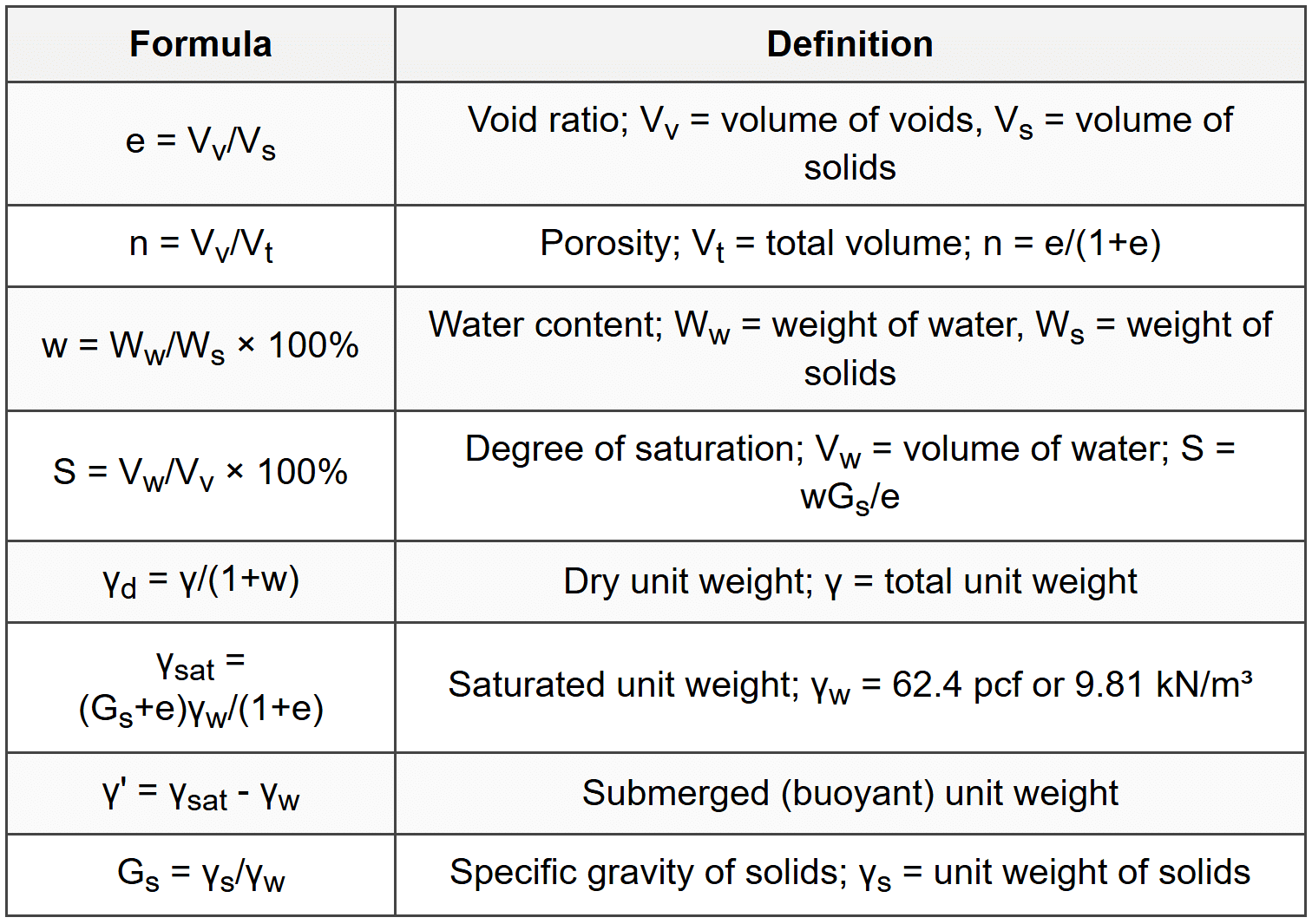
1.1 Phase Relationships
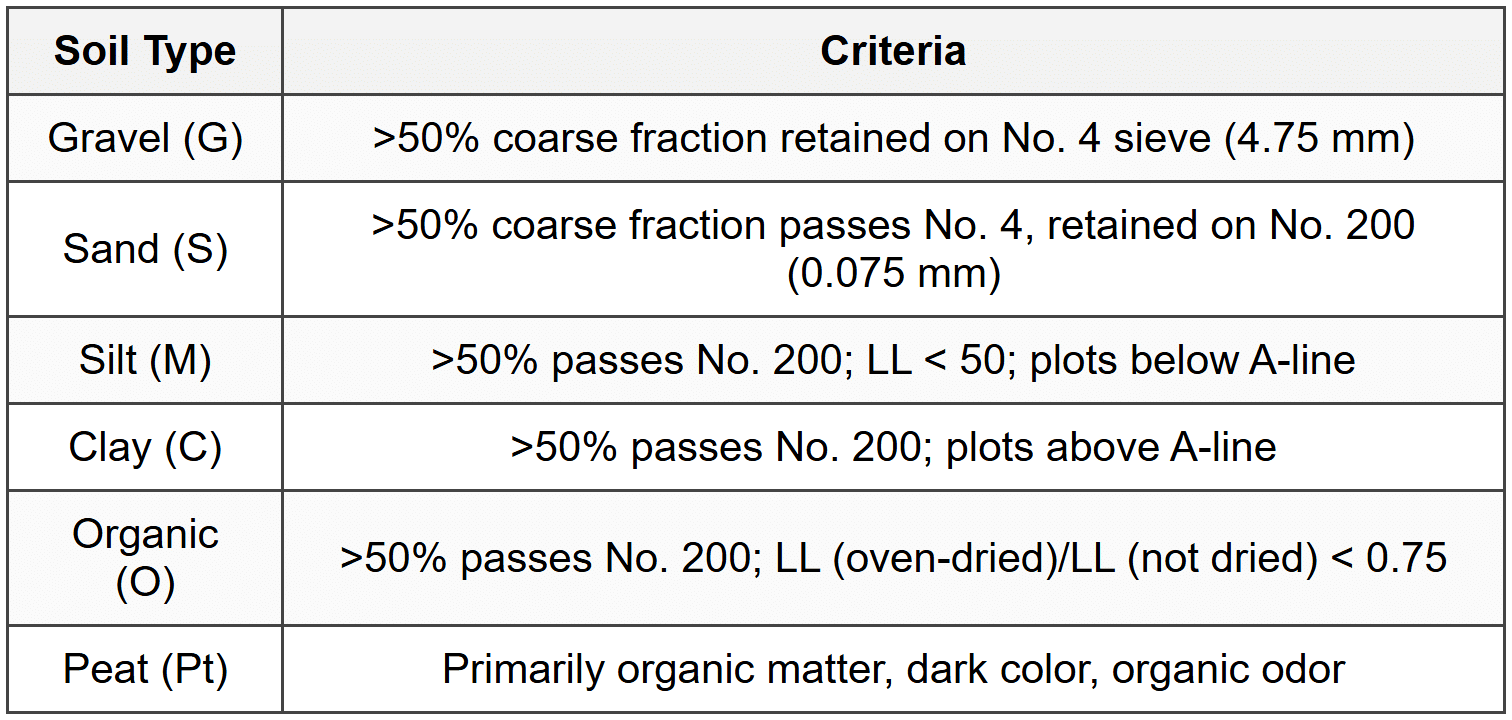
1.2 USCS Classification
1.2.1 Coarse-Grained Soil Symbols
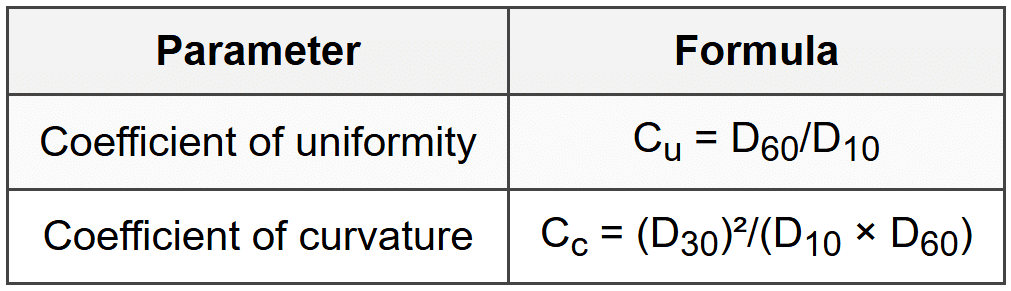
- W = well-graded; Cu ≥ 4 (gravel) or ≥ 6 (sand) AND 1 ≤ Cc ≤ 3
- P = poorly graded; does not meet well-graded criteria
- M = contains fines with low plasticity (plots below A-line)
- C = contains fines with high plasticity (plots above A-line)
- If 5-12% fines: dual symbol (e.g., GW-GM)
- If >12% fines: classify by fines (e.g., GM, GC)
1.2.2 Gradation Coefficients
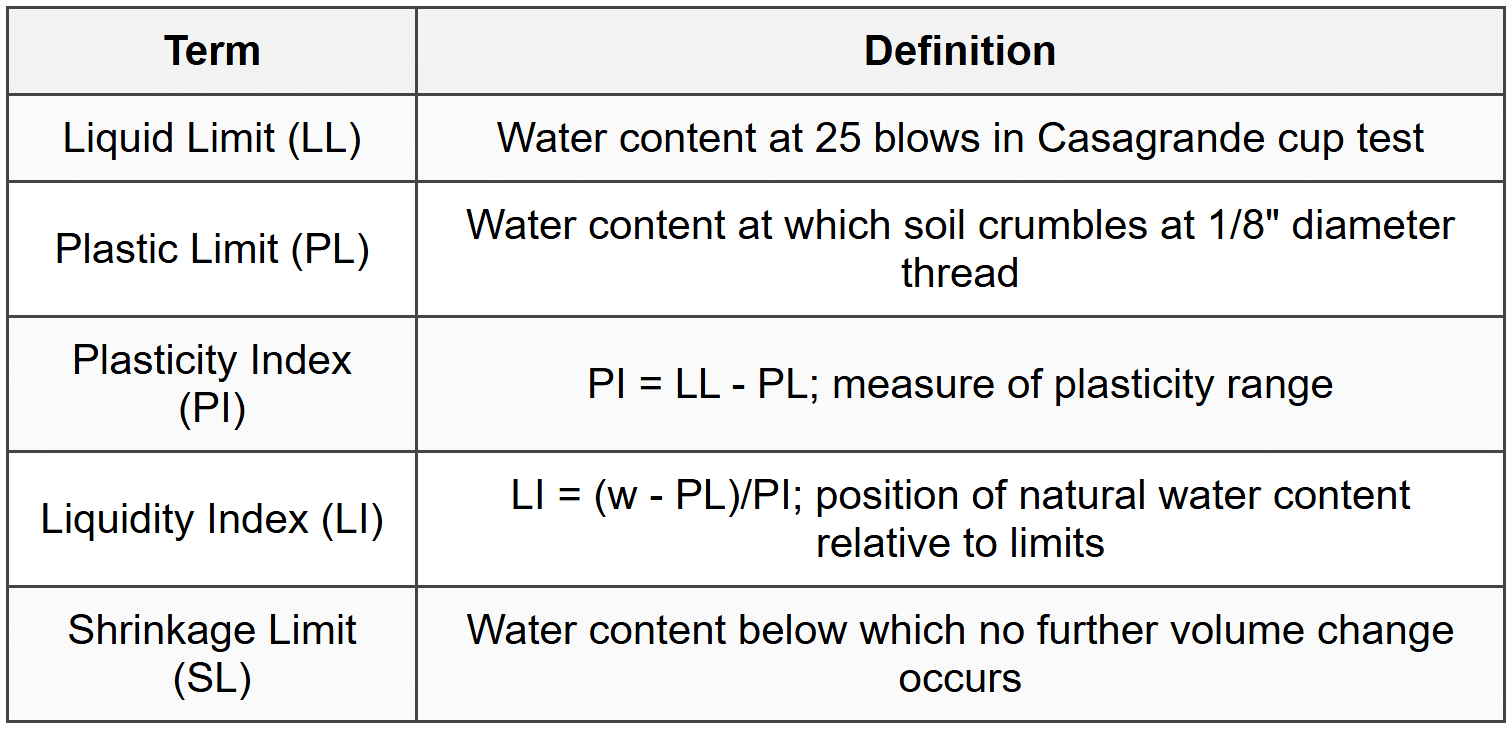
1.3 Atterberg Limits
1.3.1 Plasticity Chart (A-Line)
- A-line equation: PI = 0.73(LL - 20)
- Above A-line: Clay (C); Below A-line: Silt (M)
- LL < 50: Low plasticity (L); LL ≥ 50: High plasticity (H)
- CL-ML: plots in hatched zone between PI = 4 and A-line
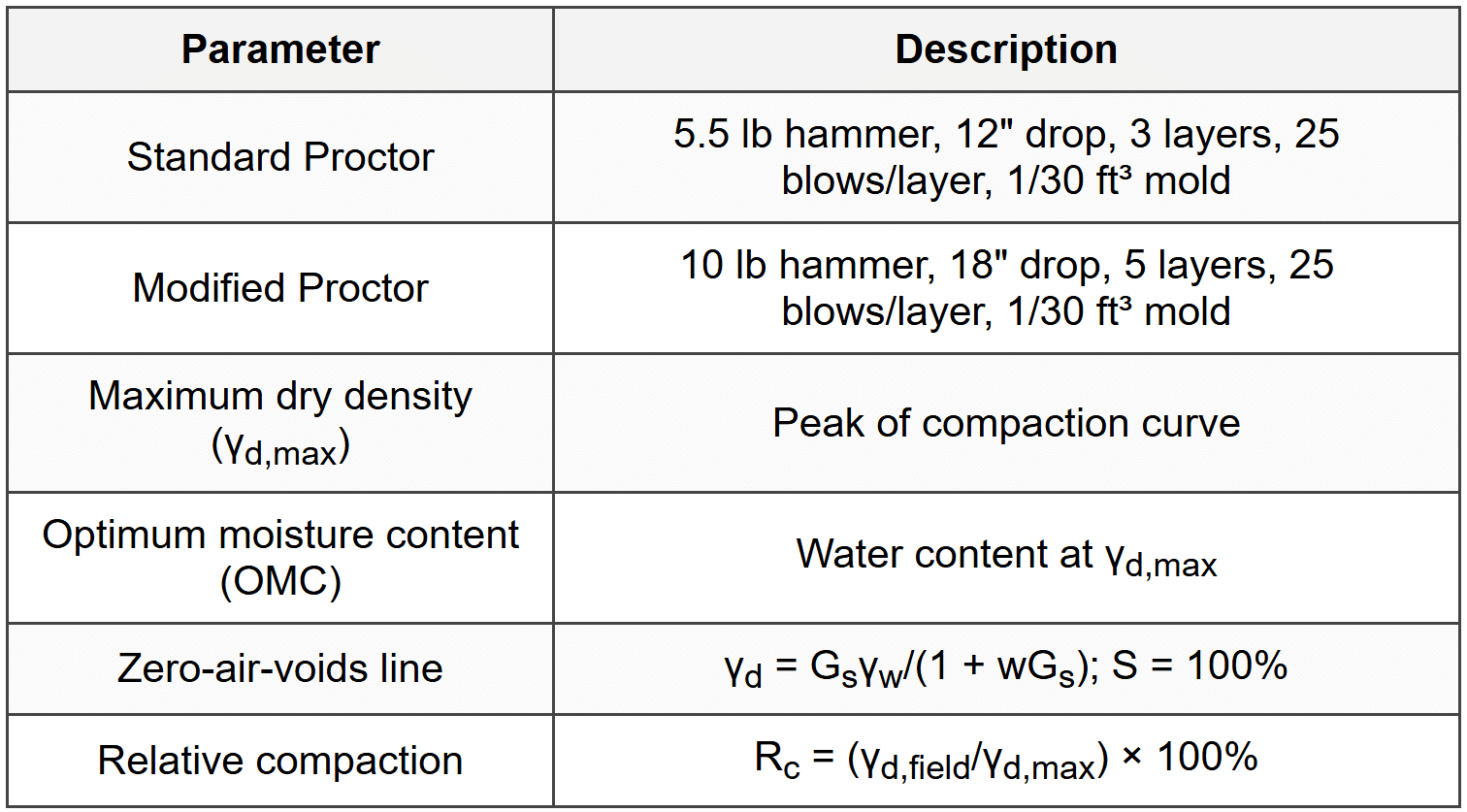
1.4 Soil Compaction
1.5 Relative Density
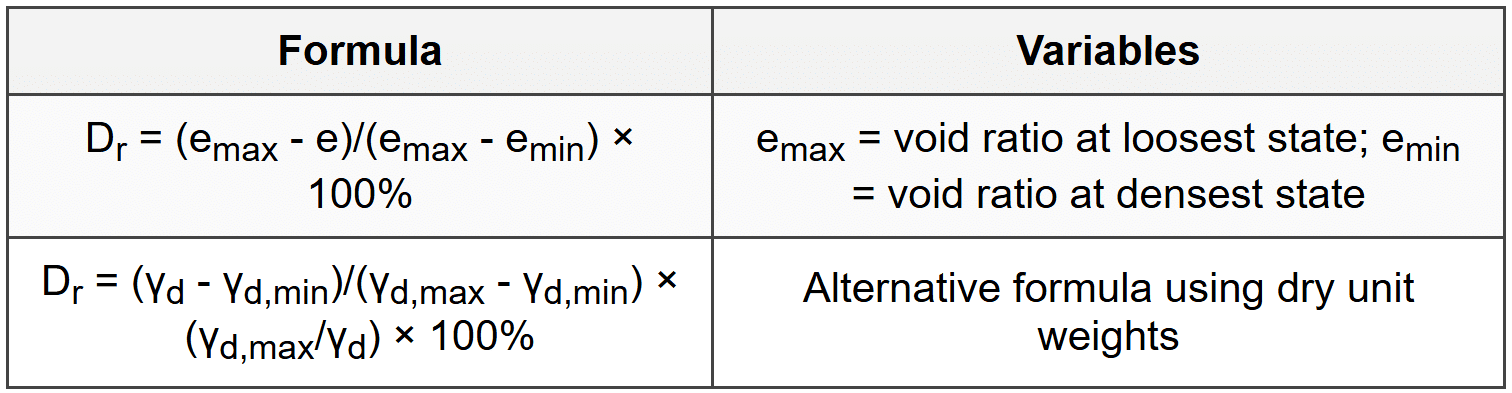
- Dr < 15%: Very loose; 15-35%: Loose; 35-65%: Medium; 65-85%: Dense; >85%: Very dense
2. Hydraulic Properties and Flow
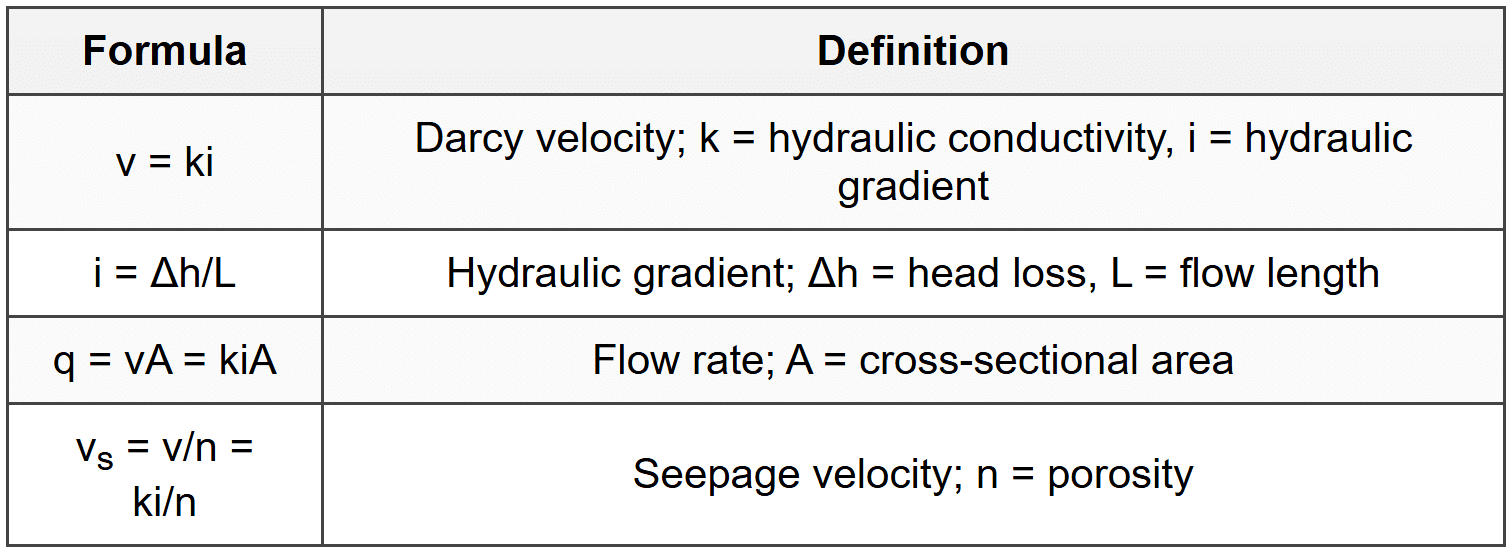
2.1 Darcy's Law
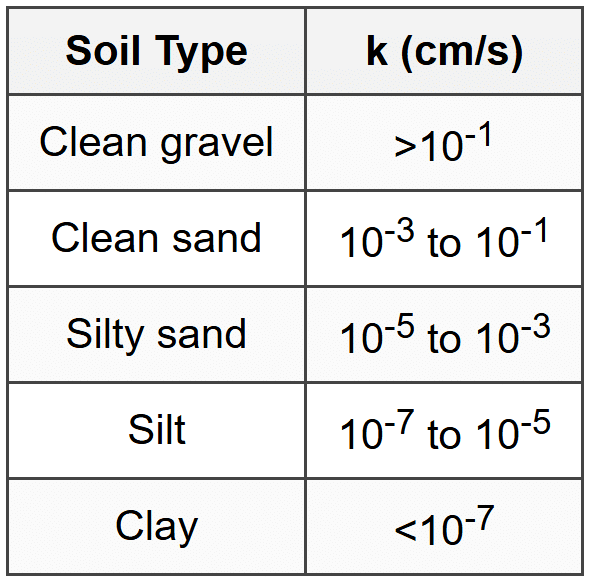
2.2 Hydraulic Conductivity
2.2.1 Empirical Formulas
- Hazen: k (cm/s) = C(D10)² where C = 100-150, D10 in cm; valid for 0.1 mm < D10 < 3 mm
- Temperature correction: kT = k20 × (μ20/μT) where μ = dynamic viscosity
2.3 Layered Soil Hydraulic Conductivity

2.4 Flow Nets
- Flow lines and equipotential lines intersect at 90°
- Flow rate per unit width: q = kh(Nf/Nd) where Nf = number of flow channels, Nd = number of potential drops, h = total head loss
- Head loss between equipotentials: Δh = h/Nd
- Pressure head at any point: hp = h - Δh × (number of drops to point) - elevation head
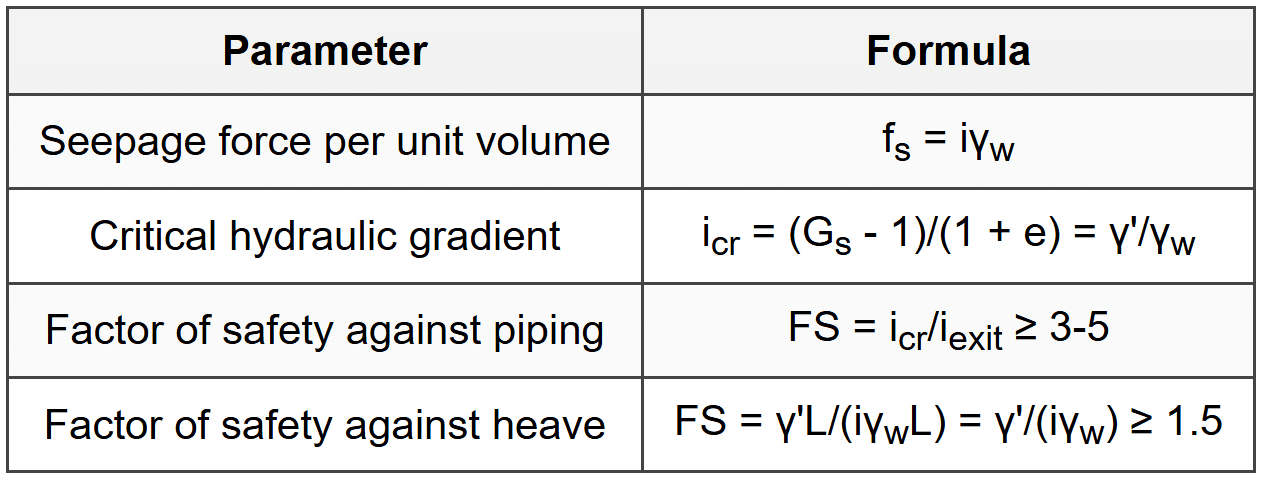
- Exit gradient: iexit = h/(Nd × Δl) where Δl = length of last flow element at exit
2.5 Seepage Force and Piping
3. Stresses in Soil
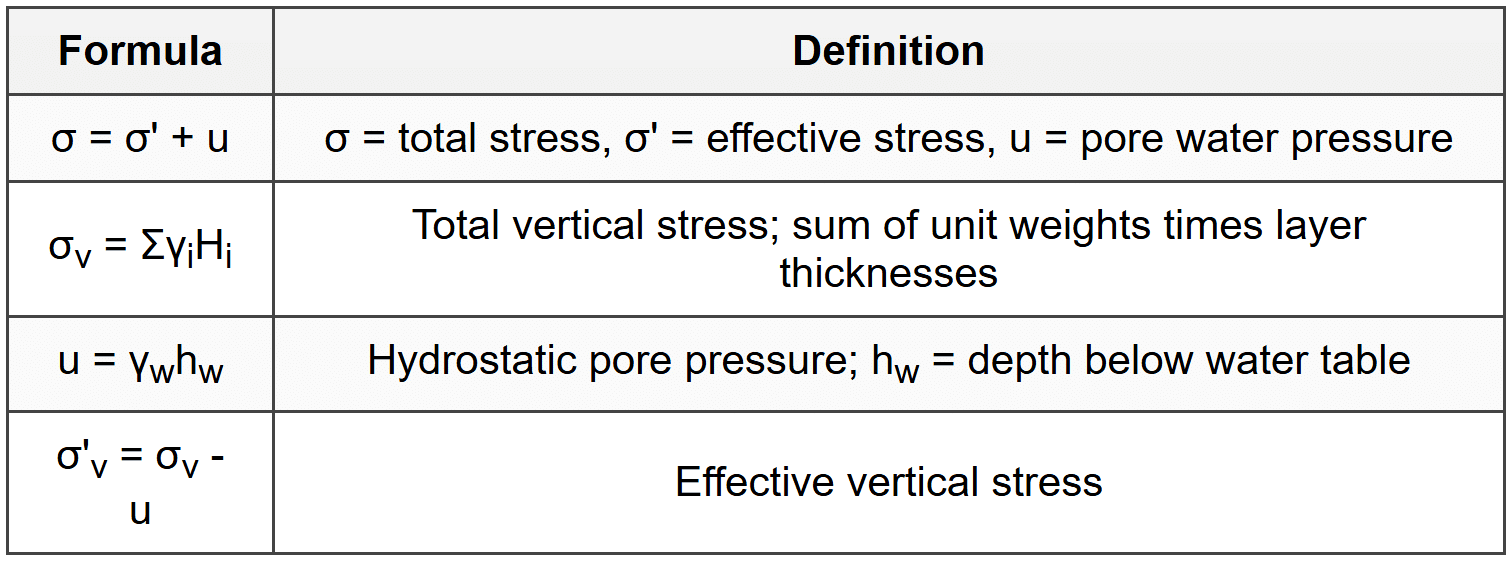
3.1 Effective Stress Principle
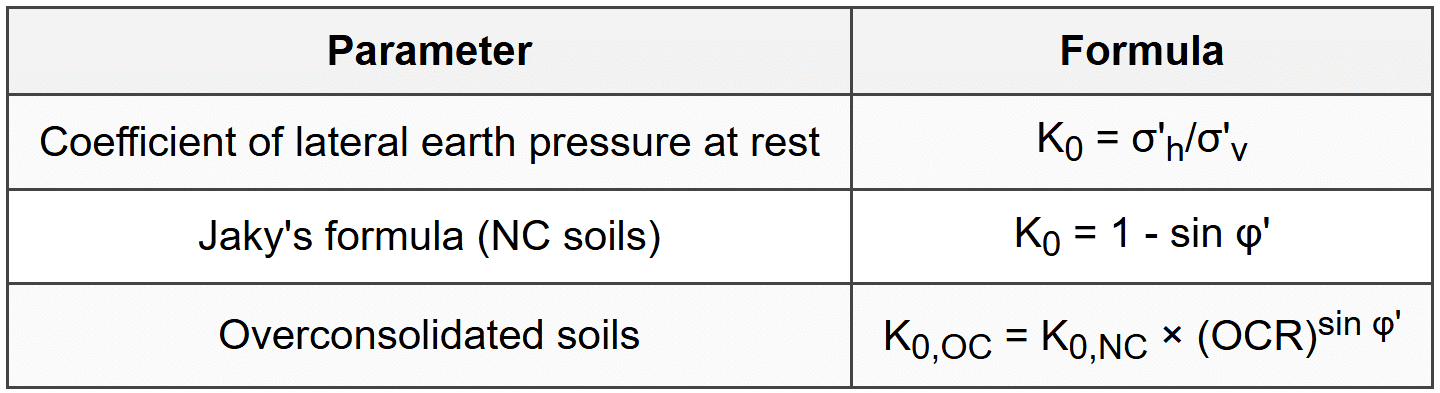
3.2 At-Rest Earth Pressure
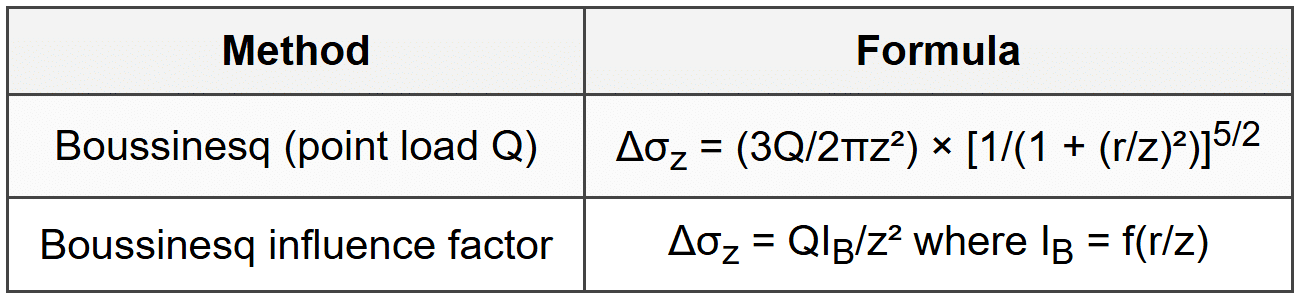
3.3 Vertical Stress Increase - Point Load
3.4 Vertical Stress Increase - Distributed Loads
3.4.1 Circular Area (radius R, uniform load q)
- Below center: Δσz = q[1 - 1/(1 + (R/z)²)3/2]
3.4.2 Rectangular Area (Newmark Chart Method)
- Use influence value I for rectangular area with dimensions m = B/z and n = L/z
- Δσz = qI where I = f(m, n) from charts or equations
- For corner of rectangle: I = (1/4π)[2mn√(m²+n²+1)/(m²+n²+m²n²+1) × (m²+n²+1)/(m²+n²+1-m²n²) + tan⁻¹(2mn√(m²+n²+1)/(m²+n²+1-m²n²))]
3.4.3 2:1 Method (Approximate)
- Δσz = qBL/[(B + z)(L + z)] at depth z below uniformly loaded rectangular area B × L
- Assumes load spreads at 2V:1H slope
3.5 Westergaard Solution
- For stratified soils with alternating stiff and soft layers (kh >> kv)
- Δσz = Q/z² × 1/[π(1 + 2(r/z)²)3/2] for point load
- Gives lower stress values than Boussinesq
4. Consolidation and Settlement
4.1 Compressibility Parameters
4.1.1 Empirical Correlations for Cc
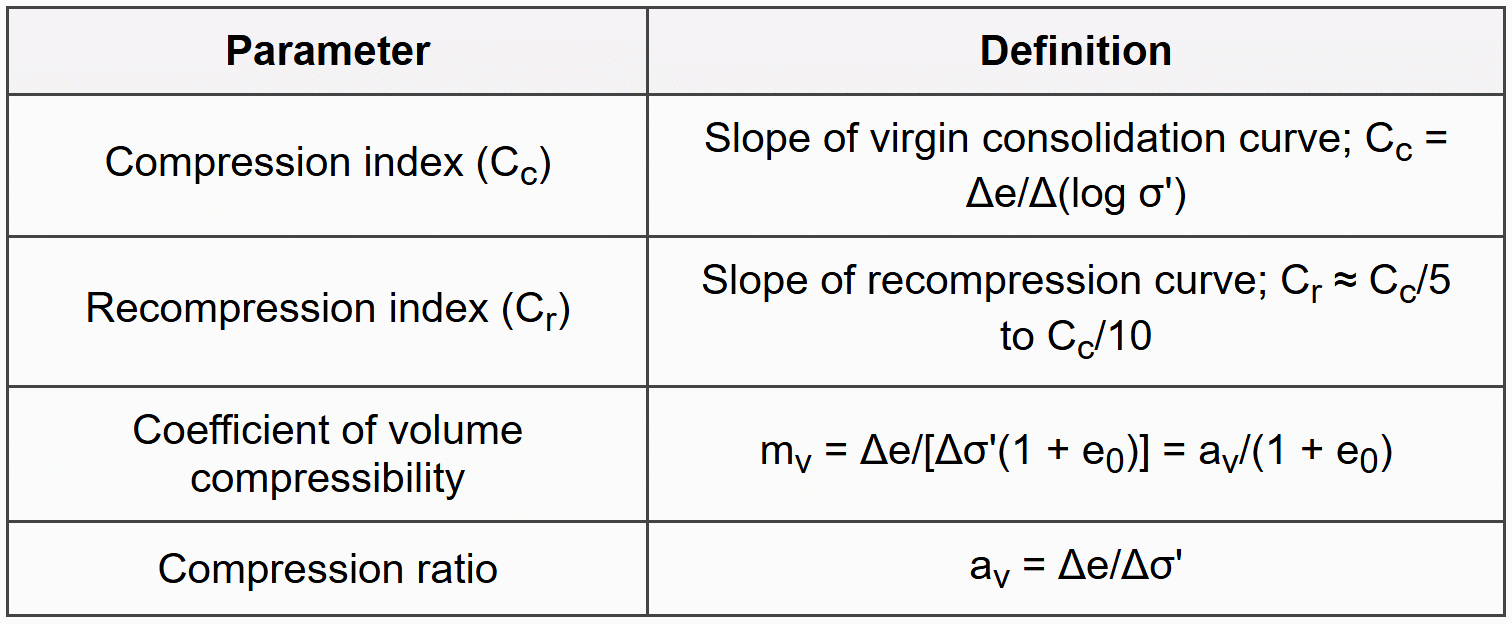
- Cc ≈ 0.009(LL - 10) for remolded clays
- Cc ≈ 0.007(LL - 7) for undisturbed clays
- Cc ≈ 0.30(e0 - 0.27) for NC clays
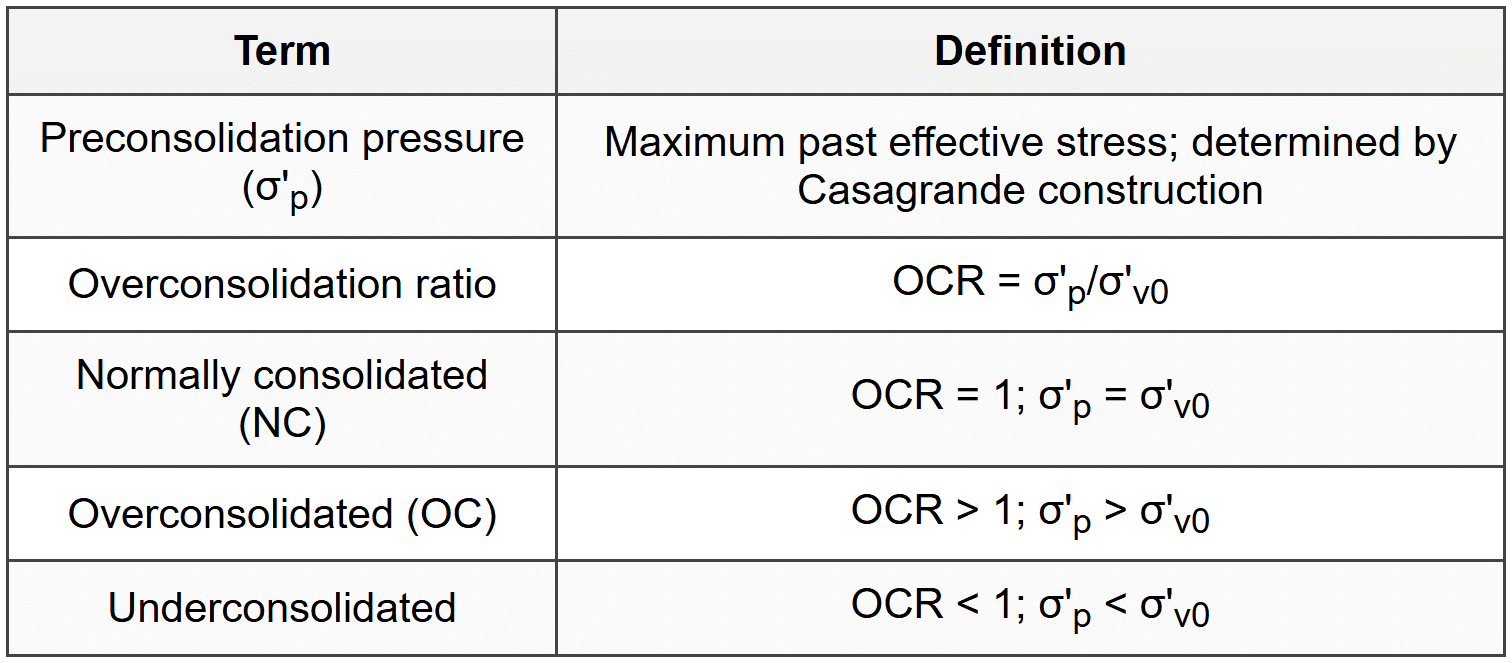
4.2 Preconsolidation Pressure
4.3 Settlement Calculation
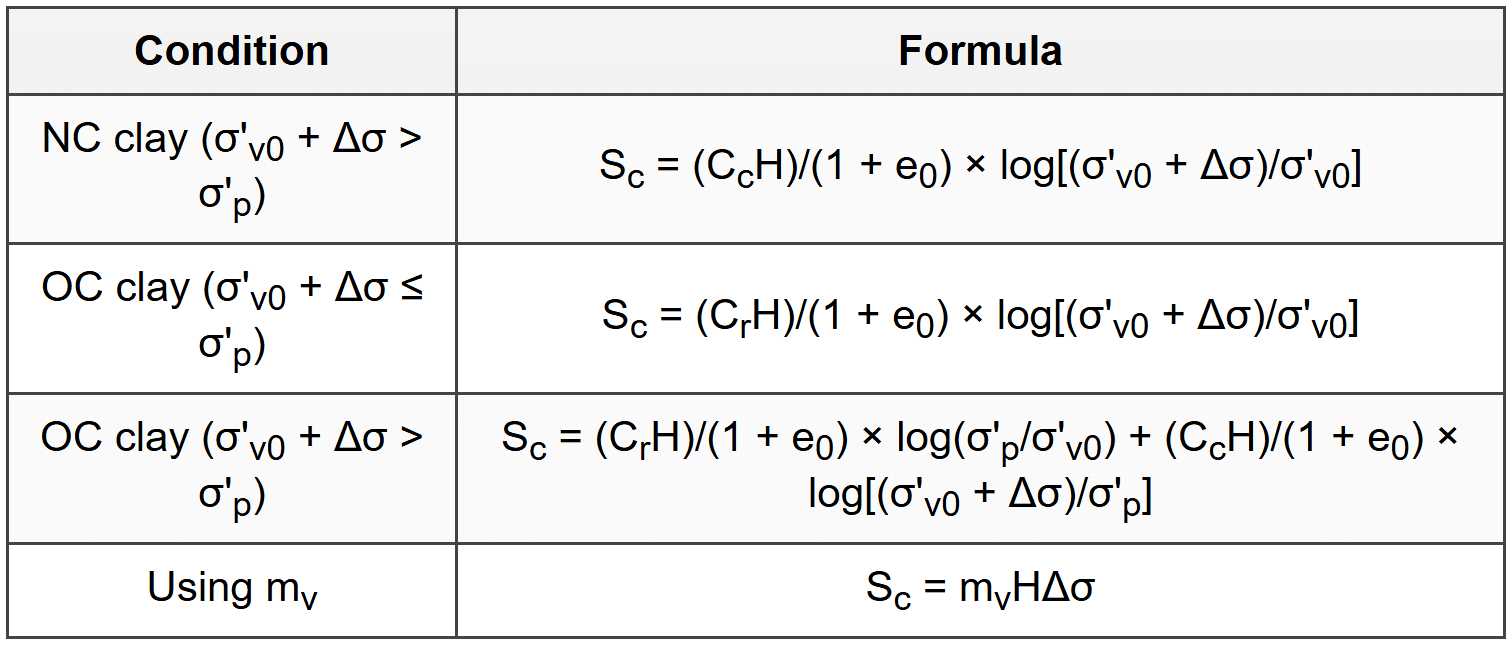
4.3.1 Primary Consolidation Settlement
4.3.2 Secondary Compression Settlement
- Ss = CαH log(t/tp) where Cα = secondary compression index, tp = time at end of primary consolidation
- Cα ≈ 0.02Cc to 0.06Cc for inorganic clays
- Cα/Cc ≈ 0.04 ± 0.01 for inorganic clays and silts
4.3.3 Immediate (Elastic) Settlement
- Se = qBIsIf(1 - μ²)/Es
- Is = shape factor; If = embedment factor; μ = Poisson's ratio; Es = elastic modulus
- For flexible circular area: Is = 1 at center, 0.64 at edge, 0.85 average
- For rigid circular area: Is = 0.79 (uniform settlement)
4.4 Rate of Consolidation
4.4.1 Time Factor Relationships
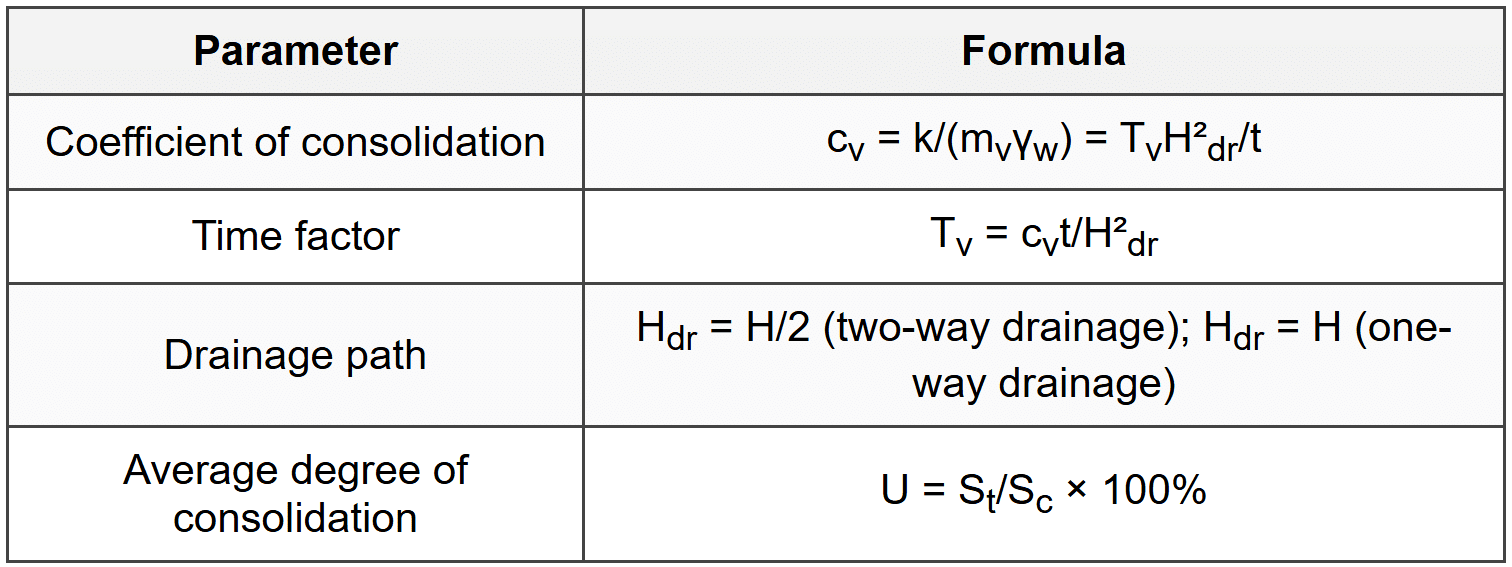
- U < 60%: Tv = (π/4)(U/100)²
- U > 60%: Tv = 1.781 - 0.933 log(100 - U)
- U = 50%: Tv = 0.197
- U = 90%: Tv = 0.848
4.4.2 Determining cv from Lab Test
- Log-time method: cv = 0.197H²dr/t50
- Square root time method: cv = 0.848H²dr/t90
5. Shear Strength
5.1 Mohr-Coulomb Failure Criterion
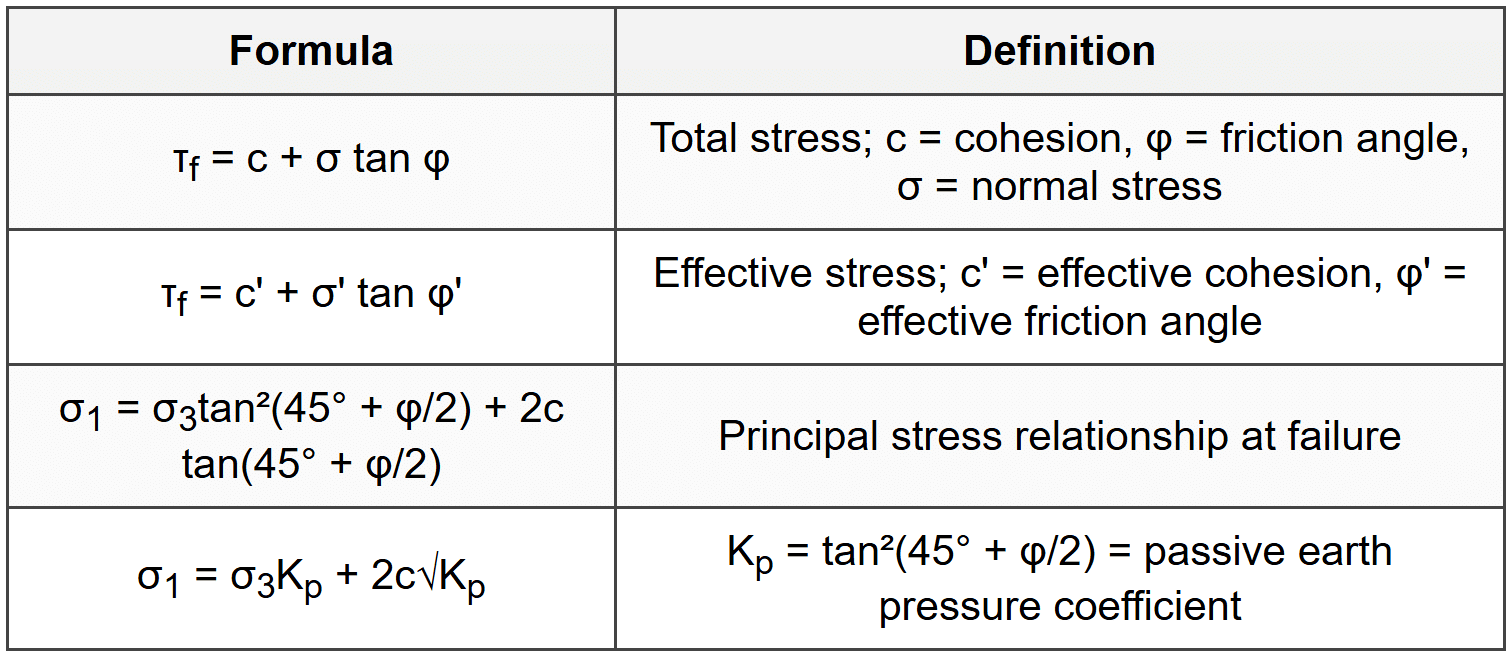
5.2 Mohr Circle Relationships
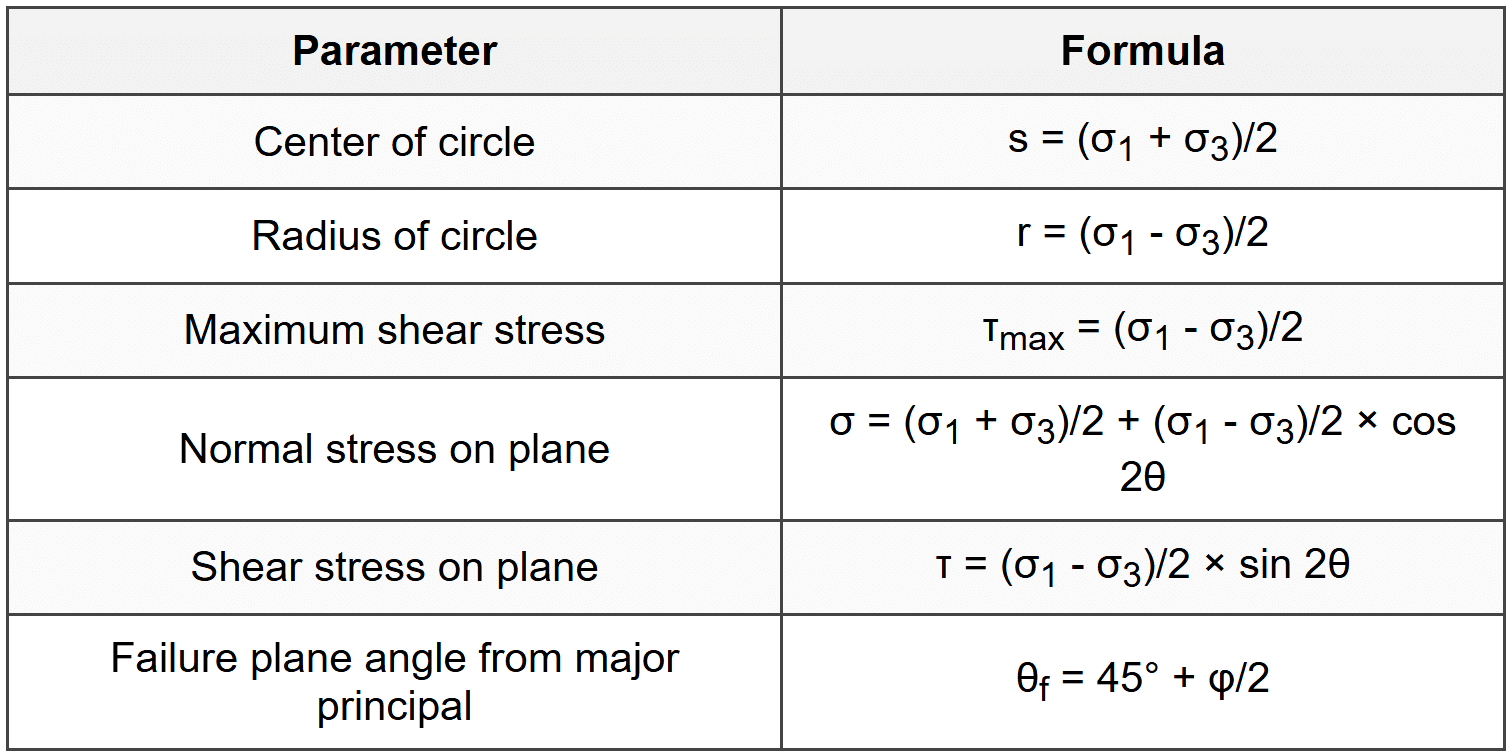
5.3 Laboratory Shear Tests
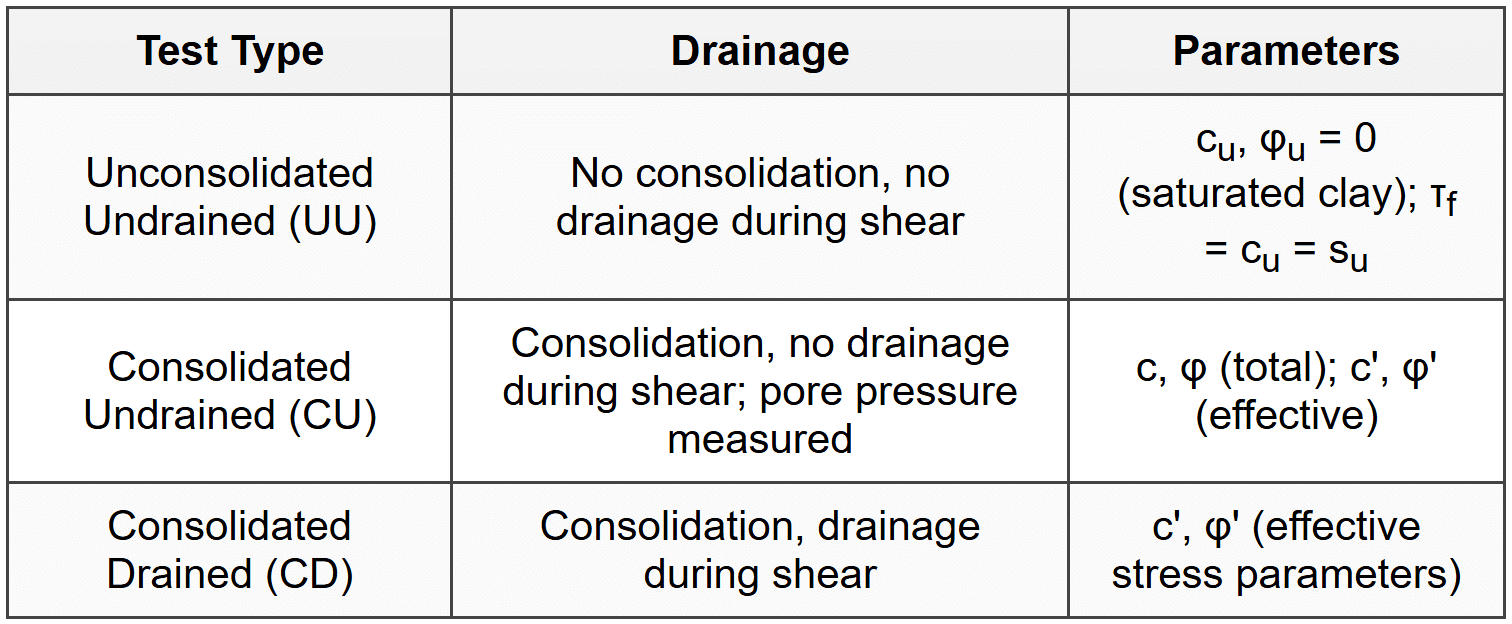
5.4 Undrained Shear Strength
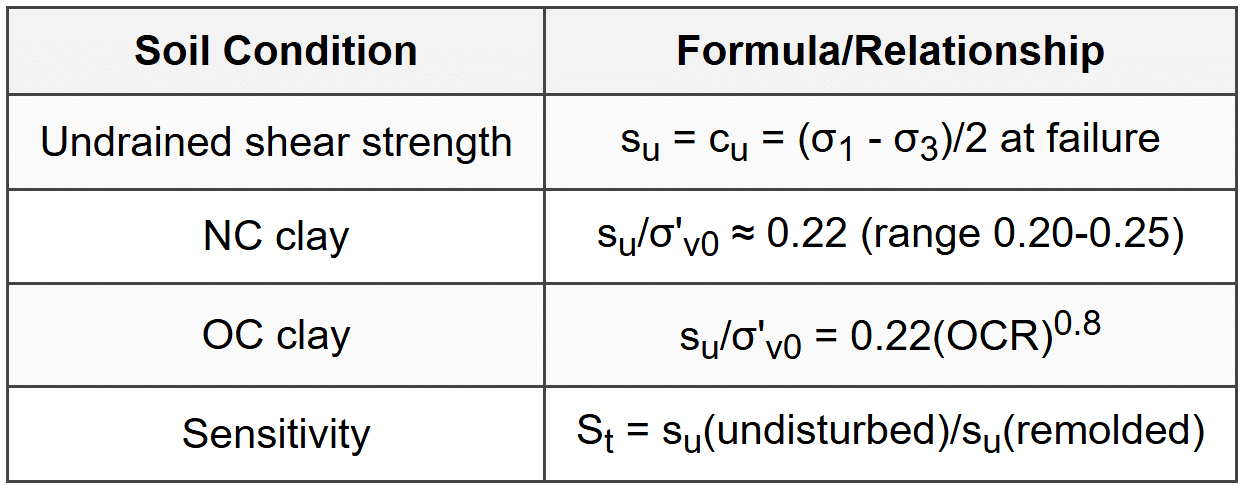
5.4.1 Sensitivity Classification
- St = 1: Insensitive; St = 2-4: Low sensitivity; St = 4-8: Medium; St = 8-16: Sensitive; St > 16: Extra sensitive (quick clay)
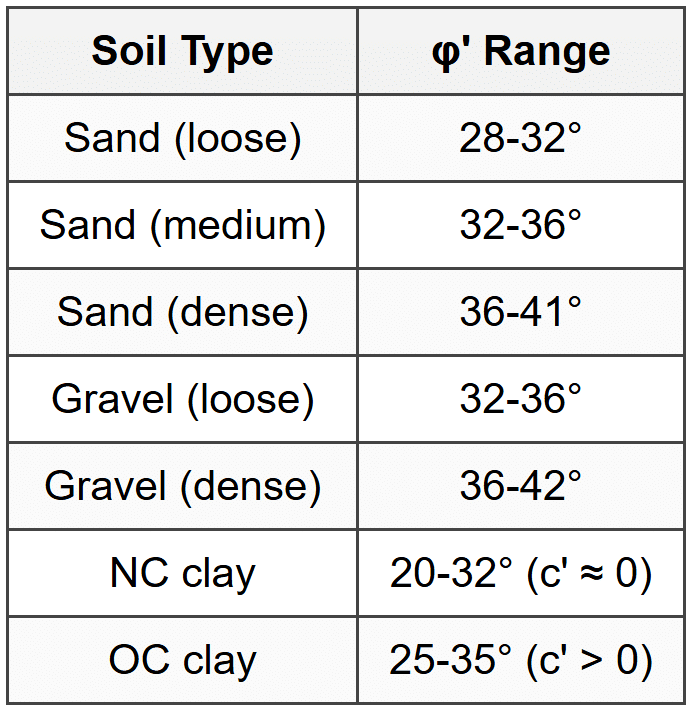
5.5 Drained Shear Strength
5.6 Correlations with SPT and CPT
5.6.1 SPT Correlations
- Granular soils: φ' ≈ 28° + 15(N60)^0.5 - 15 (Schmertmann)
- φ' ≈ 27.1 + 0.3N60 - 0.00054(N60)² (Peck, Hanson, Thornburn)
- Clays: su (kPa) ≈ 6N60 (rough estimate)
5.6.2 CPT Correlations
- Clays: su = (qc - σv)/Nk where Nk ≈ 10-20
- Sands: friction angle from charts using normalized cone resistance Qtn
5.7 Stress Path
- p = (σ1 + σ3)/2; q = (σ1 - σ3)/2
- p' = (σ'1 + σ'3)/2; q = (σ'1 - σ'3)/2
- Total stress path (TSP): plot of (p, q) points
- Effective stress path (ESP): plot of (p', q) points
- Failure envelope in p-q space: q = p tan α + d where α = sin⁻¹(sin φ/(1 + sin φ))
6. Lateral Earth Pressure
6.1 Rankine Theory
6.1.1 Active Pressure
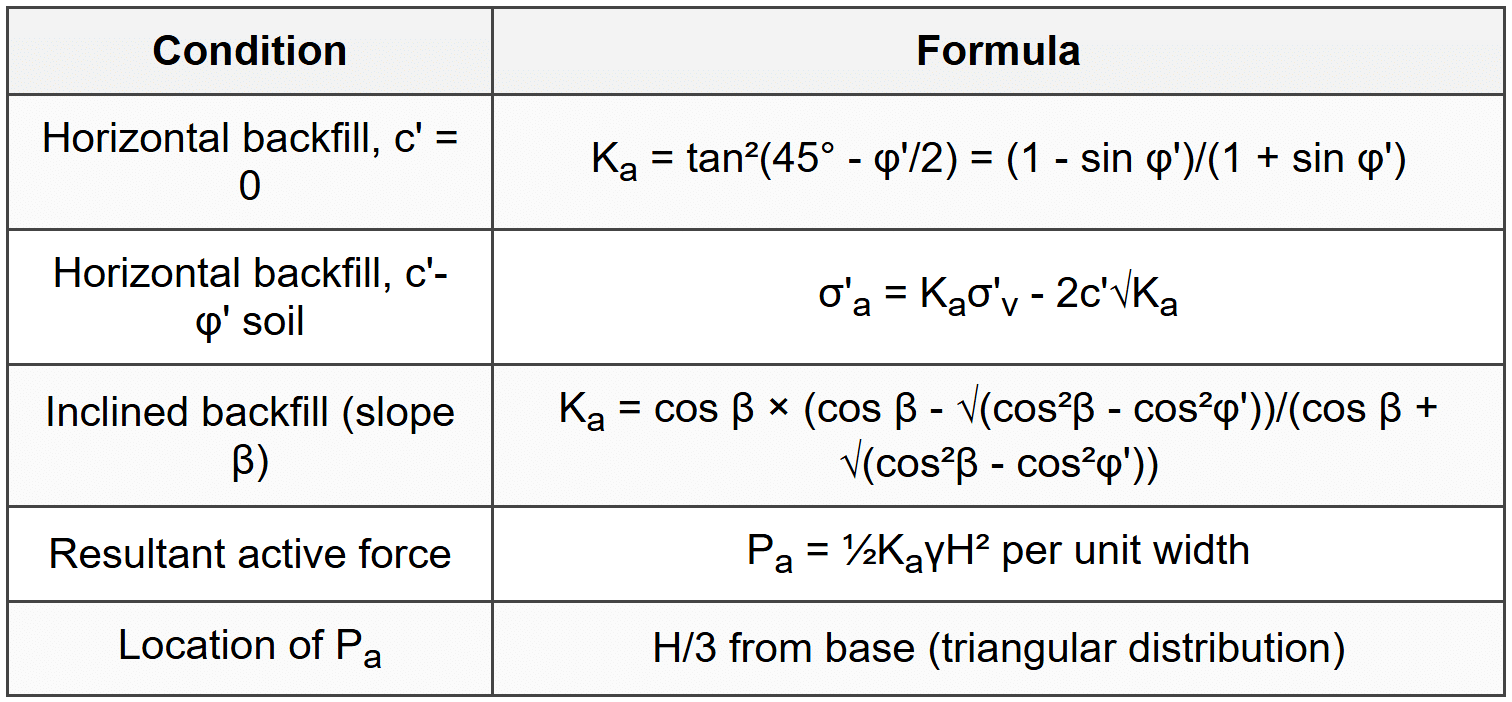
6.1.2 Passive Pressure
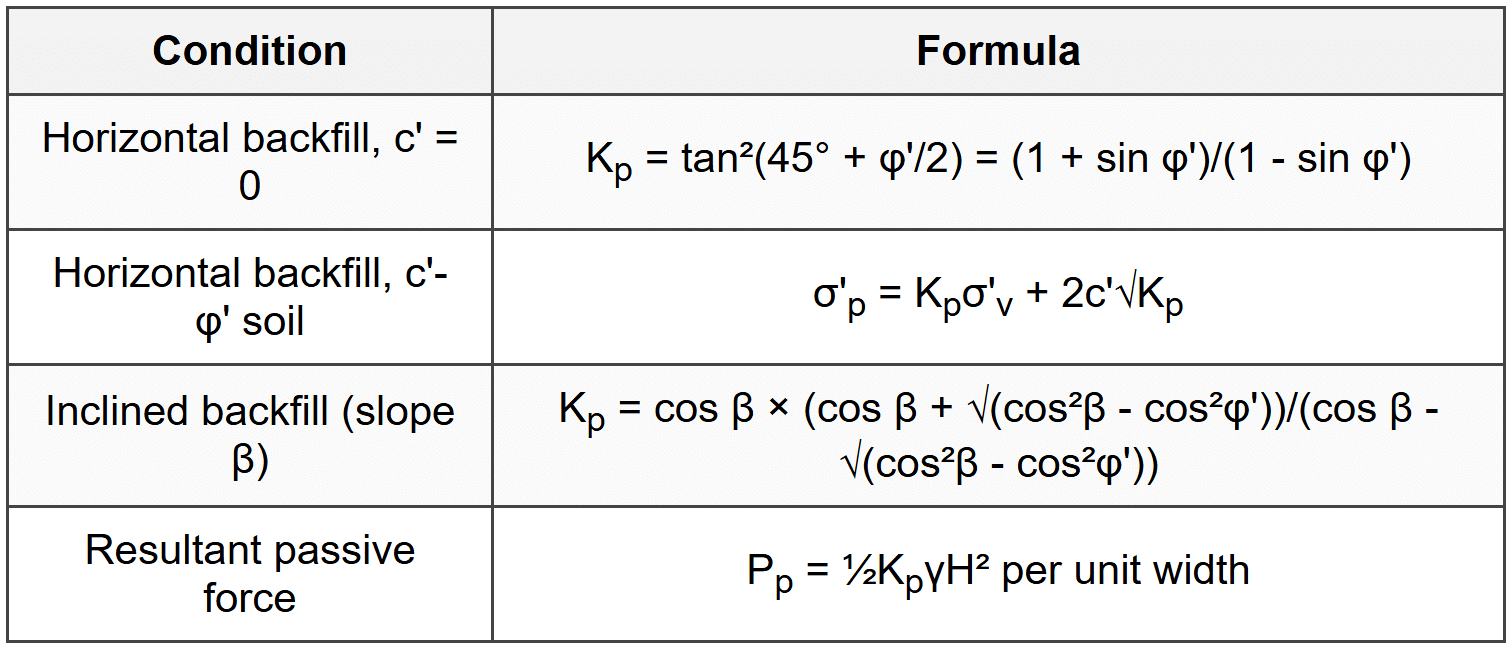
6.2 Coulomb Theory

- α = wall angle from horizontal; β = backfill slope; δ = wall friction angle; φ' = soil friction
- For vertical wall (α = 90°), horizontal backfill (β = 0), δ = 0: reduces to Rankine
- Wall friction: δ ≈ 0.5φ' to 0.67φ' for concrete on gravel; δ ≈ 0.67φ' to φ' for rough surfaces
- Passive Kp: similar equation with reversed signs in square root term
6.3 Earth Pressure with Surcharge
- Uniform surcharge q: Δσh = Kq (adds constant horizontal pressure)
- Point load: use Boussinesq or charts for lateral stress distribution
- Line load: σh = 2qK/π × [x²/(x² + z²)] where x = horizontal distance, z = depth
6.4 Water Pressure Effects
- Total lateral pressure = effective earth pressure + pore water pressure
- σh = Ka(γsat - γw)z + γwz = Kaγ'z + γwz
- For drained backfill: use effective unit weight and add separate water pressure
- For undrained clay: use total stress analysis with φu = 0
7. Slope Stability
7.1 Infinite Slope Analysis
7.1.1 Dry or Moist Soil
- FS = tan φ'/tan β where β = slope angle
- FS = c'/(γz sin β cos β) + tan φ'/tan β for c'-φ' soil
7.1.2 Seepage Parallel to Slope
- FS = γ' tan φ'/(γsat tan β) = (γsat - γw) tan φ'/(γsat tan β)
7.1.3 Submersion
- FS = γ' tan φ'/[(γsat - γw) tan β] (cancel to tan φ'/tan β)
7.2 Ordinary Method of Slices (Fellenius)
- FS = Σ[c'L + (W cos α - uL) tan φ']/Σ(W sin α)
- W = weight of slice; α = base angle; L = arc length of slice base; u = pore pressure
- Assumes interslice forces are parallel to slice base (neglects interslice shear)
- Conservative method; underestimates FS by 5-20%
7.3 Simplified Bishop Method
- FS = Σ{[c'b + (W - ub) tan φ']/mα}/Σ(W sin α)
- mα = cos α + (sin α tan φ')/FS (iterative solution required)
- b = slice width; assumes interslice shear forces are zero
- Accurate for circular failures; within 1% of rigorous methods
7.4 φu = 0 Analysis (Undrained Clay)
- FS = Σ(cuL)/Σ(W sin α) for ordinary method
- For homogeneous slope: FS = cuNs/(γH) where Ns = stability number from charts
- Ns = f(slope angle, depth factor) from Taylor charts
- Critical circle typically passes through toe for slope ≥ 53°
7.5 Factor of Safety Interpretation
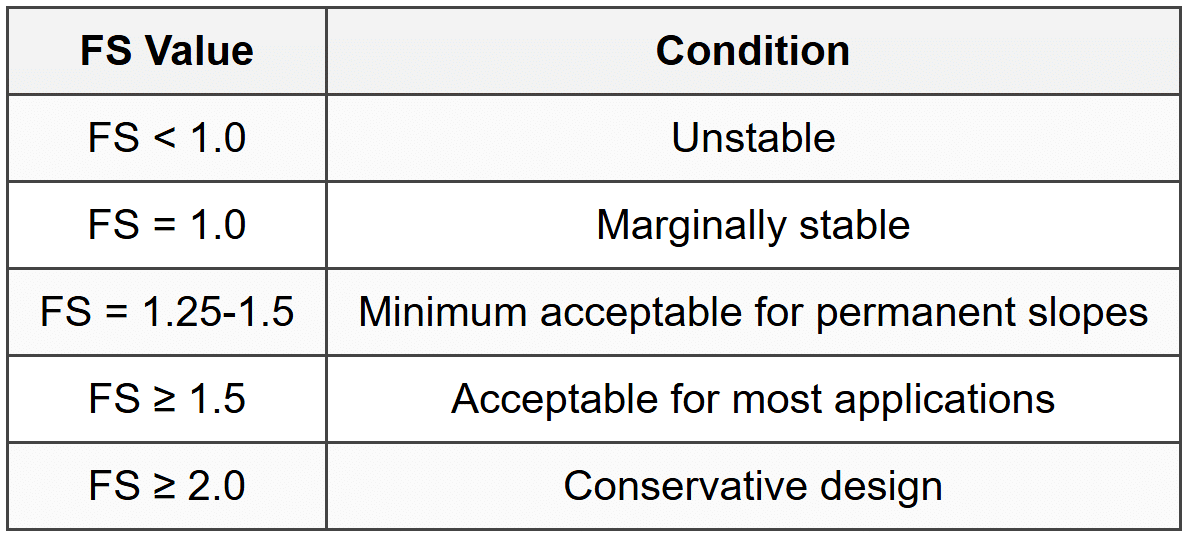
7.6 Seismic Slope Stability (Pseudostatic)
- Add horizontal force khW and vertical force kvW to each slice
- kh = horizontal seismic coefficient (0.1-0.5 for various seismic zones)
- kv = vertical seismic coefficient (often 0 or kh/2)
- Modified FS equation: add ±khW and ±kvW terms to force summation
8. Site Characterization
8.1 Standard Penetration Test (SPT)
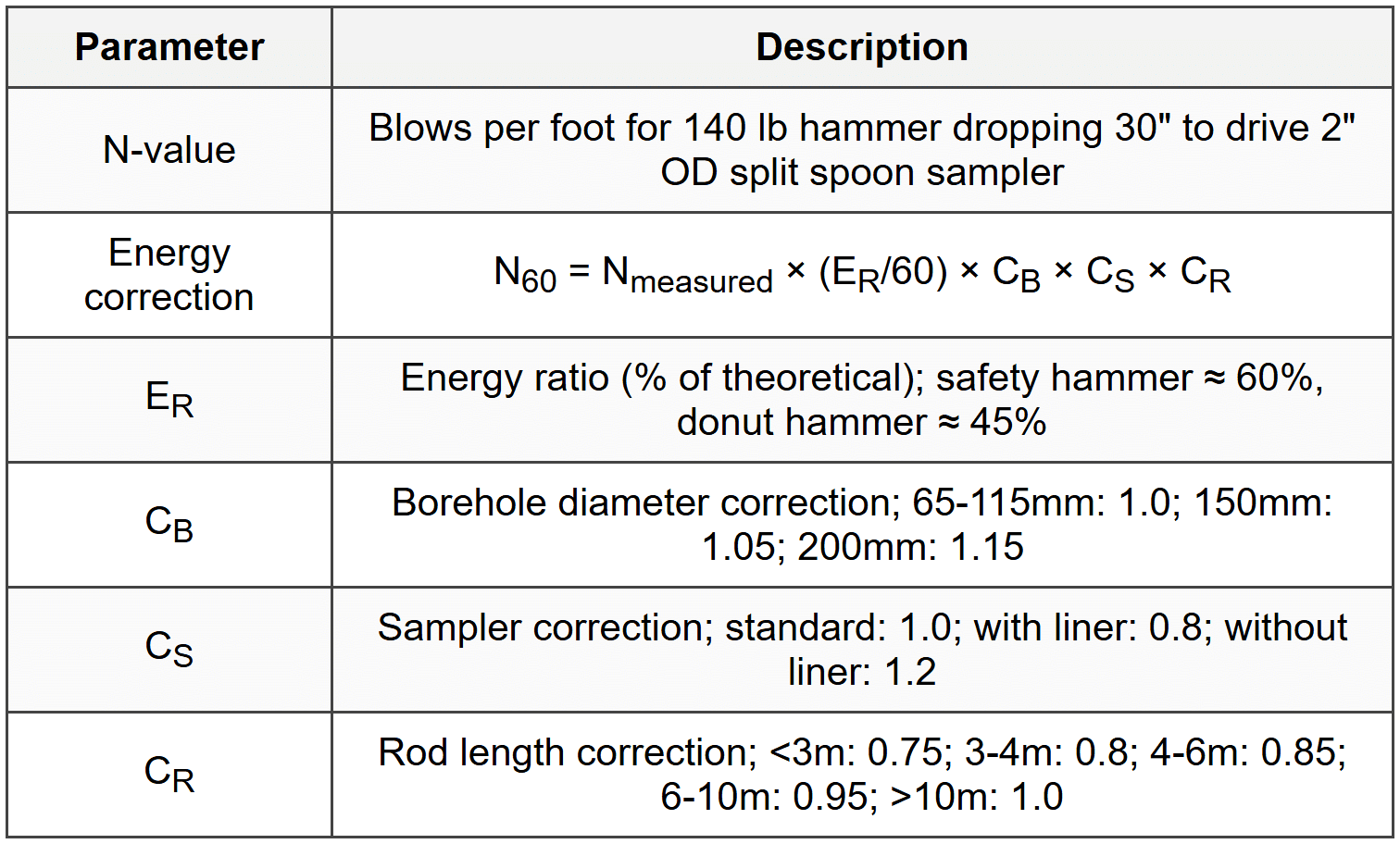
8.1.1 Overburden Correction for Sands
- (N1)60 = N60 × CN where CN = overburden correction factor
- CN = (Pa/σ'v)0.5 (Liao and Whitman); Pa = 100 kPa or 1 tsf
- CN ≤ 2.0 (cap correction factor)
- Alternative: CN = 0.77 log(1920/σ'v) where σ'v in kPa
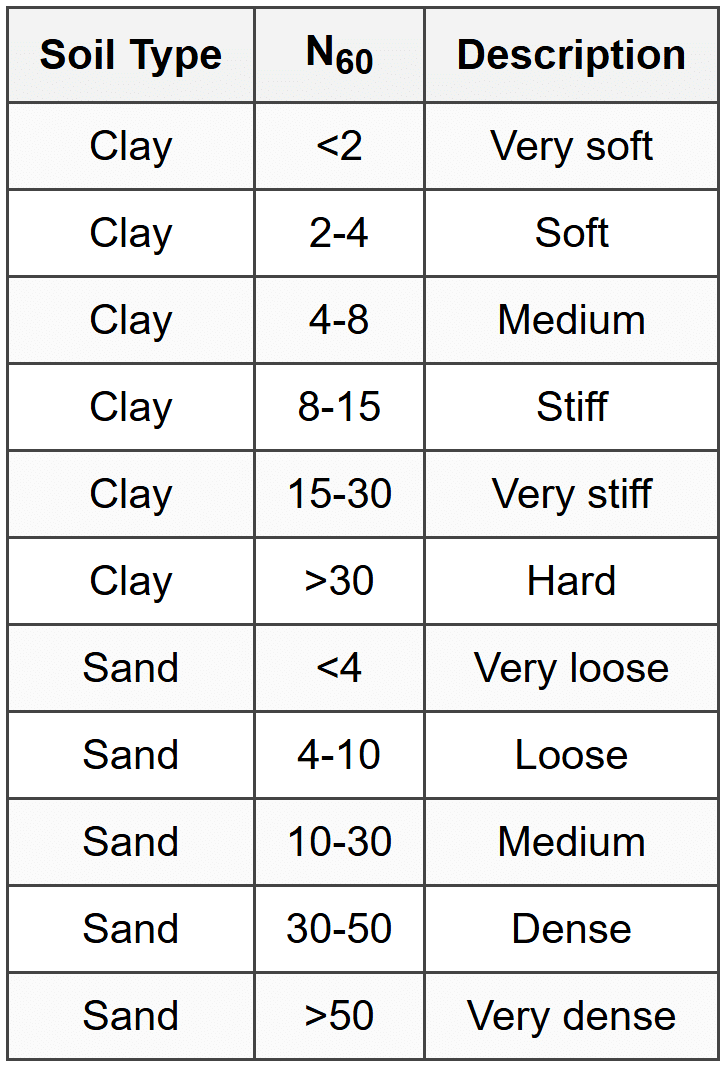
8.1.2 SPT Consistency/Density Correlations
8.2 Cone Penetration Test (CPT)
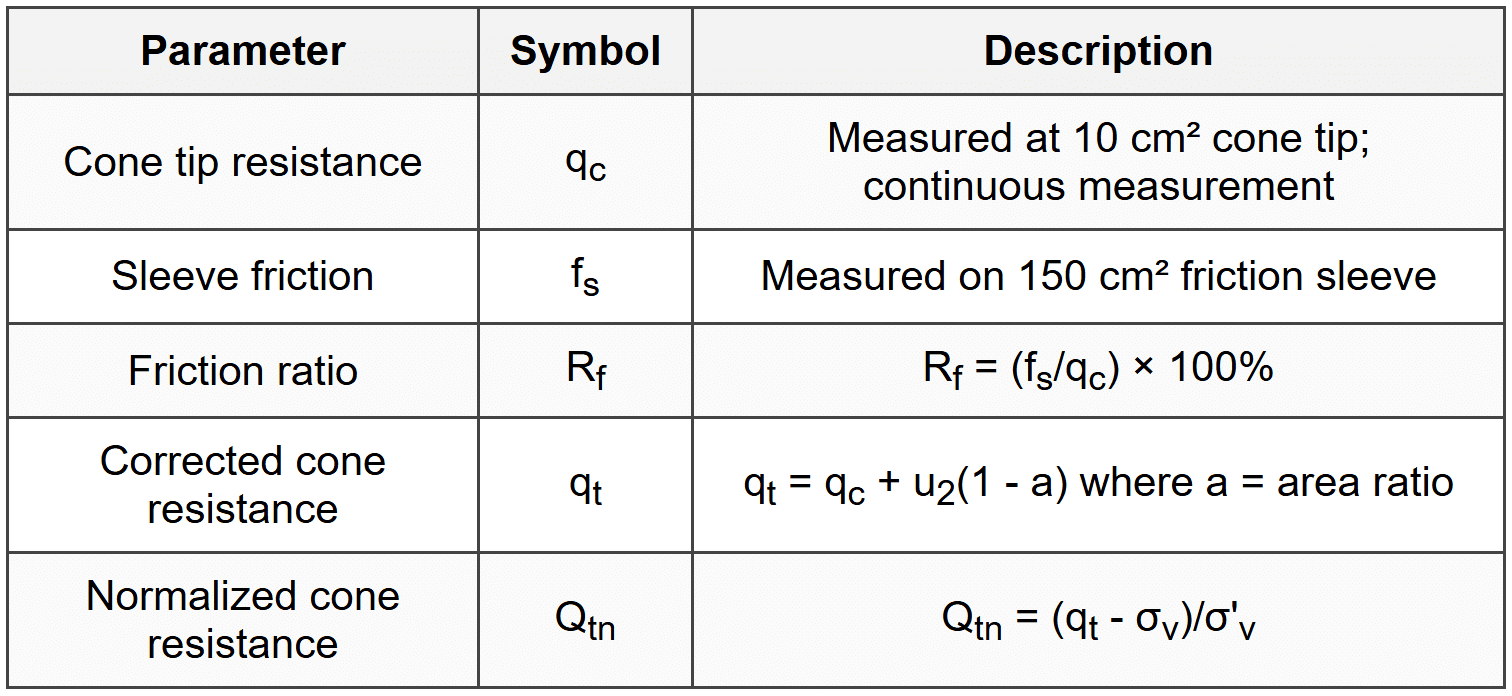
8.2.1 Soil Behavior Type from CPT
- Rf < 1%: Gravelly sand to sand
- Rf = 1-2%: Sands, silty sand to sandy silt
- Rf = 2-4%: Clayey silt to silty clay
- Rf > 4%: Silty clay to clay
- Use Robertson soil behavior type charts (Qtn vs Fr) for detailed classification
8.3 Vane Shear Test
- In-situ measurement of undrained shear strength in soft to medium clays
- su = T/(πD²H/2 + πD³/6) where T = applied torque, D = vane diameter, H = vane height
- For H = 2D: su = T/(3.66D³)
- Correction for strain rate and anisotropy: su(corrected) = μ × su(field) where μ = 0.7-1.0
- Bjerrum correction: μ ≈ 1.7 - 0.54 log(PI) for PI > 5
8.4 Pressuremeter Test (PMT)
- Measures in-situ stress-strain behavior by expanding cylindrical probe
- Pressuremeter modulus: Ep = 2(1 + μ)(V0 + Vm)Δp/ΔV
- Limit pressure pL: pressure at cavity expansion equal to initial volume
- Useful for settlement analysis: Es ≈ Ep/α where α = rheological coefficient (2-3)
8.5 Dilatometer Test (DMT)
- Flat blade with expandable membrane; measures p0 (lift-off) and p1 (1.1 mm expansion)
- Material index: ID = (p1 - p0)/(p0 - u0)
- Horizontal stress index: KD = (p0 - u0)/σ'v0
- Dilatometer modulus: ED = 34.7(p1 - p0)
- Soil classification: ID < 0.6 clay; 0.6-1.8 silt; 1.8-3.3 sand; >3.3 gravel
9. Bearing Capacity
9.1 Terzaghi Bearing Capacity
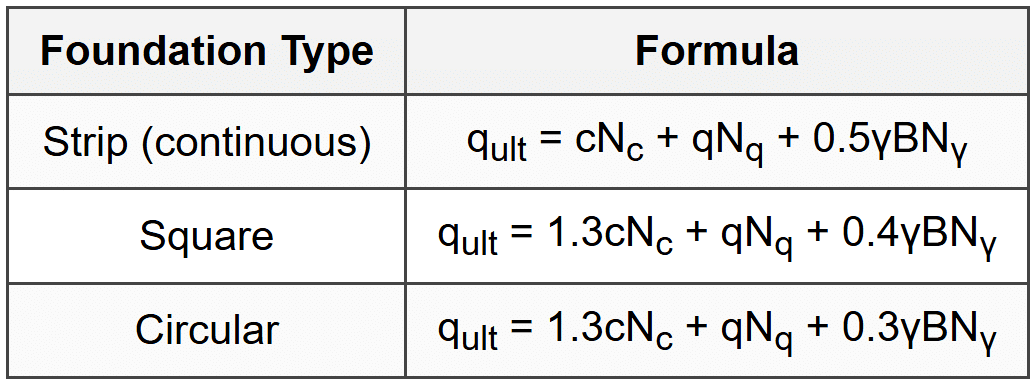
- q = effective overburden pressure at base level = γDf
- B = width (least dimension); c = cohesion; γ = unit weight of soil below base
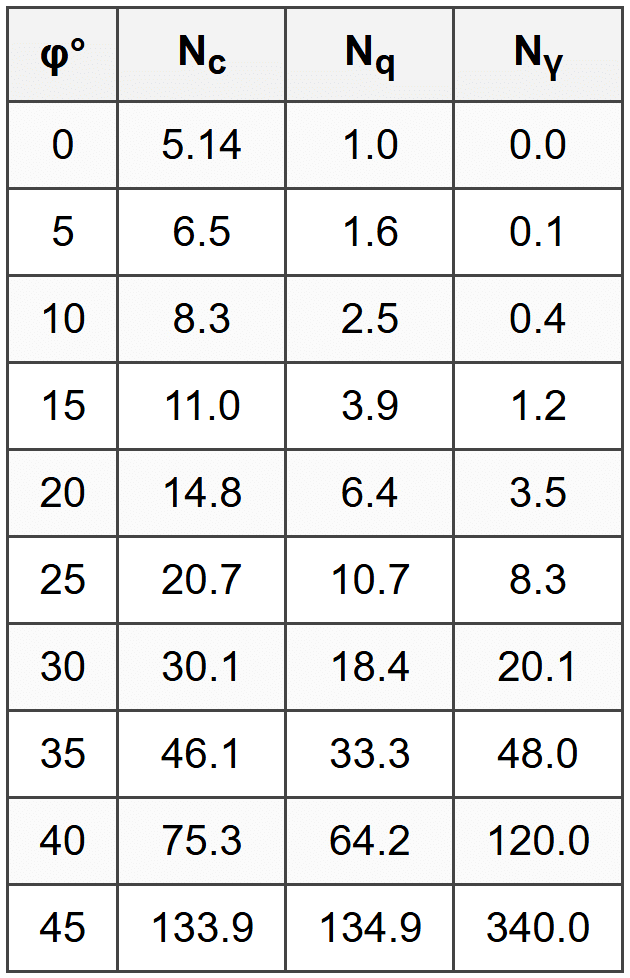
- Nc, Nq, Nγ = bearing capacity factors (functions of φ)
- For local shear failure: use c' = 2c/3, φ' = tan⁻¹(2 tan φ/3), then apply factors to N'c, N'q, N'γ
9.2 Meyerhof Bearing Capacity Factors
9.3 General Bearing Capacity Equation
- qult = cNcFcsFcdFci + qNqFqsFqdFqi + 0.5γBNγFγsFγdFγi
- Fcs, Fqs, Fγs = shape factors
- Fcd, Fqd, Fγd = depth factors
- Fci, Fqi, Fγi = inclination factors
9.3.1 Shape Factors (Vesic/Meyerhof)
- Fcs = 1 + (B/L)(Nq/Nc)
- Fqs = 1 + (B/L) tan φ
- Fγs = 1 - 0.4(B/L)
- For square: B = L, so Fcs = 1 + Nq/Nc, Fqs = 1 + tan φ, Fγs = 0.6
- For circular: use equivalent square (B = L)
9.3.2 Depth Factors (Hansen)
- Fcd = 1 + 0.4(Df/B) for Df/B ≤ 1
- Fqd = 1 + 2 tan φ(1 - sin φ)²(Df/B) for Df/B ≤ 1
- Fγd = 1.0
9.4 Bearing Capacity for Shallow Foundations on Clay
- Undrained condition (φu = 0): qult = cuNcFcsFcd + q
- For strip: qult = 5.14cu + q
- For square/circular: qult = 6.17cu + q (using Fcs ≈ 1.2)
- Skempton's formula for Df/B ≤ 2.5: qult = cuNc + q where Nc = 5(1 + 0.2Df/B)(1 + 0.2B/L)
9.5 Allowable Bearing Capacity
- qall = qult/FS where FS = 2.5-3.0 for normal conditions
- qnet,ult = qult - q (net ultimate bearing capacity)
- qnet,all = qnet,ult/FS
- Check both bearing capacity failure and settlement criteria
9.6 Bearing Capacity from SPT and CPT
9.6.1 SPT Correlations
- Meyerhof (cohesionless): qall (kPa) = 12N60(B + 0.3)²/B² × (Df/B + 0.33) for 25 mm settlement
- Terzaghi-Peck: qall (ksf) = N/4 for B ≤ 4 ft
9.6.2 CPT Correlations
- Schmertmann: qall = (qc - σv)/Fd where Fd = depth factor ≈ 2.5
- Direct method: qult ≈ qc/20 to qc/30 for shallow foundations
10. Deep Foundations
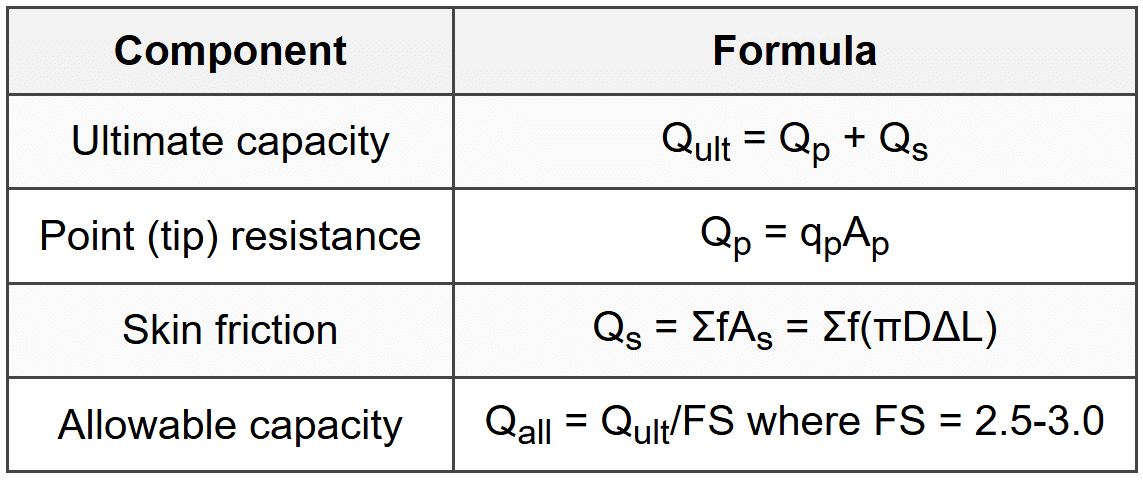
10.1 Single Pile Capacity
10.2 Pile Capacity in Sand (Effective Stress Method)
10.2.1 Point Resistance
- qp = σ'vNq where σ'v = effective stress at pile tip
- Nq from charts (Berezantsev, Meyerhof, Vesic); Nq ≈ 12-80 for φ = 30-40°
- Limit qp to 50Nq (in bar) to 100Nq for dense sand
- For driven piles: qp ≤ 200-400 bar (20-40 MPa)
10.2.2 Skin Friction
- f = βσ'v (β-method) where β = K tan δ
- K = coefficient of lateral earth pressure ≈ K0 to 2K0 for driven piles; 0.7K0 for drilled shafts
- δ = pile-soil friction angle ≈ 0.5φ to φ (steel); 0.7φ to φ (concrete); φ (timber)
- β ≈ 0.15-0.35 for loose sand; 0.25-0.50 for dense sand
- Alternative: f = Kσ'v tan φ where K decreases with depth
10.3 Pile Capacity in Clay (Total Stress Method)
10.3.1 Point Resistance
- qp = cuNc where Nc = 9 (deep foundation)
- Use cu at pile tip depth
10.3.2 Skin Friction (α-Method)
- f = αcu where α = adhesion factor (0 to 1)
- α ≈ 1.0 for cu < 25 kPa
- α ≈ 0.5 for cu = 50-100 kPa
- α ≈ 0.3-0.4 for cu > 100 kPa
- Tomlinson: α = 0.45 for driven piles in NC clay
- For cu > 70 kPa: α = 0.9/(cu/Pa)0.5 where Pa = 100 kPa
10.4 λ-Method (Effective Stress for Clay)
- f = λ(σ'v + 2cu)
- λ = 0.15-0.35 depending on OCR and depth
- Accounts for both effective stress and cohesion
10.5 Pile Capacity from SPT
10.5.1 Meyerhof Method
- Cohesionless: qp (kPa) = 40N60L/D ≤ 400N60 where L = embedded length, D = diameter
- f (kPa) = 2N60 (limit to 100 kPa)
- Cohesive: qp (kPa) = 40N60 (limit to 400N60); f (kPa) = N60
10.6 Pile Capacity from CPT
- Direct method: qp = qc (average qc near pile tip)
- f = qc/Fs where Fs = 50-200 (sand); 50-150 (clay)
- Schmertmann: average qc over 8D below to 3D above pile tip for qp
- LCPC method: uses detailed charts with soil type classification
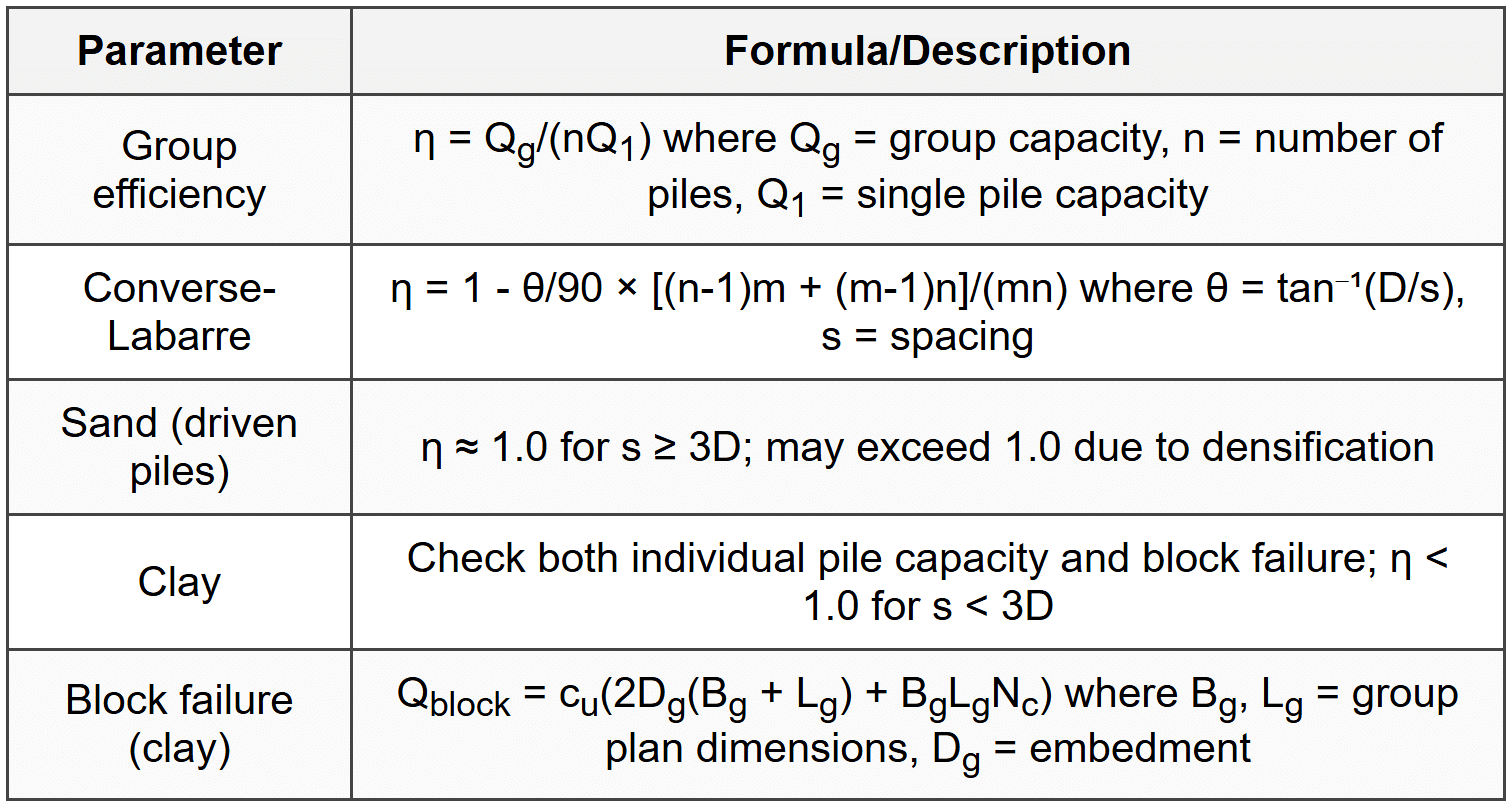
10.7 Pile Group Capacity
10.8 Negative Skin Friction (Downdrag)
- Occurs when soil settles relative to pile (consolidating fill, lowered water table)
- Qn = ΣfnAs over downdrag zone
- fn = Kσ'v tan δ (sand); fn = αcu (clay)
- Design load = Qapplied + Qn (downdrag adds to load)
- Neutral plane at depth where pile and soil movement are equal
10.9 Pile Settlement
- Elastic compression: s = (QpL)/(ApEp) + (QsL)/(2ApEp) + (QpD)/(ApEsqp)
- First term = compression of pile shaft under tip load; second term = compression under skin friction; third term = soil compression below tip
- Ep = pile elastic modulus; Es = soil modulus; D = pile width
- For group: settlement > single pile; analyze as equivalent raft foundation
10.10 Lateral Pile Capacity
- Broms method for short rigid piles (L/D < 10 typically)
- P-y curve method for flexible piles (computer analysis required)
- Ultimate lateral resistance (clay): pu = 9cuD (deep); pu = 3cuD(1 + γ'z/cu) (shallow)
- Ultimate lateral resistance (sand): pu = 3Kpγ'z D (deep)
The document Cheatsheet: Soil Mechanics is a part of the PE Exam Course Civil Engineering (PE Civil).
All you need of PE Exam at this link: PE Exam
About this Document

Apr 20, 2026 Last updated
Related Exams
Document Description: Cheatsheet: Soil Mechanics for PE Exam 2026 is part of Civil Engineering (PE Civil) preparation. The notes and questions for Cheatsheet: Soil Mechanics have been prepared according to the PE Exam exam syllabus. Information about Cheatsheet: Soil Mechanics covers topics like and Cheatsheet: Soil Mechanics Example, for PE Exam 2026 Exam. Find important definitions, questions, notes, meanings, examples, exercises and tests below for Cheatsheet: Soil Mechanics.
Introduction of Cheatsheet: Soil Mechanics in English is available as part of our Civil Engineering (PE Civil) for PE Exam & Cheatsheet: Soil Mechanics in Hindi for Civil Engineering (PE Civil) course. Download more important topics related with notes, lectures and mock test series for PE Exam Exam by signing up for free. PE Exam: Cheatsheet: Soil Mechanics
Description
Cheatsheet: Soil Mechanics of Civil Engineering to help you remember important concepts with short tricks. Start learning for PE Exam exam & improve retention with EduRev.
Information about Cheatsheet: Soil Mechanics
In this doc you can find the meaning of Cheatsheet: Soil Mechanics defined & explained in the simplest way possible. Besides explaining types of Cheatsheet: Soil Mechanics theory, EduRev gives you an ample number of questions to practice Cheatsheet: Soil Mechanics tests, examples and also practice PE Exam tests



Related Searches
Semester Notes, pdf , past year papers, ppt, shortcuts and tricks, practice quizzes, Cheatsheet: Soil Mechanics, Cheatsheet: Soil Mechanics, Summary, Free, study material, Objective type Questions, Cheatsheet: Soil Mechanics, Extra Questions, video lectures, Viva Questions, MCQs, Previous Year Questions with Solutions, mock tests for examination, Exam, Important questions, Sample Paper;