PE Exam Exam > PE Exam Notes > Chemical Engineering for PE > Cheatsheet: Heat Transfer
Cheatsheet: Heat Transfer


1. Conduction Heat Transfer
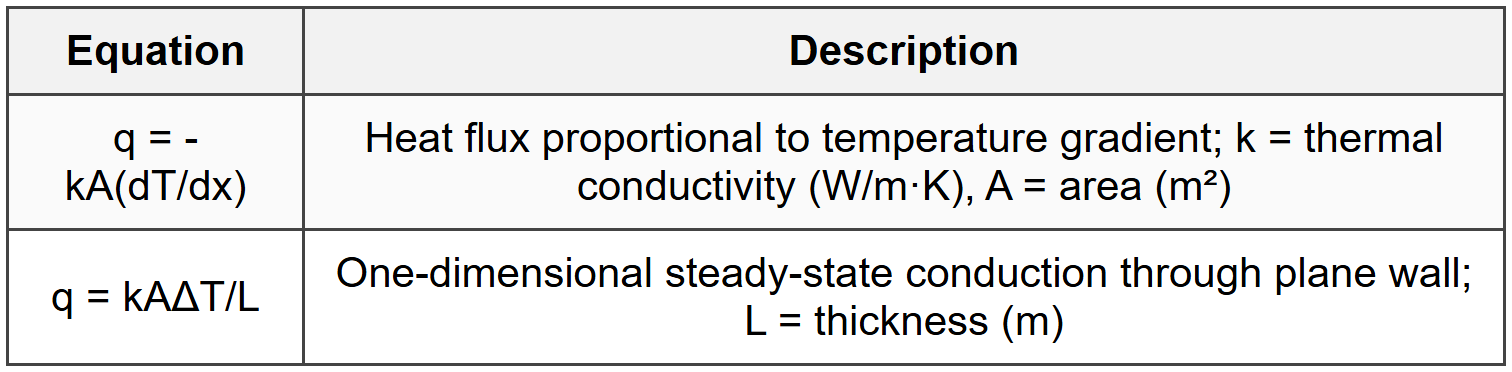
1.1 Fourier's Law
1.2 Thermal Resistance
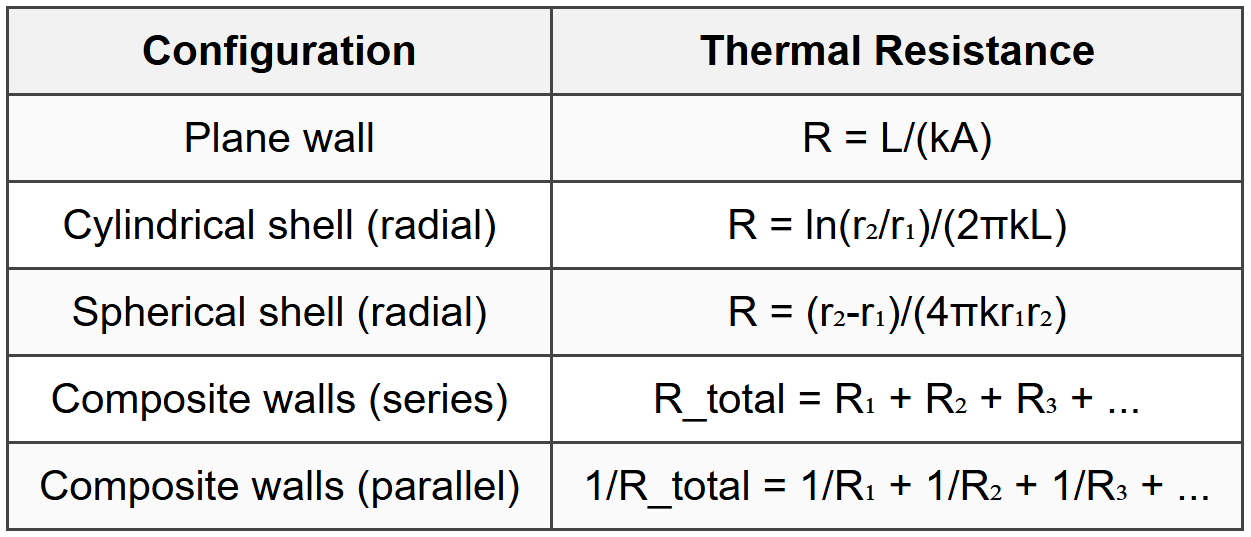
1.3 Heat Transfer Rate Through Resistances
- q = ΔT_overall/R_total
- Temperature drop across any layer: ΔT = qR
- For composite walls: q = (T₁ - T₂)/(R₁ + R₂ + R₃)
1.4 Critical Radius of Insulation

- Adding insulation increases heat transfer if outer radius < critical="">
- Maximum heat transfer occurs at r = r_c
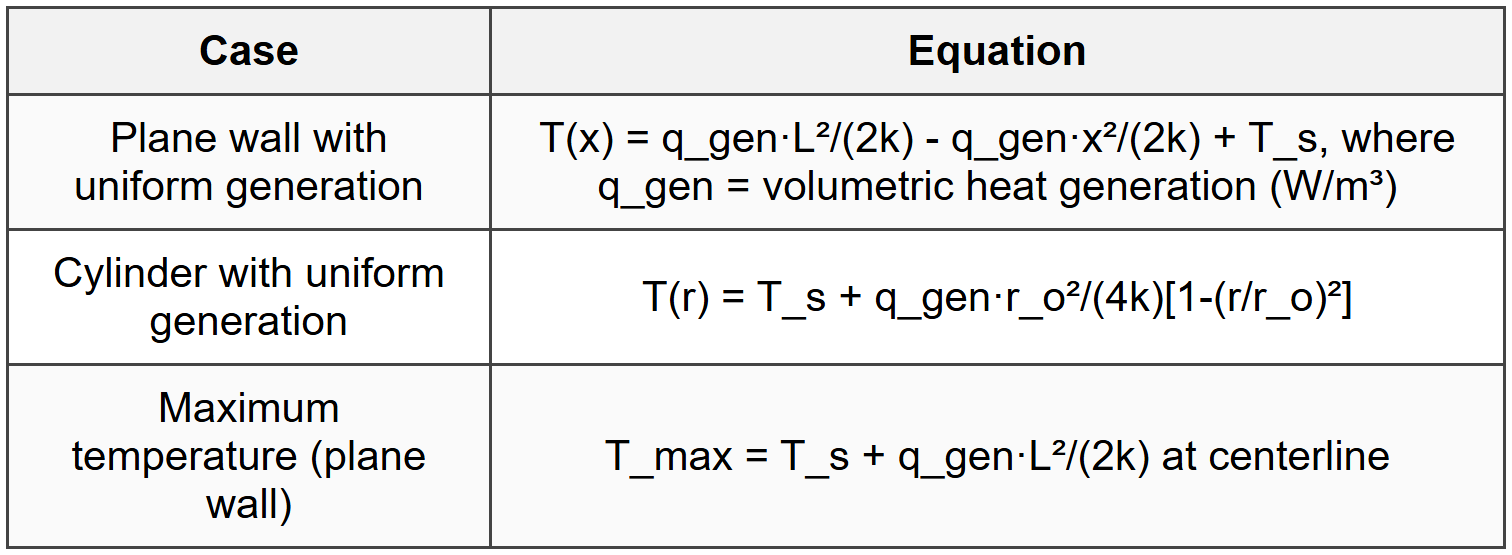
1.5 Heat Conduction with Heat Generation
1.6 Extended Surfaces (Fins)
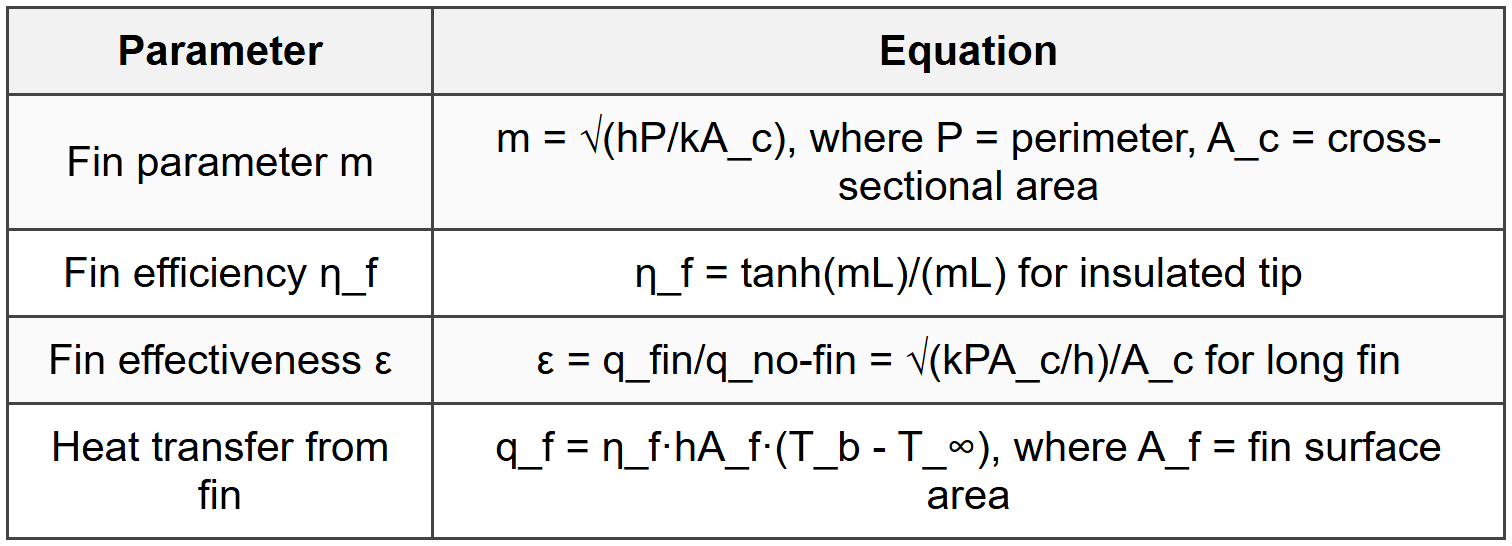
1.6.1 Fin Equations
1.6.2 Common Fin Configurations
- Rectangular fin: P = 2(w + t), A_c = wt
- Cylindrical pin fin: P = πD, A_c = πD²/4
- For very long fins (L → ∞): η_f → 1/(mL)
- Overall surface efficiency: η_o = 1 - (A_f/A_total)(1 - η_f)
2. Convection Heat Transfer
2.1 Newton's Law of Cooling

2.2 Dimensionless Numbers

2.3 Forced Convection - Internal Flow
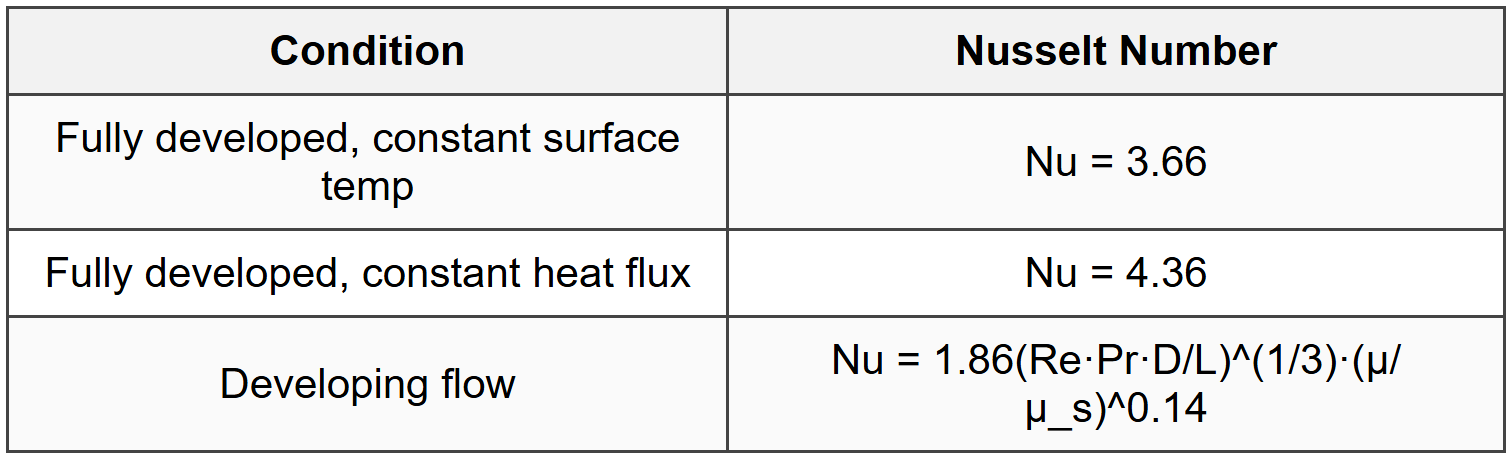
2.3.1 Laminar Flow in Circular Tubes (Re <>
2.3.2 Turbulent Flow in Circular Tubes (Re > 4000)
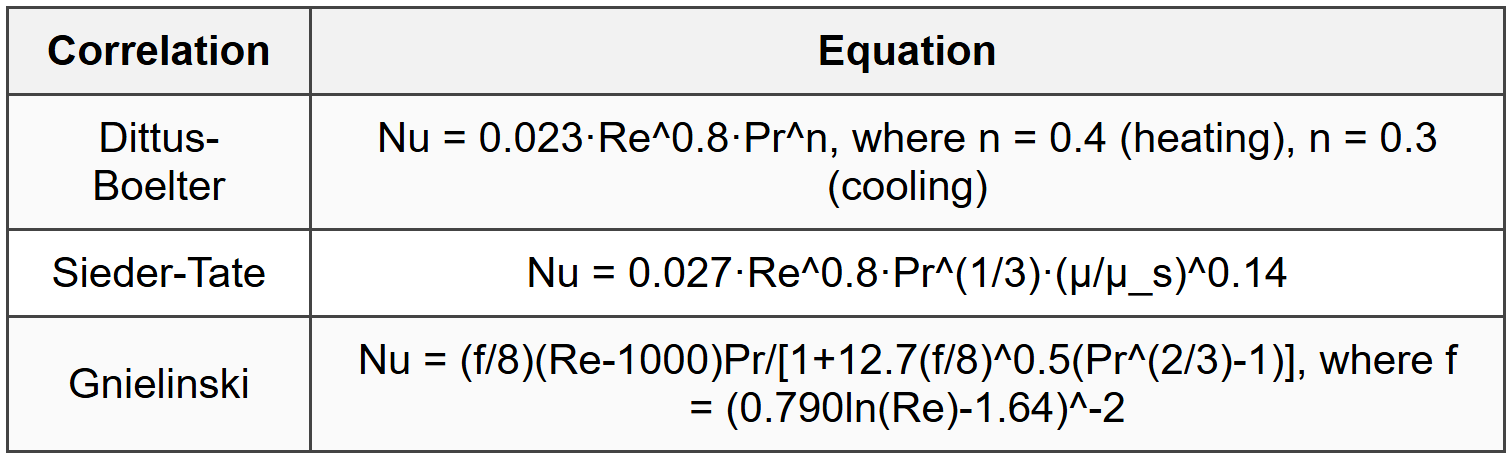
- Valid for 0.5 < pr="">< 2000="" and="" 3000="">< re=""><>
- Evaluate properties at bulk mean temperature T_m = (T_in + T_out)/2
2.4 Forced Convection - External Flow
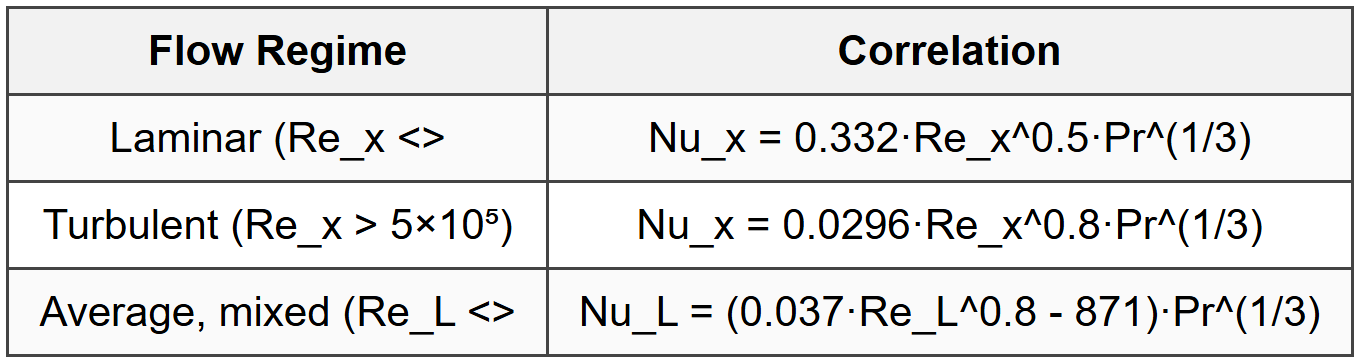
2.4.1 Flow Over Flat Plate
2.4.2 Flow Across Cylinder

2.4.3 Flow Across Sphere
- Nu = 2 + (0.4·Re^0.5 + 0.06·Re^(2/3))·Pr^0.4·(μ/μ_s)^0.25
- Valid for 3.5 < re="">< 80000,="" 0.7="">< pr=""><>
2.5 Natural Convection
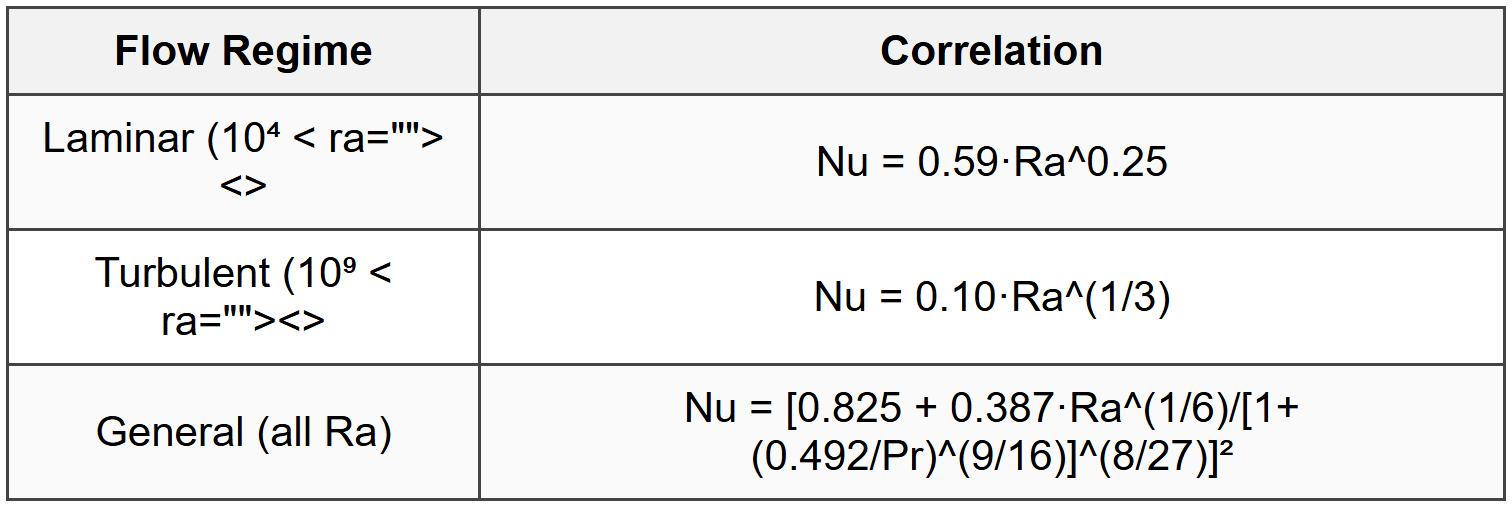
2.5.1 Vertical Plates and Cylinders
2.5.2 Horizontal Plates

2.5.3 Horizontal Cylinder
- Nu = [0.6 + 0.387·Ra^(1/6)/[1+(0.559/Pr)^(9/16)]^(8/27)]² for 10⁻⁵ < ra=""><>
2.6 Heat Exchanger Correlations
- Properties evaluated at film temperature: T_f = (T_s + T_∞)/2 for external flow
- For liquids: β ≈ 1/T_f (ideal gas approximation)
- Characteristic length L varies by geometry: plate length, cylinder diameter, etc.
3. Radiation Heat Transfer
3.1 Fundamental Laws

3.2 Surface Properties
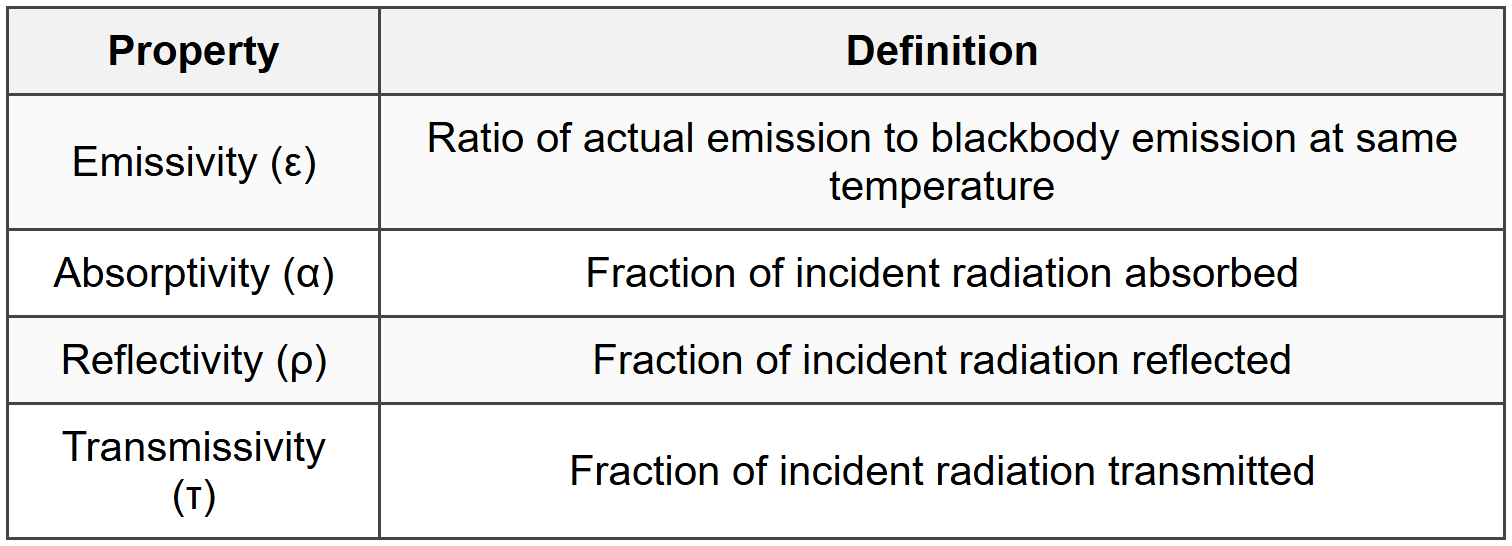
- Energy balance: α + ρ + τ = 1
- For opaque surfaces: τ = 0, so α + ρ = 1
- Kirchhoff's Law: α = ε (for surfaces at same temperature and wavelength)
- Graybody: ε and α independent of wavelength
3.3 View Factors
3.3.1 Definition and Properties
- F_ij = fraction of radiation leaving surface i that is intercepted by surface j
- Reciprocity: A_i·F_ij = A_j·F_ji
- Summation rule: Σ F_ij = 1 (for j = 1 to N)
- For flat/convex surface to itself: F_ii = 0
3.3.2 Common View Factor Relations

3.4 Radiation Exchange Between Surfaces
3.4.1 Two Black Surfaces
- q_12 = A_1·F_12·σ(T_1⁴ - T_2⁴)
3.4.2 Two Gray Diffuse Surfaces

3.5 Radiation with Convection
- Combined heat transfer: q_total = q_conv + q_rad
- q_total = hA(T_s - T_∞) + εAσ(T_s⁴ - T_surr⁴)
- Radiation heat transfer coefficient: h_r = εσ(T_s + T_surr)(T_s² + T_surr²)
- Linearized form: q_rad = h_r·A(T_s - T_surr)
3.6 Radiation Shields
- For N shields between two surfaces: q_with_shields = q_no_shields/(N+1) if all ε equal
- Single shield between infinite parallel plates: q = σ(T_1⁴ - T_2⁴)/[1/ε₁ + 1/ε₂ + 2/ε_shield - 2]
- Shields most effective when highly reflective (low ε)
4. Heat Exchangers
4.1 Heat Exchanger Types
- Parallel flow: both fluids enter same end, flow in same direction
- Counter flow: fluids enter opposite ends, flow in opposite directions
- Cross flow: fluids flow perpendicular to each other (mixed or unmixed)
- Shell-and-tube: one fluid in tubes, other in shell around tubes
4.2 Log Mean Temperature Difference (LMTD) Method
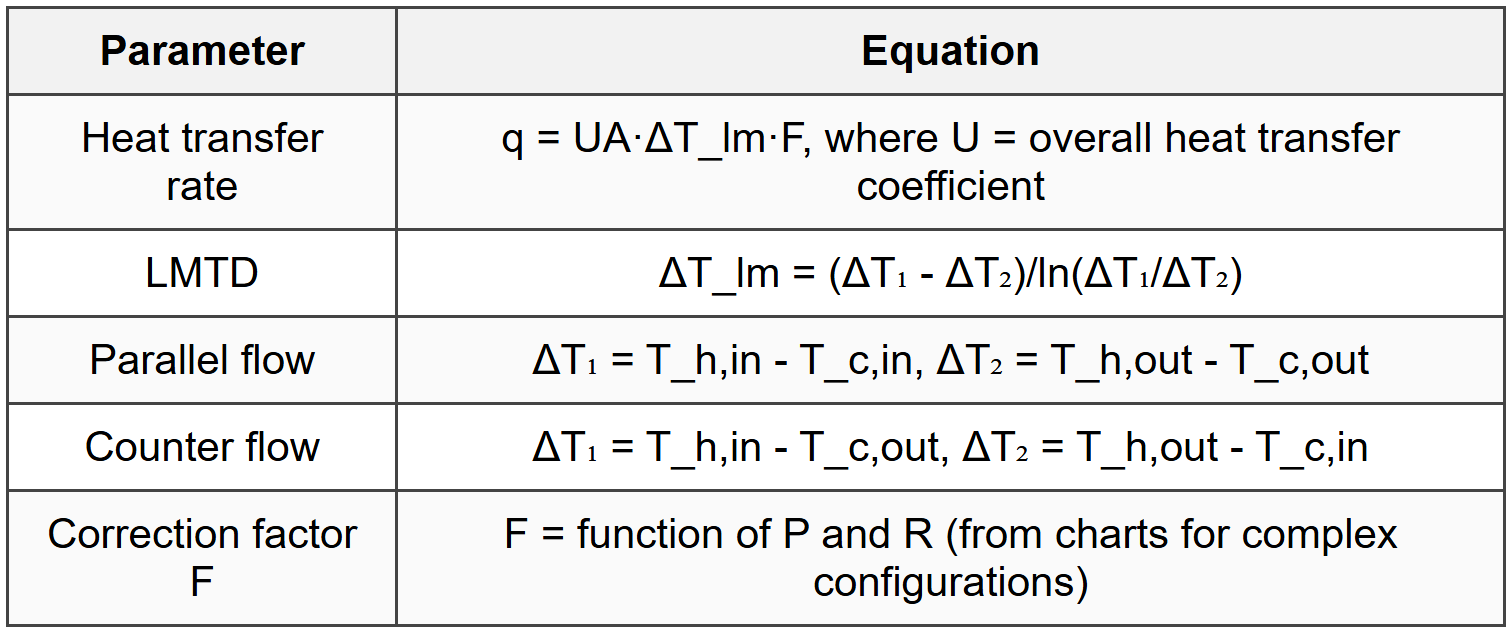
- P = (t₂ - t₁)/(T₁ - t₁) for tube-side effectiveness
- R = (T₁ - T₂)/(t₂ - t₁) for heat capacity ratio
- F = 1 for pure counter flow and parallel flow (double pipe)
4.3 Effectiveness-NTU Method
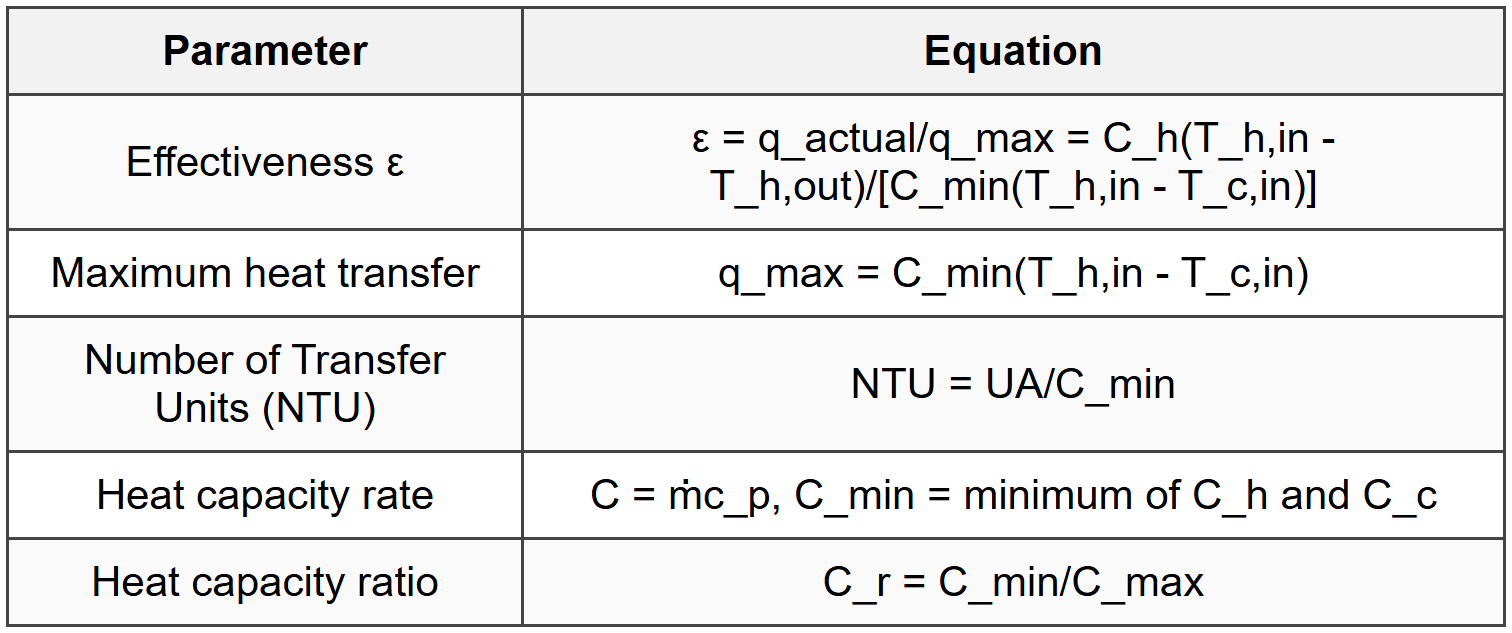
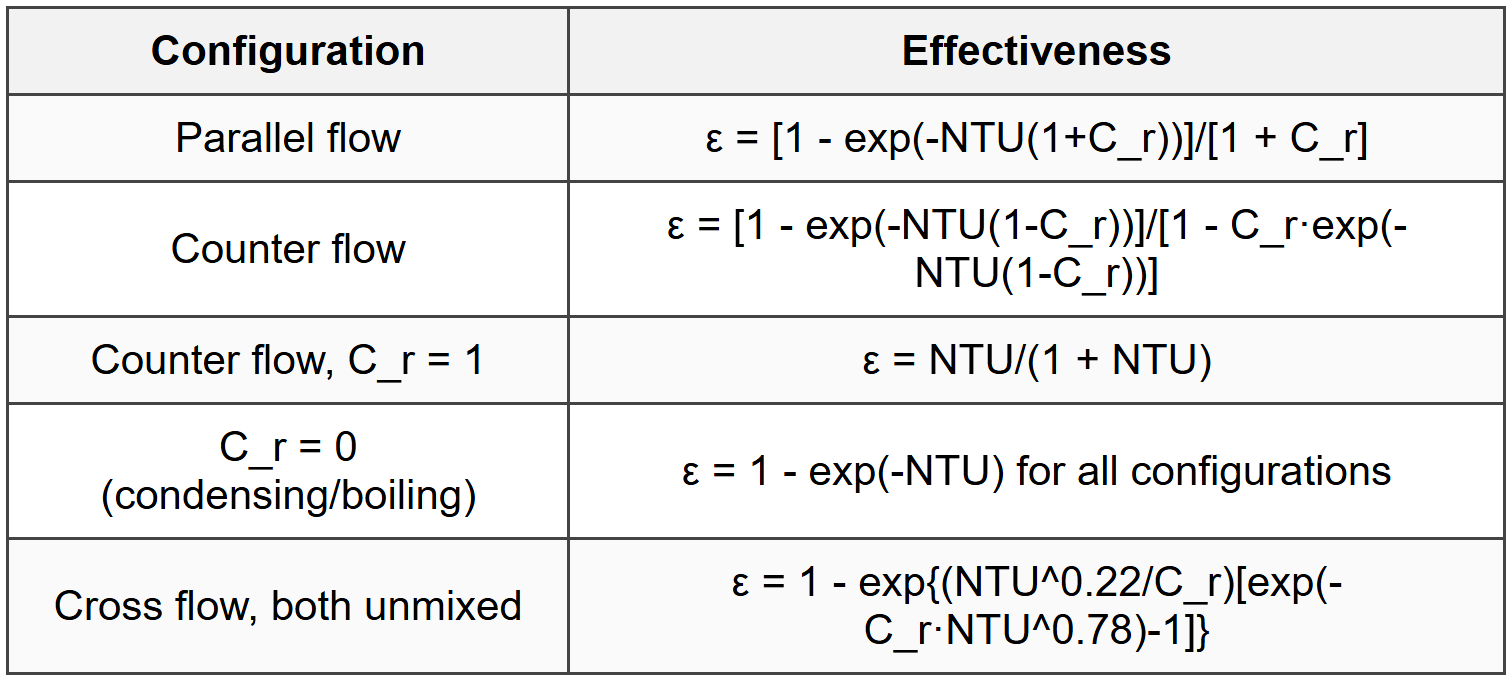
4.3.1 Effectiveness Relations
4.4 Overall Heat Transfer Coefficient

- Based on inside area: 1/(U_i·A_i) = 1/(h_i·A_i) + R_wall + A_i/(h_o·A_o)
- Based on outside area: 1/(U_o·A_o) = A_o/(h_i·A_i) + R_wall + 1/(h_o·A_o)
4.5 Heat Exchanger Analysis
- Energy balance (no phase change): q = ṁ_h·c_p,h(T_h,in - T_h,out) = ṁ_c·c_p,c(T_c,out - T_c,in)
- Use LMTD method when inlet and outlet temperatures known
- Use ε-NTU method when outlet temperatures unknown
- Counter flow most efficient (highest ε for given NTU and C_r)
- For C_r = 0: all configurations have same effectiveness
5. Transient Heat Conduction
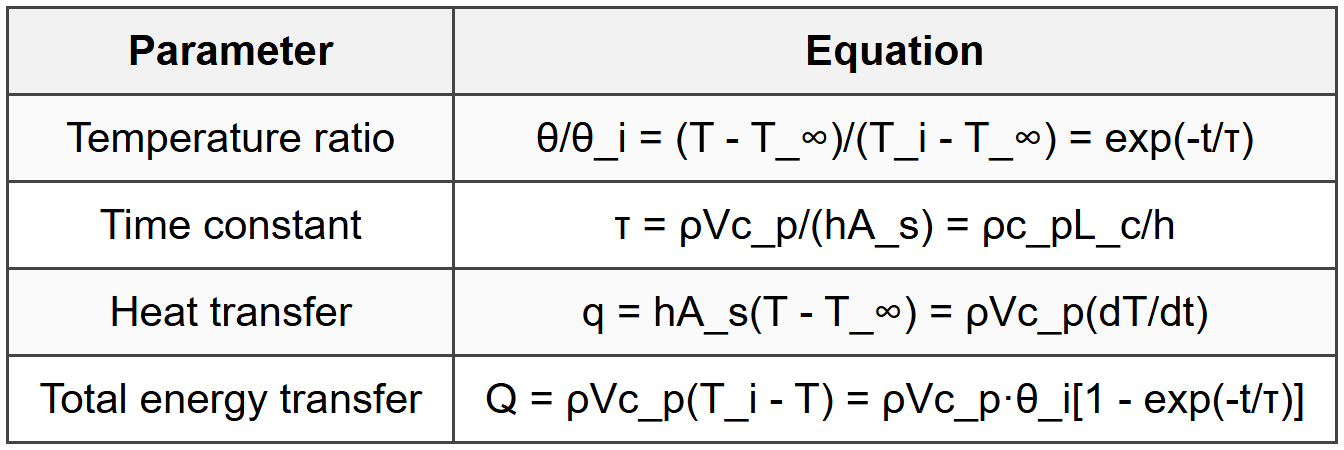
5.1 Lumped Capacitance Method
5.1.1 Applicability
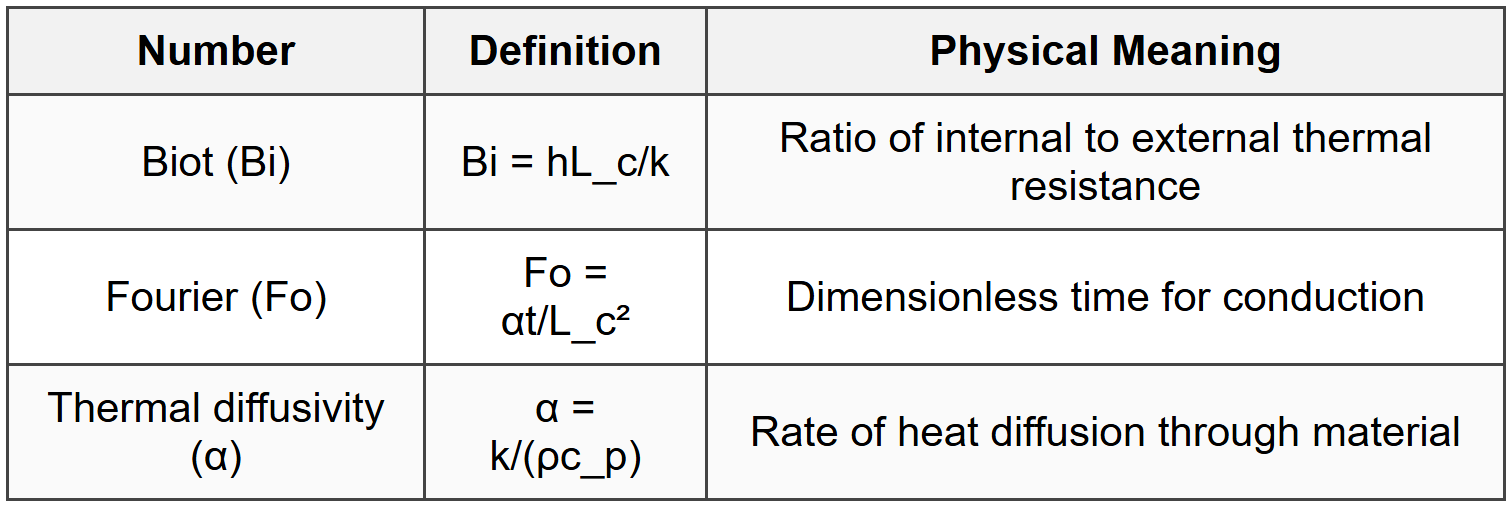
- Biot number: Bi = hL_c/k < 0.1,="" where="" l_c="V/A_s" (characteristic="">
- Assumes uniform temperature throughout body at any instant
- Internal resistance negligible compared to external resistance
5.1.2 Temperature Response
5.2 Semi-Infinite Solid
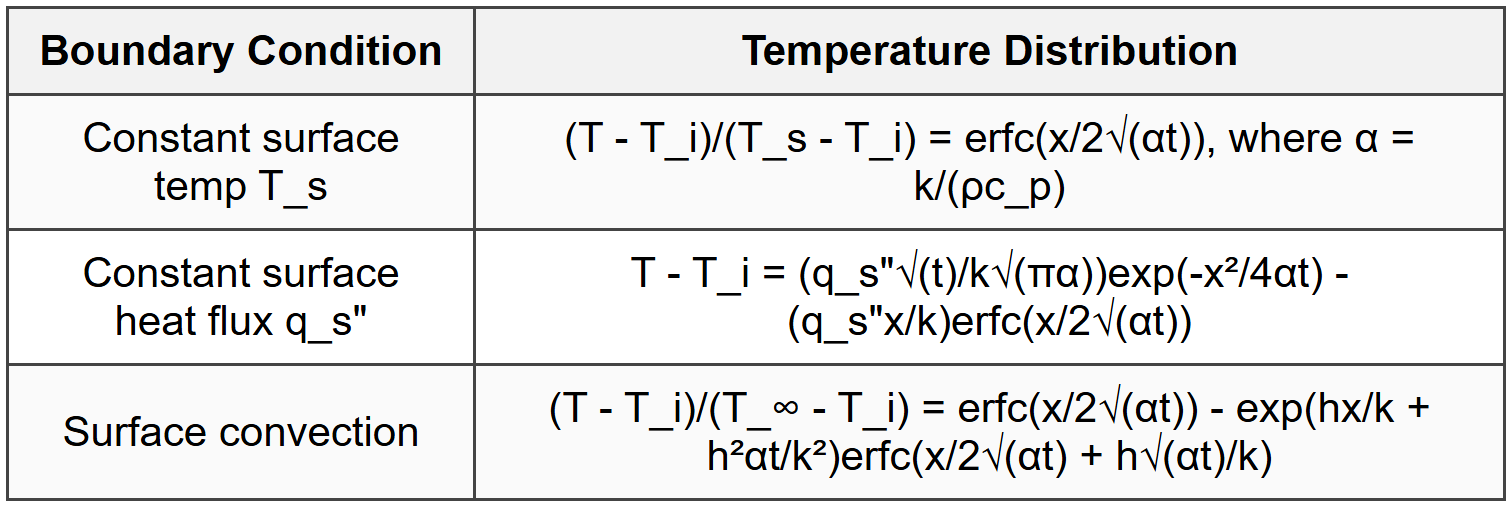
- Surface heat flux: q_s" = k(T_s - T_i)/√(παt)
- Penetration depth: δ ≈ 2√(αt) (where temperature change is ~1% of initial)
5.3 Finite-Sized Bodies
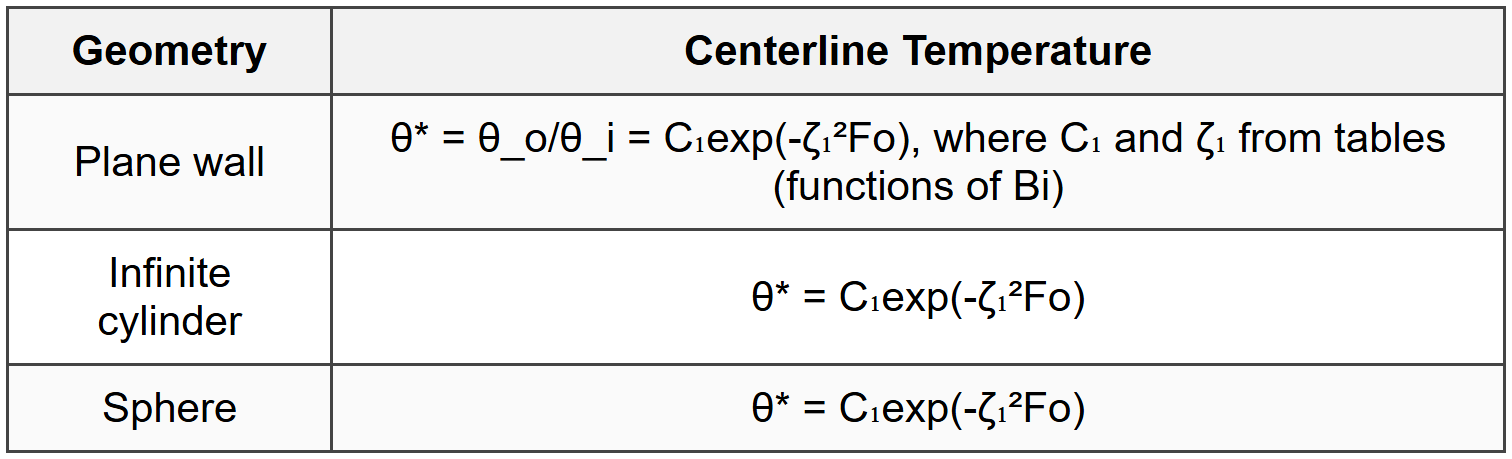
5.3.1 One-Dimensional Solutions (Charts/Heisler Charts)
- Requires Bi > 0.1 (lumped capacitance not valid)
- Fourier number: Fo = αt/L_c² (dimensionless time)
- For plane wall: L_c = L (half-thickness)
- For cylinder: L_c = r_o (radius)
- For sphere: L_c = r_o (radius)
5.3.2 Approximate Solutions (Fo > 0.2)
5.3.3 Multi-Dimensional Solutions
- Product solution method: θ(x,y,z,t) = θ_wall(x,t)·θ_wall(y,t)·θ_wall(z,t)
- Short cylinder: θ = θ_cylinder·θ_plane_wall
- Rectangular bar: θ = θ_wall,x·θ_wall,y
- Total heat transfer: Q/Q_max = 1 - product of (1 - Q_i/Q_max,i) for each dimension
5.4 Key Dimensionless Groups
6. Boiling and Condensation
6.1 Pool Boiling
6.1.1 Boiling Regimes
- Free convection: ΔT_e < 5°c,="" bubbles="" not="">
- Nucleate boiling: 5°C < δt_e="">< 30°c,="" bubbles="" form="" at="" nucleation="" sites,="" high="" heat="">
- Critical heat flux (CHF): maximum heat flux, transition to film boiling
- Film boiling: ΔT_e > 120°C, vapor film blankets surface, lower heat transfer
6.1.2 Nucleate Boiling Correlation
- Rohsenow correlation: q" = μ_l·h_fg[g(ρ_l - ρ_v)/σ]^0.5[c_p,l·ΔT_e/(C_sf·h_fg·Pr_l^n)]³
- C_sf = surface-fluid constant (0.013 for water-copper)
- n = 1.0 for water, 1.7 for other fluids
- σ = surface tension, h_fg = latent heat of vaporization
6.1.3 Critical Heat Flux
- Zuber correlation (horizontal surfaces): q"_max = 0.149·ρ_v·h_fg[σg(ρ_l - ρ_v)/ρ_v²]^0.25
- Burnout point: surface temperature increases dramatically if exceeded
6.1.4 Film Boiling
- Bromley correlation (horizontal cylinder): h = 0.62[k_v³ρ_v(ρ_l - ρ_v)gh'_fg/(μ_v·D·ΔT_e)]^0.25
- h'_fg = h_fg + 0.4c_p,v·ΔT_e (corrected latent heat)
- Combined radiation and convection: h_total = h_conv + (3/4)h_rad
6.2 Flow Boiling
- Occurs inside tubes with forced convection
- Quality x = vapor mass fraction = (h - h_f)/h_fg
- Two-phase flow patterns: bubbly, slug, annular, mist flow
- Higher heat transfer coefficients than pool boiling due to forced convection
6.3 Film Condensation
6.3.1 Laminar Film on Vertical Plate
- Nusselt theory: h = 0.943[k_l³ρ_l(ρ_l - ρ_v)gh'_fg/(μ_l·L·ΔT)]^0.25
- h'_fg = h_fg + 0.68c_p,l·ΔT (corrected latent heat)
- ΔT = T_sat - T_s (temperature difference between saturation and surface)
- Valid for Re_f < 30,="" where="" re_f="4Γ/μ_l" and="" γ="">
6.3.2 Turbulent Film on Vertical Plate
- Re_f > 1800: h = 0.0077·Re_f^0.4·k_l³ρ_l(ρ_l - ρ_v)g/(μ_l²)]^(1/3)
6.3.3 Laminar Film on Horizontal Tube
- Single tube: h = 0.725[k_l³ρ_l(ρ_l - ρ_v)gh'_fg/(μ_l·D·ΔT)]^0.25
- N horizontal tubes (vertical tier): h_N = h_1/N^0.25, where h_1 = single tube coefficient
6.4 Dropwise Condensation
- Occurs when condensate forms droplets instead of film
- Heat transfer coefficient 5-10 times higher than film condensation
- Difficult to maintain in practice (requires surface coating)
6.5 Key Properties and Parameters

7. Thermal Properties and Data
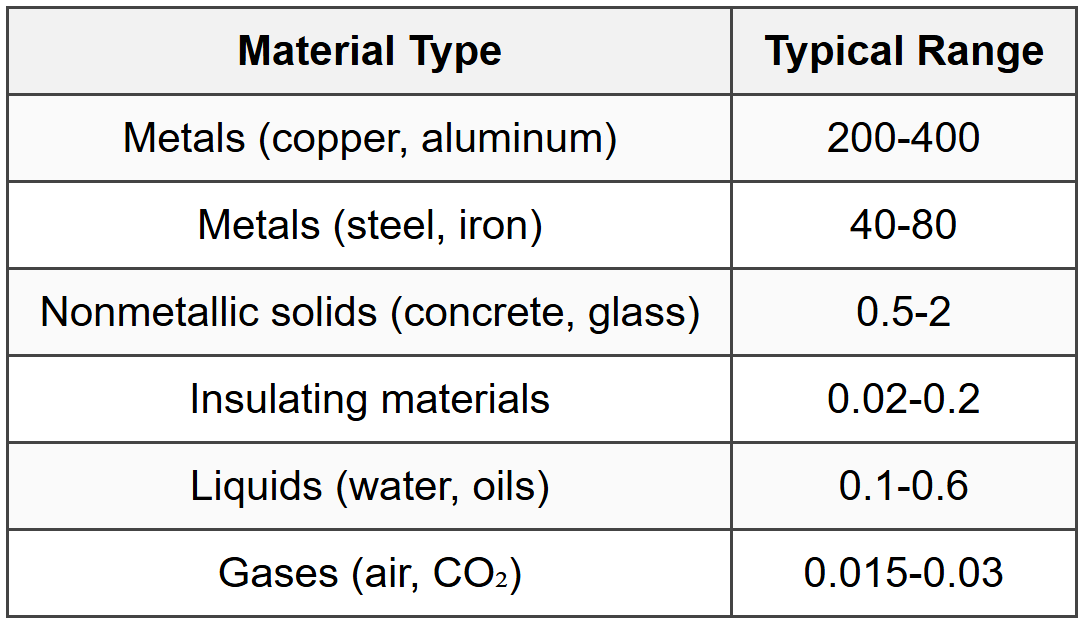
7.1 Thermal Conductivity Ranges (W/m·K at 300K)
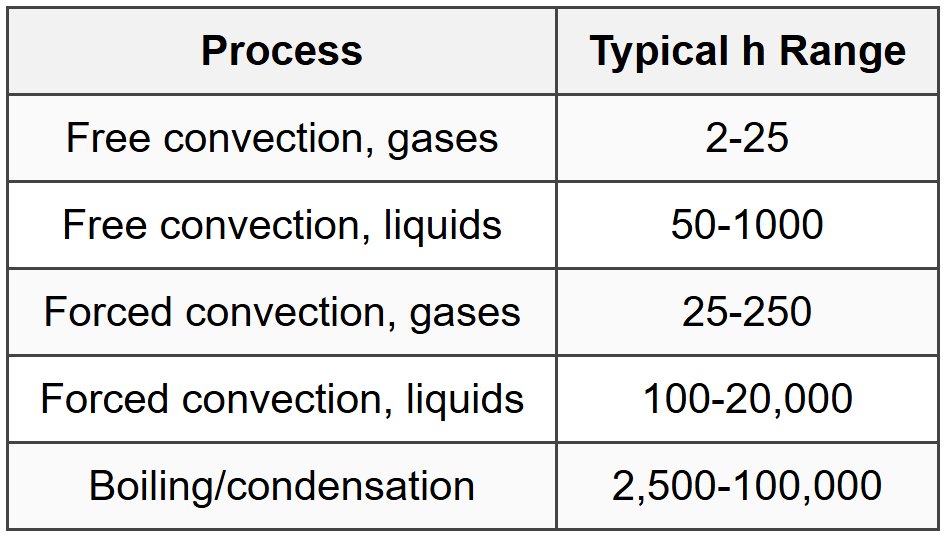
7.2 Convection Coefficient Ranges (W/m²·K)
7.3 Emissivity Values (Total, Normal, 300K)

7.4 Fouling Resistances (m²·K/W)

7.5 Common Physical Constants

7.6 Temperature-Dependent Properties
- Thermal conductivity k: increases with T for gases, decreases with T for liquids, varies for solids
- Viscosity μ: decreases with T for liquids, increases with T for gases
- For gases: ideal gas approximation β = 1/T_f (T in Kelvin)
- Always evaluate properties at appropriate reference temperature (bulk, film, or surface)
8. Problem-Solving Strategies
8.1 Heat Transfer Rate Equations

8.2 Systematic Approach
- 1. Identify heat transfer modes involved (conduction, convection, radiation)
- 2. Draw thermal circuit with resistances if applicable
- 3. Determine if steady-state or transient analysis required
- 4. Calculate dimensionless numbers (Re, Pr, Nu, Gr, Ra, Bi, Fo) to identify regime
- 5. Select appropriate correlations based on geometry and flow conditions
- 6. Evaluate fluid properties at correct reference temperature
- 7. Check assumptions and validity ranges of correlations used
- 8. Solve for unknown using energy balance or rate equations
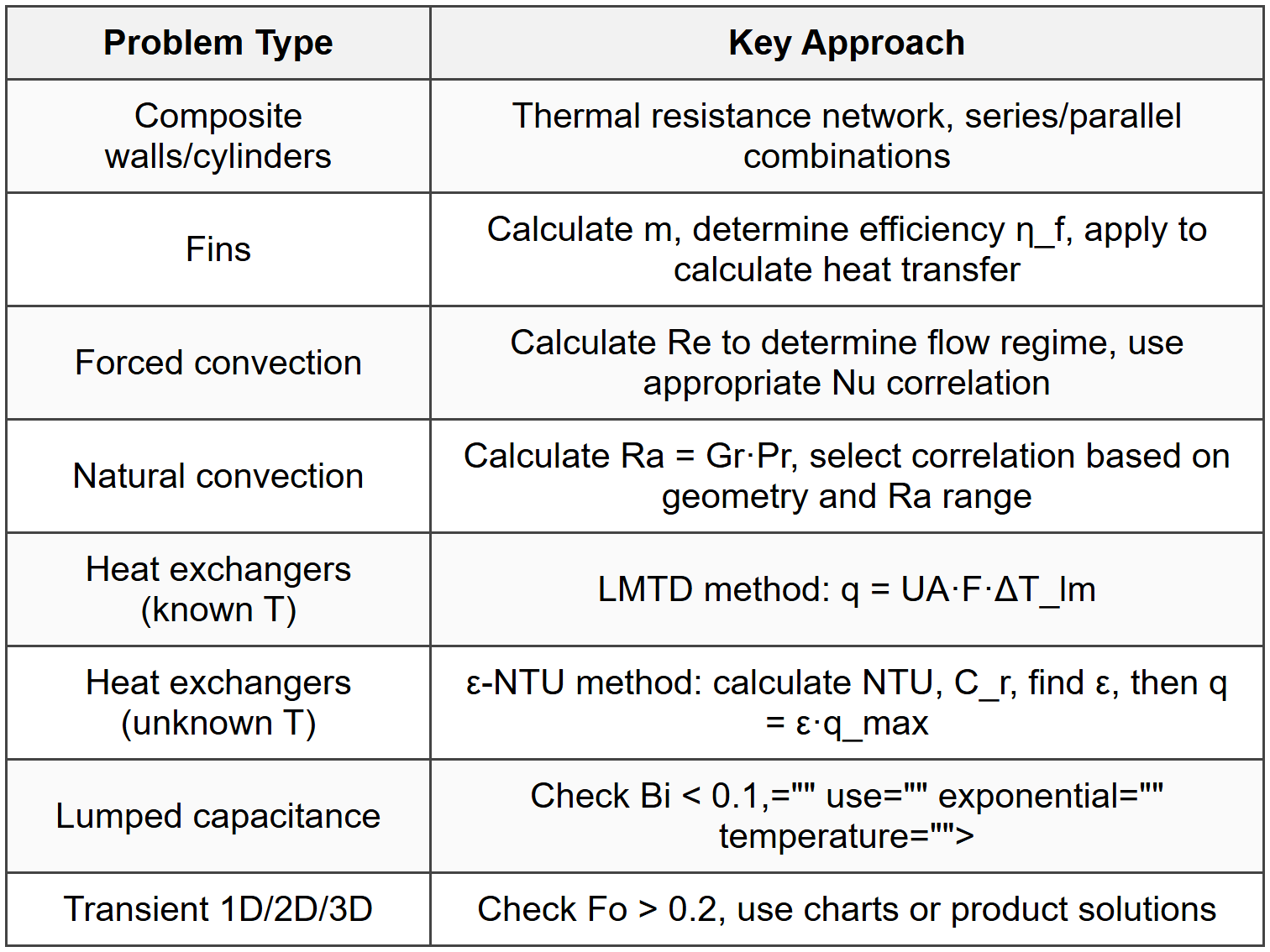
8.3 Common Analysis Types
8.4 Units and Conversions
- Temperature: T(K) = T(°C) + 273.15
- Heat flux: 1 W/m² = 0.3171 Btu/h·ft²
- Thermal conductivity: 1 W/m·K = 0.5778 Btu/h·ft·°F
- Heat transfer coefficient: 1 W/m²·K = 0.1761 Btu/h·ft²·°F
- Always use absolute temperature (K) for radiation calculations
The document Cheatsheet: Heat Transfer is a part of the PE Exam Course Chemical Engineering for PE.
All you need of PE Exam at this link: PE Exam
About this Document

Apr 20, 2026 Last updated
Related Exams
Document Description: Cheatsheet: Heat Transfer for PE Exam 2026 is part of Chemical Engineering for PE preparation. The notes and questions for Cheatsheet: Heat Transfer have been prepared according to the PE Exam exam syllabus. Information about Cheatsheet: Heat Transfer covers topics like and Cheatsheet: Heat Transfer Example, for PE Exam 2026 Exam. Find important definitions, questions, notes, meanings, examples, exercises and tests below for Cheatsheet: Heat Transfer.
Introduction of Cheatsheet: Heat Transfer in English is available as part of our Chemical Engineering for PE for PE Exam & Cheatsheet: Heat Transfer in Hindi for Chemical Engineering for PE course. Download more important topics related with notes, lectures and mock test series for PE Exam Exam by signing up for free. PE Exam: Cheatsheet: Heat Transfer
Description
Cheatsheet: Heat Transfer of Chemical Engineering to help you remember important concepts with short tricks. Start learning for PE Exam exam & improve retention with EduRev.
Information about Cheatsheet: Heat Transfer
In this doc you can find the meaning of Cheatsheet: Heat Transfer defined & explained in the simplest way possible. Besides explaining types of Cheatsheet: Heat Transfer theory, EduRev gives you an ample number of questions to practice Cheatsheet: Heat Transfer tests, examples and also practice PE Exam tests



Related Searches
Semester Notes, Important questions, Exam, Summary, practice quizzes, Cheatsheet: Heat Transfer, Viva Questions, Cheatsheet: Heat Transfer, shortcuts and tricks, Sample Paper, study material, mock tests for examination, Extra Questions, pdf , past year papers, Previous Year Questions with Solutions, video lectures, MCQs, Objective type Questions, Free, Cheatsheet: Heat Transfer, ppt;