PE Exam Exam > PE Exam Notes > Mechanical Engineering for PE > Cheatsheet: Convection
Cheatsheet: Convection


1. Convection Fundamentals
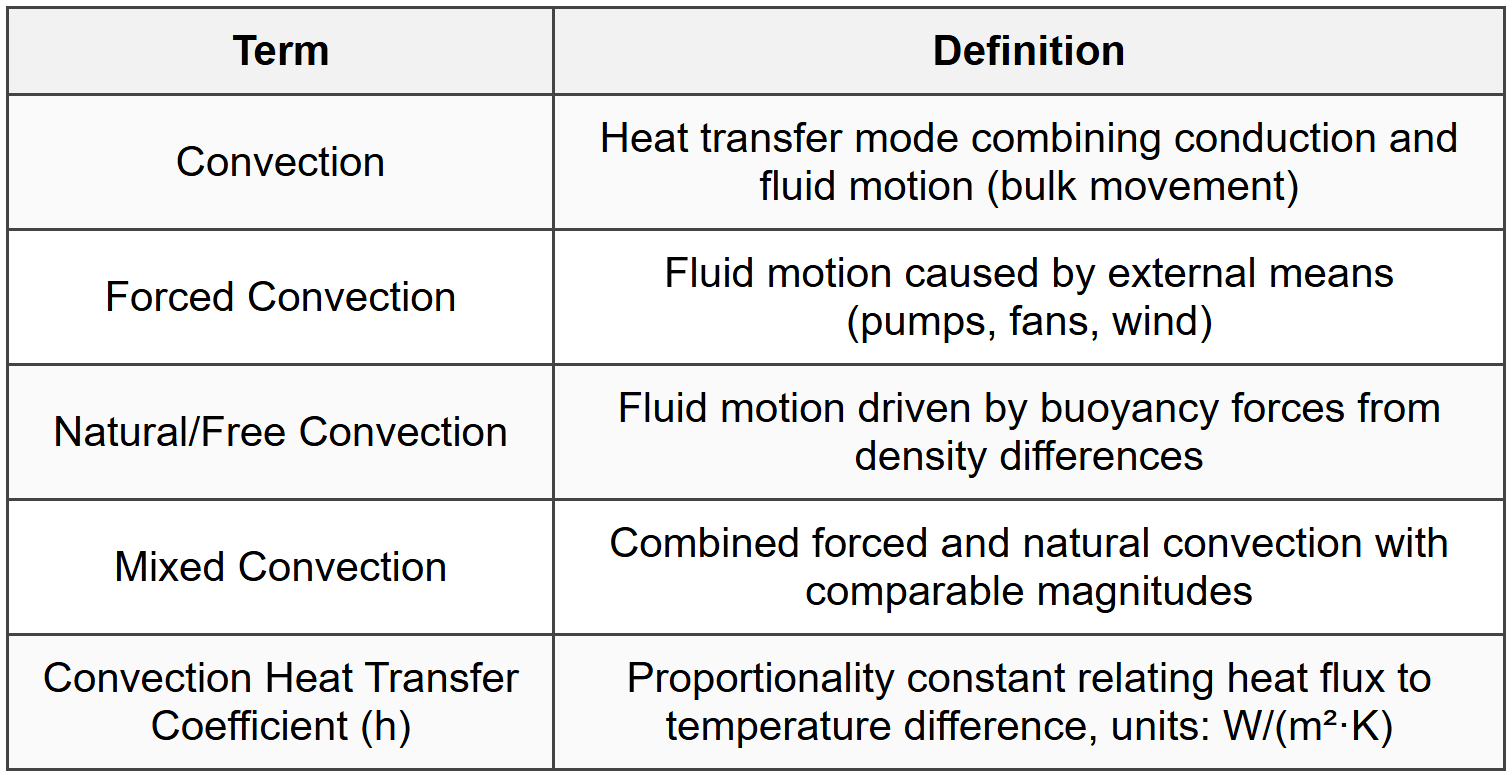
1.1 Basic Definitions
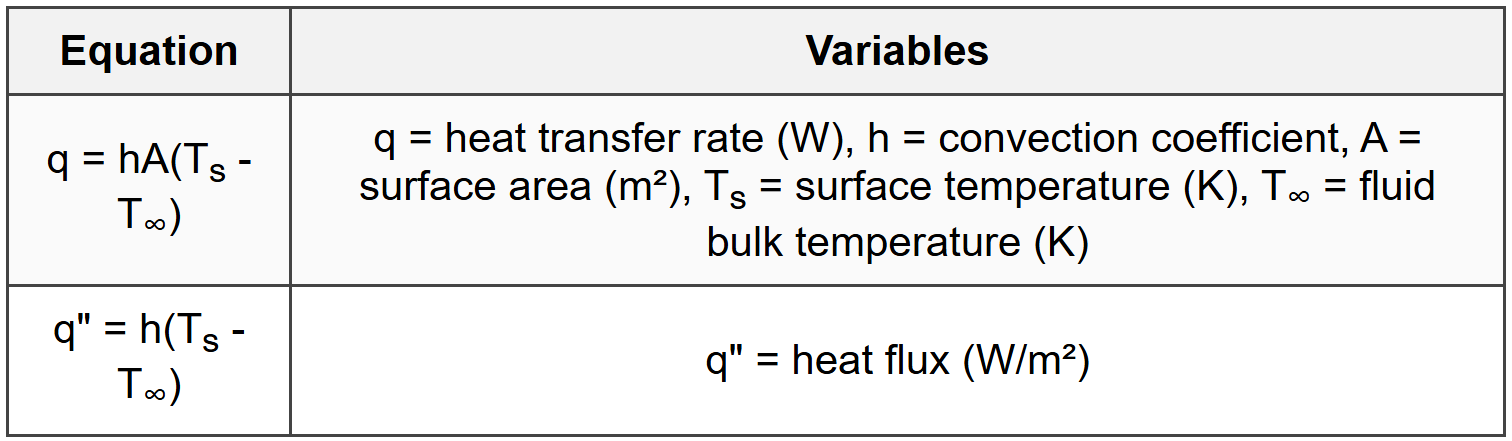
1.2 Newton's Law of Cooling
1.3 Thermal Boundary Layer
- Region where temperature gradients exist near solid surface
- Velocity boundary layer: region where velocity gradients exist
- Boundary layer thickness (δt): distance from surface where (Ts - T)/(Ts - T∞) = 0.99
- Laminar boundary layer: smooth, orderly flow with Re <>critical
- Turbulent boundary layer: chaotic flow with Re > Recritical
2. Dimensionless Numbers
2.1 Key Dimensionless Parameters

2.2 Variable Definitions
- ρ = fluid density (kg/m³)
- V = characteristic velocity (m/s)
- L = characteristic length (m)
- μ = dynamic viscosity (Pa·s or N·s/m²)
- ν = kinematic viscosity (m²/s)
- α = thermal diffusivity = k/(ρcp) (m²/s)
- k = thermal conductivity (W/(m·K))
- cp = specific heat at constant pressure (J/(kg·K))
- g = gravitational acceleration = 9.81 m/s²
- β = volumetric thermal expansion coefficient (1/K); β = 1/T for ideal gases
3. External Forced Convection
3.1 Flow Over Flat Plate
3.1.1 Critical Reynolds Number
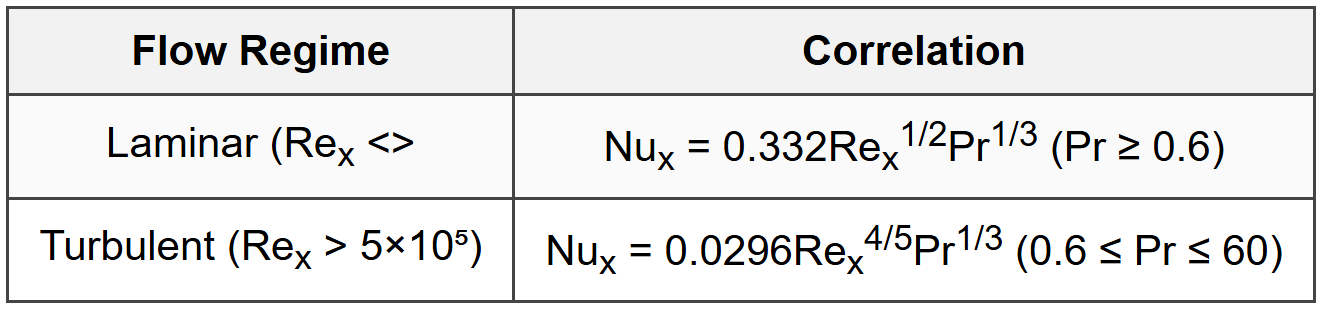
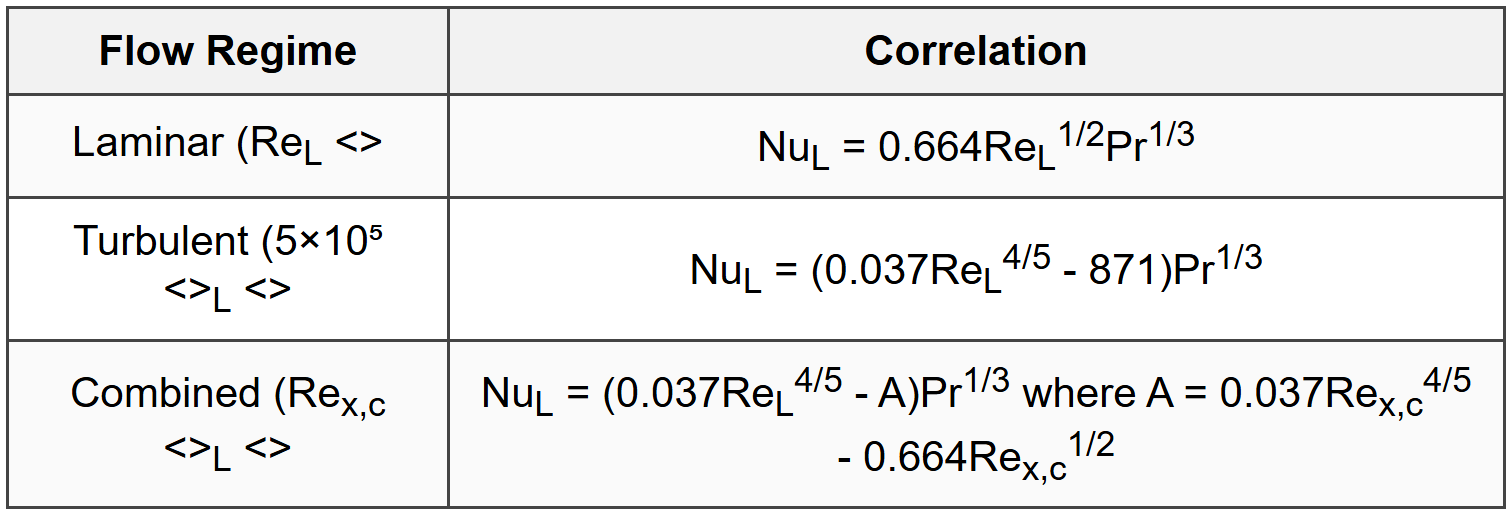
- Rex,c = 5×10⁵ (transition from laminar to turbulent)
- Rex = Vx/ν where x = distance from leading edge
3.1.2 Local Nusselt Number
3.1.3 Average Nusselt Number
3.2 Flow Across Cylinders
3.2.1 Churchill-Bernstein Correlation

3.2.2 Simplified Correlation for Cylinders
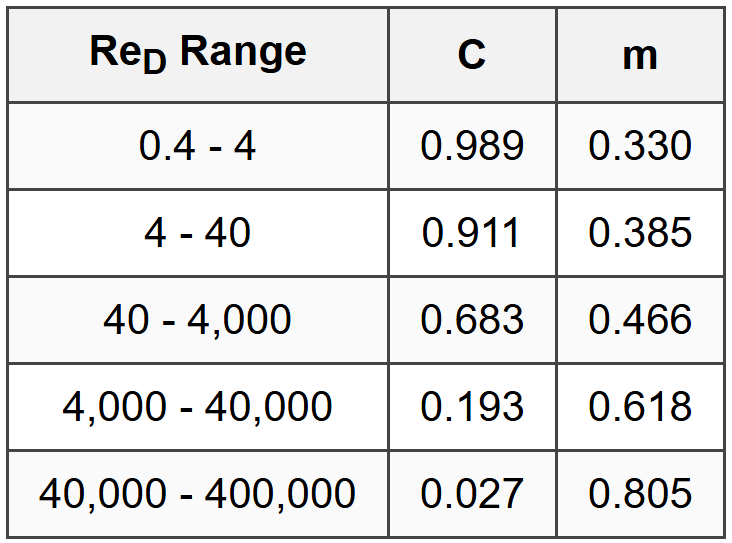
- NuD = CReDmPr1/3
- ReD = VD/ν where D = cylinder diameter
- Properties evaluated at film temperature: Tf = (Ts + T∞)/2
3.3 Flow Across Sphere

3.4 Flow Across Tube Banks
3.4.1 Configurations
- Aligned (in-line): tubes directly behind each other
- Staggered: tubes offset in successive rows
- ST = transverse pitch (center-to-center spacing perpendicular to flow)
- SL = longitudinal pitch (center-to-center spacing parallel to flow)
- SD = diagonal pitch in staggered arrangement
3.4.2 Maximum Velocity Location
- Aligned: Vmax = [ST/(ST - D)]V
- Staggered: Vmax = [ST/(ST - D)]V or Vmax = [ST/(2(SD - D))]V (use larger value)
3.4.3 Zukauskas Correlation
- NuD = C₁ReD,maxmPr0.36(Pr/Prs)1/4
- ReD,max = VmaxD/ν
- NL ≥ 20 rows (apply correction factor C₂ for NL <>
- Properties at T∞ except Prs at Ts
4. Internal Forced Convection
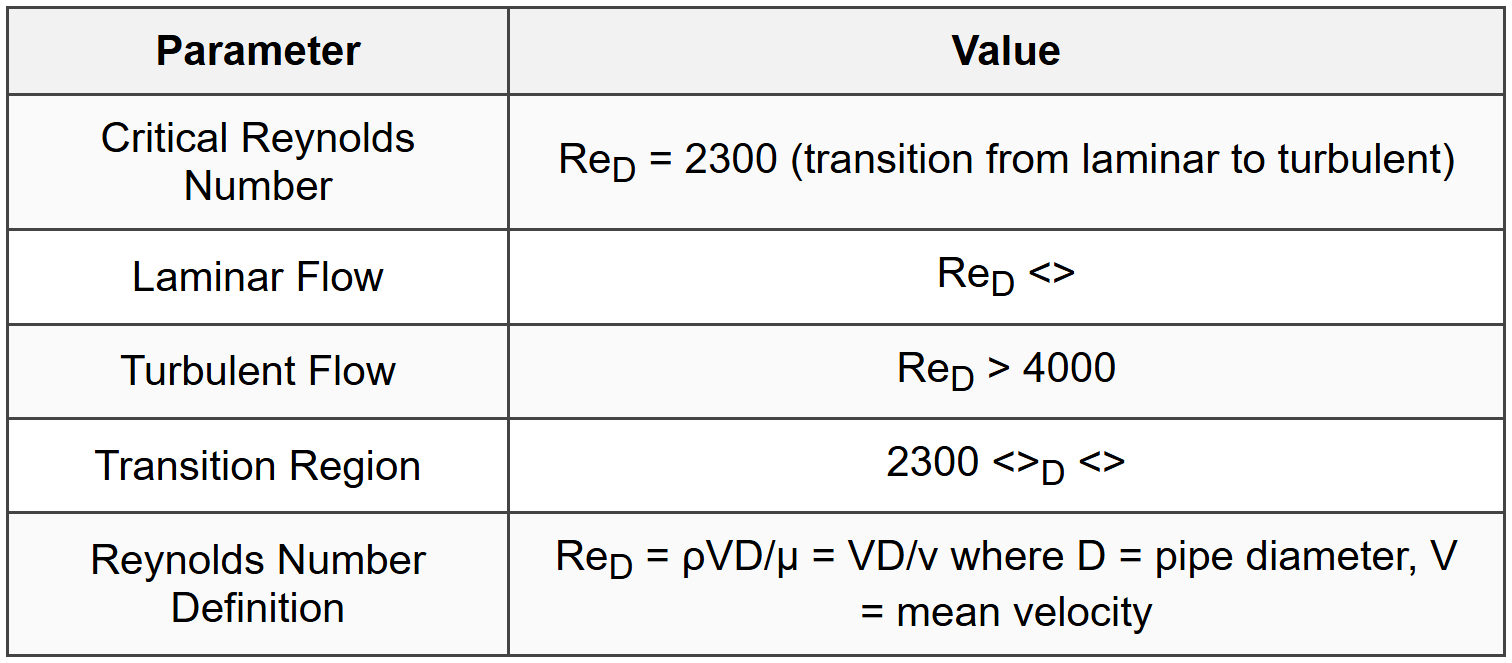
4.1 Flow Regimes in Pipes/Tubes
4.2 Entrance Lengths

4.3 Mean Temperature
- Bulk mean temperature: Tm = ∫(ρVcpT)dAc / ∫(ρVcp)dAc
- For constant properties: Tm = ∫(VT)dAc / ∫(V)dAc
- Use Tm for property evaluation in internal flow correlations
4.4 Laminar Flow in Circular Tubes
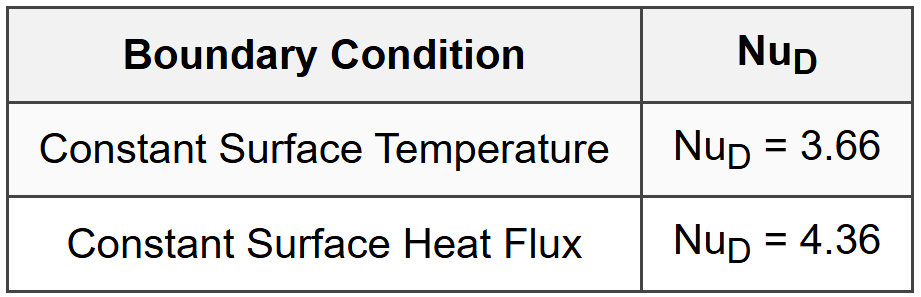
4.4.1 Fully Developed Nusselt Numbers
4.4.2 Developing Flow (Sieder-Tate)
- NuD = 1.86(ReDPr·D/L)1/3(μ/μs)0.14
- Valid for: 0.48 < pr="">< 16,700="" and="" 0.0044=""><>s) <>
- Properties at bulk mean temperature except μs at surface temperature
4.5 Turbulent Flow in Circular Tubes
4.5.1 Dittus-Boelter Equation

4.5.2 Gnielinski Equation
- NuD = [(f/8)(ReD - 1000)Pr] / [1 + 12.7(f/8)1/2(Pr2/3 - 1)]
- f = friction factor = (0.790ln(ReD) - 1.64)-2 (smooth tubes)
- Valid for: 3000 <>D < 5×10⁶;="" 0.5="" ≤="" pr="" ≤="">
- More accurate than Dittus-Boelter for wider range
4.5.3 Petukhov Equation
- NuD = [(f/8)ReDPr] / [1.07 + 12.7(f/8)1/2(Pr2/3 - 1)]
- Valid for: 10⁴ <>D < 5×10⁶;="" 0.5="" ≤="" pr="" ≤="">
4.6 Noncircular Tubes
- Use hydraulic diameter: Dh = 4Ac/P where Ac = cross-sectional area, P = wetted perimeter
- ReDh = VDh/ν
- Laminar fully developed Nu varies with geometry (not 3.66 or 4.36)
4.7 Heat Transfer Rate Calculations
4.7.1 Constant Surface Temperature
- q = hAsΔTln
- ΔTln = [(Ts - Tm,i) - (Ts - Tm,o)] / ln[(Ts - Tm,i)/(Ts - Tm,o)]
- Tm,o = Ts - (Ts - Tm,i)exp(-πDL·h/(ṁcp))
4.7.2 Constant Surface Heat Flux
- q = q"πDL = ṁcp(Tm,o - Tm,i)
- Tm(x) = Tm,i + (q"P/ṁcp)x
- Linear temperature rise along tube length
5. Natural Convection
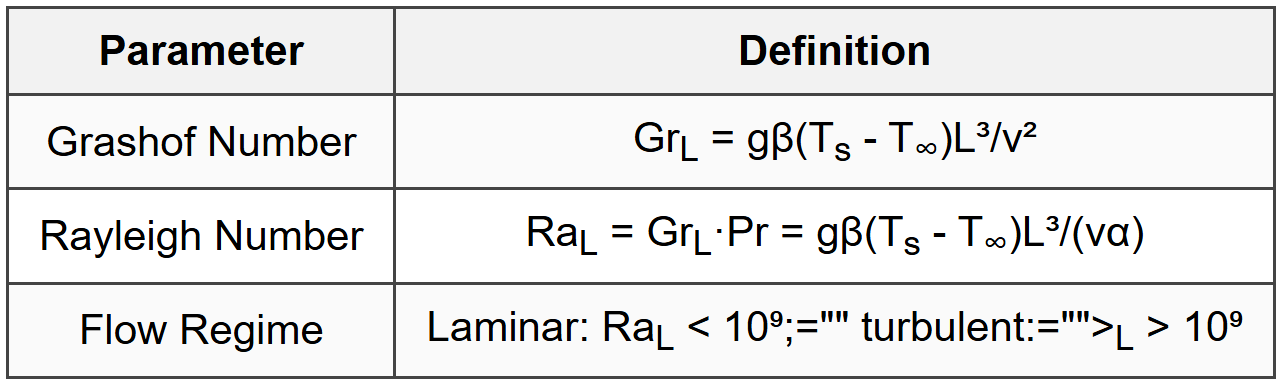
5.1 Governing Parameters
5.2 Vertical Flat Plate
5.2.1 Correlations

5.2.2 Characteristic Length
- L = height of vertical plate
- Properties evaluated at film temperature: Tf = (Ts + T∞)/2
5.3 Inclined Flat Plate
- Replace g with g·cos(θ) for surfaces inclined at angle θ from vertical
- Valid for upper surface of cold plate or lower surface of hot plate
- Valid for θ < 60°="" from="">
5.4 Horizontal Flat Plate
5.4.1 Upper Surface of Hot Plate or Lower Surface of Cold Plate

5.4.2 Lower Surface of Hot Plate or Upper Surface of Cold Plate
- NuL = 0.27RaL1/4 for 10⁵ <>L <>
5.4.3 Characteristic Length
- L = As/P where As = surface area, P = perimeter
5.5 Long Horizontal Cylinder
5.5.1 Churchill-Chu Correlation
- NuD = [0.60 + 0.387RaD1/6/[1 + (0.559/Pr)9/16]8/27]²
- Valid for: RaD <>
- Characteristic length: L = D (cylinder diameter)
5.5.2 Simplified Correlations

5.6 Sphere
- NuD = 2 + 0.589RaD1/4/[1 + (0.469/Pr)9/16]4/9
- Valid for: Pr ≥ 0.7, RaD ≤ 10¹¹
- Characteristic length: L = D (sphere diameter)
5.7 Vertical Cylinder
- Use vertical plate correlations if D ≥ 35L/GrL1/4
- Otherwise use specialized cylinder correlations
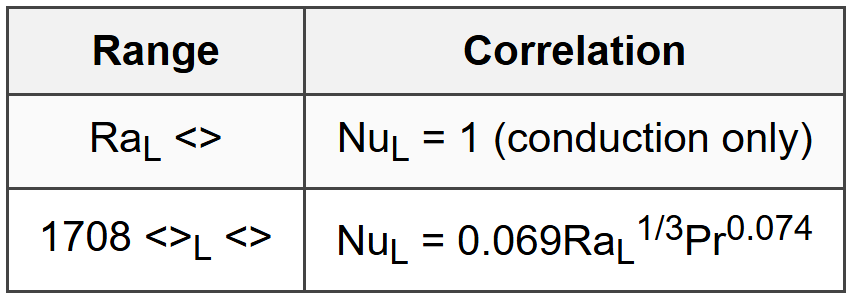
5.8 Enclosed Spaces
5.8.1 Vertical Rectangular Cavity
- NuL = 0.22(Pr/(0.2 + Pr)·RaL)0.28(H/L)-1/4
- Valid for: 2 < h/l="">< 10,="" pr="">< 10⁵,="" 10³=""><>L <>
- L = spacing between vertical walls, H = height
5.8.2 Horizontal Rectangular Cavity (Heated from Below)
6. Condensation and Boiling
6.1 Film Condensation
6.1.1 Vertical Plate (Nusselt Theory)
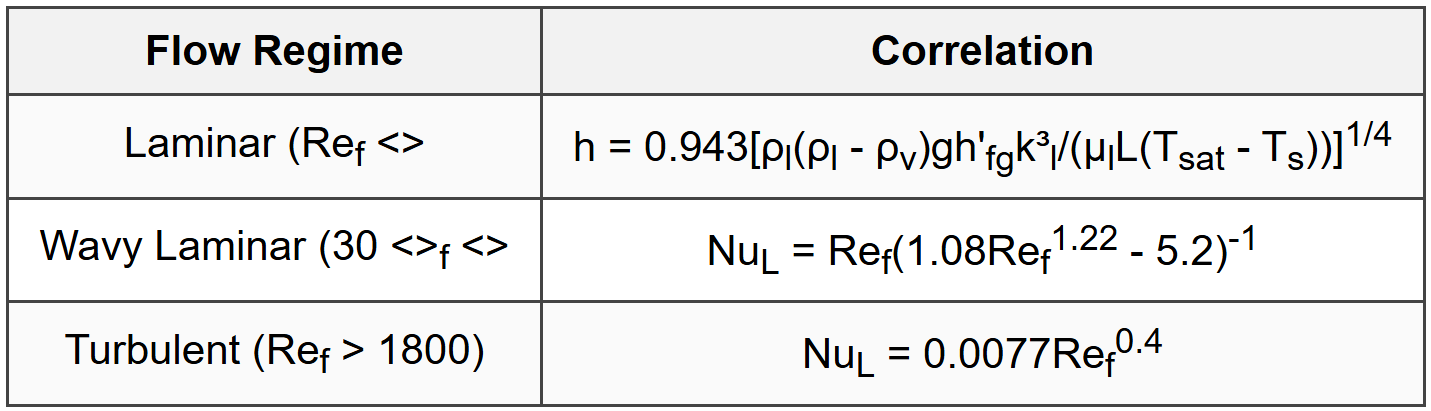
6.1.2 Film Reynolds Number
- Ref = 4Γ/μl where Γ = ṁ/P = mass flow rate per unit width
- Γ = ρlVδ for film of thickness δ
6.1.3 Modified Latent Heat
- h'fg = hfg + 0.68cp,l(Tsat - Ts)
- Accounts for sensible cooling of condensate film
6.1.4 Horizontal Tube
- h = 0.729[ρl(ρl - ρv)gh'fgk³l/(μlD(Tsat - Ts))]1/4
- For N horizontal tubes in vertical tier: multiply by N-1/4
6.1.5 Property Evaluation
- Liquid properties at film temperature: Tf = (Tsat + Ts)/2
- ρv and hfg at Tsat
6.2 Pool Boiling
6.2.1 Boiling Regimes
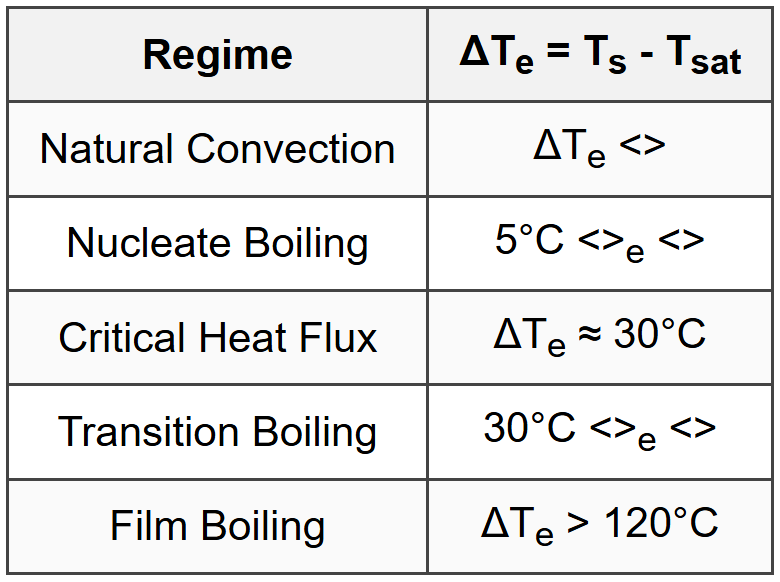
6.2.2 Rohsenow Correlation (Nucleate Boiling)
- q" = μlhfg[g(ρl - ρv)/σ]1/2[cp,l(Ts - Tsat)/(Cs,fhfgPrln)]³
- Cs,f = empirical constant (surface-fluid combination)
- n = 1.0 for water, 1.7 for other fluids
- σ = surface tension (N/m)
6.2.3 Critical Heat Flux (Zuber)
- q"max = 0.149hfgρv[σg(ρl - ρv)/ρ²v]1/4
- Maximum heat flux in nucleate boiling before transition to film boiling
6.2.4 Film Boiling on Horizontal Cylinder
- h = 0.62[ρv(ρl - ρv)gh'fgk³v/(μvD(Ts - Tsat))]1/4
- Properties of vapor at film temperature: Tf = (Ts + Tsat)/2
- h'fg = hfg + 0.80cp,v(Ts - Tsat)
6.3 Flow Boiling
- Occurs inside tubes with forced flow
- Two-phase flow: complex function of flow quality, mass flux, geometry
- Heat transfer coefficient depends on both convective and nucleate boiling contributions
- Flow patterns: bubbly, slug, annular, mist flow
7. Heat Exchangers
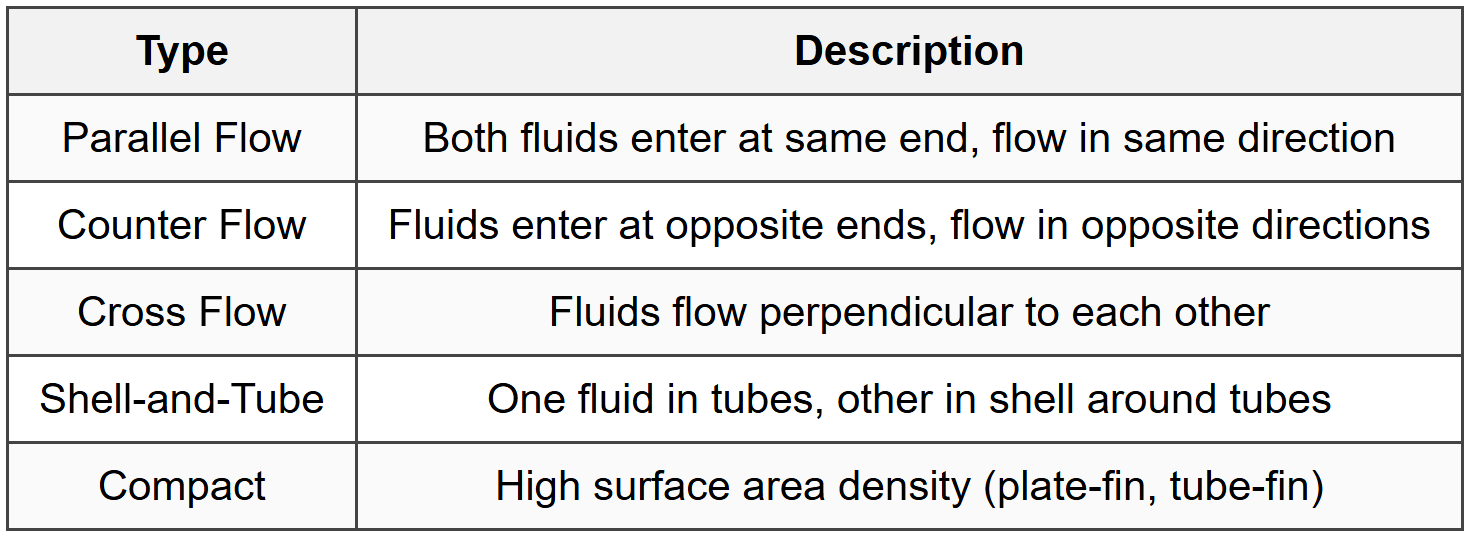
7.1 Heat Exchanger Types
7.2 Overall Heat Transfer Coefficient
7.2.1 Based on Inner Surface Area
- 1/(UiAi) = 1/(hiAi) + R"f,i/Ai + ln(ro/ri)/(2πkL) + R"f,o/Ao + 1/(hoAo)
7.2.2 Based on Outer Surface Area
- 1/(UoAo) = 1/(hoAo) + R"f,o/Ao + ln(ro/ri)/(2πkL) + R"f,i/Ai + 1/(hiAi)
7.2.3 Fouling Factors
- R"f = fouling thermal resistance (m²·K/W)
- Account for deposit buildup on heat transfer surfaces
- Typical values: 0.0001-0.001 m²·K/W depending on fluid
7.3 Log Mean Temperature Difference (LMTD) Method
7.3.1 Heat Transfer Rate
- q = UAΔtlm
- q = ṁhcp,h(Th,i - Th,o) = ṁccp,c(Tc,o - Tc,i)
7.3.2 LMTD Calculation
- Δtlm = (ΔT₁ - ΔT₂)/ln(ΔT₁/ΔT₂)
- Parallel flow: ΔT₁ = Th,i - Tc,i, ΔT₂ = Th,o - Tc,o
- Counter flow: ΔT₁ = Th,i - Tc,o, ΔT₂ = Th,o - Tc,i
7.3.3 Correction Factor for Complex Configurations
- q = UAFΔTlm,CF where F = correction factor
- ΔTlm,CF = LMTD for counter-flow arrangement
- F depends on dimensionless parameters P and R
- P = (Tc,o - Tc,i)/(Th,i - Tc,i) = temperature effectiveness
- R = (Th,i - Th,o)/(Tc,o - Tc,i) = heat capacity rate ratio
- F obtained from charts for specific configurations (shell-and-tube, cross-flow)
7.4 Effectiveness-NTU Method
7.4.1 Heat Capacity Rates
- Ch = ṁhcp,h, Cc = ṁccp,c
- Cmin = minimum of Ch and Cc
- Cmax = maximum of Ch and Cc
- Cr = Cmin/Cmax
7.4.2 Maximum Possible Heat Transfer
- qmax = Cmin(Th,i - Tc,i)
7.4.3 Effectiveness
- ε = q/qmax
- ε = Ch(Th,i - Th,o)/[Cmin(Th,i - Tc,i)]
- ε = Cc(Tc,o - Tc,i)/[Cmin(Th,i - Tc,i)]
7.4.4 Number of Transfer Units
- NTU = UA/Cmin
7.4.5 Effectiveness Relations

7.5 Special Cases
7.5.1 Phase Change (Cr = 0)
- Condensers and evaporators: one fluid isothermal (infinite heat capacity)
- ε = 1 - exp(-NTU) for all configurations
7.5.2 Balanced Counter Flow (Ch = Cc)
- Counter flow with Cr = 1
- Maximum effectiveness for given NTU
- Th,o = Tc,o at infinite NTU
8. Practical Correlations and Tips
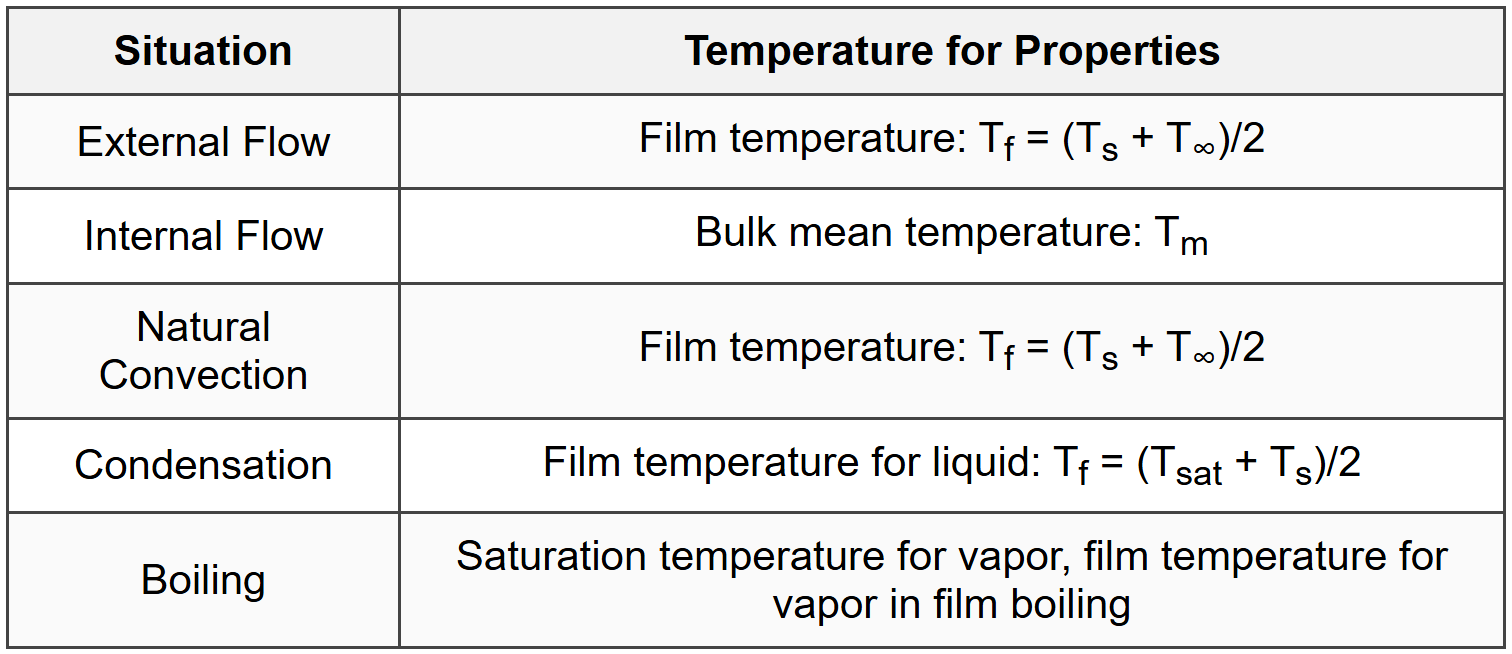
8.1 Property Evaluation Guidelines
8.2 Typical Convection Coefficient Ranges

8.3 Common Fluid Properties at 300 K

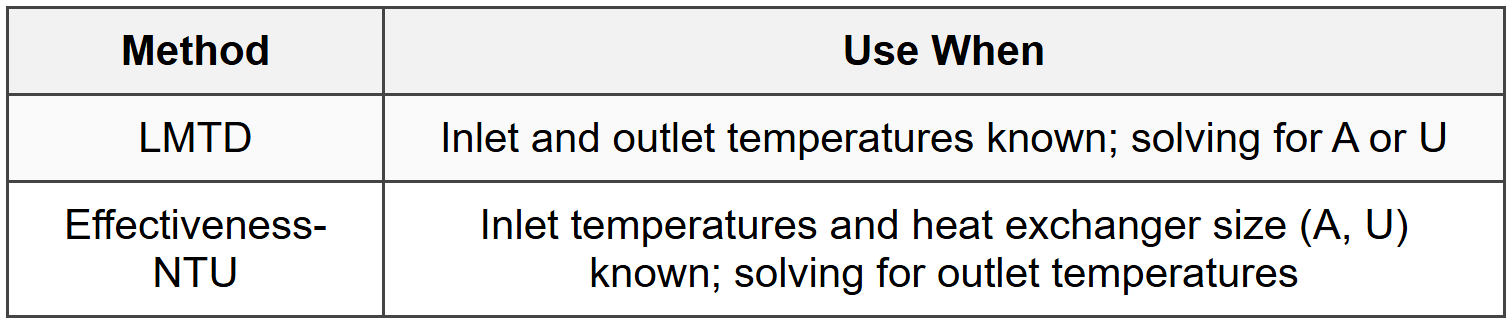
8.4 Selection Guide: LMTD vs Effectiveness-NTU
8.5 Enhancement Techniques
- Surface roughness: increases turbulence, enhances h but increases pressure drop
- Extended surfaces (fins): increases surface area, most effective for low h (gas-side)
- Flow inserts: twisted tapes, wire coils promote swirl and mixing
- Surface coatings: promote dropwise condensation or nucleate boiling
8.6 Boundary Layer Approximations
- Thermal boundary layer thinner than velocity boundary layer when Pr > 1 (liquids)
- Thermal boundary layer thicker than velocity boundary layer when Pr < 1="" (liquid="">
- Boundary layers approximately equal thickness when Pr ≈ 1 (gases)
8.7 Key Assumptions in Correlations
- Steady-state conditions
- Constant fluid properties (evaluated at reference temperature)
- Negligible radiation effects (unless specified)
- Negligible viscous dissipation
- Developed flow (unless entrance region correlation)
- Smooth surfaces (unless roughness specified)
The document Cheatsheet: Convection is a part of the PE Exam Course Mechanical Engineering for PE.
All you need of PE Exam at this link: PE Exam
About this Document

Apr 20, 2026 Last updated
Related Exams
Document Description: Cheatsheet: Convection for PE Exam 2026 is part of Mechanical Engineering for PE preparation. The notes and questions for Cheatsheet: Convection have been prepared according to the PE Exam exam syllabus. Information about Cheatsheet: Convection covers topics like and Cheatsheet: Convection Example, for PE Exam 2026 Exam. Find important definitions, questions, notes, meanings, examples, exercises and tests below for Cheatsheet: Convection.
Introduction of Cheatsheet: Convection in English is available as part of our Mechanical Engineering for PE for PE Exam & Cheatsheet: Convection in Hindi for Mechanical Engineering for PE course. Download more important topics related with notes, lectures and mock test series for PE Exam Exam by signing up for free. PE Exam: Cheatsheet: Convection
Description
Cheatsheet: Convection of Mechanical Engineering to help you remember important concepts with short tricks. Start learning for PE Exam exam & improve retention with EduRev.
Information about Cheatsheet: Convection
In this doc you can find the meaning of Cheatsheet: Convection defined & explained in the simplest way possible. Besides explaining types of Cheatsheet: Convection theory, EduRev gives you an ample number of questions to practice Cheatsheet: Convection tests, examples and also practice PE Exam tests



Related Searches
Cheatsheet: Convection, Semester Notes, practice quizzes, video lectures, MCQs, pdf , Objective type Questions, Free, past year papers, Exam, study material, mock tests for examination, shortcuts and tricks, Cheatsheet: Convection, Extra Questions, Previous Year Questions with Solutions, Important questions, Sample Paper, Cheatsheet: Convection, Summary, Viva Questions, ppt;