Chapter Notes: Prehistory


Long before humans invented writing to record their history, people lived, worked, and built communities across the world. This time before written records is called prehistory, and it spans millions of years. During this enormous stretch of time, early humans developed from simple tool-users into complex societies with agriculture, permanent settlements, and sophisticated cultures. Understanding prehistory helps us see how human beings adapted to their environment, solved problems, and laid the foundations for all civilizations that followed.
What Is Prehistory?
Prehistory refers to the time before humans developed writing systems to record events. Since there are no written documents from this period, historians and archaeologists must study physical evidence to understand how people lived. This evidence includes bones, tools, pottery, buildings, and art left behind by ancient peoples.
The study of prehistory relies on several scientific disciplines working together:
- Archaeology - the study of human history through the excavation and analysis of artifacts and physical remains
- Anthropology - the study of human societies, cultures, and their development
- Paleontology - the study of ancient life through fossils
- Geology - the study of Earth's physical structure and history, which helps date archaeological finds
Scientists use various methods to determine the age of prehistoric artifacts. Carbon dating measures the decay of radioactive carbon in organic materials like bone or wood to establish how old they are. Other techniques examine layers of rock and soil, since deeper layers are generally older than those closer to the surface.
Prehistory is typically divided into distinct periods based on the types of tools people made and how they lived. These periods overlap in different parts of the world because human societies developed at different rates depending on their environment and resources.
The Stone Age
The Stone Age is the longest period of human prehistory, lasting from approximately 2.5 million years ago until around 3,000 BCE in some regions. It is called the Stone Age because stone was the primary material people used to make tools and weapons. The Stone Age is divided into three main periods: the Paleolithic, Mesolithic, and Neolithic ages.
The Paleolithic Age (Old Stone Age)
The Paleolithic Age, or Old Stone Age, lasted from about 2.5 million years ago until roughly 10,000 BCE. This was the longest period of human history, during which early human species evolved and spread across the world.
During the Paleolithic Age, people were hunter-gatherers, meaning they obtained food by hunting wild animals and gathering wild plants, nuts, and berries. They did not farm or raise animals for food. Hunter-gatherer groups were typically small, ranging from 20 to 50 people, and they moved frequently to follow animal herds and find new sources of plant food. This lifestyle is called nomadic because people had no permanent homes.
Paleolithic people developed increasingly sophisticated stone tools over time. The earliest tools were simple stones with sharp edges created by striking one stone against another. Later, people learned to shape stones more carefully into specific tools like hand axes, scrapers, and spear points. These tools helped them hunt more effectively, process animal hides for clothing, and prepare food.
The development of tools marks a critical turning point in human evolution. Tools extended human capabilities, allowing our ancestors to survive in diverse environments and compete with other predators.
Key developments during the Paleolithic Age included:
- Control of fire (around 400,000 years ago) - Fire provided warmth, protection from predators, light at night, and a way to cook food, which made it easier to digest and safer to eat
- Language development - While we cannot know exactly when language began, evidence suggests that complex communication developed during this period, allowing people to cooperate, plan hunts, and share knowledge
- Art and symbolic thought - Paleolithic people created cave paintings, carved figurines, and made jewelry, showing that they could think symbolically and express ideas through art
- Migration across continents - Early humans spread from Africa to Asia, Europe, and eventually to Australia and the Americas
Paleolithic people lived in various shelters depending on their environment. Some used caves when available, while others built temporary structures from branches, animal skins, and mammoth bones. Their clothing was made from animal hides sewn together with bone needles and animal sinew thread.
Social organization during the Paleolithic Age was relatively simple. People lived in small family-based groups with relatively equal distribution of resources. Most archaeologists believe that men typically hunted larger game while women gathered plant foods and cared for children, though both roles were essential for group survival. Evidence suggests these groups were generally cooperative rather than hierarchical, with decisions made collectively.
The Mesolithic Age (Middle Stone Age)
The Mesolithic Age, or Middle Stone Age, occurred roughly between 10,000 BCE and 8,000 BCE in most regions. This transitional period followed the end of the last Ice Age, when global temperatures warmed and ice sheets retreated. The changing climate dramatically transformed the environment and the resources available to humans.
As large ice age animals like woolly mammoths and giant sloths became extinct, people adapted their hunting strategies. They developed new tools including:
- Microliths - tiny, precisely shaped stone blades that could be attached to wooden shafts to make arrows, spears, and other composite tools
- Bows and arrows - allowing hunters to kill game from a distance more effectively
- Fishing equipment - hooks, nets, and harpoons for catching fish
- Canoes - hollowed-out logs or boats made from animal skins, enabling water travel and fishing
During the Mesolithic period, people still lived as hunter-gatherers, but some groups began to stay in one place for longer periods, especially near rivers, lakes, or coastal areas where resources were abundant year-round. This semi-sedentary lifestyle represented an important step toward permanent settlements.
The Neolithic Age (New Stone Age)
The Neolithic Age, or New Stone Age, began around 10,000 BCE in some regions and lasted until bronze working developed (around 3,000 BCE in the earliest places). This period witnessed one of the most important transformations in human history: the development of agriculture.
The shift from hunting and gathering to farming is called the Neolithic Revolution or the Agricultural Revolution. This change did not happen everywhere at once. Instead, agriculture developed independently in several different regions of the world:
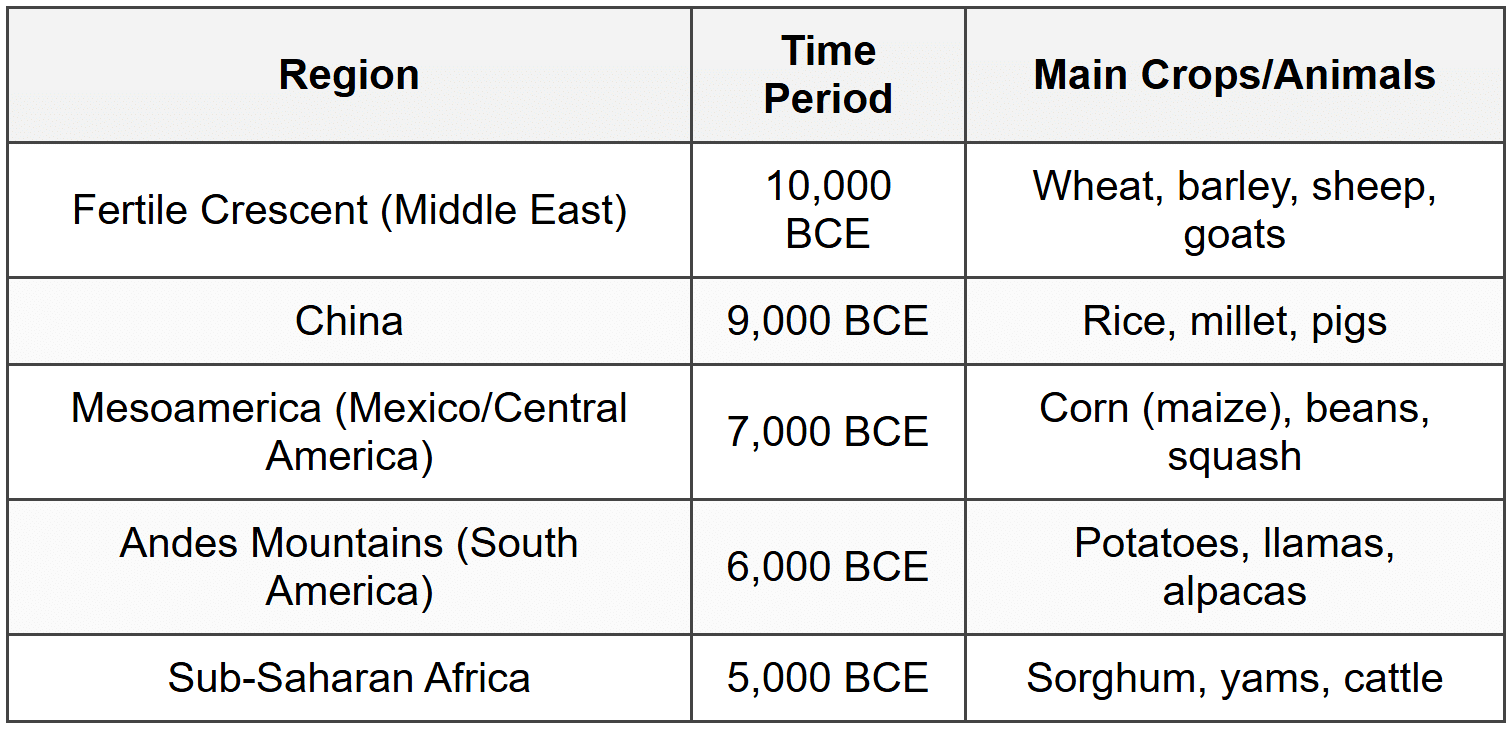
The development of agriculture involved both domestication of plants and domestication of animals. Domestication means deliberately breeding plants and animals to develop traits useful to humans. For example, early farmers selected wheat seeds from plants with the largest kernels, and over many generations, this created wheat varieties with much larger, more nutritious grains than wild wheat. Similarly, people domesticated wild animals by breeding those with the most docile temperaments, creating sheep, goats, pigs, and cattle that were easier to manage than their wild ancestors.
Imagine slowly transforming a wolf into a dog over hundreds of generations by only allowing the friendliest wolves to reproduce. This is essentially how domestication worked-patient selection over many lifetimes gradually created entirely new varieties of plants and animals.
The Agricultural Revolution had profound consequences for human society:
- Permanent settlements - Farming required people to stay in one place to plant, tend, and harvest crops. This led to the first permanent villages and towns.
- Population growth - Agriculture produced more reliable and abundant food supplies than hunting and gathering, allowing populations to increase dramatically.
- Food surpluses - For the first time, communities could produce more food than immediately needed, allowing them to store food for winter or times of scarcity.
- Specialization of labor - When not everyone needed to produce food, some people could become craftspeople, religious leaders, or administrators, developing specialized skills.
- Social hierarchy - As some people accumulated more resources than others, societies developed class structures with leaders, religious authorities, craftspeople, farmers, and laborers.
- Property ownership - The concept of owning land became important because farmers invested time and labor improving specific plots of ground.
- Technological innovation - Settled communities developed new technologies including pottery for storing food, woven textiles for clothing, and eventually metal working.
Neolithic people created more sophisticated tools than earlier periods. They learned to polish stone tools, making them smoother and more effective. They developed grinding stones to process grain into flour. They invented the pottery wheel to create uniform clay vessels for cooking and storage. They also began using looms to weave plant fibers and animal wool into cloth.
Architecture advanced significantly during the Neolithic Age. People built substantial houses from mud bricks, wood, and stone. Some communities constructed impressive structures like Stonehenge in England (built around 3,000 BCE), a massive circle of standing stones whose exact purpose remains debated but likely served religious or astronomical functions.
Early Human Species and Evolution
The story of prehistory is also the story of human evolution. Modern humans (Homo sapiens) did not suddenly appear fully formed but evolved over millions of years from earlier species.
Early Hominins
Hominins are humans and their extinct ancestors who walked upright on two legs. The earliest hominins appeared in Africa approximately 6 to 7 million years ago. Walking upright, called bipedalism, was a crucial adaptation because it freed the hands for carrying objects and using tools.
One famous early hominin is Australopithecus afarensis, which lived about 3 to 4 million years ago. The most famous fossil from this species is "Lucy," discovered in Ethiopia in 1974. Lucy and her relatives walked upright but had smaller brains than modern humans and likely did not use complex tools.
The Homo Genus
The genus Homo (meaning "human") appeared about 2.5 million years ago. Several species of Homo existed over time, sometimes overlapping with each other:
Homo habilis ("handy man") lived approximately 2.4 to 1.4 million years ago and was among the first to make stone tools. These early humans had larger brains than australopithecines and lived in Africa.
Homo erectus ("upright man") appeared about 1.9 million years ago and was the first hominin to migrate out of Africa into Asia and Europe. Homo erectus used more sophisticated tools, controlled fire, and may have used basic language. This species survived until about 140,000 years ago.
Homo neanderthalensis (Neanderthals) lived in Europe and western Asia from about 400,000 to 40,000 years ago. Neanderthals were stocky and muscular, well-adapted to cold climates. They created complex tools, buried their dead with ceremony, cared for sick and injured group members, and created simple art. For thousands of years, Neanderthals lived alongside modern humans, and DNA evidence shows that the two species interbred, meaning most people today carry some Neanderthal genes.
Homo Sapiens
Homo sapiens (modern humans) emerged in Africa between 300,000 and 200,000 years ago. Compared to earlier hominins, Homo sapiens had larger brains, more complex language abilities, and greater capacity for abstract thought and symbolic expression.
Around 70,000 to 100,000 years ago, groups of Homo sapiens began migrating out of Africa in what is called the Great Migration or Out of Africa migration. Over thousands of years, modern humans spread across the entire world:
- Middle East and Europe: 60,000-45,000 years ago
- Asia and Australia: 50,000-40,000 years ago
- Americas: 15,000-20,000 years ago (crossing from Asia via a land bridge where the Bering Strait is today)
- Pacific Islands: 3,000-1,000 years ago
By about 10,000 years ago, Homo sapiens were the only surviving human species. All humans alive today are members of this single species, despite surface differences in appearance. Genetic studies show that all humans share more than 99.9% of their DNA, making us one of the most genetically similar species on Earth.
Prehistoric Art and Culture
Evidence of culture-shared beliefs, customs, and artistic expression-appears throughout prehistory, showing that early humans were not merely focused on survival but also sought meaning, beauty, and connection.
Cave Art
Some of the most remarkable prehistoric artifacts are cave paintings found in Africa, Europe, and Asia. The most famous examples include the Lascaux Caves in France and Altamira Caves in Spain, both dating to approximately 15,000-17,000 years ago.
These paintings typically depict animals that people hunted-bison, horses, deer, and mammoths-along with human handprints and abstract symbols. The artists used natural pigments made from minerals like ochre (producing reds and yellows), charcoal (black), and manganese (dark browns and blacks). They applied these pigments with their fingers, primitive brushes made from plant fibers or animal hair, or by blowing pigment through hollow reeds.
The purpose of cave art remains debated. Some archaeologists believe the paintings had religious or spiritual significance, possibly related to hunting magic-the belief that depicting a successful hunt would make it happen in reality. Others suggest the caves served as gathering places where stories were told and cultural knowledge passed down. The fact that many paintings are located deep inside caves, requiring dangerous journeys to reach, suggests they held special importance.
Figurines and Sculpture
Prehistoric people created small carved figures from stone, bone, and ivory. The most famous are the Venus figurines-small sculptures of women with exaggerated features, particularly emphasized hips, breasts, and abdomens. These figures, found across Europe and dating from 35,000 to 10,000 years ago, may have represented fertility, motherhood, or female deities, though their exact purpose remains uncertain.
Burial Practices
Evidence of deliberate burial appears as early as 100,000 years ago. Many prehistoric burial sites contain not just bodies but also grave goods-objects placed with the deceased like tools, jewelry, weapons, and food. The inclusion of these items suggests belief in an afterlife or spiritual realm where the dead person would need these possessions.
Some burials show elaborate care. Bodies were positioned in specific ways, sometimes in a fetal position. Some were decorated with ochre pigment or adorned with shell necklaces and other ornaments. This ritual treatment of the dead indicates that prehistoric people had developed concepts of death, memory, and possibly religion.
Music and Ritual
Archaeological evidence shows that prehistoric people created music. Bone flutes dating back 40,000 years have been discovered in Europe, capable of playing multiple notes. Drums could be made from hollow logs and animal skins. Music likely accompanied rituals, celebrations, and storytelling.
The Transition to Civilization
The Neolithic Revolution set the stage for the emergence of the first civilizations. As agricultural villages grew larger and more complex, they developed characteristics that historians use to define civilization:
- Cities - large, densely populated permanent settlements
- Organized government - formal systems of leadership and laws
- Complex social structures - distinct social classes with different roles and status levels
- Organized religion - formal religious institutions with specialized priests
- Specialization of labor - people working in diverse professions beyond farming
- Record keeping and writing - systems to track resources, events, and ideas
- Art and architecture - monumental buildings and sophisticated artistic traditions
- Public works - large-scale construction projects like irrigation systems, roads, and defensive walls
By about 3,500 to 3,000 BCE, the first true civilizations appeared in several river valleys where agriculture was particularly productive. These included:
- Mesopotamia (between the Tigris and Euphrates Rivers in modern Iraq)
- Egypt (along the Nile River)
- The Indus Valley (in modern Pakistan and India)
- China (along the Yellow River)
The development of writing systems in these civilizations marks the traditional end of prehistory and the beginning of recorded history. Once people could write down their laws, religious beliefs, business transactions, and historical events, they left direct testimony of their thoughts and experiences for future generations.
The invention of writing represents one of humanity's most significant achievements. For the first time, knowledge could be preserved precisely, transmitted across vast distances, and passed to future generations without relying solely on human memory.
Why Prehistory Matters
Studying prehistory helps us understand fundamental aspects of human nature and society. During these millions of years, humans developed the basic capacities that define us: language, abstract thought, cooperation, creativity, and the ability to modify our environment.
The Agricultural Revolution demonstrates humanity's innovative problem-solving. Faced with climate change and the extinction of ice age animals, people didn't simply adapt to new conditions-they transformed their entire way of life, deliberately reshaping plants and animals to meet their needs. This same innovative spirit continues to drive human progress today.
Prehistory also reveals the long timeline of human development. Modern civilization, with its cities, technology, and writing, represents only the last tiny fraction of human existence. For more than 95% of human history, people lived as mobile hunter-gatherers in small groups. Understanding this helps explain certain human behaviors and preferences that evolved during those long prehistoric millennia.
Finally, prehistoric evidence shows that all humans share common ancestors. Every person alive today descends from the same Homo sapiens populations that emerged in Africa. The spread of humans across the globe and our subsequent development of diverse cultures demonstrates both our fundamental unity as a species and our remarkable ability to adapt to vastly different environments while maintaining what makes us essentially human.
FAQs on Chapter Notes: Prehistory
| 1. What is prehistory? |  |
| 2. What are the main periods of the Stone Age? | |
| 3. Who were the early human species, and how did they evolve? | |
| 4. What is prehistoric art, and why is it significant? | |
| 5. How did the transition to civilisation occur during prehistory? | |
