PE Exam Exam > PE Exam Notes > Engineering Fundamentals Revision for PE > Cheatsheet: Time Value of Money
Cheatsheet: Time Value of Money


1. Fundamental Concepts
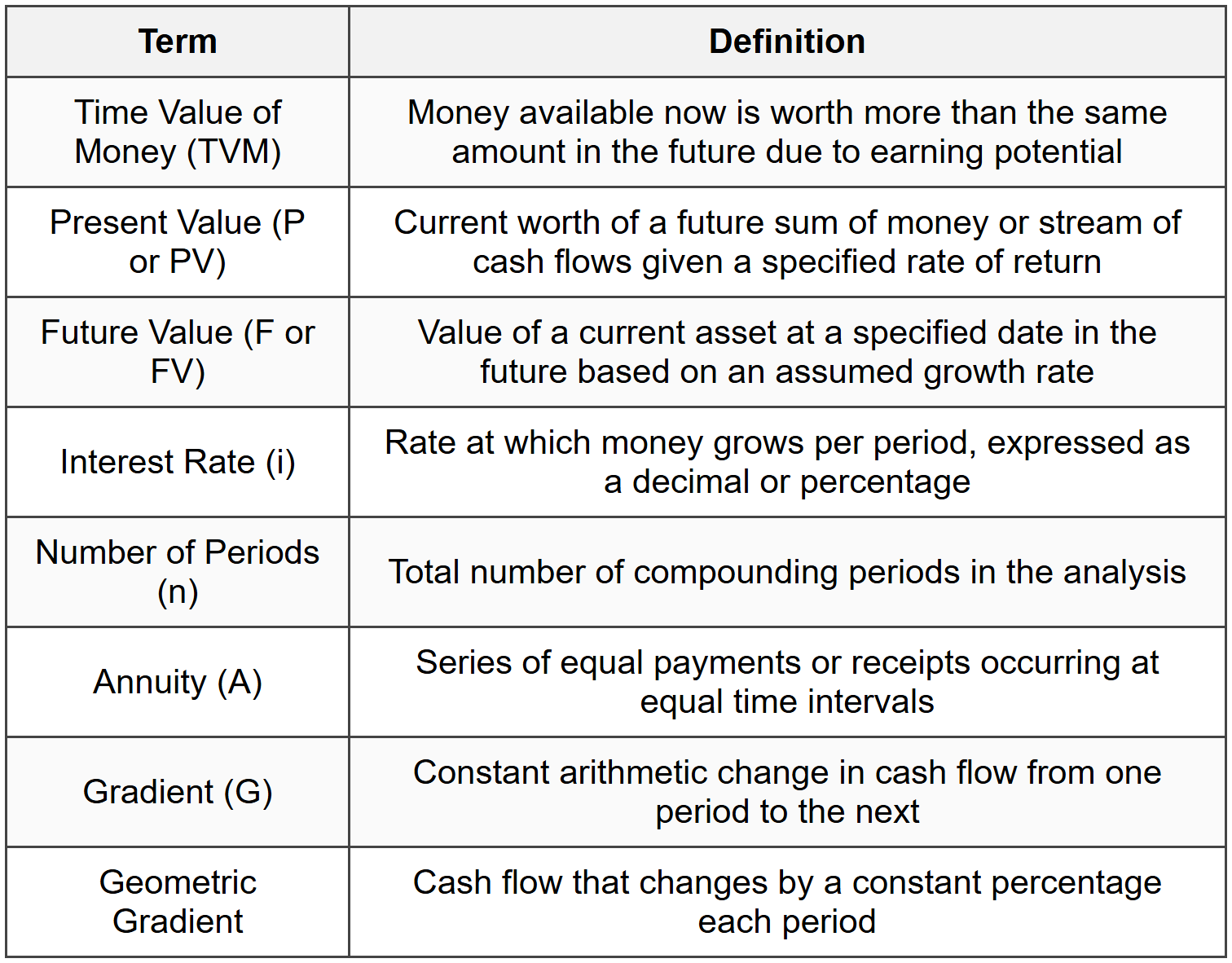
1.1 Core Definitions
1.2 Cash Flow Conventions
- End-of-Period Convention: Cash flows occur at the end of each period (standard assumption)
- Beginning-of-Period: Cash flows occur at the start of each period (annuity due)
- Inflows: Positive cash flows (receipts, revenues, salvage values)
- Outflows: Negative cash flows (costs, expenses, investments)
- Net Cash Flow: Inflows minus outflows for a given period
2. Single Payment Formulas
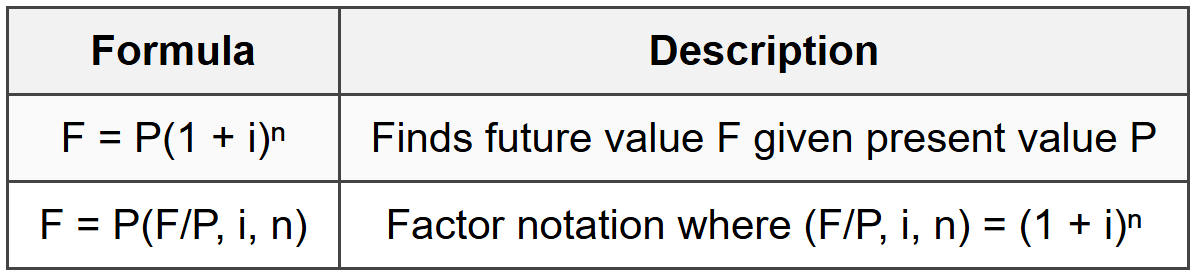
2.1 Compound Amount Factor (F/P)
2.2 Present Worth Factor (P/F)

2.3 Relationship
- (F/P, i, n) and (P/F, i, n) are reciprocals: (F/P) × (P/F) = 1
- Both factors depend on interest rate i and number of periods n
3. Uniform Series Formulas
3.1 Compound Amount Factor (F/A)

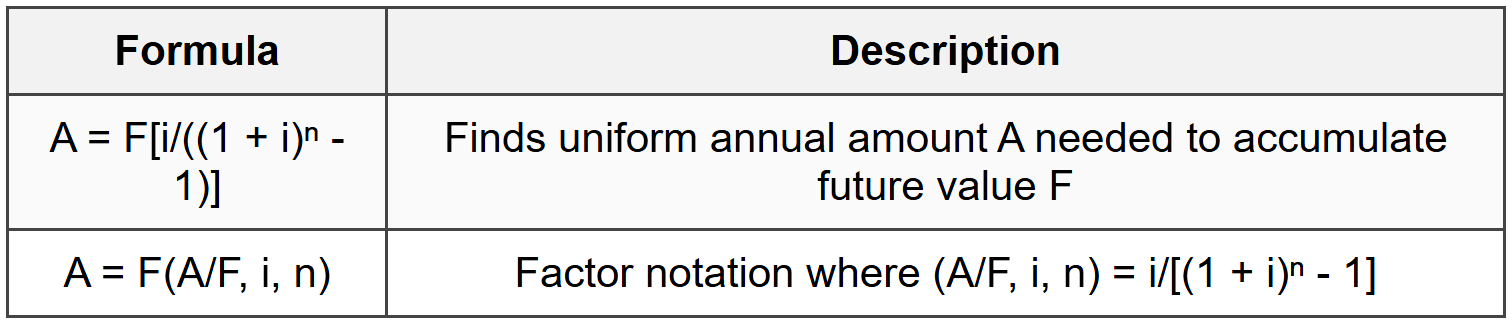
3.2 Sinking Fund Factor (A/F)
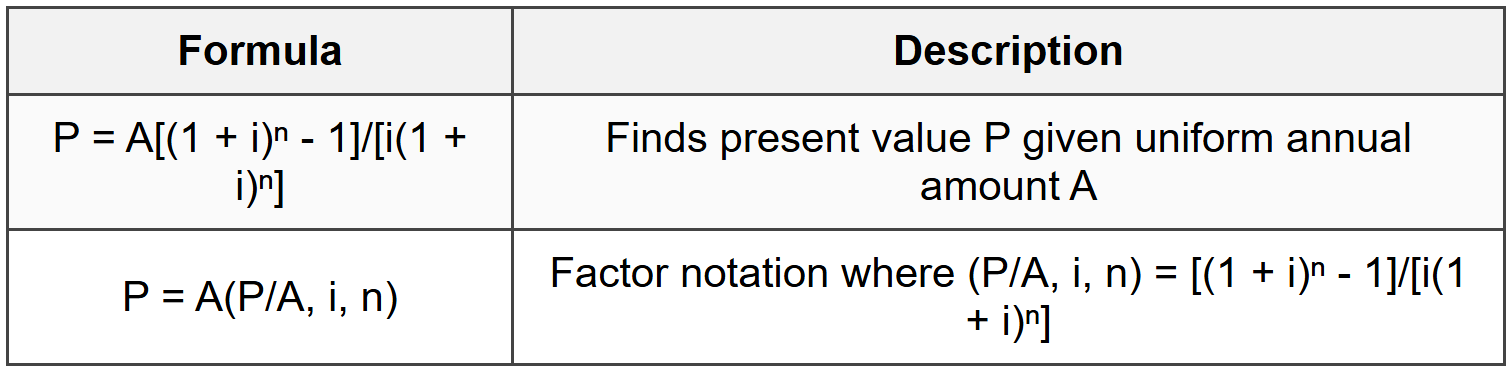
3.3 Present Worth Factor (P/A)
3.4 Capital Recovery Factor (A/P)

3.5 Uniform Series Relationships
- (F/A, i, n) and (A/F, i, n) are reciprocals
- (P/A, i, n) and (A/P, i, n) are reciprocals
- (P/A, i, n) = (P/F, i, n) × (F/A, i, n)
- (A/P, i, n) = (A/F, i, n) + i
4. Gradient Formulas
4.1 Arithmetic Gradient
4.1.1 Gradient Present Worth Factor (P/G)
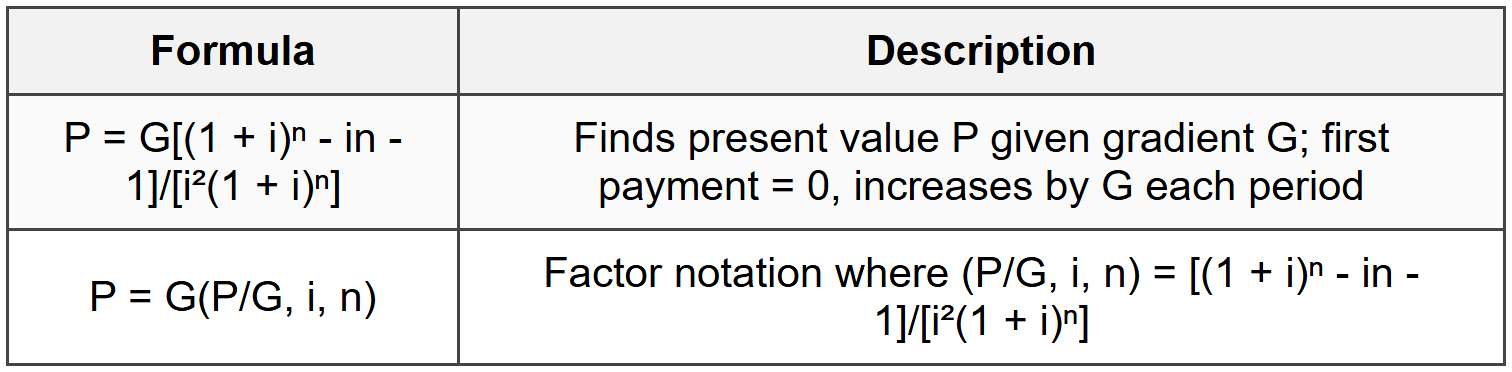
4.1.2 Gradient Uniform Series Factor (A/G)

4.1.3 Combined Uniform Series and Gradient
- Cash flow at period t: CFt = A₁ + (t - 1)G, where A₁ is the first payment
- Present value: P = A₁(P/A, i, n) + G(P/G, i, n)
- Equivalent uniform: A = A₁ + G(A/G, i, n)
4.2 Geometric Gradient
4.2.1 When g ≠ i

4.2.2 When g = i

5. Interest Rate Concepts
5.1 Nominal vs. Effective Interest Rates

5.2 Continuous Compounding
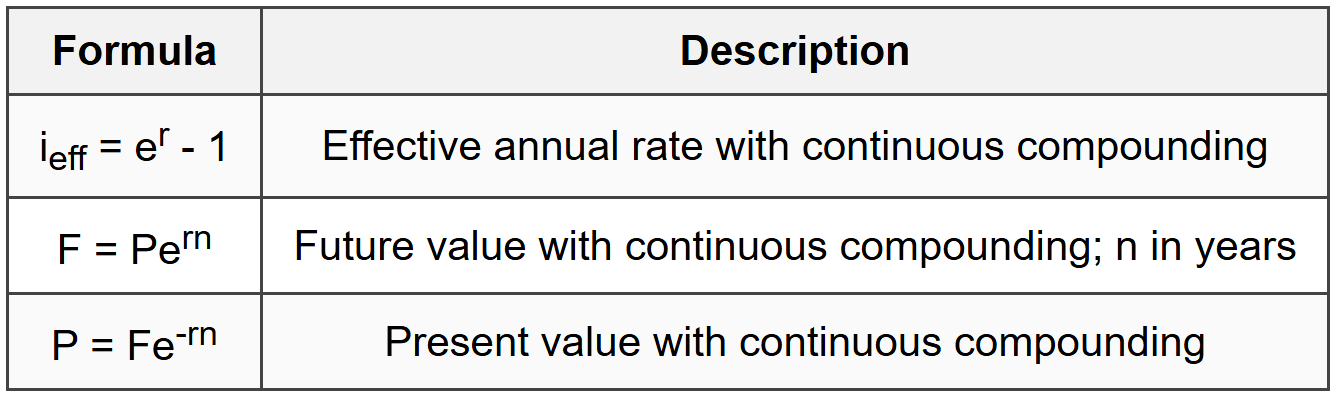
5.3 Common Compounding Frequencies
- Annual: m = 1
- Semiannual: m = 2
- Quarterly: m = 4
- Monthly: m = 12
- Daily: m = 365
- Continuous: m → ∞
6. Economic Equivalence
6.1 Equivalence Principle
- Two cash flows are equivalent if they have the same value at a common point in time using the same interest rate
- Equivalence depends on both interest rate and timing
- Different cash flow patterns can have identical present or future values
6.2 Converting Between Time Points
- Use compound interest factors to move values forward or backward in time
- Moving forward: multiply by (F/P) or (F/A) factors
- Moving backward: multiply by (P/F) or (P/A) factors
- Can convert to any common time point (present, future, or intermediate)
7. Special Cases and Applications
7.1 Deferred Annuities
- Annuity with first payment occurring after more than one period
- Method 1: Find P at one period before first payment, then discount back to time 0
- Method 2: P = A(P/A, i, n) × (P/F, i, d), where d is deferral periods
7.2 Perpetuity

7.3 Capitalized Cost
- Present value of an infinite series of cash flows
- Used for permanent installations or indefinite service life
- Pcapitalized = Initial cost + (Recurring cost)/i
7.4 Bond Valuation
- Bond value = Present value of interest payments + Present value of face value
- P = (Face value × Interest rate)(P/A, i, n) + Face value(P/F, i, n)
- Interest rate is coupon rate; i is market yield rate
8. Problem-Solving Strategies
8.1 Standard Approach
- Draw a cash flow diagram with time on horizontal axis, cash flows as arrows
- Identify given values: P, F, A, G, i, n
- Identify unknown variable to solve for
- Select appropriate formula or factor combination
- Substitute values and calculate
- Check units and reasonableness of answer
8.2 Cash Flow Diagram Conventions
- Time periods marked on horizontal axis (0, 1, 2, ..., n)
- Upward arrows represent inflows (positive)
- Downward arrows represent outflows (negative)
- Arrow length proportional to magnitude (optional)
- Label all known values and the unknown
8.3 Common Pitfalls
- Mismatching payment periods with compounding periods
- Forgetting that (P/A) assumes first payment at end of period 1
- Incorrect handling of gradient starting point (gradient starts at 0)
- Using nominal rate when effective rate is required
- Sign errors in cash flows (mixing inflows and outflows)
9. Factor Relationships Summary
9.1 Reciprocal Pairs

9.2 Useful Combinations
- (P/A, i, n) = (P/F, i, n) × (F/A, i, n)
- (A/P, i, n) = (A/F, i, n) + i
- (A/F, i, n) = (A/P, i, n) - i
- (F/A, i, n) = (F/P, i, n) × (P/A, i, n)
9.3 Limit Cases
- When n = 1: (F/P, i, 1) = (1 + i); (P/A, i, 1) = (P/F, i, 1)
- When n → ∞: (P/A, i, ∞) = 1/i; (A/P, i, ∞) = i; (A/F, i, ∞) = 0
- When i = 0: (F/P, 0, n) = 1; (P/A, 0, n) = n; (F/A, 0, n) = n
10. Quick Reference Tables
10.1 All TVM Factors

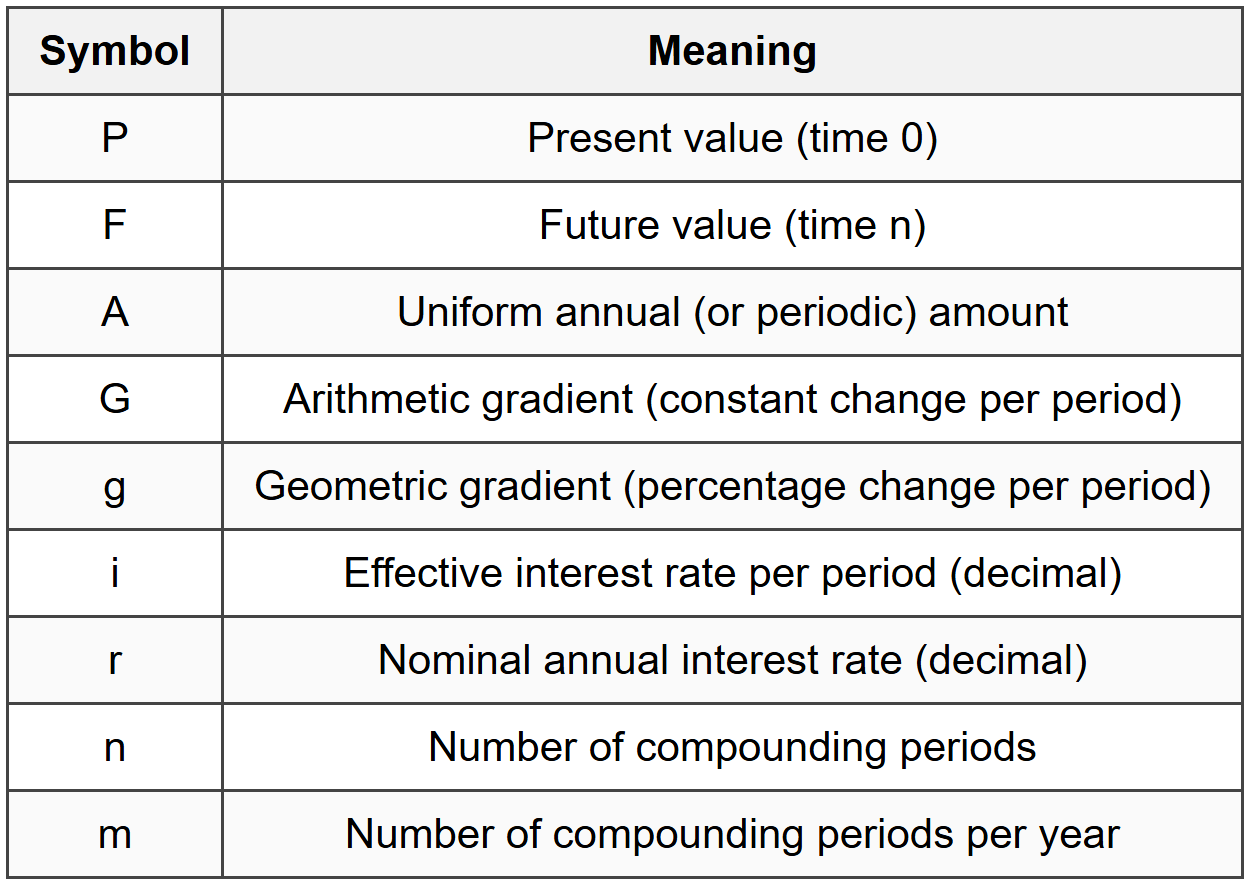
10.2 Variable Notation
The document Cheatsheet: Time Value of Money is a part of the PE Exam Course Engineering Fundamentals Revision for PE.
All you need of PE Exam at this link: PE Exam
About this Document

Apr 20, 2026 Last updated
Related Exams
Document Description: Cheatsheet: Time Value of Money for PE Exam 2026 is part of Engineering Fundamentals Revision for PE preparation. The notes and questions for Cheatsheet: Time Value of Money have been prepared according to the PE Exam exam syllabus. Information about Cheatsheet: Time Value of Money covers topics like and Cheatsheet: Time Value of Money Example, for PE Exam 2026 Exam. Find important definitions, questions, notes, meanings, examples, exercises and tests below for Cheatsheet: Time Value of Money.
Introduction of Cheatsheet: Time Value of Money in English is available as part of our Engineering Fundamentals Revision for PE for PE Exam & Cheatsheet: Time Value of Money in Hindi for Engineering Fundamentals Revision for PE course. Download more important topics related with notes, lectures and mock test series for PE Exam Exam by signing up for free. PE Exam: Cheatsheet: Time Value of Money
Description
Cheatsheet: Time Value of Money of Engineering Fundamentals Revision to help you remember important concepts with short tricks. Start learning for PE Exam exam & improve retention with EduRev.
Information about Cheatsheet: Time Value of Money
In this doc you can find the meaning of Cheatsheet: Time Value of Money defined & explained in the simplest way possible. Besides explaining types of Cheatsheet: Time Value of Money theory, EduRev gives you an ample number of questions to practice Cheatsheet: Time Value of Money tests, examples and also practice PE Exam tests



Related Searches
Previous Year Questions with Solutions, shortcuts and tricks, Exam, Summary, Extra Questions, Important questions, MCQs, Free, past year papers, Cheatsheet: Time Value of Money, study material, Cheatsheet: Time Value of Money, video lectures, ppt, Cheatsheet: Time Value of Money, pdf , practice quizzes, Sample Paper, Viva Questions, Objective type Questions, Semester Notes, mock tests for examination;