Chapter Notes: Colonial America


In the early 1600s, European nations began establishing permanent settlements along the eastern coast of North America. Over the next 150 years, thirteen distinct British colonies developed, each with its own culture, economy, and way of life. These colonies would eventually unite to form the United States of America. Understanding Colonial America means exploring why colonists came, how they survived, and how different regions developed their own unique characteristics.
Reasons for Colonization
People left Europe for the Americas for several important reasons. Economic opportunity motivated many colonists. In England and other European countries, land was expensive and difficult to obtain. The promise of owning land and building wealth in the New World attracted thousands of settlers. Religious freedom drove others to cross the Atlantic Ocean. Many groups faced persecution in Europe because of their beliefs and sought a place where they could worship freely.
Some came seeking adventure and a fresh start, while others arrived against their will. Indentured servants-people who agreed to work for several years in exchange for passage to America-made up a significant portion of early colonists. Enslaved Africans were forcibly brought to the colonies beginning in 1619, though the system of slavery expanded dramatically over time.
- Gold and riches: Early colonists hoped to find precious metals and natural resources
- Religious persecution: Groups like Puritans, Quakers, and Catholics sought freedom to practice their faith
- Overpopulation: England's growing population meant fewer opportunities at home
- Political freedom: Some colonists wanted escape from strict laws and monarchies
- Debt relief: Georgia was founded partly as a place for debtors to start over
Early Settlements and Challenges
The first permanent English settlement was Jamestown, Virginia, founded in 1607. The Virginia Company, a joint-stock company, sponsored this venture hoping to profit from gold and other resources. The early years proved catastrophic. Colonists arrived unprepared for the harsh conditions. Many were gentlemen unaccustomed to physical labor. Disease, starvation, and conflict with the Powhatan Confederacy nearly destroyed the settlement.
During the winter of 1609-1610, known as the "Starving Time," approximately 80% of Jamestown's colonists died. Of the 500 settlers present in fall 1609, only 60 survived until spring. The colony survived only because of supply ships from England and eventually the cultivation of tobacco as a cash crop. John Rolfe introduced a sweeter variety of tobacco in 1612 that became extremely profitable in European markets.
"There were never Englishmen left in a foreign country in such misery as we were in this new discovered Virginia." - George Percy, Jamestown colonist, 1609
This quote reveals the desperation and hardship colonists faced. Percy's words show that even the colonists themselves hadn't anticipated how difficult survival would be in the New World.
In 1620, the Pilgrims arrived at Plymouth, Massachusetts aboard the Mayflower. This group of Separatists sought complete independence from the Church of England. Before landing, they signed the Mayflower Compact, an agreement to create their own government and follow laws created for the common good. This document represented an early form of self-government in the colonies.
Like Jamestown, Plymouth faced severe challenges. Nearly half the Pilgrims died during their first winter. The colony survived with assistance from the Wampanoag people, particularly Squanto, who taught colonists to plant corn, fish local waters, and navigate the unfamiliar environment. The first Thanksgiving celebrated the colony's survival and harvest in fall 1621.
The Thirteen Colonies: Regional Differences
As more settlements developed, the thirteen colonies grouped into three distinct regions, each developing different economies, social structures, and ways of life based on geography, climate, and the people who settled there.
New England Colonies
The New England colonies included Massachusetts, Connecticut, Rhode Island, and New Hampshire. This region had rocky soil, dense forests, and cold winters that made large-scale farming difficult. Instead, New Englanders developed diverse economies based on available resources.
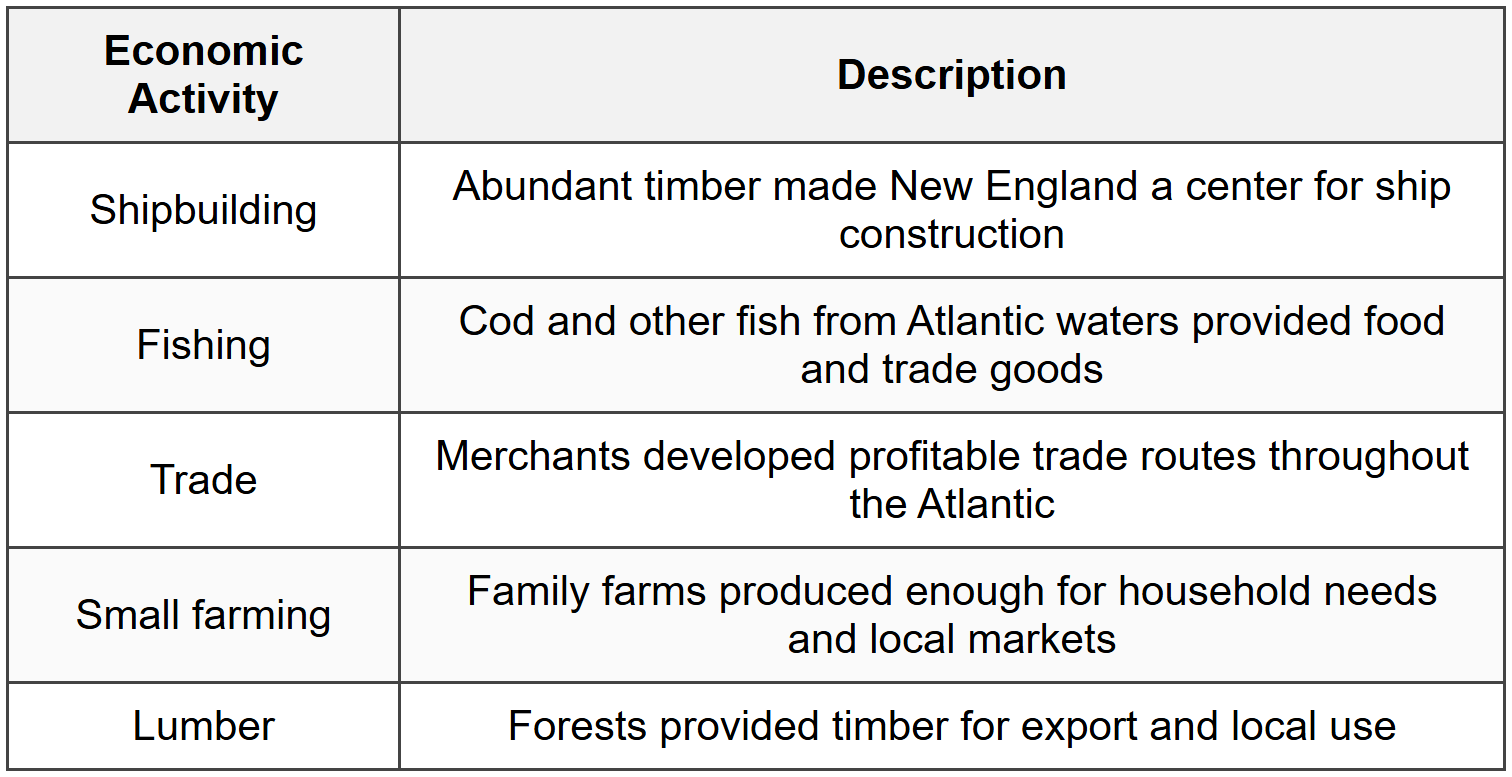
Puritans dominated New England society, especially in Massachusetts. They sought to create a "city upon a hill"-a model Christian community that would inspire others. Religion shaped daily life, education, and government. Towns built around a central meetinghouse where both religious services and town meetings occurred. Education was highly valued because Puritans believed everyone should read the Bible. Massachusetts passed laws requiring towns to establish schools, leading to higher literacy rates than other colonies.
However, Puritans also enforced strict religious conformity. Roger Williams was banished from Massachusetts in 1636 for arguing that government shouldn't enforce religious laws. He founded Rhode Island as a colony with religious tolerance and separation of church and state. Anne Hutchinson was also expelled for challenging Puritan ministers' authority and claiming individuals could interpret the Bible themselves.
Middle Colonies
The Middle Colonies-New York, Pennsylvania, New Jersey, and Delaware-were known as the "breadbasket colonies" because of their fertile soil and successful grain farming. Wheat, barley, and rye grew abundantly. The region had moderate climate and good harbors, encouraging both agriculture and trade.
These colonies were the most diverse in Colonial America. New Netherland, originally a Dutch colony, became New York when England seized it in 1664. Dutch, English, Swedish, German, and other European settlers mixed together. William Penn founded Pennsylvania in 1681 as a haven for Quakers, a religious group that believed in equality, pacifism, and direct communication with God. Penn established friendly relations with Native Americans, purchasing land rather than simply taking it.
The Middle Colonies attracted immigrants through religious tolerance and economic opportunity. Germans seeking religious freedom settled in Pennsylvania, becoming known as the Pennsylvania Dutch (from "Deutsch," meaning German). Jews, Catholics, Lutherans, and other groups found acceptance unavailable elsewhere.
Cities grew larger in the Middle Colonies than in other regions. Philadelphia became the largest colonial city, a center of trade, culture, and eventually revolutionary politics. New York City emerged as another major port. Think of these cities as the melting pots of Colonial America-places where different languages, religions, and traditions blended together.
Southern Colonies
The Southern Colonies-Maryland, Virginia, North Carolina, South Carolina, and Georgia-developed economies centered on agriculture and plantation farming. The warm climate, long growing season, and fertile soil made large-scale farming highly profitable.
Cash crops-crops grown primarily for sale rather than personal use-dominated Southern agriculture:
- Tobacco in Virginia and Maryland became so valuable it was sometimes used as money
- Rice in South Carolina's coastal lowlands required extensive labor and specialized knowledge
- Indigo, a plant producing blue dye, became profitable in South Carolina thanks to Eliza Lucas Pinckney's cultivation methods
The plantation system required enormous amounts of labor. Initially, planters relied on indentured servants from Europe. However, by the late 1600s, plantation owners increasingly turned to enslaved Africans. Several factors drove this shift: indentured servants eventually gained freedom; the supply of servants decreased; and racist laws made it possible to enslave Africans and their descendants permanently.
Slavery transformed Southern society. A small number of wealthy plantation owners controlled most of the land and political power. Most white Southerners owned small farms without enslaved workers, but the plantation elite set the region's social and economic tone. Enslaved people, who made up 40% of Virginia's population by 1750, had no legal rights. Families could be separated through sale. Slave codes-laws controlling enslaved people's behavior-became increasingly harsh, forbidding enslaved people from learning to read, gathering in groups, or traveling without permission.
Maryland was founded in 1632 by Lord Baltimore as a refuge for English Catholics facing persecution. However, Protestants soon outnumbered Catholics. Georgia, the last colony founded (1733), served multiple purposes: providing a buffer zone protecting South Carolina from Spanish Florida, offering opportunities for debtors, and initially prohibiting slavery (though this ban was later lifted).
Colonial Government and Political Development
Colonial governments developed traditions of self-rule that would eventually influence American democracy. Most colonies had similar governmental structures with three main parts:
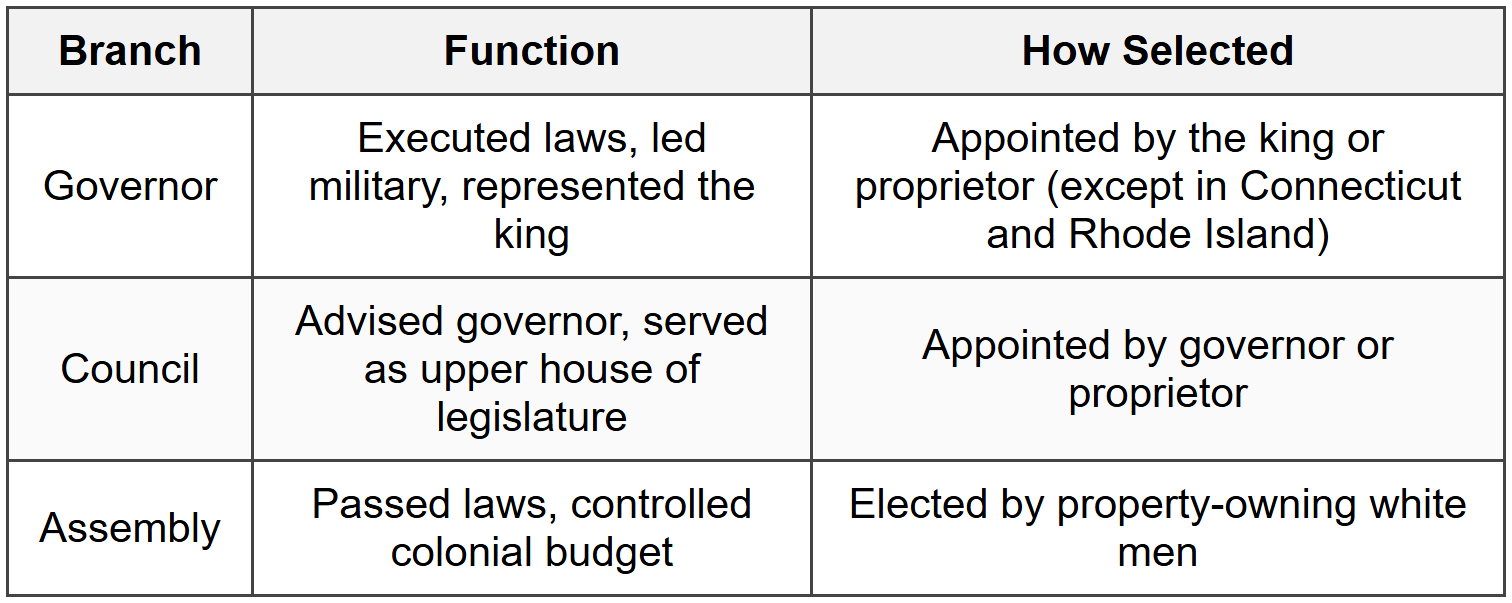
The colonial assemblies grew increasingly powerful because they controlled tax money. Governors needed assembly approval to pay for government operations and their own salaries. This gave assemblies leverage to resist unpopular policies.
The House of Burgesses in Virginia, established in 1619, was the first representative assembly in the colonies. Only white men who owned property could vote or serve, but this still represented more political participation than most Europeans enjoyed. New England town meetings allowed eligible residents to debate and vote on local issues directly.
These early experiences with self-government taught colonists to value representation and resist authority they considered unjust. Colonial assemblies became training grounds for the political leaders who would later challenge British rule.
Relations with Native Americans
European colonization devastated Native American populations and ways of life. The arrival of colonists brought catastrophic changes that reshaped the continent.
Disease proved the deadliest impact. Native Americans had no immunity to European diseases like smallpox, measles, and influenza. Epidemics swept through indigenous communities, sometimes killing 90% of a population. Entire villages disappeared. This demographic catastrophe weakened Native American societies' ability to resist European expansion.
Relations between colonists and Native Americans varied by region and time period but followed similar patterns:
- Initial cooperation: Early colonists often depended on Native American knowledge, food, and trade
- Growing tensions: As colonies expanded, competition over land intensified
- Violent conflict: Wars erupted as colonists pushed onto Native American territories
- Displacement: Native Americans were forced from ancestral lands
King Philip's War (1675-1676) was the deadliest conflict in New England. Metacom, called King Philip by colonists, led a coalition of Native American tribes against English settlements. The war devastated both sides. Thousands died, and many Native American survivors were sold into slavery or fled the region. The war effectively ended Native American resistance in southern New England.
In the Chesapeake region, the Powhatan Confederacy initially traded with Jamestown colonists. However, as tobacco farming expanded, colonists seized more land. Wars in 1622 and 1644 failed to stop English expansion. By the late 1600s, the Powhatan Confederacy had been destroyed.
Some colonies attempted more peaceful approaches. William Penn negotiated land purchases with the Lenni Lenape (Delaware) people and maintained relatively good relations. However, after Penn's death, these arrangements broke down as later colonists ignored earlier agreements.
Colonial Society and Daily Life
Daily life in Colonial America varied greatly depending on region, social class, race, and gender. Most colonists lived on farms or in small villages, though cities grew throughout the period.
Family Life and Gender Roles
Colonial families were typically large, with six to eight children being common. Families functioned like small businesses-everyone contributed labor essential for survival. Children began working at young ages, boys helping with farming and girls with cooking, cleaning, and textile production.
Gender roles were strictly defined. Men held legal authority over households and property. Women could not vote, and married women could not own property independently-everything belonged to their husbands under coverture laws. Despite these limitations, women's work was essential. They managed households, preserved food, made clothing, tended gardens, and often assisted with farm work. Widows sometimes ran businesses or farms independently.
Education
Educational opportunities varied dramatically by region and gender. New England valued literacy most highly because Puritans believed everyone should read the Bible. Massachusetts required towns with 50 or more families to hire a schoolteacher. Boys typically received more education than girls, though basic literacy was encouraged for both.
In the Middle and Southern Colonies, education was less systematic. Wealthy families hired private tutors. Some children attended dame schools, where women taught basic reading and writing in their homes. Most children learned primarily through apprenticeships and family instruction rather than formal schooling.
Religion
Religion remained central to colonial life, though its influence varied. New England's Puritan communities integrated religion into all aspects of life. Church attendance was often mandatory. Ministers were respected community leaders.
The Great Awakening (1730s-1740s) was a religious revival that swept through the colonies. Preachers like Jonathan Edwards and George Whitefield delivered emotional sermons emphasizing personal faith over formal church rituals. The Great Awakening had important effects:
- It challenged established church authority, as people chose which preachers to follow
- It promoted the idea that individuals could make their own choices about important matters
- It united colonists from different regions around shared religious experiences
- It contributed to the growth of colleges like Princeton and Dartmouth
The Colonial Economy
The British mercantilist system shaped colonial economic development. Under mercantilism, colonies existed to benefit the mother country by providing raw materials and buying manufactured goods. Britain passed Navigation Acts requiring colonists to trade primarily with England and ship goods on English vessels.
Despite these restrictions, colonial economies grew. The triangular trade connected three regions-the colonies, Africa, and the West Indies-in profitable but morally devastating commerce. One common route involved:
- Ships carrying rum from New England to Africa
- Trading rum for enslaved Africans
- The Middle Passage-the horrific voyage transporting enslaved people to the Americas
- Selling enslaved people in the West Indies or Southern Colonies
- Purchasing sugar and molasses to bring back to New England
- Distilling molasses into rum to begin the cycle again
The Middle Passage represented one of history's greatest atrocities. Enslaved Africans were packed into ships in inhumane conditions. Disease, malnutrition, and abuse killed approximately 15% during the voyage. Those who resisted were brutally punished. Survivors arrived traumatized, separated from families and homelands, facing lives of forced labor.
Colonial merchants also traded fish, lumber, grain, and tobacco. Craftspeople produced goods ranging from furniture to iron tools. While most production remained small-scale, colonial economies diversified and grew wealthier throughout the period.
Slavery in Colonial America
Slavery became deeply embedded in colonial society, especially in the South, though enslaved people lived in all thirteen colonies. The first Africans arrived in Virginia in 1619, initially with ambiguous legal status similar to indentured servants. However, by the 1660s, colonial laws established chattel slavery-treating enslaved people as property that could be bought, sold, and inherited.
Slavery expanded dramatically in the late 1600s and throughout the 1700s. By 1750, enslaved Africans and African Americans comprised about 20% of the colonial population. In South Carolina, enslaved people actually outnumbered free people.
Enslaved people resisted their bondage in numerous ways:
- Day-to-day resistance: Working slowly, breaking tools, feigning illness
- Running away: Escaping to cities, frontiers, or other colonies
- Maintaining culture: Preserving African traditions, music, and spiritual practices
- Rebellion: Armed resistance, though rare, occurred periodically
The Stono Rebellion (1739) was the largest slave uprising in the colonies. Near Charleston, South Carolina, approximately 100 enslaved people seized weapons and marched toward Spanish Florida, which offered freedom to escaped slaves. Colonial militia crushed the rebellion, killing most participants. In response, South Carolina passed even harsher slave codes limiting enslaved people's movements and gatherings.
Free African Americans existed in small numbers throughout the colonies. Some gained freedom through manumission (being freed by owners), purchasing themselves, or descent from free mothers. However, free Black people faced severe discrimination and restrictions on their rights and opportunities.
Colonial Culture and the Enlightenment
By the mid-1700s, colonial society was becoming more sophisticated and connected to European intellectual movements. The Enlightenment-an intellectual movement emphasizing reason, science, and individual rights-influenced colonial thinkers.
Benjamin Franklin embodied Enlightenment ideals in America. A printer, scientist, inventor, and writer, Franklin conducted experiments with electricity, invented practical devices like bifocals and the Franklin stove, and promoted civic improvements in Philadelphia. His Poor Richard's Almanack spread practical wisdom and became a bestseller.
Colonial cities developed cultural institutions. Libraries, newspapers, and philosophical societies emerged. Colleges including Harvard (1636), William and Mary (1693), Yale (1701), and Princeton (1746) trained ministers and educated the colonial elite.
Printing presses spread information and ideas. By 1765, all thirteen colonies had newspapers. These publications reported news from Europe and other colonies, gradually helping colonists see themselves as part of a larger American community rather than just separate provinces.
Growing Tensions with Britain
Throughout the colonial period, Britain allowed colonies considerable self-governance through salutary neglect-informal policy of not strictly enforcing trade regulations and allowing colonial assemblies substantial power. This freedom led colonists to expect rights and representation.
However, tensions emerged periodically. Britain's mercantilist policies frustrated colonial merchants who wanted to trade freely. Colonial assemblies clashed with royal governors over taxation and authority. The colonies were developing their own American identity distinct from Britain.
The French and Indian War (1754-1763), called the Seven Years' War in Europe, marked a turning point. This conflict between Britain and France for control of North America involved colonial militias and Native American allies on both sides. George Washington, a young Virginia officer, gained military experience during early battles.
Britain won the war, gaining control of French territories east of the Mississippi River. However, the war left Britain deeply in debt. British leaders believed colonists should help pay war costs since the conflict had been fought partly to protect colonial interests. This decision to tax the colonies would spark the crisis leading to the American Revolution.
By 1763, the thirteen colonies had developed from struggling settlements into prosperous societies with over two million people. They had established traditions of self-government, diverse economies, and distinct regional cultures. Colonial America had created something new-societies that blended European, African, and Native American influences in ways that would shape the nation to come. The foundations laid during the colonial period would profoundly influence American government, economy, society, and values for centuries ahead.