Chapter Notes: Place Value


Numbers help us count, measure, and compare quantities every day. But did you know that the position of a digit in a number changes its value? This special idea is called place value. Understanding place value helps you read large numbers, compare them, and perform calculations correctly. When you see the number 555, each 5 means something different because of where it sits in the number. Let's explore how place value works and why it matters!
Understanding Place Value
In our number system, the position of a digit determines its value. This means that the same digit can represent different amounts depending on where it appears in a number. We call this system the base-ten system because each place is worth ten times more than the place to its right.
Think of place value like apartment buildings on a street. The same apartment number, like "5," means something different depending on which building it's in. The building gives the apartment its full address, just like the position gives a digit its full value.
Each position in a number has a special name:
- Ones place: The rightmost position
- Tens place: One position to the left of the ones
- Hundreds place: One position to the left of the tens
- Thousands place: One position to the left of the hundreds
- Ten thousands place: One position to the left of the thousands
- Hundred thousands place: One position to the left of the ten thousands
- Millions place: One position to the left of the hundred thousands
Here is how we organize these places in a table:

Reading and Writing Multi-Digit Numbers
When we read a number, we group the digits into periods. A period is a group of three digits separated by commas. The periods from right to left are: ones, thousands, and millions.
Let's look at the number 4,827,365:
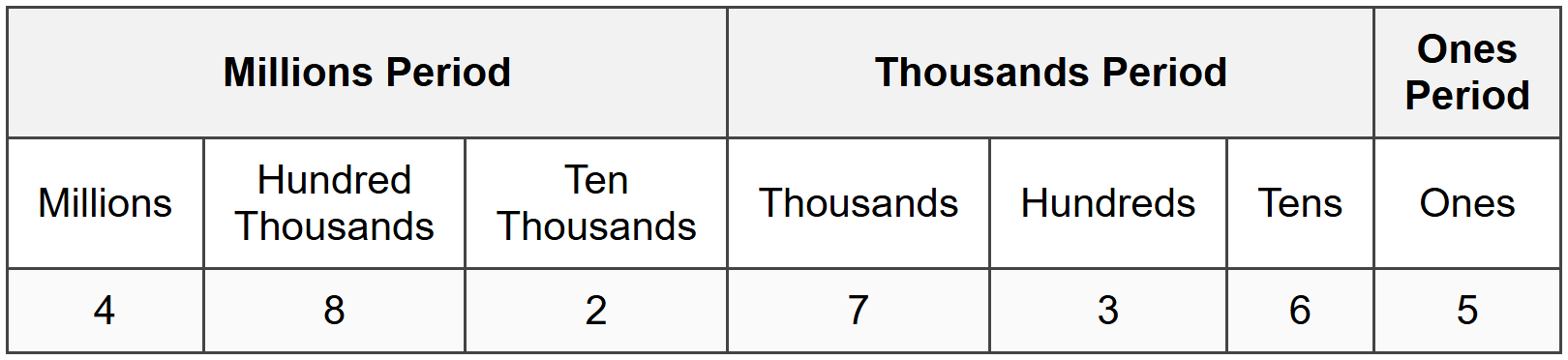
We read this number as: four million, eight hundred twenty-seven thousand, three hundred sixty-five.
Example: Write the number 6,305,492 in words.
What is this number written in words?
Solution:
First, identify the periods. The number has three periods: 6 (millions), 305 (thousands), and 492 (ones).
Read the millions period: six million
Read the thousands period: three hundred five thousand
Read the ones period: four hundred ninety-two
Combine all parts: six million, three hundred five thousand, four hundred ninety-two
The number 6,305,492 is written as six million, three hundred five thousand, four hundred ninety-two.
Example: Write the number name "two million, forty-one thousand, six hundred eight" in standard form.
What is the standard form of this number?
Solution:
Break the number into periods: two million = 2,000,000
Forty-one thousand = 41,000
Six hundred eight = 608
Add the values together: 2,000,000 + 41,000 + 608 = 2,041,608
The standard form is 2,041,608.
Expanded Form
The expanded form of a number shows the value of each digit separately. It helps us see exactly what each digit contributes to the total number. To write a number in expanded form, we multiply each digit by its place value and then add all the parts together.
For example, the number 3,456 in expanded form is:
3,000 + 400 + 50 + 6
Each part shows one digit multiplied by its place value:
- 3 × 1,000 = 3,000
- 4 × 100 = 400
- 5 × 10 = 50
- 6 × 1 = 6
Example: Write 52,738 in expanded form.
What is the expanded form?
Solution:
Identify each digit and its place value:
5 is in the ten thousands place: 5 × 10,000 = 50,000
2 is in the thousands place: 2 × 1,000 = 2,000
7 is in the hundreds place: 7 × 100 = 700
3 is in the tens place: 3 × 10 = 30
8 is in the ones place: 8 × 1 = 8
Write the expanded form: 50,000 + 2,000 + 700 + 30 + 8
The expanded form of 52,738 is 50,000 + 2,000 + 700 + 30 + 8.
Example: What number is represented by the expanded form 400,000 + 30,000 + 5,000 + 200 + 9?
What is the standard form?
Solution:
Look at each addend and identify the digit and place:
400,000 means 4 in the hundred thousands place
30,000 means 3 in the ten thousands place
5,000 means 5 in the thousands place
200 means 2 in the hundreds place
0 in the tens place (no tens are shown)
9 means 9 in the ones place
Combine all digits to write the standard form: 435,209
The number is 435,209.
Comparing Numbers Using Place Value
Place value helps us compare numbers to determine which is greater or whether two numbers are equal. When comparing numbers, we use these symbols:
- > means "greater than"
- means "less than"
- = means "equal to"
To compare two numbers, follow these steps:
- Line up the numbers by place value
- Start comparing from the leftmost place (the highest place value)
- If the digits are the same, move one place to the right and compare again
- The first place where the digits differ tells you which number is greater
Example: Compare 45,982 and 45,892.
Which number is greater?
Solution:
Line up the numbers by place value and compare from left to right:
Ten thousands: 4 = 4 (same, so continue)
Thousands: 5 = 5 (same, so continue)
Hundreds: 9 > 8 (different! 9 is greater than 8)
Since 9 > 8 in the hundreds place, we know 45,982 > 45,892
The number 45,982 is greater than 45,892.
Example: Use the symbols <,>, or = to compare 1,234,567 and 1,243,567.
Which symbol makes the statement true?
Solution:
Line up the numbers and compare from the left:
Millions: 1 = 1 (same)
Hundred thousands: 2 = 2 (same)
Ten thousands: 3 < 4="" (different!="" 3="" is="" less="" than="">
Since 3 < 4="" in="" the="" ten="" thousands="" place:="" 1,234,567=""><>
The correct symbol is , so 1,234,567 1,243,567.
Rounding Numbers
Rounding means changing a number to a nearby number that is easier to work with. We round numbers to a specific place value. When we round, we make a decision: do we round up or round down?
Here are the rules for rounding:
- Find the digit in the place you are rounding to
- Look at the digit immediately to the right (the next smaller place)
- If that digit is 5 or greater, round up (add 1 to the rounding place)
- If that digit is less than 5, round down (keep the rounding place the same)
- Change all digits to the right of the rounding place to zeros
Example: Round 7,846 to the nearest hundred.
What is 7,846 rounded to the nearest hundred?
Solution:
Find the hundreds place: the digit 8 is in the hundreds place
Look at the digit to the right: the digit in the tens place is 4
Since 4 < 5,="" round="" down="" (keep="" the="">
Change all digits to the right to zeros: 7,800
The number 7,846 rounded to the nearest hundred is 7,800.
Example: Round 452,678 to the nearest ten thousand.
What is 452,678 rounded to the nearest ten thousand?
Solution:
Find the ten thousands place: the digit 5 is in the ten thousands place
Look at the digit to the right: the digit in the thousands place is 2
Since 2 < 5,="" round="" down="" (keep="" the="">
Change all digits to the right to zeros: 450,000
The number 452,678 rounded to the nearest ten thousand is 450,000.
Example: Round 89,520 to the nearest thousand.
What is 89,520 rounded to the nearest thousand?
Solution:
Find the thousands place: the digit 9 is in the thousands place
Look at the digit to the right: the digit in the hundreds place is 5
Since 5 = 5, round up (add 1 to the 9, which gives 10)
When we add 1 to 9, we get 10, so we write 0 in the thousands place and carry 1 to the ten thousands place
This gives us 90,000
The number 89,520 rounded to the nearest thousand is 90,000.
Using Place Value with Addition and Subtraction
Understanding place value is essential when adding or subtracting multi-digit numbers. We always line up numbers by their place values, so that ones are under ones, tens are under tens, and so on. This ensures we are adding or subtracting digits with the same value.
When we add or subtract, we work from right to left, starting with the ones place. Sometimes we need to regroup, which means borrowing from or carrying to the next place value.
Example: Add 4,567 + 2,845 using place value.
What is the sum?
Solution:
Line up the numbers by place value:
4,567
+ 2,845Add the ones: 7 + 5 = 12 (write 2, carry 1 to the tens place)
Add the tens: 6 + 4 + 1 = 11 (write 1, carry 1 to the hundreds place)
Add the hundreds: 5 + 8 + 1 = 14 (write 4, carry 1 to the thousands place)
Add the thousands: 4 + 2 + 1 = 7
The sum is 7,412.
The answer is 7,412.
Example: Subtract 5,324 - 2,168 using place value.
What is the difference?
Solution:
Line up the numbers by place value:
5,324
- 2,168Ones: 4 - 8 cannot be done, so borrow 1 ten (making 14 ones); 14 - 8 = 6
Tens: 1 - 6 cannot be done (we borrowed 1, so we have 1 ten left), so borrow 1 hundred (making 11 tens); 11 - 6 = 5
Hundreds: 2 - 1 = 1 (we borrowed 1, so we have 2 hundreds left); 2 - 1 = 1
Thousands: 5 - 2 = 3
The difference is 3,156.
The answer is 3,156.
Place Value Patterns
Place value creates predictable patterns in our number system. Understanding these patterns helps you work with large numbers more easily.
Multiplying by 10, 100, and 1,000:
- When you multiply by 10, each digit moves one place to the left
- When you multiply by 100, each digit moves two places to the left
- When you multiply by 1,000, each digit moves three places to the left
For example:
- 45 × 10 = 450
- 45 × 100 = 4,500
- 45 × 1,000 = 45,000
Dividing by 10, 100, and 1,000:
- When you divide by 10, each digit moves one place to the right
- When you divide by 100, each digit moves two places to the right
- When you divide by 1,000, each digit moves three places to the right
For example:
- 4,500 ÷ 10 = 450
- 4,500 ÷ 100 = 45
- 45,000 ÷ 1,000 = 45
Example: What is 237 × 100?
Find the product.
Solution:
When we multiply by 100, each digit moves two places to the left
The digit 2 moves from the hundreds place to the ten thousands place
The digit 3 moves from the tens place to the thousands place
The digit 7 moves from the ones place to the hundreds place
We fill the empty ones and tens places with zeros: 23,700
The product of 237 × 100 is 23,700.
Zero as a Placeholder
The digit zero plays a special role in place value. Zero is a placeholder, which means it holds a position when there is no other digit in that place. Without zero, we could not tell the difference between numbers like 45 and 405.
Consider these examples:
- 405 has 4 hundreds, 0 tens, and 5 ones
- 45 has 4 tens and 5 ones
- 4,005 has 4 thousands, 0 hundreds, 0 tens, and 5 ones
Think of zero like an empty chair at a dinner table. Even though no one is sitting there, the chair still takes up a spot and affects where everyone else sits.
Example: Write the number that has 6 thousands, 0 hundreds, 4 tens, and 8 ones.
What is the number in standard form?
Solution:
Place each digit in its correct position:
6 goes in the thousands place
0 goes in the hundreds place (as a placeholder)
4 goes in the tens place
8 goes in the ones place
Write the complete number: 6,048
The number is 6,048.
Understanding place value is one of the most important skills in mathematics. It helps you read, write, compare, and compute with numbers of any size. Whether you are working with money, measuring distances, or solving problems, place value is the foundation that makes everything work!