Chapter Notes: Rounding Whole Numbers


Every day we work with numbers that are large or have many digits. Sometimes we don't need an exact number. When you tell a friend how many people were at a soccer game, you might say "about 500 people" instead of "497 people." This is called rounding. Rounding makes numbers easier to work with and understand. In this chapter, you will learn how to round whole numbers to the nearest ten, hundred, and thousand. You will also learn when rounding is helpful and how to use it in real-life situations.
What Is Rounding?
Rounding is a way to change a number to another number that is close to it but easier to use. When we round, we find the nearest ten, hundred, thousand, or other place value. The rounded number is not exact, but it is close enough for many purposes.
Think of rounding like this: Imagine you are standing on a number line between two "friendly" numbers. Rounding means choosing which friendly number you are closer to.
For example:
- The number 23 is between 20 and 30. It is closer to 20, so 23 rounds to 20.
- The number 28 is between 20 and 30. It is closer to 30, so 28 rounds to 30.
We use rounding when:
- We want a quick estimate
- An exact number is not needed
- We want to make mental math easier
- We are describing amounts in everyday conversation
Understanding Place Value
Before we round numbers, we need to understand place value. Every digit in a number has a place value that tells us how much it is worth.
Look at the number 3,572:
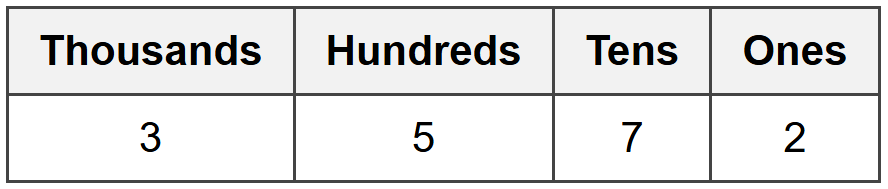
- The 3 is in the thousands place. It represents 3,000.
- The 5 is in the hundreds place. It represents 500.
- The 7 is in the tens place. It represents 70.
- The 2 is in the ones place. It represents 2.
When we round, we choose which place value we want to round to. Then we decide whether to round up or round down.
Rounding to the Nearest Ten
When we round to the nearest ten, we are finding which multiple of 10 is closest to our number. The multiples of 10 are: 10, 20, 30, 40, 50, 60, 70, 80, 90, 100, and so on.
Steps for Rounding to the Nearest Ten
- Find the tens place. This is the digit we are rounding to.
- Look at the digit to the right. This is the ones place. This digit helps us decide.
- Use the rounding rule:
- If the ones digit is 0, 1, 2, 3, or 4, round down. Keep the tens digit the same and change the ones digit to 0.
- If the ones digit is 5, 6, 7, 8, or 9, round up. Add 1 to the tens digit and change the ones digit to 0.
Helpful Tip: Remember the rule as "Five or above, give it a shove. Four or below, let it go." This means 5 or higher rounds up, and 4 or lower rounds down.
Example: Round 34 to the nearest ten.
What is 34 rounded to the nearest ten?
Solution:
Step 1: Find the tens place. The digit 3 is in the tens place.
Step 2: Look at the digit to the right. The digit 4 is in the ones place.
Step 3: Use the rounding rule. Since 4 is less than 5, we round down. Keep the tens digit as 3 and change the ones digit to 0.
34 rounds to 30.
The number 34 rounded to the nearest ten is 30.
Example: Round 67 to the nearest ten.
What is 67 rounded to the nearest ten?
Solution:
Step 1: Find the tens place. The digit 6 is in the tens place.
Step 2: Look at the digit to the right. The digit 7 is in the ones place.
Step 3: Use the rounding rule. Since 7 is 5 or greater, we round up. Add 1 to the tens digit (6 + 1 = 7) and change the ones digit to 0.
67 rounds to 70.
The number 67 rounded to the nearest ten is 70.
Example: Round 85 to the nearest ten.
What is 85 rounded to the nearest ten?
Solution:
Step 1: Find the tens place. The digit 8 is in the tens place.
Step 2: Look at the digit to the right. The digit 5 is in the ones place.
Step 3: Use the rounding rule. Since 5 equals 5, we round up. Add 1 to the tens digit (8 + 1 = 9) and change the ones digit to 0.
85 rounds to 90.
The number 85 rounded to the nearest ten is 90.
Rounding to the Nearest Hundred
When we round to the nearest hundred, we are finding which multiple of 100 is closest to our number. The multiples of 100 are: 100, 200, 300, 400, 500, 600, 700, 800, 900, 1,000, and so on.
Steps for Rounding to the Nearest Hundred
- Find the hundreds place. This is the digit we are rounding to.
- Look at the digit to the right. This is the tens place. This digit helps us decide.
- Use the rounding rule:
- If the tens digit is 0, 1, 2, 3, or 4, round down. Keep the hundreds digit the same and change all digits to the right to 0.
- If the tens digit is 5, 6, 7, 8, or 9, round up. Add 1 to the hundreds digit and change all digits to the right to 0.
Example: Round 342 to the nearest hundred.
What is 342 rounded to the nearest hundred?
Solution:
Step 1: Find the hundreds place. The digit 3 is in the hundreds place.
Step 2: Look at the digit to the right. The digit 4 is in the tens place.
Step 3: Use the rounding rule. Since 4 is less than 5, we round down. Keep the hundreds digit as 3 and change the tens and ones digits to 0.
342 rounds to 300.
The number 342 rounded to the nearest hundred is 300.
Example: Round 678 to the nearest hundred.
What is 678 rounded to the nearest hundred?
Solution:
Step 1: Find the hundreds place. The digit 6 is in the hundreds place.
Step 2: Look at the digit to the right. The digit 7 is in the tens place.
Step 3: Use the rounding rule. Since 7 is 5 or greater, we round up. Add 1 to the hundreds digit (6 + 1 = 7) and change the tens and ones digits to 0.
678 rounds to 700.
The number 678 rounded to the nearest hundred is 700.
Example: Round 850 to the nearest hundred.
What is 850 rounded to the nearest hundred?
Solution:
Step 1: Find the hundreds place. The digit 8 is in the hundreds place.
Step 2: Look at the digit to the right. The digit 5 is in the tens place.
Step 3: Use the rounding rule. Since 5 equals 5, we round up. Add 1 to the hundreds digit (8 + 1 = 9) and change the tens and ones digits to 0.
850 rounds to 900.
The number 850 rounded to the nearest hundred is 900.
Rounding to the Nearest Thousand
When we round to the nearest thousand, we are finding which multiple of 1,000 is closest to our number. The multiples of 1,000 are: 1,000, 2,000, 3,000, 4,000, 5,000, and so on.
Steps for Rounding to the Nearest Thousand
- Find the thousands place. This is the digit we are rounding to.
- Look at the digit to the right. This is the hundreds place. This digit helps us decide.
- Use the rounding rule:
- If the hundreds digit is 0, 1, 2, 3, or 4, round down. Keep the thousands digit the same and change all digits to the right to 0.
- If the hundreds digit is 5, 6, 7, 8, or 9, round up. Add 1 to the thousands digit and change all digits to the right to 0.
Example: Round 3,241 to the nearest thousand.
What is 3,241 rounded to the nearest thousand?
Solution:
Step 1: Find the thousands place. The digit 3 is in the thousands place.
Step 2: Look at the digit to the right. The digit 2 is in the hundreds place.
Step 3: Use the rounding rule. Since 2 is less than 5, we round down. Keep the thousands digit as 3 and change the hundreds, tens, and ones digits to 0.
3,241 rounds to 3,000.
The number 3,241 rounded to the nearest thousand is 3,000.
Example: Round 6,789 to the nearest thousand.
What is 6,789 rounded to the nearest thousand?
Solution:
Step 1: Find the thousands place. The digit 6 is in the thousands place.
Step 2: Look at the digit to the right. The digit 7 is in the hundreds place.
Step 3: Use the rounding rule. Since 7 is 5 or greater, we round up. Add 1 to the thousands digit (6 + 1 = 7) and change the hundreds, tens, and ones digits to 0.
6,789 rounds to 7,000.
The number 6,789 rounded to the nearest thousand is 7,000.
Example: Round 4,500 to the nearest thousand.
What is 4,500 rounded to the nearest thousand?
Solution:
Step 1: Find the thousands place. The digit 4 is in the thousands place.
Step 2: Look at the digit to the right. The digit 5 is in the hundreds place.
Step 3: Use the rounding rule. Since 5 equals 5, we round up. Add 1 to the thousands digit (4 + 1 = 5) and change the hundreds, tens, and ones digits to 0.
4,500 rounds to 5,000.
The number 4,500 rounded to the nearest thousand is 5,000.
Special Cases in Rounding
Numbers That End in Zero
Sometimes the digit you need to look at is already a zero. When this happens, you round down because zero is less than 5.
Example: Round 340 to the nearest hundred.
What is 340 rounded to the nearest hundred?
Solution:
Step 1: Find the hundreds place. The digit 3 is in the hundreds place.
Step 2: Look at the digit to the right. The digit 4 is in the tens place.
Step 3: Use the rounding rule. Since 4 is less than 5, we round down.
340 rounds to 300.
The number 340 rounded to the nearest hundred is 300.
Numbers That Are Exactly Halfway
When a number is exactly halfway between two rounding numbers, we always round up. For example, 25 is exactly halfway between 20 and 30. We round 25 up to 30.
Rounding Large Numbers
The same rules work for numbers of any size. You just need to identify the correct place value and look at the digit to the right.
Example: Round 47,832 to the nearest thousand.
What is 47,832 rounded to the nearest thousand?
Solution:
Step 1: Find the thousands place. The digit 7 is in the thousands place.
Step 2: Look at the digit to the right. The digit 8 is in the hundreds place.
Step 3: Use the rounding rule. Since 8 is 5 or greater, we round up. Add 1 to the thousands digit (7 + 1 = 8) and change all digits to the right to 0.
47,832 rounds to 48,000.
The number 47,832 rounded to the nearest thousand is 48,000.
Using Rounding in Real Life
Rounding helps us understand numbers quickly and make good estimates. Here are some situations where rounding is useful:
- Money: A jacket costs $48. You might say it costs "about $50."
- Attendance: There were 1,847 people at a basketball game. The news reports "about 2,000 people attended."
- Distance: A trip is 287 miles. You tell your friend it is "about 300 miles."
- Time: You worked for 123 minutes. You could say you worked for "about 120 minutes" or "about 2 hours."
Rounding is like using a shortcut for numbers. You give up a little accuracy to gain simplicity and speed.
When NOT to Round
While rounding is helpful, there are times when we need exact numbers:
- Counting money in a cash register
- Measuring medicine doses
- Recording test scores
- Keeping track of inventory in a store
- Building something that needs precise measurements
Tips for Success with Rounding
- Identify the place value first. Circle or underline the digit you are rounding to.
- Look to the right. The digit immediately to the right is your "helper digit."
- Remember the rule: 0-4 round down, 5-9 round up.
- Change all digits to the right to zero. After rounding, all places smaller than the rounding place become zero.
- Practice with real numbers. Use prices, populations, or distances you see every day.
Comparing Rounded Numbers
Sometimes we round numbers to compare them more easily. When two numbers are rounded to the same place value, it is easier to see which is larger or if they are close in size.
Example: Compare 3,842 and 4,156 by rounding each to the nearest thousand.
Which number is larger when both are rounded?
Solution:
First, round 3,842 to the nearest thousand. The thousands digit is 3. The hundreds digit is 8. Since 8 is 5 or greater, round up. 3,842 rounds to 4,000.
Next, round 4,156 to the nearest thousand. The thousands digit is 4. The hundreds digit is 1. Since 1 is less than 5, round down. 4,156 rounds to 4,000.
Both numbers round to 4,000.
When rounded to the nearest thousand, both numbers are about 4,000, so they are very close in size.
Summary of Rounding Rules
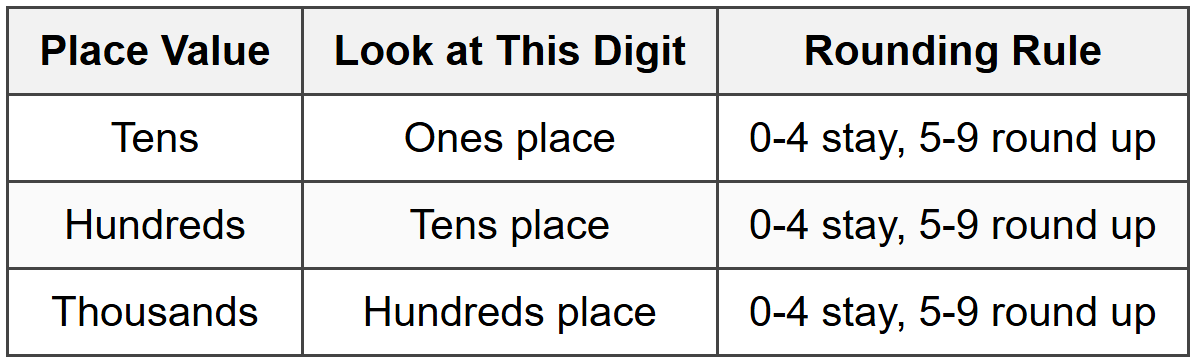
Rounding whole numbers is a skill you will use throughout math and in your everyday life. By understanding place value and following simple rounding rules, you can quickly estimate and communicate numbers with confidence. Remember: rounding is about finding the nearest "friendly" number that makes calculations and comparisons easier!