Chapter Notes: Adding Multi-Digit Numbers


Adding numbers is one of the most important math skills you will ever learn. You already know how to add small numbers, like 5 + 3 or 12 + 6. Now you are ready to add much bigger numbers-numbers with two digits, three digits, or even more! When we add multi-digit numbers, we use special strategies to keep our work organized and accurate. Multi-digit means a number with more than one digit, like 45, 328, or 1,562. In this chapter, you will learn how to add these larger numbers step by step, using tools like place value and regrouping. By the end, you will be able to add big numbers quickly and confidently!
Understanding Place Value in Addition
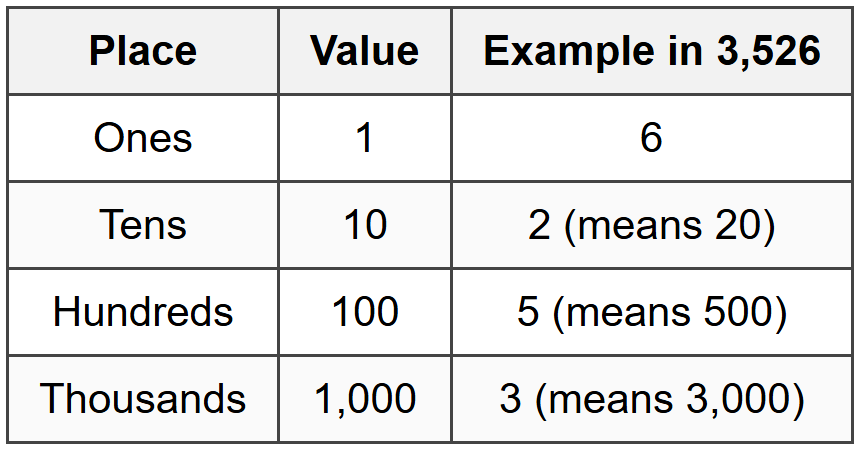
Before we add multi-digit numbers, we need to understand place value. Place value tells us what each digit in a number is worth based on where it sits in the number. Each place has a different value: ones, tens, hundreds, thousands, and so on.
For example, in the number 425:
- The 5 is in the ones place, so it means 5 ones.
- The 2 is in the tens place, so it means 2 tens, or 20.
- The 4 is in the hundreds place, so it means 4 hundreds, or 400.
When we add multi-digit numbers, we line up the digits by their place value. This means we put ones under ones, tens under tens, hundreds under hundreds, and so on. This keeps everything organized and helps us add correctly.
Example: What is the value of each digit in the number 682?
Solution:
The digit 2 is in the ones place, so it means 2.
The digit 8 is in the tens place, so it means 8 tens = 80.
The digit 6 is in the hundreds place, so it means 6 hundreds = 600.
The number 682 is made up of 600 + 80 + 2.
Adding Two-Digit Numbers Without Regrouping
Let's start with adding two-digit numbers when we don't need to regroup. Regrouping means carrying a ten from one place to the next. We will learn about regrouping soon, but first, let's practice adding when the sum of each place is 9 or less.
When we add two-digit numbers, we follow these steps:
- Write the numbers so the ones line up and the tens line up.
- Add the digits in the ones place.
- Add the digits in the tens place.
- Write your answer.
Example: Add 42 + 35.
What is the sum?
Solution:
Write the numbers with ones under ones and tens under tens:
42
+ 35Add the ones place: 2 + 5 = 7.
Add the tens place: 4 + 3 = 7.
Write the answer: 77.
The sum of 42 + 35 is 77.
Adding Two-Digit Numbers With Regrouping
Sometimes when we add the digits in a place, the sum is 10 or more. When this happens, we need to regroup. Regrouping means we take 10 ones and turn them into 1 ten, or take 10 tens and turn them into 1 hundred. This is also called carrying.
Here are the steps for adding with regrouping:
- Write the numbers with digits lined up by place value.
- Add the ones place. If the sum is 10 or more, write the ones digit below the line and carry the tens digit above the tens column.
- Add the tens place, including any number you carried.
- Write your answer.
Example: Add 47 + 28.
What is the sum?
Solution:
Write the numbers with place values lined up:
47
+ 28Add the ones place: 7 + 8 = 15. That is 1 ten and 5 ones. Write the 5 in the ones place and carry the 1 to the tens place:
1
47
+ 28
5Add the tens place: 1 + 4 + 2 = 7. Write the 7 in the tens place:
1
47
+ 28
75The sum of 47 + 28 is 75.
Example: Add 56 + 37.
What is the sum?
Solution:
Write the numbers:
56
+ 37Add the ones: 6 + 7 = 13. Write 3 in the ones place and carry 1 to the tens place:
1
56
+ 37
3Add the tens: 1 + 5 + 3 = 9. Write 9 in the tens place:
93The sum of 56 + 37 is 93.
Adding Three-Digit Numbers Without Regrouping
Adding three-digit numbers uses the same idea as adding two-digit numbers. We just have one more place to add: the hundreds place.
Steps for adding three-digit numbers without regrouping:
- Line up the numbers by place value.
- Add the ones place.
- Add the tens place.
- Add the hundreds place.
- Write your answer.
Example: Add 324 + 152.
What is the sum?
Solution:
Write the numbers with digits lined up:
324
+ 152Add the ones place: 4 + 2 = 6.
Add the tens place: 2 + 5 = 7.
Add the hundreds place: 3 + 1 = 4.
Write the answer: 476.
The sum of 324 + 152 is 476.
Adding Three-Digit Numbers With Regrouping
When we add three-digit numbers, we might need to regroup in the ones place, the tens place, or both. We follow the same regrouping steps we used with two-digit numbers.
Example: Add 378 + 145.
What is the sum?
Solution:
Write the numbers:
378
+ 145Add the ones: 8 + 5 = 13. Write 3 in the ones place and carry 1 to the tens place:
1
378
+ 145
3Add the tens: 1 + 7 + 4 = 12. Write 2 in the tens place and carry 1 to the hundreds place:
11
378
+ 145
23Add the hundreds: 1 + 3 + 1 = 5. Write 5 in the hundreds place:
523The sum of 378 + 145 is 523.
Example: A store sold 487 toys in January and 265 toys in February.
How many toys did the store sell in both months?What is the total number of toys sold?
Solution:
Add 487 + 265. Write the numbers:
487
+ 265Add the ones: 7 + 5 = 12. Write 2 and carry 1:
1
487
+ 265
2Add the tens: 1 + 8 + 6 = 15. Write 5 and carry 1:
11
487
+ 265
52Add the hundreds: 1 + 4 + 2 = 7:
752The store sold 752 toys in both months.
Adding Four-Digit Numbers
Adding four-digit numbers is the same process as adding smaller numbers. We just have more places: ones, tens, hundreds, and thousands. Always remember to line up your digits by place value and regroup when needed.
Example: Add 2,536 + 1,847.
What is the sum?
Solution:
Write the numbers with place values lined up:
2,536
+ 1,847Add the ones: 6 + 7 = 13. Write 3 and carry 1:
1
2,536
+ 1,847
3Add the tens: 1 + 3 + 4 = 8. Write 8:
83Add the hundreds: 5 + 8 = 13. Write 3 and carry 1:
1 1
2,536
+ 1,847
383Add the thousands: 1 + 2 + 1 = 4. Write 4:
4,383The sum of 2,536 + 1,847 is 4,383.
Adding More Than Two Numbers
Sometimes you need to add three or more numbers together. The strategy is the same: line up the digits by place value, then add one column at a time from right to left. Regroup whenever a column's sum is 10 or more.
Example: Add 215 + 134 + 328.
What is the sum?
Solution:
Write the numbers with digits lined up:
215
134
+ 328Add the ones: 5 + 4 + 8 = 17. Write 7 and carry 1:
1
215
134
+ 328
7Add the tens: 1 + 1 + 3 + 2 = 7. Write 7:
77Add the hundreds: 2 + 1 + 3 = 6. Write 6:
677The sum of 215 + 134 + 328 is 677.
Estimating Sums
Estimating means finding an answer that is close to the exact answer. We estimate to check if our answer makes sense. One way to estimate is by rounding each number to the nearest ten or hundred before adding.
For example, if you want to estimate 427 + 385:
- Round 427 to the nearest hundred: 400.
- Round 385 to the nearest hundred: 400.
- Add the rounded numbers: 400 + 400 = 800.
So, the estimated sum is about 800. The exact sum is 812, which is very close to our estimate!
Example: Estimate the sum of 562 + 239 by rounding to the nearest hundred.
What is the estimated sum?
Solution:
Round 562 to the nearest hundred: 600.
Round 239 to the nearest hundred: 200.
Add the rounded numbers: 600 + 200 = 800.
The estimated sum is 800.
Checking Your Work
It is important to check your addition to make sure you didn't make a mistake. Here are two ways to check:
- Add again: Do the same problem a second time and see if you get the same answer.
- Use subtraction: If you added 245 + 378 and got 623, subtract one of the numbers from your answer. For example, 623 - 378 should equal 245. If it does, your addition is correct!
- Estimate: Round the numbers and add to see if your exact answer is close to the estimate.
Example: You added 456 + 287 and got 743.
Check your work using subtraction.Is the answer correct?
Solution:
Subtract 287 from 743:
743
- 287Subtract ones: 3 - 7 needs regrouping. Borrow 1 ten: 13 - 7 = 6.
Subtract tens: 3 - 8 needs regrouping. Borrow 1 hundred: 13 - 8 = 5.
Subtract hundreds: 6 - 2 = 4. The result is 456.
Since 743 - 287 = 456, the addition is correct.
Word Problems Involving Multi-Digit Addition
Many real-world problems require us to add multi-digit numbers. When solving word problems, follow these steps:
- Read the problem carefully.
- Decide what the problem is asking you to find.
- Identify the numbers you need to add.
- Write the addition problem with digits lined up.
- Solve the problem.
- Write your answer in a complete sentence.
Example: A school has 1,245 students in the morning session.
The afternoon session has 1,387 students.
How many students attend the school in total?What is the total number of students?
Solution:
Add 1,245 + 1,387. Write the numbers:
1,245
+ 1,387Add the ones: 5 + 7 = 12. Write 2 and carry 1.
Add the tens: 1 + 4 + 8 = 13. Write 3 and carry 1.
Add the hundreds: 1 + 2 + 3 = 6. Write 6.
Add the thousands: 1 + 1 = 2. Write 2. The total is 2,632.
The school has 2,632 students in total.
Example: A farmer picked 348 apples on Monday, 275 apples on Tuesday, and 412 apples on Wednesday.
How many apples did the farmer pick in all three days?What is the total number of apples?
Solution:
Add 348 + 275 + 412. Write the numbers:
348
275
+ 412Add the ones: 8 + 5 + 2 = 15. Write 5 and carry 1.
Add the tens: 1 + 4 + 7 + 1 = 13. Write 3 and carry 1.
Add the hundreds: 1 + 3 + 2 + 4 = 10. Write 0 and carry 1.
Write the thousands: 1. The total is 1,035.
The farmer picked 1,035 apples in all three days.
Summary of Key Steps
When adding multi-digit numbers, always remember these important steps:
- Line up the numbers by place value: ones under ones, tens under tens, hundreds under hundreds, and so on.
- Start adding from the ones place on the right and move left.
- Regroup (carry) when the sum in any place is 10 or more.
- Check your work by estimating or using subtraction.
- Write your final answer clearly.
With practice, adding multi-digit numbers will become quick and easy. You will use this skill in many areas of math and in everyday life, such as adding money, measuring distances, or keeping score in games. Keep practicing, and soon you will be an addition expert!