Chapter Notes: Subtracting Multi-Digit Numbers


Subtraction is one of the most important skills in mathematics. You use it every day when you find out how much money you have left after buying something, or how many more points you need to win a game. When we subtract larger numbers with two, three, four, or more digits, we follow special steps to make sure we get the correct answer. In this chapter, you will learn how to subtract multi-digit numbers accurately and confidently using different methods.
Understanding Place Value in Subtraction
Before we can subtract large numbers, we need to understand place value. Place value tells us what each digit in a number means based on where it sits. In the number 3,456, the 6 is in the ones place, the 5 is in the tens place, the 4 is in the hundreds place, and the 3 is in the thousands place.
When we subtract multi-digit numbers, we must line up the digits by their place value. This means ones go under ones, tens go under tens, hundreds go under hundreds, and so on. If we don't line them up correctly, our answer will be wrong.
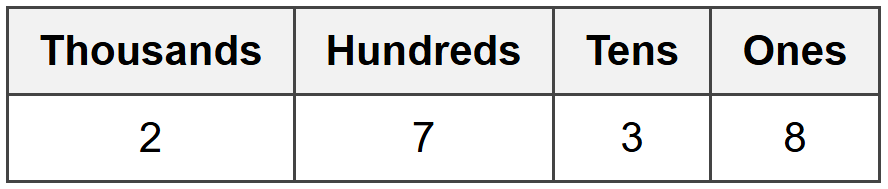
Example: Write the number 2,738 in a place value chart.
What does each digit represent?
Solution:
2 is in the thousands place = 2,000
7 is in the hundreds place = 700
3 is in the tens place = 30
8 is in the ones place = 8
The number 2,738 means 2,000 + 700 + 30 + 8.
Subtracting Without Regrouping
The simplest type of multi-digit subtraction happens when we don't need to borrow from another place. This is called subtracting without regrouping. We start at the ones place and subtract each column from right to left.
Steps for Subtracting Without Regrouping
- Write the larger number on top and the smaller number below it.
- Line up the numbers by place value.
- Start with the ones place and subtract.
- Move to the tens place and subtract.
- Continue moving left through each place until finished.
Example: Subtract 5,432 - 2,201.
What is the difference?
Solution:
Write the problem vertically with numbers lined up:
5,432 - 2,201 -------
Ones place: 2 - 1 = 1
Tens place: 3 - 0 = 3
Hundreds place: 4 - 2 = 2
Thousands place: 5 - 2 = 3
5,432 - 2,201 ------- 3,231
The answer is 3,231.
Example: A store had 8,759 bottles of water.
They sold 3,428 bottles.
How many bottles are left?How many bottles remain?
Solution:
We need to subtract 3,428 from 8,759.
8,759 - 3,428 -------
Ones place: 9 - 8 = 1
Tens place: 5 - 2 = 3
Hundreds place: 7 - 4 = 3
Thousands place: 8 - 3 = 5
8,759 - 3,428 ------- 5,331
There are 5,331 bottles left in the store.
Subtracting with Regrouping
Sometimes when we subtract, the digit on top is smaller than the digit below it. When this happens, we need to borrow from the next place to the left. This is called regrouping or borrowing.
Think of regrouping like trading money. If you have 3 dimes and need to give away 5 pennies but only have 2 pennies, you can trade 1 dime for 10 pennies. Now you have 2 dimes and 12 pennies, and you can subtract easily.
Steps for Subtracting with Regrouping
- Write the numbers vertically, lining up place values.
- Start at the ones place.
- If the top digit is smaller than the bottom digit, borrow 1 from the next place to the left.
- Cross out the digit you borrowed from and write the new smaller number.
- Add 10 to the digit where you are subtracting.
- Subtract and write the answer below the line.
- Continue moving left, regrouping as needed.
Example: Subtract 524 - 178.
What is the difference?
Solution:
Write the problem vertically:
524 - 178 -----
Ones place: 4 is smaller than 8, so we need to regroup.
Borrow 1 ten from the tens place. The 2 tens becomes 1 ten. The 4 ones becomes 14 ones.
1 5̶2̶14 - 178 -----
Now subtract ones: 14 - 8 = 6
Tens place: 1 is smaller than 7, so we regroup again.
Borrow 1 hundred from the hundreds place. The 5 hundreds becomes 4 hundreds. The 1 ten becomes 11 tens.
11 4̶5̶1̶2̶14 - 178 ----- 6
Tens place: 11 - 7 = 4
Hundreds place: 4 - 1 = 3
524 - 178 ----- 346
The answer is 346.
Example: A school collected 4,215 cans for recycling.
Students from one class brought 1,687 cans.
How many cans did the other classes bring?How many cans came from other classes?
Solution:
We subtract 1,687 from 4,215.
4,215 - 1,687 -------
Ones place: 5 is smaller than 7, so regroup. Borrow 1 ten. Now we have 0 tens and 15 ones.
15 - 7 = 8
Tens place: 0 is smaller than 8, so regroup. Borrow 1 hundred. Now we have 1 hundred and 10 tens.
10 - 8 = 2
Hundreds place: 1 is smaller than 6, so regroup. Borrow 1 thousand. Now we have 3 thousands and 11 hundreds.
11 - 6 = 5
Thousands place: 3 - 1 = 2
4,215 - 1,687 ------- 2,528
The other classes brought 2,528 cans.
Regrouping Across Zeros
One of the trickiest situations in subtraction is when you need to regroup from a zero. When this happens, you must look to the next digit to the left that is not zero and borrow from there.
Example: Subtract 6,002 - 3,478.
What is the difference?
Solution:
Write the problem vertically:
6,002 - 3,478 -------
Ones place: 2 is smaller than 8. We need to borrow, but the tens place is 0.
Look at the hundreds place-it's also 0. Look at the thousands place-it's 6.
Borrow 1 thousand from the 6. The 6 becomes 5.
The borrowed thousand equals 10 hundreds, so the 0 hundreds becomes 10 hundreds.
Now borrow 1 hundred from the 10 hundreds. The 10 becomes 9 hundreds.
The borrowed hundred equals 10 tens, so the 0 tens becomes 10 tens.
Now borrow 1 ten from the 10 tens. The 10 becomes 9 tens.
The borrowed ten equals 10 ones, so 2 ones becomes 12 ones.
9 9 5̶6̶,0̶0̶1̶0̶12 - 3,478 -------
Ones: 12 - 8 = 4
Tens: 9 - 7 = 2
Hundreds: 9 - 4 = 5
Thousands: 5 - 3 = 2
6,002 - 3,478 ------- 2,524
The answer is 2,524.
Checking Your Subtraction
After you finish a subtraction problem, it's always smart to check your work. The easiest way to check subtraction is by using addition. Since subtraction and addition are opposite operations, if you add your answer to the number you subtracted, you should get the original number.
To check: Answer + Number Subtracted = Original Number
Example: Check whether 845 - 367 = 478 is correct.
Is the answer correct?
Solution:
Add the answer (478) to the number subtracted (367).
478 + 367 ----- 845
8 + 7 = 15, write 5 and carry 1
7 + 6 + 1 = 14, write 4 and carry 1
4 + 3 + 1 = 8
We get 845, which matches the original number.
The subtraction is correct.
Solving Word Problems with Subtraction
Many real-life situations require us to subtract multi-digit numbers. When you see a word problem, look for key words that tell you to subtract. Words like "how many more," "how many left," "difference," "remain," and "how much greater" often mean you need to subtract.
Steps for Solving Word Problems
- Read the problem carefully.
- Identify what you need to find.
- Decide which numbers to subtract.
- Set up the subtraction problem with the larger number on top.
- Subtract and regroup if needed.
- Write your answer in a complete sentence.
Example: A movie theater sold 3,642 tickets on Saturday.
On Sunday, they sold 2,896 tickets.
How many more tickets were sold on Saturday than on Sunday?What is the difference in ticket sales?
Solution:
The words "how many more" tell us to subtract.
We subtract the smaller number (Sunday) from the larger number (Saturday).
3,642 - 2,896 -------
Ones: 2 is smaller than 6, so regroup. Borrow 1 ten. 12 - 6 = 6
Tens: 3 is smaller than 9, so regroup. Borrow 1 hundred. 13 - 9 = 4
Hundreds: 5 is smaller than 8, so regroup. Borrow 1 thousand. 15 - 8 = 7
Thousands: 2 - 2 = 0
3,642 - 2,896 ------- 746
The theater sold 746 more tickets on Saturday than on Sunday.
Example: A library has 8,450 books.
If 1,275 books are checked out, how many books remain in the library?How many books are still in the library?
Solution:
The word "remain" tells us to subtract.
Subtract the books checked out from the total.
8,450 - 1,275 -------
Ones: 0 is smaller than 5, so regroup. Borrow 1 ten. 10 - 5 = 5
Tens: 4 is smaller than 7, so regroup. Borrow 1 hundred. 14 - 7 = 7
Hundreds: 3 (after borrowing) is smaller than 2. No regrouping needed. 3 - 2 = 1
Thousands: 8 - 1 = 7
8,450 - 1,275 ------- 7,175
There are 7,175 books remaining in the library.
Estimating Differences
Before you subtract, it's helpful to estimate the answer. An estimate is a close guess that helps you know if your final answer makes sense. To estimate, we round each number to a friendly place value and then subtract the rounded numbers.
Steps for Estimating
- Round each number to the nearest ten, hundred, or thousand (whichever makes the most sense).
- Subtract the rounded numbers.
- Compare the estimate with your exact answer to see if it's reasonable.
Example: Estimate the difference for 7,823 - 3,197.
What is a reasonable estimate?
Solution:
Round 7,823 to the nearest thousand: 8,000
Round 3,197 to the nearest thousand: 3,000
Subtract the rounded numbers: 8,000 - 3,000 = 5,000
The estimated difference is about 5,000.
(The actual answer is 4,626, which is close to our estimate, so the answer is reasonable.)
Common Mistakes to Avoid
Even careful students sometimes make mistakes when subtracting multi-digit numbers. Here are some common errors and how to avoid them:
- Not lining up place values correctly: Always write numbers so that ones are under ones, tens are under tens, and so on.
- Subtracting the top digit from the bottom digit: Always subtract the smaller number from the larger number in each column after regrouping.
- Forgetting to change the digit after borrowing: When you borrow from a place, remember to cross out the old digit and write the new smaller digit.
- Skipping zeros: When regrouping across zeros, make sure to borrow correctly from the first non-zero digit.
- Not checking your work: Always add your answer to the number you subtracted to see if you get the original number.
Practice Tips
Becoming good at subtracting multi-digit numbers takes practice. Here are some helpful tips:
- Write neatly and keep your columns straight. Use grid paper if it helps.
- Work slowly and carefully. Speed comes with practice.
- Say the steps out loud as you work. This helps you remember what to do.
- Always estimate first to check if your answer makes sense.
- Check every problem by adding.
- If you make a mistake, figure out where it happened and try again.
Subtraction is a powerful tool that you will use throughout your life. Whether you're managing money, measuring ingredients for a recipe, or keeping score in a game, knowing how to subtract multi-digit numbers quickly and accurately will serve you well. With practice and patience, these steps will become automatic, and you'll solve subtraction problems with confidence!