Chapter Notes: Multi-Digit Multiplication: Place Value and Area Models


When you multiply larger numbers, like 23 × 14, it can feel tricky at first. But when you understand how place value works and use a special tool called an area model, multiplication becomes much easier! In this chapter, you will learn how to break apart numbers based on their place value, use the area model to organize your work, and multiply multi-digit numbers step by step. These strategies will help you understand why multiplication works the way it does, not just how to get the answer.
Understanding Place Value in Multiplication
Place value tells us what each digit in a number represents based on its position. For example, in the number 47, the 4 is in the tens place, so it represents 40 (or 4 tens). The 7 is in the ones place, so it represents 7 ones. When we multiply multi-digit numbers, we use place value to break apart the numbers and make the problem easier to solve.
Let's think about the number 34. We can break it apart like this:
- 34 = 30 + 4
This is called decomposing the number. Decomposing means breaking a number into smaller parts based on place value. We can do this with any number. For example:
- 52 = 50 + 2
- 68 = 60 + 8
- 123 = 100 + 20 + 3
When we multiply, we can decompose both numbers. This helps us multiply each part separately and then add all the parts together at the end.
Example: Decompose the number 46 using place value.
What are the parts of 46 based on place value?
Solution:
The digit 4 is in the tens place, so it represents 40.
The digit 6 is in the ones place, so it represents 6.
Therefore, 46 = 40 + 6.
The number 46 can be decomposed into 40 + 6.
Introduction to the Area Model
The area model is a visual tool that helps us multiply numbers by breaking them into parts and organizing our work in a rectangle. Imagine a garden that is 23 feet long and 14 feet wide. To find the total area of the garden, we need to multiply 23 × 14. Instead of trying to multiply these numbers all at once, we can break them into smaller, easier pieces.
The area model works like this:
- We draw a large rectangle to represent the multiplication problem.
- We divide the rectangle into smaller rectangles based on place value.
- We find the area of each smaller rectangle.
- We add all the smaller areas together to find the total area.
Think of the area model like cutting a cake into smaller pieces. Each piece is easier to measure, and when you add all the pieces together, you get the whole cake!
Parts of the Area Model
When we use the area model, we label the sides of the rectangle with the decomposed numbers. For example, if we want to multiply 23 × 14, we would:
- Decompose 23 into 20 + 3
- Decompose 14 into 10 + 4
- Draw a rectangle and divide it into four smaller rectangles
Each smaller rectangle represents one part of the multiplication. The four parts are:
- 20 × 10
- 20 × 4
- 3 × 10
- 3 × 4
We multiply each part, then add all four products together to get the final answer.
Using the Area Model to Multiply Two-Digit Numbers
Now let's see how to use the area model to multiply two two-digit numbers step by step.
Example: Use the area model to multiply 32 × 15.
What is 32 × 15?
Solution:
Step 1: Decompose both numbers using place value.
32 = 30 + 2
15 = 10 + 5Step 2: Draw a rectangle and divide it into four parts. Label the sides.
Step 3: Find the area of each smaller rectangle.
Top left: 30 × 10 = 300
Top right: 30 × 5 = 150
Bottom left: 2 × 10 = 20
Bottom right: 2 × 5 = 10Step 4: Add all four products together.
300 + 150 + 20 + 10 = 480The answer is 480.
Notice how we turned one difficult problem (32 × 15) into four easier problems. Each smaller multiplication used basic facts you already know!
Example: Use the area model to multiply 41 × 23.
What is 41 × 23?
Solution:
Step 1: Decompose both numbers.
41 = 40 + 1
23 = 20 + 3Step 2: Set up the four smaller rectangles.
Step 3: Multiply each part.
40 × 20 = 800
40 × 3 = 120
1 × 20 = 20
1 × 3 = 3Step 4: Add all products.
800 + 120 + 20 + 3 = 943The product of 41 and 23 is 943.
Organizing Work with Tables
Sometimes it helps to organize the area model using a table. The table shows exactly the same information as the rectangle, but some students find it easier to keep track of all the parts.
Here's how the area model for 32 × 15 looks in table form:
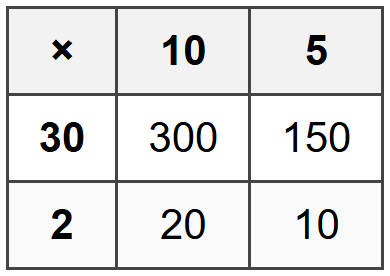
Each cell in the table shows the product of the row number and the column number. After filling in all four cells, we add them: 300 + 150 + 20 + 10 = 480.
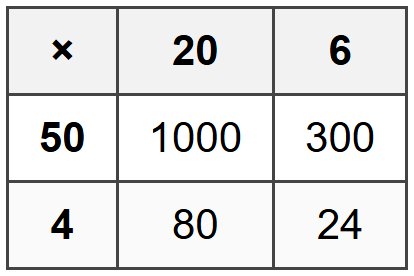
Example: Create a table to multiply 54 × 26 using the area model.
What is 54 × 26?
Solution:
Step 1: Decompose the numbers.
54 = 50 + 4
26 = 20 + 6Step 2: Create the table.
Step 3: Add all products.
1000 + 300 + 80 + 24 = 1404The product of 54 and 26 is 1404.
Multiplying Three-Digit by One-Digit Numbers
The area model works great for multiplying larger numbers too! When we multiply a three-digit number by a one-digit number, we decompose the three-digit number into hundreds, tens, and ones.
Example: Use the area model to multiply 234 × 3.
What is 234 × 3?
Solution:
Step 1: Decompose 234 using place value.
234 = 200 + 30 + 4Step 2: Multiply each part by 3.
200 × 3 = 600
30 × 3 = 90
4 × 3 = 12Step 3: Add all products together.
600 + 90 + 12 = 702The answer is 702.
Notice that we broke 234 into three parts instead of two. The area model still works the same way-we just have more rectangles to add up!
Multiplying Three-Digit by Two-Digit Numbers
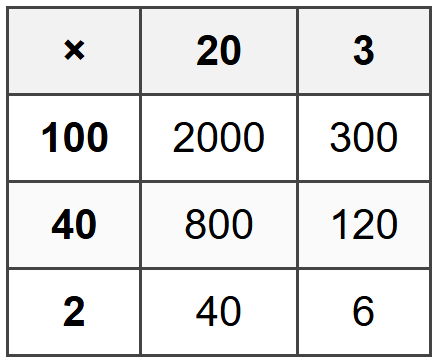
When we multiply a three-digit number by a two-digit number, we need even more rectangles in our area model. We decompose both numbers and multiply every part together.
Example: Use the area model to multiply 142 × 23.
What is 142 × 23?
Solution:
Step 1: Decompose both numbers.
142 = 100 + 40 + 2
23 = 20 + 3Step 2: Create a table with six rectangles.
Step 3: Add all six products.
2000 + 300 + 800 + 120 + 40 + 6 = 3266The product of 142 and 23 is 3266.
Connecting the Area Model to the Standard Algorithm
The standard algorithm is the traditional way of multiplying numbers that you may have seen before. It involves writing one number above the other and multiplying digit by digit. The area model and the standard algorithm are actually doing the same work-they just look different!
Let's see how 32 × 15 looks using the standard algorithm:
32
× 15
______
160 (This is 32 × 5)
320 (This is 32 × 10)
______
480
Compare this to our area model:
- When we multiply 32 × 5, we're finding 30 × 5 = 150 and 2 × 5 = 10, which adds to 160.
- When we multiply 32 × 10, we're finding 30 × 10 = 300 and 2 × 10 = 20, which adds to 320.
- Adding 160 + 320 gives us 480, just like adding our four partial products!
The area model helps you see why each step of the standard algorithm works. Both methods give the same answer because they're both using place value to break the problem into smaller parts.
Properties That Make Multiplication Work
Several important properties of multiplication help explain why the area model works so well.
The Distributive Property
The distributive property says that you can break apart one of the numbers in a multiplication problem, multiply each part separately, and then add the results. This is exactly what we do in the area model!
For example: 5 × (10 + 3) = (5 × 10) + (5 × 3)
Let's check: 5 × 13 = 65, and (50) + (15) = 65. It works!
When we use the area model for 32 × 15, we're really using the distributive property twice:
- 32 × 15 = 32 × (10 + 5) = (32 × 10) + (32 × 5)
- Then we break 32 apart: (30 + 2) × 10 + (30 + 2) × 5
- This gives us four products: (30 × 10) + (2 × 10) + (30 × 5) + (2 × 5)
The Commutative Property
The commutative property says that you can multiply numbers in any order and get the same answer. For example, 4 × 7 = 7 × 4. Both equal 28.
This means that 23 × 14 is the same as 14 × 23. You can decompose whichever number feels easier to you! The area model will look slightly different, but the answer will be the same.
Tips for Success with Multi-Digit Multiplication
Here are some helpful tips to remember when multiplying multi-digit numbers:
- Always decompose by place value. Break numbers into hundreds, tens, and ones. This keeps your work organized.
- Keep track of all your partial products. In the area model, each rectangle is important. Don't forget any of them!
- Line up your numbers carefully. When adding partial products, make sure to line up the digits by place value.
- Check your work. You can estimate to see if your answer makes sense. For example, 32 × 15 is close to 30 × 15 = 450, so 480 seems reasonable.
- Practice with different sized numbers. Start with smaller numbers until you feel comfortable, then try larger ones.
Estimating to Check Your Answer
Estimation means finding an answer that is close to the exact answer. When you multiply large numbers, it's smart to estimate first. This helps you know if your final answer is reasonable.
To estimate a multiplication problem, round each number to the nearest ten or hundred, then multiply the rounded numbers.
Example: Estimate 48 × 22, then find the exact answer using the area model.
What is a good estimate, and what is the exact product?
Solution:
Step 1: Estimate by rounding.
48 rounds to 50
22 rounds to 20
50 × 20 = 1000
Our estimate is about 1000.Step 2: Find the exact answer using the area model.
48 = 40 + 8
22 = 20 + 240 × 20 = 800
40 × 2 = 80
8 × 20 = 160
8 × 2 = 16800 + 80 + 160 + 16 = 1056
The exact answer is 1056, which is close to our estimate of 1000.
When your exact answer is close to your estimate, you can feel confident that you did the multiplication correctly!
Real-World Applications
Multi-digit multiplication appears in many everyday situations. Here are some examples:
- Shopping: If one shirt costs $24 and you buy 15 shirts for a team, how much do you spend in total? You would calculate 24 × 15.
- Gardening: A rectangular garden is 18 feet long and 12 feet wide. The area is 18 × 12 square feet.
- Baking: A recipe makes 12 cookies, but you need to make 36 batches for a bake sale. You need 12 × 36 cookies total.
- Travel: If you drive 55 miles per hour for 4 hours, you travel 55 × 4 = 220 miles.
Think of multiplication as a shortcut for repeated addition. Instead of adding 24 + 24 + 24 fifteen times, you can multiply 24 × 15 and get your answer much faster!
Building Confidence with Practice
Learning to multiply multi-digit numbers takes practice, but the area model makes it easier to understand what's happening at each step. As you practice more, you'll notice patterns:
- Multiplying by 10 always adds a zero to the end of a number.
- Multiplying larger place values gives larger partial products.
- Breaking numbers apart doesn't change the final answer-it just makes the work easier.
Remember that every expert mathematician started by learning these same basic skills. Each time you use the area model, you're building a stronger understanding of how numbers work together. With practice, you'll be able to multiply multi-digit numbers quickly and confidently!