Chapter Notes: Multiply With Partial Products


Multiplication is one of the most important skills you will use in math and in everyday life. When you multiply larger numbers, like 34 × 6 or 42 × 23, it can feel tricky at first. But there is a special method called partial products that breaks big multiplication problems into smaller, easier pieces. This method helps you see exactly what is happening when you multiply, and it makes checking your work much simpler. Once you master partial products, you'll be able to multiply any numbers with confidence!
What Are Partial Products?
When we multiply two numbers, we can break them apart by place value. Partial products are the smaller products you get when you multiply each part of one number by each part of the other number. Then you add all those smaller products together to get the final answer.
Think of it like packing a suitcase. Instead of shoving everything in at once, you pack one section at a time-shirts, pants, socks-and then put them all together. Partial products work the same way: you multiply piece by piece, then combine everything at the end.
For example, if you want to multiply 23 × 4, you can break 23 into 20 and 3. Then you multiply each part separately:
- 20 × 4 = 80
- 3 × 4 = 12
Finally, you add the partial products: 80 + 12 = 92.
Why Use Partial Products?
Partial products help you understand what happens in multiplication. When you use this method, you can see each step clearly. It also helps you:
- Understand place value better
- Check your work more easily
- Build a strong foundation for harder multiplication
- See the connection between addition and multiplication
Many students find that partial products make multiplication less confusing because every step is written out.
Multiplying a Two-Digit Number by a One-Digit Number
Let's start with the simplest type of partial products: multiplying a two-digit number by a one-digit number.
Breaking Apart the Two-Digit Number
When you multiply a number like 46 by 3, you first break 46 into its place value parts:
- 46 = 40 + 6
Now multiply each part by 3:
- 40 × 3 = 120
- 6 × 3 = 18
These two answers (120 and 18) are the partial products.
Add the partial products together:
120 + 18 = 138
So, 46 × 3 = 138.
Example: A bakery makes 34 cupcakes each hour.
How many cupcakes does the bakery make in 5 hours?How many cupcakes in total?
Solution:
We need to multiply 34 × 5.
Break 34 into 30 + 4.
Multiply each part by 5:
30 × 5 = 150
4 × 5 = 20Add the partial products:
150 + 20 = 170The bakery makes 170 cupcakes in 5 hours.
Example: Solve 72 × 6 using partial products.
What is 72 × 6?
Solution:
Break 72 into 70 + 2.
Multiply each part by 6:
70 × 6 = 420
2 × 6 = 12Add the partial products:
420 + 12 = 432The answer is 432.
Writing It Vertically
You can also write partial products in a vertical format, which looks more organized and helps you keep track of place values. Here is how you would solve 53 × 7 vertically:
Write the problem:
53
× 7
--
Multiply the ones place: 3 × 7 = 21. Write 21.
Multiply the tens place: 50 × 7 = 350. Write 350 below the first partial product.
Add them together:
53
× 7
--
21 ← (3 × 7)
350 ← (50 × 7)
--
371
So, 53 × 7 = 371.
Multiplying a Two-Digit Number by a Two-Digit Number
When both numbers have two digits, you will have four partial products instead of two. This is because you break both numbers into tens and ones, and then multiply every part by every other part.
The Four Partial Products
Let's say you want to multiply 24 × 13. Break each number into tens and ones:
- 24 = 20 + 4
- 13 = 10 + 3
Now you need to multiply every part of 24 by every part of 13:
- 20 × 10 = 200
- 20 × 3 = 60
- 4 × 10 = 40
- 4 × 3 = 12
These four numbers are the partial products. Now add them all together:
200 + 60 + 40 + 12 = 312
So, 24 × 13 = 312.
Example: A theater has 32 rows of seats.
Each row has 15 seats.
How many seats are in the theater?How many seats in total?
Solution:
We need to multiply 32 × 15.
Break 32 into 30 + 2.
Break 15 into 10 + 5.Find all four partial products:
30 × 10 = 300
30 × 5 = 150
2 × 10 = 20
2 × 5 = 10Add the partial products:
300 + 150 + 20 + 10 = 480The theater has 480 seats.
Example: Find 47 × 26 using partial products.
What is 47 × 26?
Solution:
Break 47 into 40 + 7.
Break 26 into 20 + 6.Find all four partial products:
40 × 20 = 800
40 × 6 = 240
7 × 20 = 140
7 × 6 = 42Add the partial products:
800 + 240 + 140 + 42 = 1,222The answer is 1,222.
Using a Table to Organize Partial Products
Sometimes it helps to use a table or grid to organize your partial products. This is also called the area model or box method. Here is how to use it for 36 × 24:
Break 36 into 30 + 6 and 24 into 20 + 4. Draw a table with two rows and two columns:
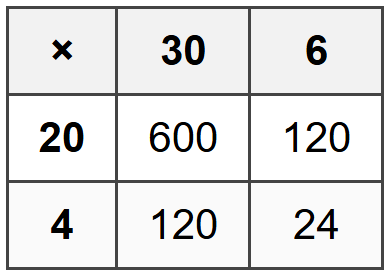
Now add all four products in the table:
600 + 120 + 120 + 24 = 864
So, 36 × 24 = 864.
The table helps you see all the partial products at once and makes sure you don't forget any.
Writing Partial Products Vertically
When you multiply two-digit numbers, you can also write the partial products vertically. This looks similar to the standard algorithm, but you write out every partial product separately instead of carrying numbers in your head.
Here is how to solve 52 × 34 using the vertical method:
52
× 34
--
8 ← (2 × 4, ones × ones)
200 ← (50 × 4, tens × ones)
60 ← (2 × 30, ones × tens)
1500 ← (50 × 30, tens × tens)
--
1768
Notice that we multiplied:
- 2 × 4 = 8
- 50 × 4 = 200
- 2 × 30 = 60
- 50 × 30 = 1,500
Then we added all four partial products to get 1,768.
Example: Use the vertical method to find 68 × 43.
What is 68 × 43?
Solution:
Write the problem vertically:
68
× 43
--Multiply by the ones digit (3):
8 × 3 = 24
60 × 3 = 180Multiply by the tens digit (40):
8 × 40 = 320
60 × 40 = 2,400Write all partial products:
24
180
320
2400
--
2924The answer is 2,924.
Connecting Partial Products to Place Value
Partial products work because of place value. Every digit in a number has a value based on its position. When you multiply, you are really multiplying the value of each digit, not just the digit itself.
For example, in the number 47:
- The 4 is in the tens place, so it represents 40.
- The 7 is in the ones place, so it represents 7.
When you multiply 47 × 5, you are really multiplying:
- 40 × 5 = 200
- 7 × 5 = 35
Then you add: 200 + 35 = 235.
Understanding place value helps you see why partial products always give the correct answer.
Comparing Partial Products to the Standard Algorithm
You may have learned another way to multiply called the standard algorithm. In the standard algorithm, you also multiply each digit, but you "carry" numbers to the next column as you go.
Both methods give the same answer! The partial products method writes out every step, while the standard algorithm combines some steps to save space. Some students prefer partial products because it is easier to see what is happening. Others like the standard algorithm because it is faster once you get good at it.
Here is the same problem solved both ways:
Partial Products:
43
× 27
--
21 ← (3 × 7)
280 ← (40 × 7)
60 ← (3 × 20)
800 ← (40 × 20)
--
1161
Standard Algorithm:
43
× 27
--
301 ← (43 × 7)
860 ← (43 × 20)
--
1161
Both methods give 1,161 as the answer. The partial products method shows all four products separately, while the standard algorithm combines them into two lines.
Tips for Success with Partial Products
Here are some helpful tips to make partial products easier:
- Break numbers by place value carefully. Always separate tens and ones before you start multiplying.
- Write neatly and line up your numbers. This helps you avoid mistakes when adding.
- Use graph paper. It can help you keep columns straight.
- Double-check each partial product. Make sure you multiply correctly before adding.
- Add carefully at the end. Even if your partial products are correct, adding them wrong will give the wrong answer.
- Practice with smaller numbers first. Once you feel confident, move to larger numbers.
Real-World Uses of Partial Products
Partial products are not just for math class. You can use them in everyday situations:
- Shopping: If you buy 12 packs of juice and each pack costs $3, you can use partial products to find the total cost.
- Cooking: If a recipe serves 4 people and you need to make it for 23 people, partial products can help you figure out how much of each ingredient you need.
- Sports: If a basketball player scores 14 points per game and plays 15 games, you can find the total points using partial products.
- Gardening: If you plant 18 rows of flowers with 12 flowers in each row, partial products help you find the total number of flowers.
Anytime you need to multiply larger numbers in your head or on paper, partial products give you a clear, step-by-step way to find the answer.
Example: A farmer plants 25 apple trees in each of 16 rows.
How many apple trees does the farmer plant in total?How many trees in all?
Solution:
We need to multiply 25 × 16.
Break 25 into 20 + 5.
Break 16 into 10 + 6.Find all four partial products:
20 × 10 = 200
20 × 6 = 120
5 × 10 = 50
5 × 6 = 30Add the partial products:
200 + 120 + 50 + 30 = 400The farmer plants 400 apple trees.
Summary
Multiplying with partial products is a powerful strategy that helps you break down multiplication into smaller, easier steps. By separating numbers into tens and ones, multiplying each part, and then adding the results, you can solve even large multiplication problems with confidence. This method strengthens your understanding of place value and gives you a clear way to check your work. Whether you use a table, a vertical format, or just list the partial products, this strategy will serve you well in math and in real life.
