Chapter Notes: Multiply By 10s


Have you ever counted by tens? Ten, twenty, thirty, forty... It's one of the fastest ways to count! When we multiply by 10, 100, or 1,000, we use a special pattern that makes math quick and easy. Understanding how to multiply by tens helps us solve problems with money, measurements, and large numbers. In this chapter, you will learn the patterns and shortcuts that make multiplying by 10s simple and fun!
Understanding What "Multiply by 10" Means
When we multiply by 10, we are making a number ten times bigger. If you have 3 apples and you multiply by 10, you now have 30 apples. That's 10 groups of 3 apples!
Let's think about what happens when we multiply a number by 10:
- 2 × 10 = 20
- 5 × 10 = 50
- 8 × 10 = 80
- 12 × 10 = 120
Do you notice a pattern? When we multiply a whole number by 10, we add a zero to the end of the number. This pattern works every time!
Think of it like this: If you have 4 boxes and each box holds 10 crayons, you have 4 × 10 = 40 crayons total. The 4 becomes 40 by adding a zero.
The Pattern: Adding Zeros
The simplest way to multiply by 10 is to add one zero to the end of the number. This shortcut works because our number system is based on groups of ten.
Here's how it works:
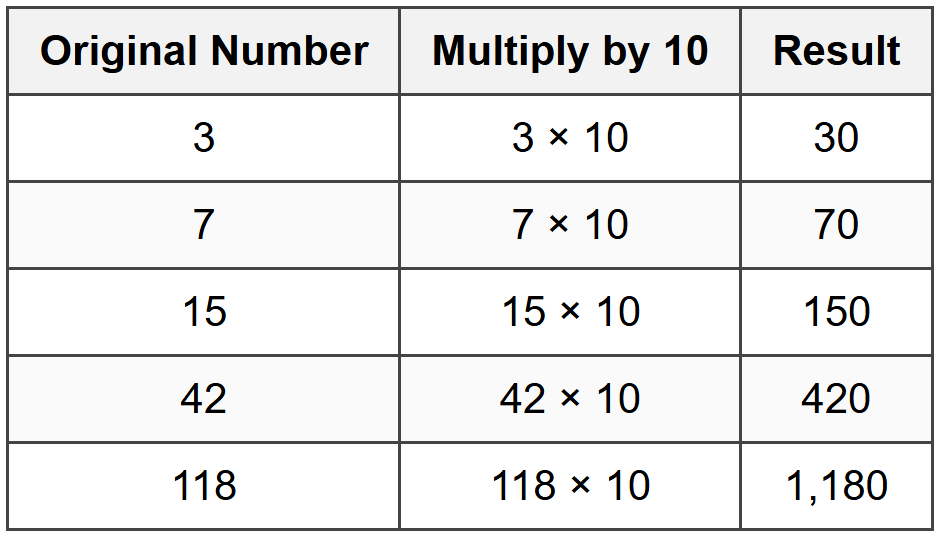
Notice that each number gets bigger by moving one place to the left, and a zero fills the empty spot in the ones place.
Example: A bakery makes 24 cookies each hour.
How many cookies does the bakery make in 10 hours?How many cookies are made in 10 hours?
Solution:
We need to multiply 24 by 10.
Using our pattern, we add one zero to the end of 24.
24 × 10 = 240
The bakery makes 240 cookies in 10 hours.
Multiplying by 20, 30, 40, and Other Tens
What happens when we multiply by 20, 30, or 40? These numbers are called multiples of 10 because they are 10 times another number (20 = 2 × 10, 30 = 3 × 10, and so on).
To multiply by a multiple of 10, we follow these steps:
- Multiply by the digit in the tens place (ignore the zero for now)
- Add one zero to the end of your answer
Let's see how this works with examples:
Example: Calculate 6 × 30.
What is 6 × 30?
Solution:
First, multiply 6 × 3 = 18
Next, add one zero to the end: 180
Therefore, 6 × 30 = 180
The answer is 180.
Example: A school has 8 classrooms.
Each classroom has 20 desks.
How many desks are there in total?How many desks are in the school?
Solution:
We need to find 8 × 20.
First, multiply 8 × 2 = 16
Next, add one zero to get 160
The school has 160 desks in total.
More Examples with Different Multiples of 10
Here are more examples to help you see the pattern clearly:
- 5 × 40 = 5 × 4 = 20, then add a zero → 200
- 7 × 50 = 7 × 5 = 35, then add a zero → 350
- 9 × 60 = 9 × 6 = 54, then add a zero → 540
- 4 × 80 = 4 × 8 = 32, then add a zero → 320
Example: There are 70 books on each shelf.
The library has 5 shelves.
How many books are there altogether?What is the total number of books?
Solution:
We need to calculate 5 × 70.
First, multiply 5 × 7 = 35
Then add one zero to make 350
There are 350 books altogether.
Multiplying Larger Numbers by 10
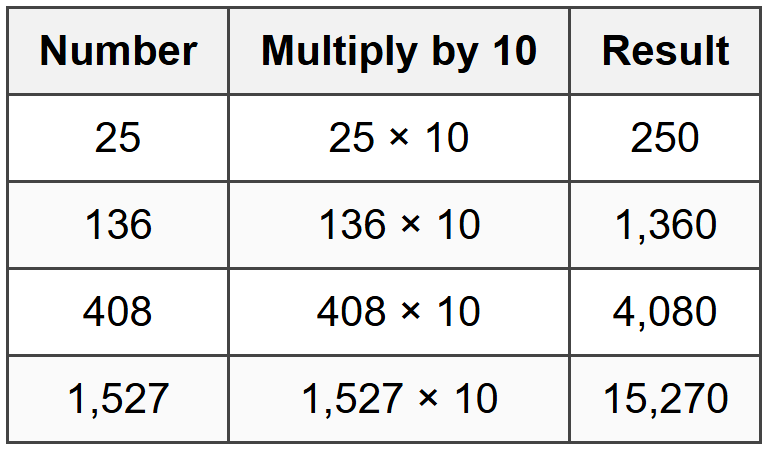
The same pattern works when we multiply larger numbers by 10. Whether the number is 2 or 2,000, we simply add a zero to the end.
Example: A toy store sold 147 toys in one week.
If the store continues at this rate, how many toys will it sell in 10 weeks?How many toys will be sold in 10 weeks?
Solution:
We multiply 147 by 10.
Add one zero to the end of 147.
147 × 10 = 1,470
The store will sell 1,470 toys in 10 weeks.
Multiplying by 100
When we multiply by 100, we make a number one hundred times bigger. Since 100 has two zeros, we add two zeros to the end of the number.
Let's look at the pattern:
- 3 × 100 = 300
- 8 × 100 = 800
- 15 × 100 = 1,500
- 42 × 100 = 4,200
- 256 × 100 = 25,600
Think of money: If you have 5 dollar bills and someone gives you 100 times that amount, you would have 500 dollars!
Example: A farmer plants 18 rows of corn.
Each row has 100 corn plants.
How many corn plants are there in total?How many corn plants does the farmer have?
Solution:
We need to find 18 × 100.
Add two zeros to the end of 18.
18 × 100 = 1,800
The farmer has 1,800 corn plants in total.
Multiplying by 1,000
When we multiply by 1,000, the number becomes one thousand times bigger. Since 1,000 has three zeros, we add three zeros to the end of the number.
Here's the pattern:
- 4 × 1,000 = 4,000
- 9 × 1,000 = 9,000
- 12 × 1,000 = 12,000
- 67 × 1,000 = 67,000
- 345 × 1,000 = 345,000
Example: A factory produces 25 cars each day.
How many cars does the factory produce in 1,000 days?How many cars are produced in 1,000 days?
Solution:
We multiply 25 by 1,000.
Add three zeros to the end of 25.
25 × 1,000 = 25,000
The factory produces 25,000 cars in 1,000 days.
Multiplying Two-Digit Numbers by Multiples of 10
Now let's combine what we've learned. When we multiply a two-digit number by a multiple of 10, we use the same strategy:
- Multiply the two-digit number by the digit in the tens place
- Add one zero to the result
Example: Calculate 23 × 40.
What is 23 × 40?
Solution:
First, multiply 23 × 4:
23 × 4 = 92Next, add one zero to the end:
920Therefore, 23 × 40 = 920
The answer is 920.
Example: A sports team needs to buy 30 uniforms.
Each uniform costs 45 dollars.
How much will all the uniforms cost?What is the total cost?
Solution:
We need to find 45 × 30.
First, multiply 45 × 3 = 135
Then add one zero: 1,350
The total cost is 1,350 dollars.
Why Does This Pattern Work?
Our number system is called a base-ten system or decimal system. Each place in a number is worth 10 times more than the place to its right.
Look at how place value works:
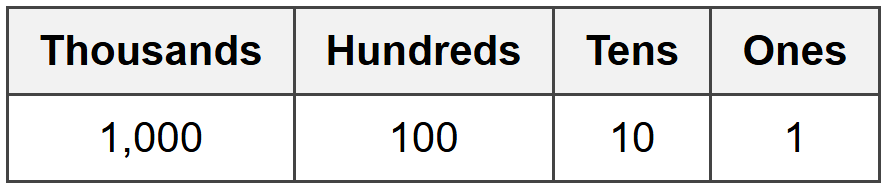
When we multiply by 10, every digit moves one place to the left. The number 4 in the ones place becomes 4 in the tens place, which equals 40. A zero fills the empty ones place.
Imagine a train where each car is 10 times bigger than the one behind it. When you multiply by 10, all the passengers move forward one car, and an empty car (zero) is added at the back.
Common Mistakes to Avoid
When multiplying by 10s, watch out for these common errors:
- Forgetting to add the zero: Remember that 6 × 10 = 60, not 6.
- Adding too many zeros: When multiplying by 20, you only add one zero at the end, not two. For example, 5 × 20 = 100, not 1,000.
- Confusing multiplication with addition: Multiplying 3 × 10 means three groups of ten (30), not three plus ten (13).
- Mixing up the steps: When multiplying by 30, first multiply by 3, then add the zero. Don't add the zero first!
Using Multiplication by 10s in Real Life
Multiplying by 10s helps us solve many everyday problems:
- Money: If one notebook costs 3 dollars, then 10 notebooks cost 30 dollars.
- Measurement: If one rope is 12 feet long, then 10 ropes placed end-to-end would be 120 feet long.
- Time: If you read 15 pages each day, you will read 150 pages in 10 days.
- Sports: If a basketball team scores 80 points in one game and plays 10 games, they score 800 points total (if they score the same each time).
Example: A gardener plants 60 flower seeds in each garden bed.
There are 7 garden beds.
How many seeds does the gardener plant altogether?How many seeds are planted in total?
Solution:
We calculate 7 × 60.
First, multiply 7 × 6 = 42
Then add one zero to get 420
The gardener plants 420 seeds altogether.
Quick Mental Math Tricks
Once you understand the pattern, you can multiply by 10s in your head very quickly! Here are some tips:
- For × 10: Just say the number and add "ty" or add a zero. 7 becomes 70.
- For × 20, 30, etc.: Think of the simpler multiplication first, then add a zero.
- For × 100: Say the number and add "hundred," or write it with two zeros.
- For × 1,000: Say the number and add "thousand," or write it with three zeros.
With practice, these calculations become automatic. You'll be able to solve problems like 8 × 50 = 400 almost instantly!
Connecting to Division
Multiplication and division are opposite operations. If you know that 4 × 10 = 40, then you also know that 40 ÷ 10 = 4. This connection helps you check your work!
When you divide by 10, you do the opposite of multiplying by 10. Instead of adding a zero, you remove a zero (or move the digits one place to the right).
- 80 ÷ 10 = 8
- 350 ÷ 10 = 35
- 1,200 ÷ 10 = 120
This relationship helps you understand that multiplication and division by 10 are two sides of the same pattern.
Summary of Key Ideas
Let's review what we've learned about multiplying by 10s:
- To multiply any whole number by 10, add one zero to the end of the number.
- To multiply by 20, 30, 40, etc., first multiply by the digit in the tens place, then add one zero.
- To multiply by 100, add two zeros to the end of the number.
- To multiply by 1,000, add three zeros to the end of the number.
- Our base-ten number system makes this pattern work because each place value is 10 times the place to its right.
- These shortcuts help us solve problems with money, measurement, and counting quickly.
Multiplying by 10s is one of the most useful skills in mathematics. Once you master this pattern, you'll find it easier to work with large numbers, estimate answers, and solve real-world problems. Practice using these shortcuts, and soon you'll be multiplying by 10s without even thinking about it!