Chapter Notes: Multiply 2-Digit Numbers With Partial Products


When you need to multiply larger numbers, breaking the problem into smaller, easier parts can make the work much simpler. Multiplying 2-digit numbers with partial products means splitting the numbers into tens and ones, multiplying each part separately, and then adding all the parts together. This method helps you see exactly what happens in multiplication and builds a strong understanding of place value. Once you master partial products, you'll be ready to multiply even bigger numbers with confidence!
Understanding Partial Products
A partial product is the result you get when you multiply one part of a number by another part. When we multiply 2-digit numbers, we can break each number into tens and ones. Then we multiply each part and add all the results together.
Think of it like organizing a large group of people into rows and columns. Instead of counting everyone at once, you count smaller groups first, then add them all together.
For example, if we want to multiply 23 × 14, we can think of 23 as 20 + 3 and 14 as 10 + 4. This gives us four separate, smaller multiplications to do:
- 20 × 10
- 20 × 4
- 3 × 10
- 3 × 4
Each of these smaller multiplications creates a partial product. When we add all the partial products together, we get the final answer.
Breaking Numbers into Tens and Ones
Before we can use partial products, we need to understand how to break 2-digit numbers into tens and ones. This skill uses place value, which means understanding what each digit represents based on its position.
In the number 47:
- The digit 4 is in the tens place, so it represents 4 tens, or 40.
- The digit 7 is in the ones place, so it represents 7 ones, or just 7.
- So 47 = 40 + 7
Let's look at a few more examples:
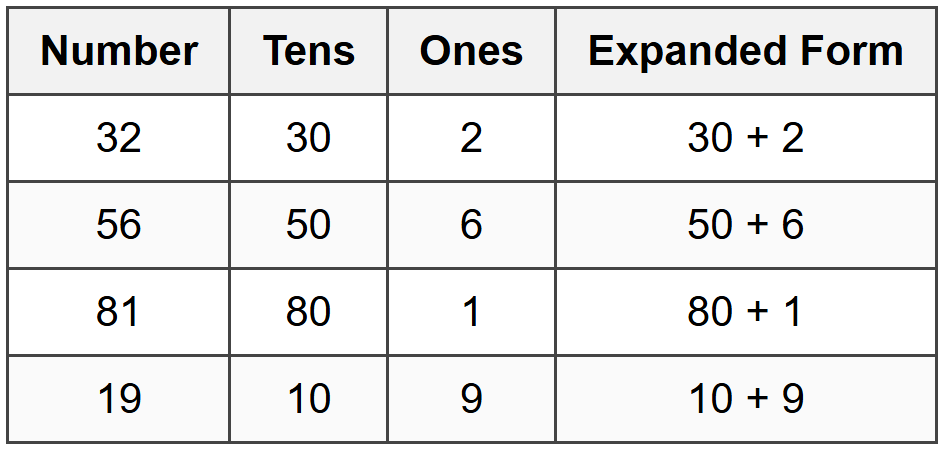
Breaking numbers into tens and ones is the first step in the partial products method. It helps us see the value of each digit clearly.
The Four Partial Products
When we multiply two 2-digit numbers, we get exactly four partial products. Let's see why this happens using a rectangular area model.
Imagine a garden that is 23 feet long and 14 feet wide. To find the total area, we can split the garden into four smaller rectangles and find each area separately.
For 23 × 14, we break the numbers like this:
- 23 = 20 + 3
- 14 = 10 + 4
Now we multiply each part of the first number by each part of the second number:
- Tens × Tens: 20 × 10 = 200
- Tens × Ones: 20 × 4 = 80
- Ones × Tens: 3 × 10 = 30
- Ones × Ones: 3 × 4 = 12
These four results (200, 80, 30, and 12) are our partial products. To find the final answer, we add them all together:
200 + 80 + 30 + 12 = 322
So 23 × 14 = 322.
Step-by-Step Process for Partial Products
Here is the complete process for multiplying 2-digit numbers using partial products:
- Break apart both numbers into tens and ones.
- Multiply the tens of the first number by the tens of the second number.
- Multiply the tens of the first number by the ones of the second number.
- Multiply the ones of the first number by the tens of the second number.
- Multiply the ones of the first number by the ones of the second number.
- Add all four partial products together to get the final answer.
Let's work through several examples to practice this process.
Worked Examples
Example: A bakery makes 12 boxes of cookies.
Each box contains 24 cookies.How many cookies does the bakery make in total?
Solution:
We need to multiply 12 × 24.
Step 1: Break apart both numbers into tens and ones.
12 = 10 + 2
24 = 20 + 4Step 2: Find all four partial products.
Tens × Tens: 10 × 20 = 200
Tens × Ones: 10 × 4 = 40
Ones × Tens: 2 × 20 = 40
Ones × Ones: 2 × 4 = 8
Step 3: Add all the partial products together.
200 + 40 + 40 + 8 = 288The bakery makes 288 cookies in total.
Example: A school auditorium has 32 rows of seats.
Each row has 15 seats.How many seats are in the auditorium altogether?
Solution:
We need to multiply 32 × 15.
Step 1: Break apart both numbers.
32 = 30 + 2
15 = 10 + 5Step 2: Find all four partial products.
Tens × Tens: 30 × 10 = 300
Tens × Ones: 30 × 5 = 150
Ones × Tens: 2 × 10 = 20
Ones × Ones: 2 × 5 = 10
Step 3: Add all the partial products together.
300 + 150 + 20 + 10 = 480The auditorium has 480 seats altogether.
Example: A farmer plants apple trees in an orchard.
There are 26 rows with 18 trees in each row.How many apple trees are in the orchard?
Solution:
We need to multiply 26 × 18.
Step 1: Break apart both numbers.
26 = 20 + 6
18 = 10 + 8Step 2: Find all four partial products.
Tens × Tens: 20 × 10 = 200
Tens × Ones: 20 × 8 = 160
Ones × Tens: 6 × 10 = 60
Ones × Ones: 6 × 8 = 48
Step 3: Add all the partial products together.
200 + 160 + 60 + 48 = 468There are 468 apple trees in the orchard.
Organizing Partial Products Vertically
You can organize the partial products method in a vertical format that looks similar to the standard multiplication algorithm. This helps keep your work neat and organized.
Here's how to set up the problem 34 × 27 vertically:
Example: Multiply 34 × 27 using the vertical partial products method.
Solution:
Write the problem vertically and find each partial product:
34
× 27
______
28 ← 4 × 7 (ones × ones)
210 ← 30 × 7 (tens × ones)
80 ← 4 × 20 (ones × tens)
+ 600 ← 30 × 20 (tens × tens)
______
918The answer is 918.
Notice that we can write the partial products in any order. Some people prefer to start with ones × ones and work up to tens × tens. Others start with the largest partial product first. Either way works as long as you include all four partial products!
Using an Area Model
An area model is a visual way to show partial products. We draw a rectangle and divide it into four smaller rectangles, one for each partial product.
Let's use an area model for 43 × 25:
Example: Use an area model to multiply 43 × 25.
Solution:
Step 1: Break apart the numbers.
43 = 40 + 3
25 = 20 + 5Step 2: Draw a rectangle divided into four parts.
Step 3: Add all four partial products.
800 + 60 + 200 + 15 = 1,075The product of 43 × 25 is 1,075.
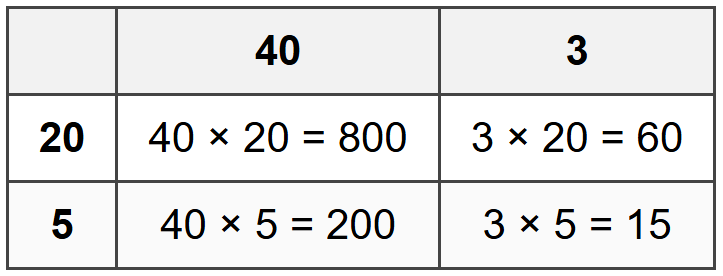
The area model helps you see how multiplication relates to finding the area of a rectangle. Each small rectangle inside represents one partial product, and the total area is the final answer.
Multiplying with Numbers That Have Zeros
When one of the digits is zero, some partial products will be zero. This actually makes the problem easier because you have fewer numbers to add!
Example: Multiply 40 × 23.
Solution:
Step 1: Break apart the numbers.
40 = 40 + 0
23 = 20 + 3Step 2: Find all four partial products.
Tens × Tens: 40 × 20 = 800
Tens × Ones: 40 × 3 = 120
Ones × Tens: 0 × 20 = 0
Ones × Ones: 0 × 3 = 0
Step 3: Add the partial products.
800 + 120 + 0 + 0 = 920The product is 920.
When you see a zero in the ones place, you know that two of your partial products will be zero. You can skip writing those and just focus on the two non-zero partial products.
Larger Products and Regrouping
Sometimes when you add the partial products together, you need to regroup. This means carrying a ten or a hundred to the next place value column. Let's look at an example where regrouping is necessary.
Example: A toy store orders 48 boxes of building blocks.
Each box contains 37 sets of blocks.How many sets of blocks does the store order in total?
Solution:
We need to multiply 48 × 37.
Step 1: Break apart the numbers.
48 = 40 + 8
37 = 30 + 7Step 2: Find all four partial products.
Tens × Tens: 40 × 30 = 1,200
Tens × Ones: 40 × 7 = 280
Ones × Tens: 8 × 30 = 240
Ones × Ones: 8 × 7 = 56
Step 3: Add the partial products carefully.
1,200 + 280 = 1,480
1,480 + 240 = 1,720
1,720 + 56 = 1,776The store orders 1,776 sets of blocks in total.
When the partial products are larger numbers, it helps to add them two at a time. This keeps your work organized and helps you avoid mistakes.
Why Partial Products Work
The partial products method works because of the distributive property. This property says that when you multiply a number by a sum, you can multiply the number by each part of the sum separately and then add the results.
For example, with 23 × 14:
23 × 14 = (20 + 3) × (10 + 4)
When we expand this, we multiply each part of the first number by each part of the second number:
= (20 × 10) + (20 × 4) + (3 × 10) + (3 × 4)
= 200 + 80 + 30 + 12
= 322
The distributive property guarantees that breaking numbers apart, multiplying the parts, and adding them back together will always give you the correct answer.
Comparing Partial Products to Other Methods
There are several ways to multiply 2-digit numbers. The partial products method shows every step clearly and helps you understand what's happening with place value. The standard algorithm is faster but requires you to keep track of regrouping in your head.
Both methods give the same answer. Many students find that learning partial products first makes the standard algorithm easier to understand later. Partial products help you see exactly where each digit in the answer comes from.
Tips for Success
- Write neatly: Keep your partial products lined up so they're easy to add.
- Check your place values: Make sure you understand whether you're multiplying tens or ones.
- Use scratch paper: Don't try to do all the addition in your head. Write each step.
- Count your partial products: With two 2-digit numbers, you should always have four partial products (though some might be zero).
- Estimate first: Round the numbers to the nearest ten and multiply to get a rough answer. Then check if your exact answer is close to your estimate.
Tip: To estimate 28 × 34, round to 30 × 30 = 900. So your exact answer should be close to 900. The actual answer is 952, which makes sense!
Connecting Partial Products to Real Life
Multiplication with partial products appears in many real-world situations:
- Shopping: If you buy 15 packages of juice boxes and each package has 12 boxes, you use multiplication to find the total.
- Gardening: A garden with 22 rows and 18 plants per row requires multiplication to find how many plants you need.
- Sports: If a basketball team plays 24 games and scores an average of 45 points per game, multiplication helps find total points.
- Construction: Building projects often involve calculating areas of rectangular spaces using 2-digit measurements.
Understanding partial products helps you break down these larger problems into manageable pieces, just like we break numbers into tens and ones.
