Chapter Notes: Remainders


When you share things equally with your friends, sometimes there are extra items left over that cannot be divided evenly. These extra items are called remainders. Understanding remainders helps us solve real-life problems about sharing, grouping, and dividing things fairly. In this chapter, we will learn what remainders are, how to find them, and how to use them in different situations.
What Is a Remainder?
A remainder is the amount left over after dividing one number by another when the division does not come out evenly. Think of it like this: if you have 13 cookies and you want to put them into boxes of 4 cookies each, you can fill 3 boxes completely. But you will have 1 cookie left over. That 1 cookie is the remainder.
When we write division problems with remainders, we use the letter R to show the remainder. For example:
13 ÷ 4 = 3 R1
This means 13 divided by 4 equals 3 with a remainder of 1.
Think of remainders like slicing a pizza. If you have 17 slices and each person gets 5 slices, you can serve 3 people completely. You will have 2 slices left over as the remainder.
Understanding Division with Remainders
Division is the process of splitting a number into equal groups. When we divide, we ask: "How many groups can we make?" and "Is there anything left over?"
Every division problem has four parts:
- Dividend: The number being divided (the total amount you start with)
- Divisor: The number you are dividing by (the size of each group)
- Quotient: The answer to the division (the number of groups you can make)
- Remainder: The amount left over after making equal groups
We can write this relationship as:
Dividend ÷ Divisor = Quotient R Remainder
Example: You have 23 apples.
You want to put them into bags with 5 apples in each bag.How many full bags can you make, and how many apples will be left over?
Solution:
Dividend = 23 (the total apples)
Divisor = 5 (apples in each bag)
We need to find how many times 5 fits into 23.
5 × 1 = 5
5 × 2 = 10
5 × 3 = 15
5 × 4 = 20
5 × 5 = 25 (too big!)5 goes into 23 four times because 5 × 4 = 20
Now find what is left over: 23 - 20 = 3
So 23 ÷ 5 = 4 R3
You can make 4 full bags with 3 apples left over.
Finding Remainders Using Multiplication
One way to find remainders is to use multiplication facts. We find the largest multiple of the divisor that fits into the dividend, then subtract to find what is left over.
Follow these steps:
- Look at the dividend and divisor.
- Ask: "What number times the divisor gets closest to the dividend without going over?"
- Multiply the divisor by that number.
- Subtract this product from the dividend to find the remainder.
Example: Find the remainder when 29 is divided by 6.
What is 29 ÷ 6?
Solution:
We need to find how many times 6 fits into 29.
6 × 1 = 6
6 × 2 = 12
6 × 3 = 18
6 × 4 = 24
6 × 5 = 30 (too big!)The closest we can get is 6 × 4 = 24
Now subtract: 29 - 24 = 5
So 29 ÷ 6 = 4 R5
The remainder is 5.
Finding Remainders Using Long Division
Long division is a method that helps us organize our work when dividing larger numbers. Even though we are working with remainders, the process is the same as regular long division. We just stop when we cannot divide anymore and report what is left as the remainder.
Here are the steps for long division with remainders:
- Divide: How many times does the divisor fit into the first part of the dividend?
- Multiply: Multiply the divisor by that number.
- Subtract: Subtract the product from the dividend.
- Bring down: Bring down the next digit if there is one.
- Repeat: Repeat the process until there are no more digits to bring down.
- Remainder: Whatever is left after the last subtraction is the remainder.
Example: Divide 47 by 8 using long division.
What is 47 ÷ 8?
Solution:
Set up the long division: 8 goes into 47 how many times?
8 × 5 = 40 (this fits)
8 × 6 = 48 (too big)So 8 goes into 47 five times. Write 5 above the division bracket.
Multiply: 5 × 8 = 40
Subtract: 47 - 40 = 7
There are no more digits to bring down, so 7 is our remainder.
Therefore, 47 ÷ 8 = 5 R7
The answer is 5 with a remainder of 7.
Checking Your Answer
You can always check if your division with remainders is correct by using multiplication and addition. The rule is:
(Quotient × Divisor) + Remainder = Dividend
This means if you multiply your answer by the divisor and then add the remainder, you should get back to the original number you started with.
Example: Check if 47 ÷ 8 = 5 R7 is correct.
Does our answer check out?
Solution:
Use the formula: (Quotient × Divisor) + Remainder = Dividend
Quotient = 5, Divisor = 8, Remainder = 7
Calculate: (5 × 8) + 7
First multiply: 5 × 8 = 40
Then add the remainder: 40 + 7 = 47
We got back to 47, which was our original dividend, so our answer is correct!
Important Facts About Remainders
There are several important rules about remainders that you should remember:
- The remainder is always smaller than the divisor. If your remainder is equal to or bigger than the divisor, you can divide again.
- The smallest remainder possible is 0, which means the division is exact with nothing left over.
- The largest remainder you can have is always one less than the divisor. For example, if you divide by 7, the largest remainder can only be 6.
- When the remainder is 0, we say the dividend is divisible by the divisor.
Think of remainders like the last few minutes of an hour. In one hour there are 60 minutes. If you have 67 minutes, that is 1 hour with 7 minutes remaining. The remainder (7) is smaller than the divisor (60).
Example: Maria is arranging 34 chairs into rows.
Each row must have exactly 6 chairs.How many complete rows can she make, and how many chairs will not fit into a complete row?
Solution:
We need to divide 34 by 6.
6 × 1 = 6
6 × 2 = 12
6 × 3 = 18
6 × 4 = 24
6 × 5 = 30
6 × 6 = 36 (too big)6 goes into 34 five times: 6 × 5 = 30
Subtract to find the remainder: 34 - 30 = 4
So 34 ÷ 6 = 5 R4
Maria can make 5 complete rows with 4 chairs left over.
Word Problems with Remainders
Remainders appear in many real-life situations. Sometimes the remainder is the most important part of the answer! When solving word problems, you need to think carefully about what the remainder means in the context of the problem.
When to Round Up
Sometimes you need to round up to the next whole number because you need enough for everyone or everything, even if it is not perfectly even.
Example: A teacher has 38 students going on a field trip.
Each van can hold 9 students.How many vans does the teacher need?
Solution:
Divide 38 by 9 to find how many vans.
9 × 4 = 36
9 × 5 = 45 (too big)So 9 goes into 38 four times: 38 ÷ 9 = 4 R2
This means 4 vans can hold 36 students, with 2 students left over.
But we cannot leave 2 students behind! We need one more van for them.
The teacher needs 5 vans total.
When the Remainder Is the Answer
Sometimes the question asks specifically about what is left over, so the remainder itself is the answer you need.
Example: A baker has 50 cookies.
She puts them into boxes of 8 cookies each.
She fills as many boxes as she can.How many cookies will be left over?
Solution:
Divide 50 by 8.
8 × 6 = 48
8 × 7 = 56 (too big)So 8 goes into 50 six times: 8 × 6 = 48
Subtract to find the remainder: 50 - 48 = 2
The question asks how many are left over, so we report the remainder.
There will be 2 cookies left over.
When to Ignore the Remainder
Sometimes the remainder does not matter for the answer because the question only asks about complete groups.
Example: A rope is 45 feet long.
You need to cut it into pieces that are 7 feet long each.How many complete 7-foot pieces can you cut?
Solution:
Divide 45 by 7.
7 × 6 = 42
7 × 7 = 49 (too big)So 45 ÷ 7 = 6 R3
The question asks for complete pieces only.
You can cut 6 complete pieces that are 7 feet long.
Patterns with Remainders
Remainders follow interesting patterns. When you divide many numbers in a row by the same divisor, the remainders repeat in a pattern. This can help you predict remainders without doing all the division.
For example, when dividing by 4, the remainders can only be 0, 1, 2, or 3. Let us look at the pattern:
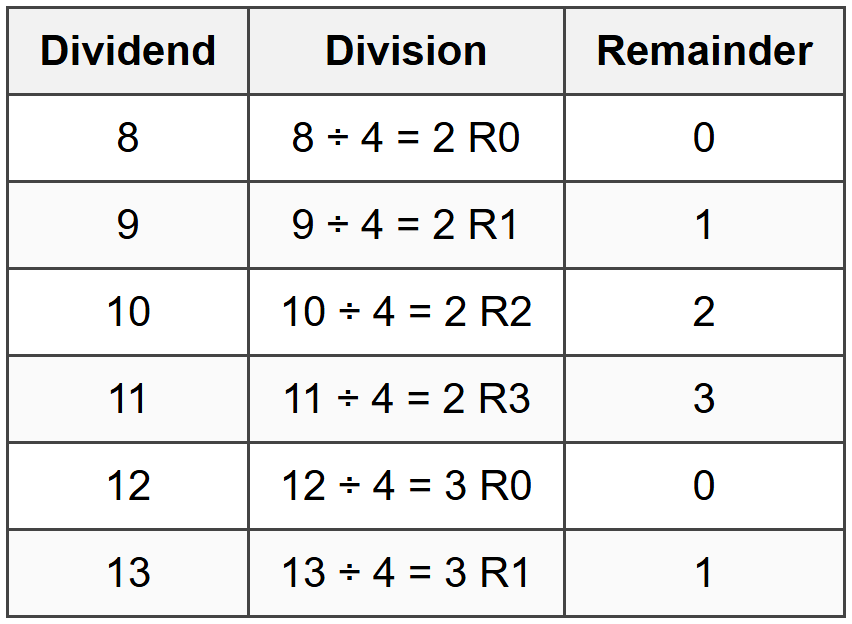
Notice how the remainders repeat: 0, 1, 2, 3, 0, 1, 2, 3... This pattern continues forever!
Remainders with Larger Numbers
The same rules and methods work with larger numbers. You just need to be more careful with your multiplication and subtraction.
Example: Find the remainder when 156 is divided by 12.
What is 156 ÷ 12?
Solution:
Use long division or find the right multiple.
12 × 10 = 120
12 × 11 = 132
12 × 12 = 144
12 × 13 = 156 (exactly!)Since 12 × 13 = 156 exactly, there is no remainder.
156 ÷ 12 = 13 R0
The remainder is 0, which means 156 divides evenly by 12.
Common Mistakes to Avoid
Here are some common errors students make when working with remainders:
- Remainder too big: Remember the remainder must always be smaller than the divisor. If your remainder equals or exceeds the divisor, you can divide one more time.
- Forgetting to subtract: After multiplying, you must subtract to find what is left over. Do not skip this step!
- Wrong operation in word problems: Make sure you understand what the problem is asking. Does it want the quotient, the remainder, or both?
- Not checking your work: Always check by multiplying the quotient by the divisor and adding the remainder. You should get back to the dividend.
Using Remainders in Real Life
Remainders are useful in many everyday situations:
- Sharing items equally: When you have treats to share with friends and want to know if there will be extras
- Packaging: Figuring out how many boxes you need and if any items will not fit
- Time: Converting minutes to hours and minutes (65 minutes = 1 hour and 5 minutes)
- Sports teams: Dividing players into equal teams and seeing if anyone will be left out
- Money: Figuring out how many items you can buy and how much money you will have left
Imagine you are planning a party and have 75 party favors. You have 8 guests. How many favors does each guest get, and how many are left for you? Divide: 75 ÷ 8 = 9 R3. Each guest gets 9 favors, and you have 3 left over!
Understanding remainders helps you solve problems where things do not divide evenly. By learning how to find remainders and interpret what they mean, you can tackle many real-world math challenges with confidence. Remember to practice the different methods, check your work, and think carefully about what the remainder means in each situation!