Chapter Notes: Divide Multiples of 10, 100, and 1,000 By 1-Digit Numbers


Have you ever noticed that some numbers end in zeros? Numbers like 20, 300, and 5,000 are special because they are made by multiplying smaller numbers by 10, 100, or 1,000. When we divide these numbers, we can use patterns and shortcuts to make our work easier and faster. In this chapter, you will learn how to divide multiples of 10, 100, and 1,000 by 1-digit numbers. Once you understand the patterns, dividing large numbers becomes much simpler!
Understanding Multiples of 10, 100, and 1,000
Before we divide, let's understand what we mean by multiples. A multiple is the result you get when you multiply a number by another number. For example:
- Multiples of 10 are numbers like 10, 20, 30, 40, 50, and so on. Each one ends with exactly one zero.
- Multiples of 100 are numbers like 100, 200, 300, 400, and so on. Each one ends with exactly two zeros.
- Multiples of 1,000 are numbers like 1,000, 2,000, 3,000, 4,000, and so on. Each one ends with exactly three zeros.
These numbers follow a pattern. When you multiply a number by 10, you add one zero to the end. When you multiply by 100, you add two zeros. When you multiply by 1,000, you add three zeros.
For example:
- 6 × 10 = 60
- 6 × 100 = 600
- 6 × 1,000 = 6,000
When we divide, we are doing the opposite of multiplication. So dividing by a 1-digit number will follow a similar pattern, and we can use the zeros to help us!
Dividing Multiples of 10 by 1-Digit Numbers
When we divide a multiple of 10 by a 1-digit number, we can use a helpful strategy. First, we think about the basic division fact without the zero. Then we add the zero back to our answer.
Think of it like this: if you have 60 cookies and you want to share them equally among 3 friends, you can first think about sharing 6 cookies among 3 friends, then remember that each friend gets 10 times more because we started with 60, not just 6.
The Pattern for Dividing Multiples of 10
Here is the pattern:
- Remove the zero from the multiple of 10.
- Divide the remaining number by the 1-digit number.
- Add one zero to your answer.
Let's see this pattern in action:
Example: Divide 80 by 4.
What is 80 ÷ 4?
Solution:
Step 1: Remove the zero from 80. We get 8.
Step 2: Divide 8 by 4.
8 ÷ 4 = 2Step 3: Add one zero back to the answer.
2 becomes 20.The answer is 20.
Example: A farmer has 60 eggs.
He wants to pack them into cartons of 5 eggs each.How many cartons does he need?
Solution:
We need to find 60 ÷ 5.
Step 1: Remove the zero from 60. We get 6.
Step 2: Divide 6 by 5.
6 ÷ 5 = 1 with a remainder, but let's think: 5 goes into 6 one time with 1 left over.
Actually, 5 × 1 = 5, so 6 ÷ 5 is not even. Let's reconsider: 60 ÷ 5.
Think: 6 ÷ 5 won't work evenly. Let's use another method.Let's use the related fact: 5 × 12 = 60.
So 60 ÷ 5 = 12.The farmer needs 12 cartons.
Wait! In the second example, our pattern didn't work perfectly because 6 doesn't divide evenly by 5. When the basic division fact doesn't work out evenly, we need to think about the related multiplication fact instead, or use long division.
Example: Divide 90 by 3.
What is 90 ÷ 3?
Solution:
Step 1: Remove the zero from 90. We get 9.
Step 2: Divide 9 by 3.
9 ÷ 3 = 3Step 3: Add one zero back to the answer.
3 becomes 30.The answer is 30.
Dividing Multiples of 100 by 1-Digit Numbers
Now let's look at multiples of 100. These numbers have two zeros at the end. The pattern is very similar to dividing multiples of 10, but we work with two zeros instead of one.
The Pattern for Dividing Multiples of 100
- Remove the two zeros from the multiple of 100.
- Divide the remaining number by the 1-digit number.
- Add two zeros to your answer.
Example: Divide 800 by 4.
What is 800 ÷ 4?
Solution:
Step 1: Remove the two zeros from 800. We get 8.
Step 2: Divide 8 by 4.
8 ÷ 4 = 2Step 3: Add two zeros back to the answer.
2 becomes 200.The answer is 200.
Example: A school has 600 pencils.
The pencils will be shared equally among 6 classrooms.How many pencils will each classroom get?
Solution:
We need to find 600 ÷ 6.
Step 1: Remove the two zeros from 600. We get 6.
Step 2: Divide 6 by 6.
6 ÷ 6 = 1Step 3: Add two zeros back to the answer.
1 becomes 100.Each classroom will get 100 pencils.
Example: Divide 500 by 5.
What is 500 ÷ 5?
Solution:
Step 1: Remove the two zeros from 500. We get 5.
Step 2: Divide 5 by 5.
5 ÷ 5 = 1Step 3: Add two zeros back to the answer.
1 becomes 100.The answer is 100.
Dividing Multiples of 1,000 by 1-Digit Numbers
Multiples of 1,000 have three zeros at the end. The pattern continues in the same way, but now we work with three zeros.
The Pattern for Dividing Multiples of 1,000
- Remove the three zeros from the multiple of 1,000.
- Divide the remaining number by the 1-digit number.
- Add three zeros to your answer.
Example: Divide 8,000 by 4.
What is 8,000 ÷ 4?
Solution:
Step 1: Remove the three zeros from 8,000. We get 8.
Step 2: Divide 8 by 4.
8 ÷ 4 = 2Step 3: Add three zeros back to the answer.
2 becomes 2,000.The answer is 2,000.
Example: A factory produces 9,000 bottles of juice.
The bottles are packed into boxes of 3 bottles each.How many boxes are needed?
Solution:
We need to find 9,000 ÷ 3.
Step 1: Remove the three zeros from 9,000. We get 9.
Step 2: Divide 9 by 3.
9 ÷ 3 = 3Step 3: Add three zeros back to the answer.
3 becomes 3,000.The factory needs 3,000 boxes.
Example: Divide 6,000 by 2.
What is 6,000 ÷ 2?
Solution:
Step 1: Remove the three zeros from 6,000. We get 6.
Step 2: Divide 6 by 2.
6 ÷ 2 = 3Step 3: Add three zeros back to the answer.
3 becomes 3,000.The answer is 3,000.
Using Basic Facts and Place Value
The reason our pattern works is because of place value. Place value tells us what each digit in a number means based on where it is located. When we divide multiples of 10, 100, or 1,000, we are really using our basic division facts and then adjusting for place value.
Let's think about 80 ÷ 4:
- 80 is the same as 8 tens.
- When we divide 8 tens by 4, we get 2 tens.
- 2 tens equals 20.
This is exactly what our pattern does! We divide 8 by 4 to get 2, then we add the zero back to show that we have 2 tens, which equals 20.
Think of tens, hundreds, and thousands like different-sized groups. If you have 8 groups of ten and you split them into 4 equal parts, each part has 2 groups of ten, which is 20.
Comparing Division Across Place Values
Let's look at how the same basic division fact can help us divide multiples of 10, 100, and 1,000:
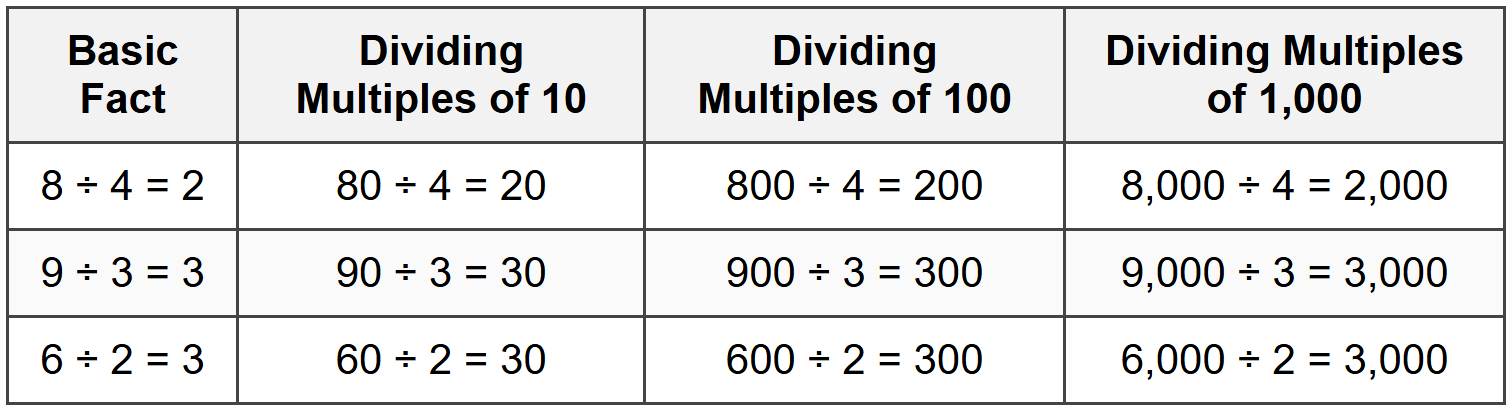
Do you see the pattern? The basic division stays the same, but we add zeros to match the place value we started with. Each column adds one more zero than the column before it.
Step-by-Step Strategy for All Problems
Here is a strategy you can use for any problem involving division of multiples of 10, 100, or 1,000 by a 1-digit number:
- Count the zeros at the end of the number you are dividing. Write down how many there are.
- Remove all the zeros temporarily. Write down the number without any zeros.
- Do the basic division with the number that's left.
- Add the zeros back to your answer. Add the same number of zeros you removed in Step 1.
- Check your work by multiplying your answer by the divisor. You should get the original number.
Example: A library has 7,000 books.
The books are arranged on 7 floors.If each floor has the same number of books, how many books are on each floor?
Solution:
We need to find 7,000 ÷ 7.
Step 1: Count the zeros in 7,000. There are 3 zeros.
Step 2: Remove the three zeros. We have 7.
Step 3: Do the basic division: 7 ÷ 7 = 1
Step 4: Add three zeros back to the answer: 1 becomes 1,000.
Step 5: Check: 1,000 × 7 = 7,000 ✓
Each floor has 1,000 books.
Special Cases and Things to Watch For
Sometimes you might come across problems that seem tricky. Here are some things to watch for:
When the Answer Has Fewer Zeros
Not every division problem will have the same number of zeros in the answer as in the number you started with. This happens when the basic division gives you a two-digit answer.
Example: Divide 80 by 2.
What is 80 ÷ 2?
Solution:
Step 1: Remove the zero from 80. We get 8.
Step 2: Divide 8 by 2.
8 ÷ 2 = 4Step 3: Add one zero back to the answer.
4 becomes 40.The answer is 40.
Notice that we started with 80 (one zero) and ended with 40 (one zero). The pattern still works!
When You Need to Know Your Division Facts
This method only works well when you know your basic division facts. If you don't know that 8 ÷ 4 = 2, then it's hard to figure out that 800 ÷ 4 = 200. Make sure you practice your basic division facts from 1 ÷ 1 up to 81 ÷ 9.
Real-World Applications
Dividing multiples of 10, 100, and 1,000 is useful in many everyday situations:
- Money: If you have $500 and want to split it equally among 5 people, each person gets $100.
- Time: If a project takes 3,000 minutes and you work for 3 hours each day (180 minutes), you can figure out how many equal parts you need.
- Measurement: If a road is 6,000 feet long and you want to place signs every equal distance apart using 6 signs, the signs are 1,000 feet apart.
- Shopping: If a store has 900 cans of soup and puts them on 9 shelves equally, each shelf has 100 cans.
Imagine you are organizing a big event with thousands of people. Being able to divide quickly helps you figure out how many tables, chairs, or meals you need!
Mental Math Tips
Once you understand the pattern, you can do many of these problems in your head! Here are some tips:
- Think about the basic fact first. What is 8 ÷ 4? It's 2. So 8,000 ÷ 4 is 2,000.
- Count zeros carefully. Write them down if you need to, especially when working with thousands.
- Use multiplication to check. If you think 600 ÷ 3 = 200, multiply: 200 × 3 = 600. You're right!
- Practice with patterns. Once you see how 6 ÷ 2 = 3 leads to 60 ÷ 2 = 30, then 600 ÷ 2 = 300, and finally 6,000 ÷ 2 = 3,000, you'll remember the pattern forever.
Example: Divide 4,000 by 8.
What is 4,000 ÷ 8?
Solution:
Think: What is 4 ÷ 8? That doesn't work because 4 is smaller than 8.
Let's try differently: What is 40 ÷ 8? That's 5.
So 4,000 has three zeros. If we remove two zeros from 4,000, we get 40.
40 ÷ 8 = 5Now add two zeros back: 5 becomes 500.
Check: 500 × 8 = 4,000 ✓
The answer is 500.
This last example shows that sometimes we need to be flexible. When the basic fact doesn't help, we can remove fewer zeros and still use our pattern.
Summary of Key Ideas
Let's review what we've learned about dividing multiples of 10, 100, and 1,000 by 1-digit numbers:
- Multiples of 10 end in one zero (20, 30, 40...).
- Multiples of 100 end in two zeros (200, 300, 400...).
- Multiples of 1,000 end in three zeros (2,000, 3,000, 4,000...).
- To divide these numbers, use the pattern: remove the zeros, divide using basic facts, then add the zeros back.
- The number of zeros in your answer matches the place value you're working with.
- Always check your work by multiplying your answer by the divisor.
- Knowing your basic division facts makes this process fast and easy.
With practice, you'll be able to divide large numbers quickly and confidently. Remember that understanding the pattern is more important than memorizing rules. Once you see how place value and basic facts work together, dividing multiples of 10, 100, and 1,000 becomes as simple as dividing small numbers!