Chapter Notes: Division With Place Value


Division is one of the most important skills in math. When we divide, we split a number into equal groups or share things fairly. Sometimes we need to divide large numbers, like hundreds or thousands. Understanding place value helps us divide these big numbers step by step. Place value tells us the value of each digit based on where it sits in a number. The ones place, tens place, hundreds place, and thousands place all work together when we divide. In this chapter, you will learn how to use place value to divide numbers accurately and confidently.
Understanding Place Value in Division
Before we divide large numbers, we need to understand how place value works. Every digit in a number has a value based on its position. Let's review the place value chart:
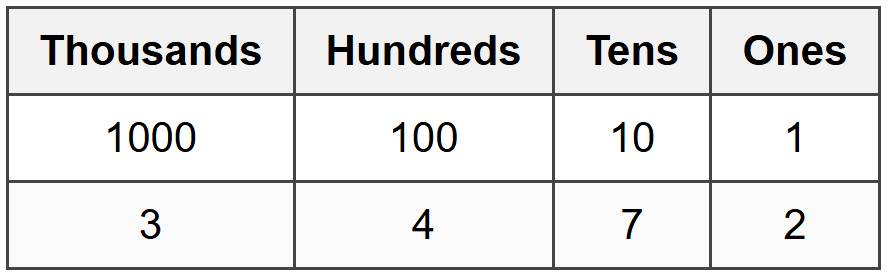
In the number 3,472, the digit 3 is in the thousands place, so it represents 3,000. The digit 4 is in the hundreds place, so it represents 400. The digit 7 is in the tens place, so it represents 70. The digit 2 is in the ones place, so it represents 2.
When we divide, we work with each place value from left to right, starting with the largest place. This is just like reading a book-we start at the left and move right. Division with place value means we divide the thousands first, then the hundreds, then the tens, and finally the ones.
Dividing Multiples of 10, 100, and 1,000
Before tackling harder division problems, let's practice dividing numbers that are multiples of 10, 100, or 1,000. These are numbers like 80, 300, or 5,000. When we divide these numbers, we can use basic facts we already know and then adjust for the zeros.
A basic fact is a simple division problem we have memorized, like 8 ÷ 2 = 4 or 12 ÷ 3 = 4.
Example: Divide 80 ÷ 2.
What is 80 ÷ 2?
Solution:
First, think about the basic fact: 8 ÷ 2 = 4.
Now notice that 80 has one zero at the end.
So we write the answer to the basic fact and add the zero: 40.
The answer is 40.
Example: Divide 600 ÷ 3.
What is 600 ÷ 3?
Solution:
First, think about the basic fact: 6 ÷ 3 = 2.
Now notice that 600 has two zeros at the end.
So we write the answer to the basic fact and add the two zeros: 200.
The answer is 200.
Example: Divide 4,000 ÷ 4.
What is 4,000 ÷ 4?
Solution:
First, think about the basic fact: 4 ÷ 4 = 1.
Now notice that 4,000 has three zeros at the end.
So we write the answer to the basic fact and add the three zeros: 1,000.
The answer is 1,000.
This strategy works because place value is built on groups of ten. When we divide 80 by 2, we're really dividing 8 tens by 2, which gives us 4 tens, or 40.
Using Models to Understand Division
Sometimes it helps to see division with a picture or model. One way to show division is with base-ten blocks. These blocks show ones (small cubes), tens (long rods), hundreds (flat squares), and thousands (large cubes).
Imagine you have 84 small candies to share equally among 4 friends. You can think of 84 as 8 tens and 4 ones. First, you share the 8 tens equally: each friend gets 2 tens (20 candies). Then you share the 4 ones equally: each friend gets 1 more candy. So each friend gets 21 candies total.
This same idea works when we divide larger numbers. We divide each place value starting from the left, and if we have any leftovers, we regroup them into the next smaller place value.
Dividing Two-Digit Numbers by One-Digit Numbers
Now let's divide a two-digit number by a one-digit number using place value. We will work step by step, dividing the tens first, then the ones.
Example: Divide 68 ÷ 4.
What is 68 ÷ 4?
Solution:
Step 1: Look at the tens place. We have 6 tens (which is 60).
Step 2: Divide 6 tens by 4. We can make 1 group of 4 tens with 2 tens left over.
Step 3: So we write 1 in the tens place of our answer. That's 1 ten, or 10.
Step 4: The 2 leftover tens equal 20. We regroup this with the 8 ones to make 28 ones.
Step 5: Now divide 28 ones by 4. That's 7 ones.
Step 6: Write 7 in the ones place of our answer.
Our answer is 10 + 7 = 17.
The answer is 17.
Example: Divide 96 ÷ 3.
What is 96 ÷ 3?
Solution:
Step 1: Look at the tens place. We have 9 tens.
Step 2: Divide 9 tens by 3. That gives us 3 tens, which is 30.
Step 3: Write 3 in the tens place of our answer.
Step 4: Now we have 6 ones left.
Step 5: Divide 6 ones by 3. That gives us 2 ones.
Step 6: Write 2 in the ones place of our answer.
Our answer is 30 + 2 = 32.
The answer is 32.
Dividing Three-Digit Numbers by One-Digit Numbers
When we divide three-digit numbers, we follow the same process. We start with the hundreds place, move to the tens place, and finish with the ones place. If at any step we can't divide evenly, we regroup the leftovers into the next place value.
Example: Divide 248 ÷ 2.
What is 248 ÷ 2?
Solution:
Step 1: Start with the hundreds place. We have 2 hundreds.
Step 2: Divide 2 hundreds by 2. That gives 1 hundred, or 100.
Step 3: Write 1 in the hundreds place of our answer.
Step 4: Move to the tens place. We have 4 tens.
Step 5: Divide 4 tens by 2. That gives 2 tens, or 20.
Step 6: Write 2 in the tens place of our answer.
Step 7: Move to the ones place. We have 8 ones.
Step 8: Divide 8 ones by 2. That gives 4 ones.
Step 9: Write 4 in the ones place of our answer.
Our answer is 100 + 20 + 4 = 124.
The answer is 124.
Example: Divide 372 ÷ 3.
What is 372 ÷ 3?
Solution:
Step 1: Start with the hundreds place. We have 3 hundreds.
Step 2: Divide 3 hundreds by 3. That gives 1 hundred, or 100.
Step 3: Write 1 in the hundreds place of our answer.
Step 4: Move to the tens place. We have 7 tens.
Step 5: Divide 7 tens by 3. We can make 2 groups of 3 tens, which is 6 tens. That leaves 1 ten.
Step 6: Write 2 in the tens place of our answer.
Step 7: Regroup the leftover 1 ten as 10 ones. Now we have 10 + 2 = 12 ones.
Step 8: Divide 12 ones by 3. That gives 4 ones.
Step 9: Write 4 in the ones place of our answer.
Our answer is 100 + 20 + 4 = 124.
The answer is 124.
What Happens When There Aren't Enough in a Place Value?
Sometimes when we're dividing, we find that a place value doesn't have enough to divide. For example, if we're dividing 216 by 3 and we look at the tens place, we might find we need to regroup. Let's see how this works.
Example: Divide 126 ÷ 6.
What is 126 ÷ 6?
Solution:
Step 1: Look at the hundreds place. We have 1 hundred.
Step 2: Can we divide 1 hundred by 6? No, 1 hundred is smaller than 6 hundreds.
Step 3: So we regroup. Change 1 hundred into 10 tens. Now we have 10 tens + 2 tens = 12 tens.
Step 4: Divide 12 tens by 6. That gives us 2 tens, or 20.
Step 5: Write 2 in the tens place of our answer.
Step 6: Now move to the ones place. We have 6 ones.
Step 7: Divide 6 ones by 6. That gives us 1 one.
Step 8: Write 1 in the ones place of our answer.
Our answer is 20 + 1 = 21.
The answer is 21.
Notice that when we couldn't divide the hundreds, we didn't write 0 in the hundreds place of our answer. We just moved to the next place value and combined them together.
Using the Standard Division Algorithm
The standard division algorithm is a step-by-step method we use to divide numbers, especially when they're large. It uses a special format that looks like this:
We write the division problem with the divisor (the number we're dividing by) outside a division bracket, and the dividend (the number being divided) inside the bracket. The quotient (the answer) goes on top.
Let's practice using the standard algorithm with place value thinking.
Example: Use the standard algorithm to divide 456 ÷ 4.
What is 456 ÷ 4?
Solution:
Step 1: Set up the problem. Put 4 outside the bracket and 456 inside.
Step 2: Start with the hundreds. Can 4 go into 4? Yes, exactly 1 time.
Step 3: Write 1 above the hundreds place. Multiply: 1 × 4 = 4. Subtract: 4 - 4 = 0.
Step 4: Bring down the 5 from the tens place. Now we have 5.
Step 5: Can 4 go into 5? Yes, 1 time with 1 left over.
Step 6: Write 1 above the tens place. Multiply: 1 × 4 = 4. Subtract: 5 - 4 = 1.
Step 7: Bring down the 6 from the ones place. Now we have 16.
Step 8: Can 4 go into 16? Yes, exactly 4 times.
Step 9: Write 4 above the ones place. Multiply: 4 × 4 = 16. Subtract: 16 - 16 = 0.
The quotient is 114.
The answer is 114.
Checking Division with Multiplication
One of the best ways to know if our division answer is correct is to check it using multiplication. Division and multiplication are inverse operations, which means they undo each other. If we divide correctly, then when we multiply the answer by the divisor, we should get back the original number.
For example, if 456 ÷ 4 = 114, then 114 × 4 should equal 456.
Example: Check whether 248 ÷ 2 = 124 is correct.
Is 248 ÷ 2 = 124 correct?
Solution:
Step 1: Take the quotient (124) and multiply it by the divisor (2).
Step 2: Calculate 124 × 2.
Step 3: 124 × 2 = 248.
Step 4: Since 248 is the original dividend, our division is correct.
The division is correct.
Dividing with Remainders
Sometimes when we divide, the numbers don't split evenly. We end up with a remainder, which is the amount left over after dividing. Understanding remainders is an important part of division with place value.
Example: Divide 85 ÷ 4.
What is 85 ÷ 4?
Solution:
Step 1: Start with the tens place. We have 8 tens.
Step 2: Divide 8 tens by 4. That gives us 2 tens, or 20.
Step 3: Write 2 in the tens place of our answer.
Step 4: Now we have 5 ones.
Step 5: Divide 5 ones by 4. We can make 1 group of 4, which leaves 1 left over.
Step 6: Write 1 in the ones place of our answer.
Step 7: We have 1 one left over, so the remainder is 1.
Our answer is 21 R1 (21 with a remainder of 1).
The answer is 21 R1.
We can also check division with remainders using multiplication and addition. To check 85 ÷ 4 = 21 R1, we calculate (21 × 4) + 1. That gives us 84 + 1 = 85, which matches our original number.
Solving Word Problems with Division and Place Value
Division with place value helps us solve real-world problems. When we read a word problem, we need to figure out what information we have and what we need to find. Look for words like "each," "equal groups," "share," or "per" to know when to use division.
Example: A bakery made 144 cookies.
They want to pack them into boxes.
Each box holds 6 cookies.How many boxes do they need?
Solution:
Step 1: We need to divide the total cookies (144) by the number in each box (6).
Step 2: Divide 144 ÷ 6.
Step 3: Start with the hundreds place. We have 1 hundred, which is too small to divide by 6.
Step 4: Regroup 1 hundred as 10 tens, plus the 4 tens we already have = 14 tens.
Step 5: Divide 14 tens by 6. That's 2 tens with 2 tens left over.
Step 6: Regroup 2 tens as 20 ones, plus the 4 ones we have = 24 ones.
Step 7: Divide 24 ones by 6. That's exactly 4 ones.
Step 8: Our answer is 20 + 4 = 24.
The bakery needs 24 boxes.
Example: A school has 275 students.
They are forming teams for field day.
Each team will have 5 students.How many teams can they make?
Solution:
Step 1: We divide the total students (275) by the number on each team (5).
Step 2: Divide 275 ÷ 5.
Step 3: Start with the hundreds place. We have 2 hundreds. Can't divide by 5.
Step 4: Regroup as tens: 2 hundreds = 20 tens, plus 7 tens = 27 tens.
Step 5: Divide 27 tens by 5. That's 5 tens with 2 tens left over.
Step 6: Regroup 2 tens as 20 ones, plus the 5 ones = 25 ones.
Step 7: Divide 25 ones by 5. That's exactly 5 ones.
Step 8: Our answer is 50 + 5 = 55.
The school can make 55 teams.
When solving word problems, always read carefully to understand what the problem is asking. Decide whether you need to find how many groups, how many in each group, or whether there will be items left over. Then use your division skills with place value to find the answer.
Estimating Quotients Using Place Value
Sometimes we don't need an exact answer right away. We can estimate the quotient by using place value and rounding. An estimate helps us check if our final answer makes sense.
To estimate a quotient, we round the dividend to a number that's easy to divide, then use basic facts and place value.
Example: Estimate 238 ÷ 6.
What is a good estimate for 238 ÷ 6?
Solution:
Step 1: Round 238 to the nearest ten or hundred that's easy to divide by 6.
Step 2: 238 is close to 240, and 240 is easy to divide by 6.
Step 3: Think: 24 ÷ 6 = 4.
Step 4: Since 240 is 24 tens, the answer is 4 tens, or 40.
A good estimate is 40.
Estimating is a helpful strategy because it lets us know if our exact answer is reasonable. If we calculate 238 ÷ 6 and get an answer like 8 or 200, we know something went wrong because those are very far from our estimate of 40.