Chapter Notes: Division With Area Models


Division is a way to split a number into equal groups or parts. Sometimes we need to divide bigger numbers, and drawing pictures helps us understand what is happening. An area model is a special rectangle we use to show division. It helps us break apart large numbers into smaller, easier pieces. Think of it like cutting a big sheet of paper into smaller sections that are easier to count. Once you learn the area model, you can divide numbers that seem too hard to do in your head!
What Is an Area Model?
An area model is a rectangle that helps us solve math problems. For division, we use it to find out how many fit into a number. The rectangle shows the total amount we are dividing. One side of the rectangle shows the divisor, which is the number we are dividing by. The other side shows the quotient, which is the answer we are looking for. The inside of the rectangle shows the dividend, which is the total number we started with.
Imagine you have a big garden that is 72 square feet. You want to make rows that are each 4 feet wide. The area model helps you figure out how long each row will be.
Here are the parts of a division problem:
- Dividend: The total number you are dividing. This is the number inside the rectangle.
- Divisor: The number you are dividing by. This is one side of the rectangle.
- Quotient: The answer to the division problem. This is the other side of the rectangle.
When we write a division problem like 72 ÷ 4, we can say: "72 is the dividend, 4 is the divisor, and we are looking for the quotient."
Building an Area Model for Division
To use an area model for division, we follow clear steps. We draw a rectangle and break the dividend into parts that are easy to divide. This is called decomposing the number. Decomposing means breaking a number into smaller pieces.
Steps to Create an Area Model
- Draw a rectangle. This rectangle will represent the whole dividend.
- Label one side with the divisor. This is the number you are dividing by.
- Break the dividend into smaller parts. Choose parts that are easy to divide by the divisor.
- Divide each part. Find out what number times the divisor gives you each part.
- Add the quotients. Add up all the small quotients to get your final answer.
Let's see how this works with a real example.
Example: A bakery has 84 cookies.
They want to put them into boxes.
Each box holds 4 cookies.How many boxes do they need?
Solution:
We need to solve 84 ÷ 4.
Step 1: Draw a rectangle. The area inside is 84.
Step 2: Label one side with 4 (the divisor).
Step 3: Break 84 into parts that are easy to divide by 4. We can use 80 and 4 because 80 + 4 = 84.
Step 4: Divide each part by 4.
80 ÷ 4 = 20
4 ÷ 4 = 1Step 5: Add the quotients together.
20 + 1 = 21The bakery needs 21 boxes for all the cookies.
Choosing Good Parts to Break Apart the Dividend
When you break apart the dividend, you want to choose numbers that are friendly with the divisor. Friendly numbers are numbers that divide evenly without remainders. Here are some tips:
- Look for multiples of 10 that are close to your dividend (like 10, 20, 30, 40, 50, 60, 70, 80, 90).
- Make sure the parts add up to the dividend.
- Choose parts you know how to divide easily.
Think of breaking apart a number like breaking a candy bar along the lines. You want to break it where it's easy to snap, not in the middle of a square!
Using Area Models with Two-Digit Divisors
We can also use area models when we divide by numbers bigger than 10. The steps are the same, but we might need to break the dividend into more parts.
Example: A school has 96 students.
They want to form teams.
Each team has 6 students.How many teams can they make?
Solution:
We need to solve 96 ÷ 6.
Step 1: Draw a rectangle with area 96.
Step 2: Label one side with 6.
Step 3: Break 96 into easy parts. Let's use 60 and 36 because 60 + 36 = 96, and both divide evenly by 6.
Step 4: Divide each part by 6.
60 ÷ 6 = 10
36 ÷ 6 = 6Step 5: Add the quotients.
10 + 6 = 16The school can make 16 teams of students.
Sometimes you might break the dividend into three or even four parts. That's okay! The important thing is to choose parts you can divide easily.
Example: A farmer has 126 apples.
He wants to put them into baskets.
Each basket holds 6 apples.How many baskets does he need?
Solution:
We need to solve 126 ÷ 6.
Step 1: Draw a rectangle with area 126.
Step 2: Label one side with 6.
Step 3: Break 126 into parts. Let's use 60, 60, and 6 because 60 + 60 + 6 = 126.
Step 4: Divide each part by 6.
60 ÷ 6 = 10
60 ÷ 6 = 10
6 ÷ 6 = 1Step 5: Add all the quotients.
10 + 10 + 1 = 21The farmer needs 21 baskets for all the apples.
Drawing and Labeling Area Models
When you draw an area model, it doesn't have to be perfect, but it should be clear. Here's how to make your area model easy to read:
- Draw the rectangle large enough to write numbers inside.
- Divide the rectangle with vertical lines to show the different parts of the dividend.
- Write each part of the dividend inside its section.
- Label the divisor on the left side of the rectangle.
- Write the quotient for each part on the top of the rectangle.
Here is what the area model for 84 ÷ 4 looks like:
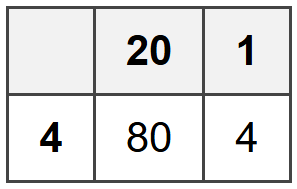
The top row shows the quotients (20 and 1). The left column shows the divisor (4). The inside boxes show the parts of the dividend (80 and 4). When you add the top numbers, you get 20 + 1 = 21, which is the answer.
Connecting Area Models to the Division Algorithm
The division algorithm is the traditional way of writing division with a division bracket. The area model and the division algorithm show the same math in different ways. When you understand the area model, the division algorithm makes more sense!
In the division algorithm, we divide, multiply, subtract, and bring down. With the area model, we break apart, divide each part, and add. Both methods give the same answer.
Think of it like two different roads to the same destination. One road might be more scenic (the area model), while the other is more direct (the division algorithm). Both get you where you need to go!
Solving Division Problems Step by Step
Let's practice solving more division problems using area models. Remember to break the dividend into friendly parts.
Example: A library has 145 books.
They want to put them on shelves.
Each shelf holds 5 books.How many shelves do they need?
Solution:
We need to solve 145 ÷ 5.
Draw a rectangle with area 145. Label one side with 5.
Break 145 into parts that divide evenly by 5. Let's use 100, 40, and 5 because 100 + 40 + 5 = 145.
Divide each part by 5:
100 ÷ 5 = 20
40 ÷ 5 = 8
5 ÷ 5 = 1Add the quotients:
20 + 8 + 1 = 29The library needs 29 shelves for all the books.
Example: A toy store has 168 toy cars.
They want to package them in sets.
Each set has 8 toy cars.How many sets can they make?
Solution:
We need to solve 168 ÷ 8.
Draw a rectangle with area 168. Label one side with 8.
Break 168 into friendly parts. Let's use 80, 80, and 8 because 80 + 80 + 8 = 168.
Divide each part by 8:
80 ÷ 8 = 10
80 ÷ 8 = 10
8 ÷ 8 = 1Add the quotients:
10 + 10 + 1 = 21The toy store can make 21 sets of toy cars.
Working with Larger Numbers
Area models work for even bigger numbers! The steps stay the same. Just break the dividend into parts you know how to divide.
Example: A factory produces 256 bottles of juice.
They pack them into crates.
Each crate holds 4 bottles.How many crates do they fill?
Solution:
We need to solve 256 ÷ 4.
Draw a rectangle with area 256. Label one side with 4.
Break 256 into parts. Let's use 200, 40, and 16 because 200 + 40 + 16 = 256.
Divide each part by 4:
200 ÷ 4 = 50
40 ÷ 4 = 10
16 ÷ 4 = 4Add the quotients:
50 + 10 + 4 = 64The factory fills 64 crates with bottles.
Why Area Models Help Us Understand Division
Area models are helpful because they show what division really means. When we divide, we are asking "How many groups?" or "How much in each group?" The area model makes this question visible.
Here are some reasons why area models are useful:
- They show the problem visually. You can see the total amount and how it breaks apart.
- They let you use what you know. You can break numbers into parts you already know how to divide.
- They build understanding. You learn why division works, not just how to get an answer.
- They connect to multiplication. Area models for multiplication look similar, so you see how multiplication and division are related.
Using an area model is like showing your work with a picture. It helps you think through the problem and helps others understand your thinking too.
Tips for Success with Area Models
Here are some helpful tips when you use area models for division:
- Always check that your parts add up to the dividend before you start dividing.
- Use numbers that end in 0 when you can. They are usually easier to divide.
- Draw your rectangles big enough to write clearly inside.
- Label everything! Write the divisor, the parts of the dividend, and the quotients.
- Check your answer by multiplying. The quotient times the divisor should equal the dividend.
Checking Your Work: After you find a quotient, multiply it by the divisor. If you get the dividend back, your answer is correct! For example, if 84 ÷ 4 = 21, then check: 21 × 4 = 84. It works!
Common Mistakes to Avoid
When using area models, watch out for these common mistakes:
- Forgetting to add all the quotients. Make sure you add every small quotient at the end.
- Breaking the dividend into parts that don't add up. Always check: do your parts equal the original dividend?
- Choosing parts that are hard to divide. Try to pick friendly numbers that divide evenly.
- Mixing up the divisor and quotient. Remember: the divisor goes on the side, and the quotient goes on top.
Practice Strategies
To get better at using area models for division, try these practice ideas:
- Start with smaller numbers and work your way up to larger dividends.
- Practice breaking numbers apart in different ways. There is often more than one correct way to split the dividend!
- Draw the rectangles carefully and label every part.
- Always check your answer by multiplying.
- Think about real-world situations where you would need to divide, like sharing items equally or organizing things into groups.
Area models are a powerful tool for understanding division. They help you see what happens when you divide and make big problems feel smaller. With practice, you'll be able to use area models to solve division problems quickly and confidently. Remember, the key is to break the dividend into parts you can work with easily, divide each part, and then add up your answers. Happy dividing!