Chapter Notes: Estimate Quotients


Division is one of the four basic operations in math. When we divide, we are splitting a number into equal groups or finding out how many times one number fits into another. Sometimes we need an exact answer, but other times a close answer is good enough. When we estimate quotients, we are finding an answer that is close to the exact quotient but easier to calculate. This skill helps us check if our exact answers make sense, solve problems quickly, and understand the size of an answer before doing detailed work.
What Does It Mean to Estimate?
To estimate means to find an answer that is close to the exact answer. We do not need the perfect answer when we estimate. Instead, we use numbers that are easier to work with. Think of estimation like guessing how many jellybeans are in a jar. You might not count every single one, but you can make a smart guess that is close to the real number.
When we estimate quotients in division, we round the numbers first to make them easier to divide. Then we perform the division with these simpler numbers. The result is an estimated quotient.
Why Do We Estimate Quotients?
There are several good reasons to estimate quotients:
- Speed: Estimation is faster than finding the exact answer.
- Checking: We can use estimation to check if our exact answer is reasonable.
- Real Life: Many real-world situations do not require exact answers. For example, if you have 87 cookies and want to share them among 9 friends, knowing you will get about 10 cookies each is often enough information.
- Mental Math: Estimation helps us do math in our heads without paper or a calculator.
Rounding Numbers for Estimation
The first step in estimating quotients is to round the numbers. Rounding means changing a number to the nearest ten, hundred, or other place value to make it easier to work with.
Rounding to the Nearest Ten
When we round to the nearest ten, we look at the ones place:
- If the ones digit is 0, 1, 2, 3, or 4, we round down. The tens place stays the same, and the ones place becomes 0.
- If the ones digit is 5, 6, 7, 8, or 9, we round up. The tens place increases by 1, and the ones place becomes 0.
Example: Round 47 to the nearest ten.
What is 47 rounded to the nearest ten?
Solution:
Look at the ones place: the digit is 7.
Since 7 is greater than 5, we round up.
47 rounded to the nearest ten is 50.
The number 47 becomes 50 when rounded to the nearest ten.
Example: Round 82 to the nearest ten.
What is 82 rounded to the nearest ten?
Solution:
Look at the ones place: the digit is 2.
Since 2 is less than 5, we round down.
82 rounded to the nearest ten is 80.
The number 82 becomes 80 when rounded to the nearest ten.
Rounding to the Nearest Hundred
When we round to the nearest hundred, we look at the tens place:
- If the tens digit is 0, 1, 2, 3, or 4, we round down. The hundreds place stays the same, and the tens and ones places become 0.
- If the tens digit is 5, 6, 7, 8, or 9, we round up. The hundreds place increases by 1, and the tens and ones places become 0.
Example: Round 376 to the nearest hundred.
What is 376 rounded to the nearest hundred?
Solution:
Look at the tens place: the digit is 7.
Since 7 is greater than 5, we round up.
376 rounded to the nearest hundred is 400.
The number 376 becomes 400 when rounded to the nearest hundred.
Using Compatible Numbers
Another helpful strategy for estimating quotients is using compatible numbers. Compatible numbers are numbers that are easy to divide mentally. They are close to the actual numbers in the problem but divide evenly or almost evenly.
Think of compatible numbers as friendly numbers that work well together, like puzzle pieces that fit nicely.
Finding Compatible Numbers
To find compatible numbers for division, we look for numbers close to the original numbers that divide without a remainder or with a very small remainder.
For example:
- If we are dividing by 4, we might look for multiples of 4 like 8, 12, 16, 20, 24, 28, etc.
- If we are dividing by 5, we might look for multiples of 5 like 10, 15, 20, 25, 30, etc.
- If we are dividing by 9, we might look for multiples of 9 like 18, 27, 36, 45, 54, etc.
Example: Estimate 247 ÷ 5 using compatible numbers.
What is a good estimate for 247 ÷ 5?
Solution:
Think of a number close to 247 that divides evenly by 5.
250 is close to 247, and 250 ÷ 5 = 50.
So, 247 ÷ 5 is about 50.
Using compatible numbers, we estimate that 247 ÷ 5 is about 50.
Estimating Quotients with One-Digit Divisors
When dividing by a one-digit number, we can round the dividend (the number being divided) to make the division easier.
Steps for Estimating with One-Digit Divisors
- Round the dividend to a number that is easy to divide by the divisor, or round to the nearest ten or hundred.
- Divide the rounded number by the divisor.
- The result is your estimated quotient.
Example: Estimate 83 ÷ 4.
What is a reasonable estimate for 83 ÷ 4?
Solution:
Round 83 to the nearest ten: 83 rounds to 80.
Now divide: 80 ÷ 4 = 20.
The estimated quotient is 20.
We estimate that 83 ÷ 4 is about 20.
Example: Estimate 275 ÷ 9.
What is a reasonable estimate for 275 ÷ 9?
Solution:
Think of a compatible number close to 275 that divides evenly by 9.
270 is close to 275, and 270 ÷ 9 = 30.
The estimated quotient is 30.
We estimate that 275 ÷ 9 is about 30.
Example: Estimate 418 ÷ 7.
What is a reasonable estimate for 418 ÷ 7?
Solution:
Round 418 to the nearest hundred: 418 rounds to 400.
Now divide: 400 ÷ 7.
Since 400 ÷ 7 is not easy, try using compatible numbers instead.
Think: 7 × 60 = 420, which is very close to 418.
So 420 ÷ 7 = 60.
The estimated quotient is 60.
We estimate that 418 ÷ 7 is about 60.
Estimating Quotients with Two-Digit Divisors
When the divisor (the number we are dividing by) has two digits, we can round both the dividend and the divisor to make the problem easier.
Steps for Estimating with Two-Digit Divisors
- Round the divisor to the nearest ten.
- Round the dividend to a compatible number that divides easily by the rounded divisor.
- Divide the rounded numbers.
- The result is your estimated quotient.
Example: Estimate 392 ÷ 42.
What is a reasonable estimate for 392 ÷ 42?
Solution:
Round 42 to the nearest ten: 42 rounds to 40.
Round 392 to a number that divides easily by 40: 392 rounds to 400.
Now divide: 400 ÷ 40 = 10.
The estimated quotient is 10.
We estimate that 392 ÷ 42 is about 10.
Example: Estimate 563 ÷ 78.
What is a reasonable estimate for 563 ÷ 78?
Solution:
Round 78 to the nearest ten: 78 rounds to 80.
Round 563 to a compatible number that divides easily by 80: 563 is close to 560.
Now divide: 560 ÷ 80 = 7.
The estimated quotient is 7.
We estimate that 563 ÷ 78 is about 7.
Example: Estimate 1,846 ÷ 62.
What is a reasonable estimate for 1,846 ÷ 62?
Solution:
Round 62 to the nearest ten: 62 rounds to 60.
Round 1,846 to a compatible number that divides easily by 60: 1,846 is close to 1,800.
Now divide: 1,800 ÷ 60 = 30.
The estimated quotient is 30.
We estimate that 1,846 ÷ 62 is about 30.
Choosing the Best Method
There are different ways to estimate quotients. The best method depends on the numbers in the problem and what makes the division easiest.
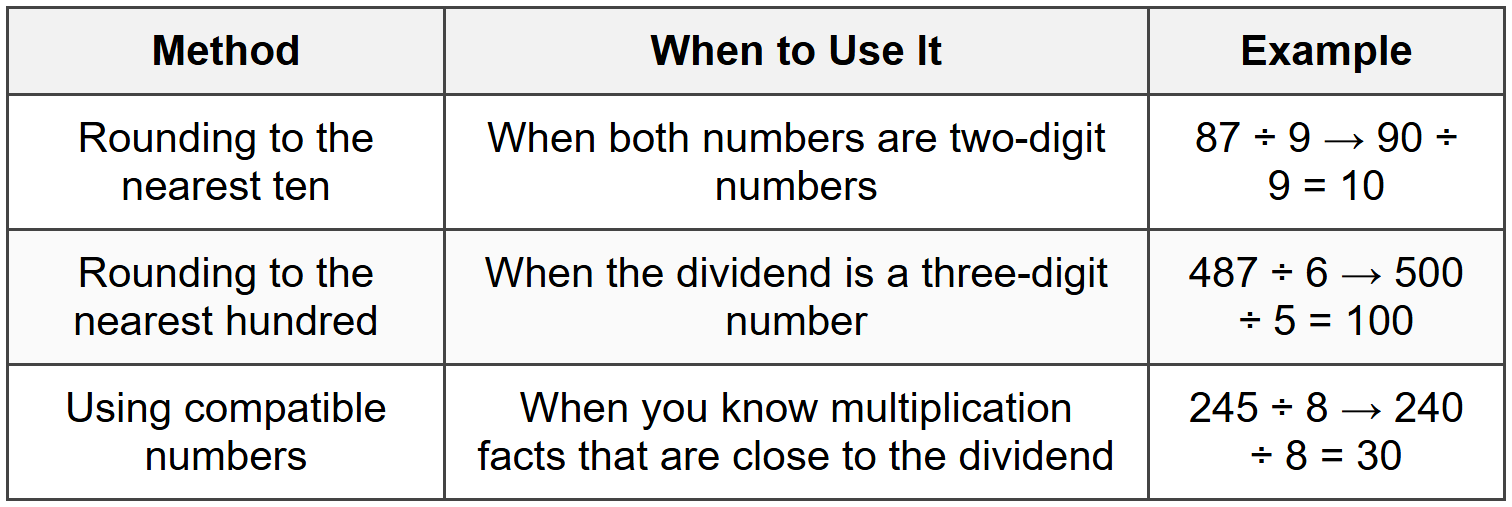
Sometimes more than one method will work. The important thing is to choose numbers that make the division simple and give a reasonable estimate.
Checking Exact Answers with Estimation
One of the most useful reasons to estimate quotients is to check whether an exact answer makes sense. After solving a division problem, we can estimate to see if our answer is reasonable.
Example: Maria solved 184 ÷ 8 and got an answer of 23.
Use estimation to check if her answer is reasonable.Is Maria's answer of 23 reasonable?
Solution:
Estimate 184 ÷ 8 using compatible numbers.
180 is close to 184, and 180 ÷ 6 is not easy, but we know 8 × 20 = 160 and 8 × 25 = 200.
So 184 ÷ 8 should be between 20 and 25.
Maria's answer of 23 falls in this range, so her answer is reasonable.
Maria's answer of 23 is reasonable because our estimate shows the quotient should be between 20 and 25.
Example: Jack solved 456 ÷ 19 and got an answer of 4.
Use estimation to check if his answer is reasonable.Is Jack's answer of 4 reasonable?
Solution:
Estimate 456 ÷ 19 by rounding.
Round 19 to 20.
Round 456 to 400 or 460.
Using 460 ÷ 20 = 23.
Jack's answer of 4 is much smaller than 23, so his answer is not reasonable.
Jack's answer of 4 is not reasonable because our estimate of 23 shows the quotient should be much larger.
Real-World Applications of Estimating Quotients
Estimation is a valuable skill we use in everyday life. Here are some situations where estimating quotients is helpful:
- Shopping: If you have $50 and each item costs $7, you can estimate 50 ÷ 7 to be about 7 items to know roughly how many you can buy.
- Cooking: If a recipe serves 8 people but you need to serve 35 people, estimating 35 ÷ 8 ≈ 4 tells you to make about 4 times the recipe.
- Travel: If you need to travel 285 miles and your car can go 32 miles per gallon, estimating 285 ÷ 32 ≈ 300 ÷ 30 = 10 tells you that you need about 10 gallons of gas.
- Time Management: If you have 95 minutes to complete 4 homework assignments, estimating 95 ÷ 4 ≈ 100 ÷ 4 = 25 tells you to spend about 25 minutes on each assignment.
Example: A teacher has 215 pencils.
She wants to give them equally to 9 classes.
About how many pencils will each class receive?Approximately how many pencils per class?
Solution:
Estimate 215 ÷ 9.
Use compatible numbers: 215 is close to 210, and we know 9 × 20 = 180 and 9 × 25 = 225.
Since 215 is close to 210, and 210 is between 180 and 225, try 9 × 24 = 216.
So 216 ÷ 9 = 24.
Each class will receive about 24 pencils.
Each class will receive approximately 24 pencils.
Tips for Successful Estimation
Here are some helpful tips to remember when estimating quotients:
- Use what you know: Think about your multiplication facts. If you know that 6 × 40 = 240, then you know 240 ÷ 6 = 40.
- Round sensibly: Choose numbers that make the division easy. Sometimes rounding to the nearest ten works best; other times compatible numbers are better.
- Check your estimate: Ask yourself if your estimated quotient makes sense. If you are dividing 50 by 5, an estimate of 100 does not make sense because division makes numbers smaller (or stays the same).
- Practice mental math: The more you practice dividing simple numbers in your head, the faster and more accurate your estimates will become.
- Remember the purpose: An estimate does not have to be perfect. It just needs to be close enough to be useful.
Estimating quotients is like taking a shortcut. You might not arrive at the exact same spot, but you get close enough to know you are heading in the right direction!
Summary
Estimating quotients is an important skill that helps us work with division more efficiently. We learned that:
- Estimation means finding an answer that is close to the exact answer.
- We can estimate by rounding numbers to the nearest ten or hundred.
- Compatible numbers are numbers close to the original numbers that divide easily.
- When dividing by one-digit divisors, we usually round the dividend.
- When dividing by two-digit divisors, we round both the dividend and the divisor.
- We can use estimation to check if exact answers are reasonable.
- Estimation is useful in many real-world situations.
By practicing these strategies, you will become more confident with division and better at solving problems quickly. Estimation is a tool that makes math easier and helps you think about numbers in flexible ways.